Key Takeaways
- Largest planet in solar system - over 1,300 Earths could fit inside Jupiter
- Famous Great Red Spot storm has raged for over 300 years
- Has 101 confirmed moons including the four large Galilean satellites (March 2026)
Table of Contents
The Largest Planet in Our Solar System
Jupiter is the largest planet in our solar system by a long way. If you were to combine all of the other planets in our solar system together, Jupiter would still be over two and a half times bigger! This gas giant dominates the outer solar system with its immense size and powerful gravitational influence.
Named after the supreme god in Roman mythology, Jupiter was the god of the sky, heavens and law. The planet's massive presence in our night sky has inspired astronomers and stargazers for thousands of years.
Jupiter is mainly composed of hydrogen and helium, the same as the Sun. In fact, if Jupiter had formed 80 times bigger than what it is now, it would have become a star rather than a planet.
The Galilean Moons
Jupiter has 4 main moons: Io, Europa, Ganymede and Callisto. Collectively these 4 moons are called the Galilean satellites after the astronomer Galileo Galilei who first discovered them in the year 1610. These massive moons are fascinating worlds in their own right, each with unique characteristics.
Ganymede is the largest moon in our solar system, even larger than the planet Mercury. Europa is believed to have a subsurface ocean that may harbor conditions suitable for life. Io is the most volcanically active body in the solar system, while Callisto's ancient, heavily cratered surface tells the story of our solar system's violent past.
Jupiter's Extensive Moon System
As of March 2026, Jupiter has 101 confirmed moons — the second-highest count of any planet in the solar system, behind Saturn's 285. Beyond the four Galilean moons, most of Jupiter's other satellites are much smaller, usually no more than 4 km across. These irregular moons are likely captured asteroids or fragments from ancient collisions that fell under Jupiter's gravitational influence billions of years ago.
In March 2026, the Minor Planet Center announced four new Jupiter moons — S/2011 J 4, S/2011 J 5, S/2018 J 5, and S/2024 J 1 — discovered by a team led by Scott Sheppard of the Carnegie Institution for Science using data from observatories in Chile and Hawaii. All four belong to known irregular moon families: the Himalaya, Carme, and Ananke groups. Read the full story →
Jupiter's Named Moons (selected)
2. Europa
3. Ganymede
4. Callisto
5. Amalthea
6. Himalia
7. Elara
8. Pasiphae
9. Sinope
10. Lysithea
11. Carme
12. Ananke
13. Leda
14. Thebe
15. Adrastea
16. Metis
17. Callirrhoe
18. Themisto
19. Megaclite
20. Taygete
21. Chaldene
23. Kalyke
24. Iocaste
25. Erinome
26. Isonoe
27. Praxidike
28. Autonoe
29. Thyone
30. Hermippe
31. Aitne
32. Eurydome
33. Euanthe
34. Euporie
35. Orthosie
36. Sponde
37. Kale
38. Pasithee
39. Hegemone
40. Mneme
41. Aoede
42. Thelxinoe
44. Kallichore
45. Helike
46. Carpo
47. Eukelade
48. Cyllene
49. Kore
50. S/2003 J2
51. S/2003 J3
52. S/2003 J4
53. S/2003 J5
54. S/2003 J9
55. S/2003 J10
56. S/2003 J12
57. S/2003 J15
58. S/2003 J16
59. S/2003 J17
60. S/2003 J18
61. S/2003 J19
62. S/2003 J23

The Great Red Spot
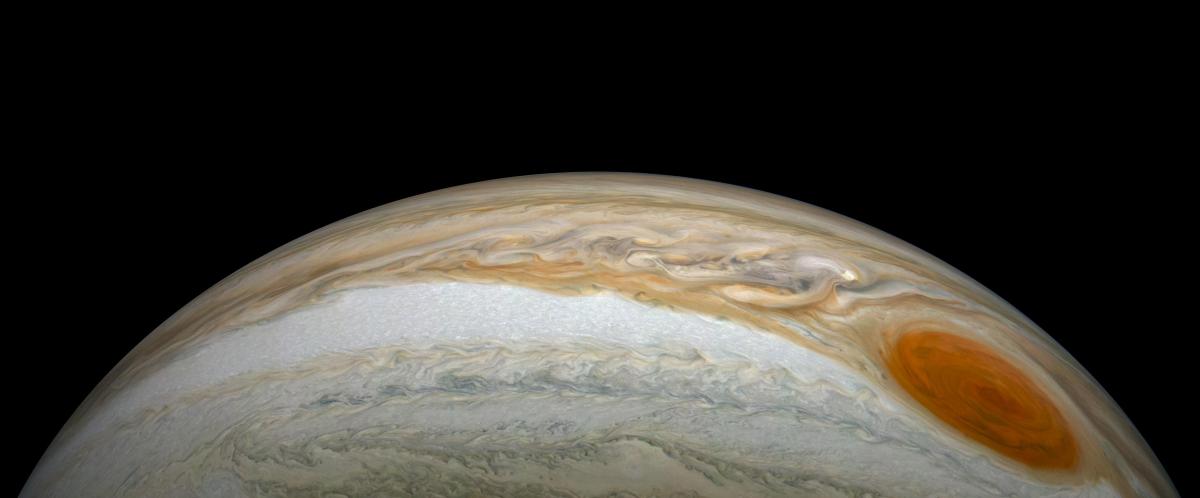
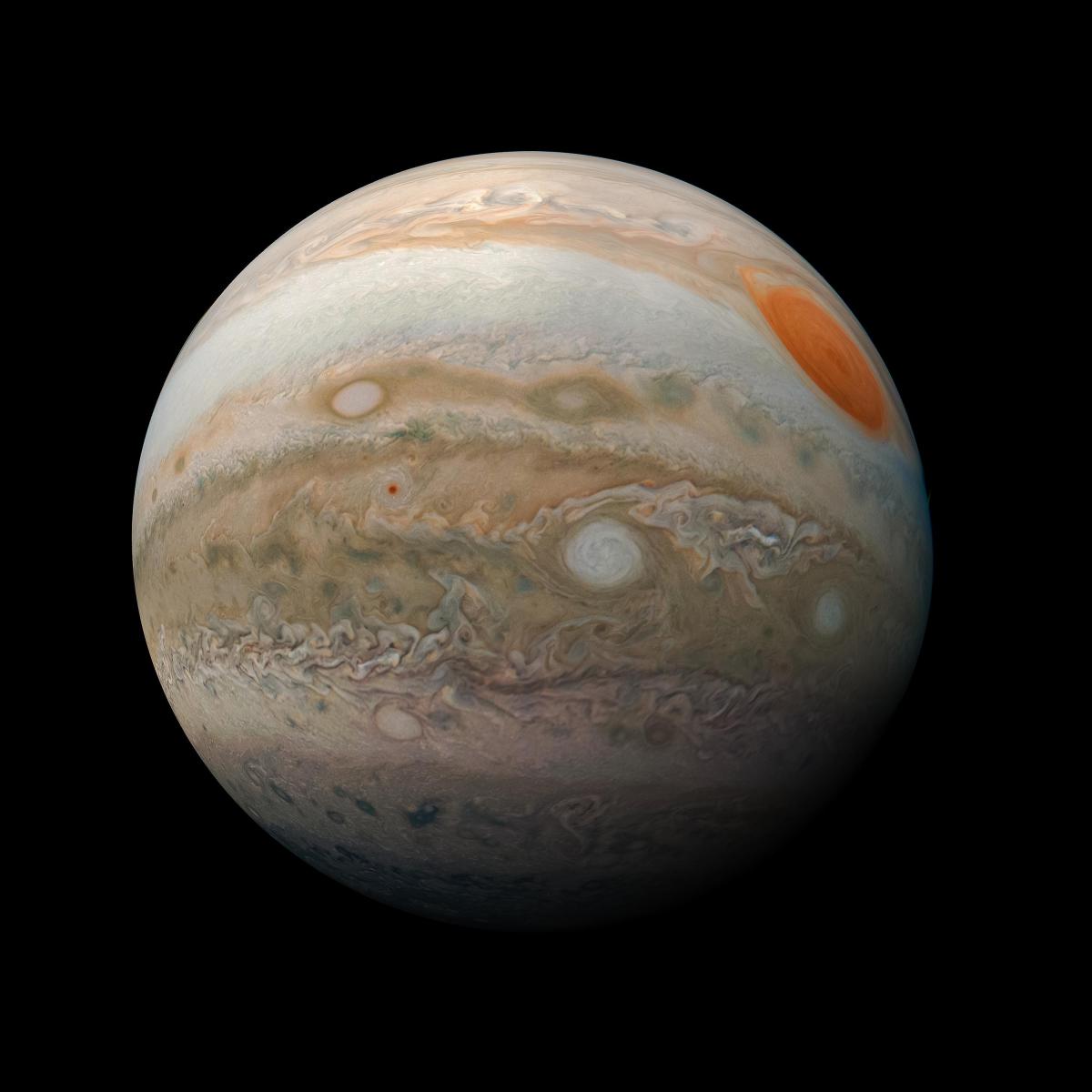
The Great Red Spot is Jupiter's most iconic feature — a storm system that has been raging for at least 350 years. At its largest it was three times the width of Earth, though it has been slowly shrinking. NASA's Juno spacecraft, which has been orbiting Jupiter since 2016, has captured the most detailed views of the storm ever taken.
Io: Jupiter's Volcanic Moon
Io is the most volcanically active body in the solar system, driven by the immense tidal forces Jupiter exerts on it. When New Horizons flew past Jupiter in February 2007 on its way to Pluto, it captured some of the most dramatic images of Io ever taken — including a real-time eruption of the Tvashtar volcano, hurling lava 330 kilometres above the surface.
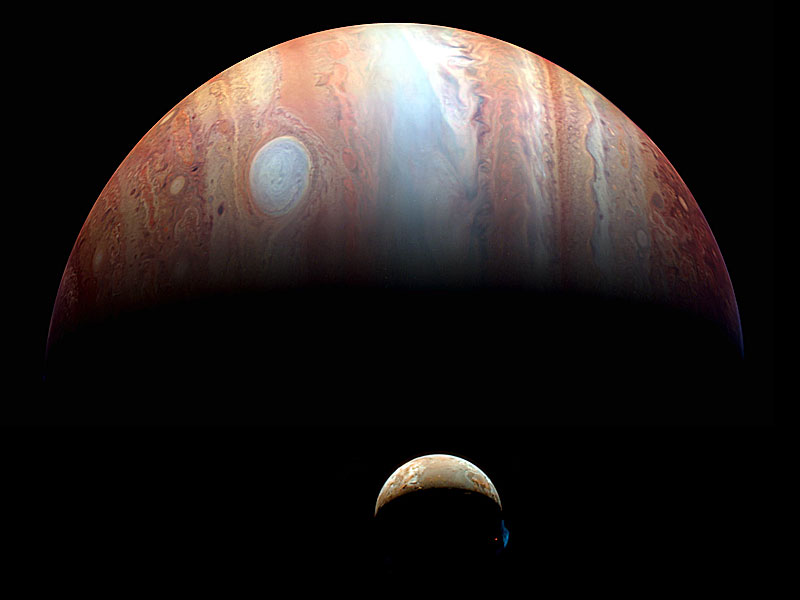
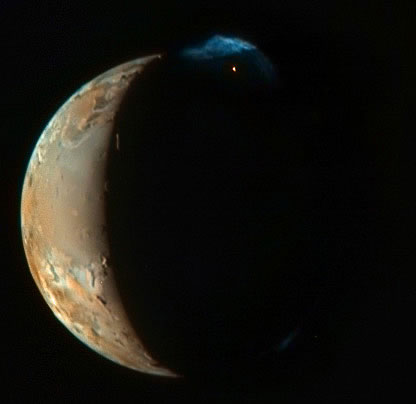
New Horizons captured five images over eight minutes showing lava spraying 330km above Io's surface. Click here to watch the Tvashtar eruption animation — one of the most dramatic sequences ever captured in planetary science. Credit: NASA / JHU APL / SwRI