Constellation Guide
Leo
The Lion of the Spring Sky
The Lion of the Spring Sky
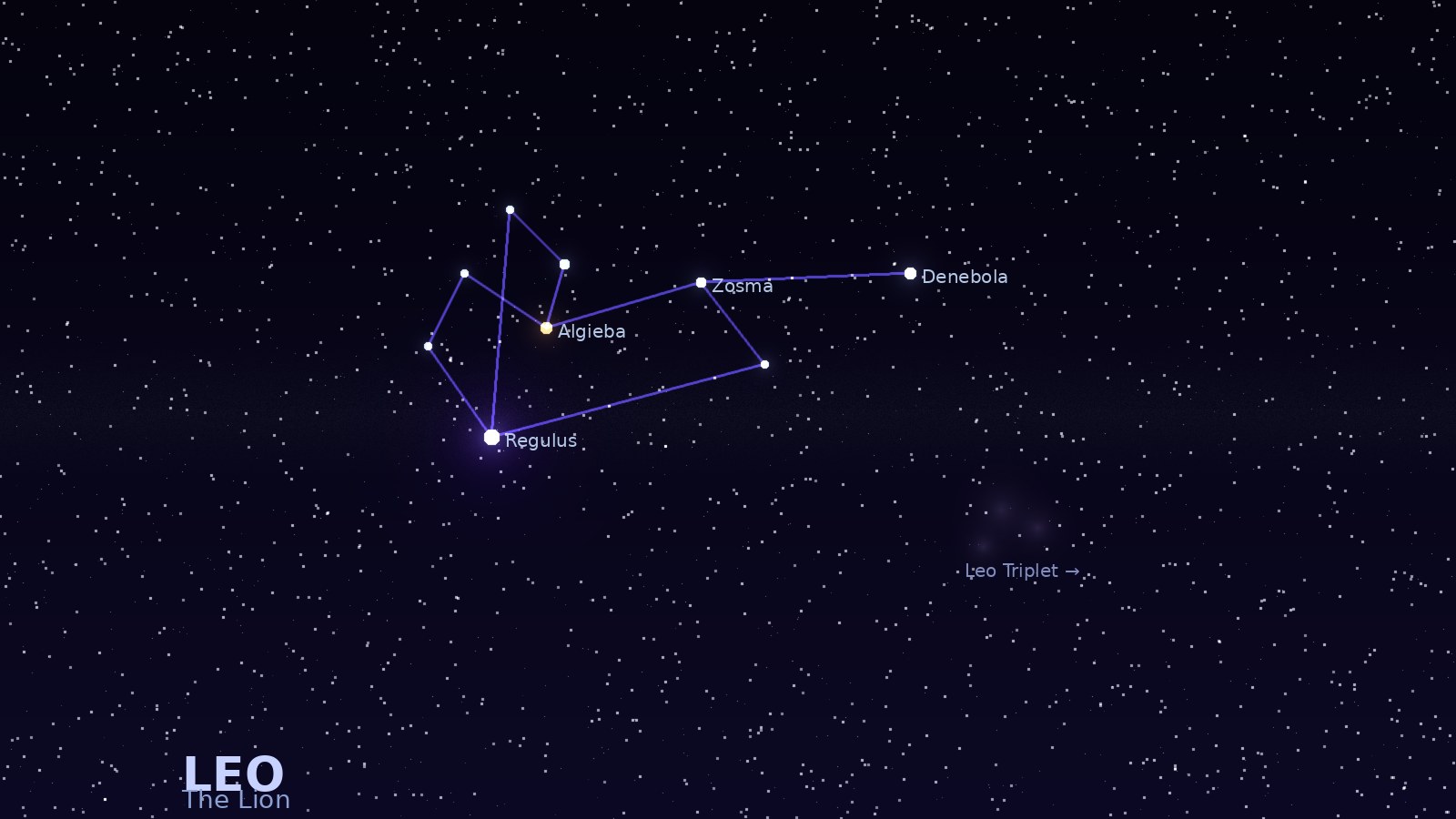
Leo is the magnificent lion of the zodiac — one of the few constellations that genuinely resembles what it is supposed to depict. Its bright star Regulus anchors the base of the Sickle, a backwards question-mark asterism that forms the lion's head and mane. Leo is a spring constellation, rising in the east after sunset in March and reaching its best in April and May. It is also the parent constellation of the annual Leonid meteor shower.
Leo is best found by using the Big Dipper (Plough) as a guide, or by looking for Regulus — a bright blue-white star low in the south on spring evenings. The Sickle pattern, once seen, is unmistakable.
The Sickle is a backwards question mark — or a hook — of six stars. Regulus sits at the base (the dot of the question mark), and the curve of stars arcing upward and to the right forms the lion's mane and head. Once you spot this shape it is impossible to mistake.
Point a line from the two bowl stars of the Plough (Dubhe and Merak) in the opposite direction to Polaris — southward. Follow this line down roughly 60° and you will land very close to Regulus, the brightest star in Leo and one of the brightest in the spring sky.
Leo lies on the ecliptic — the Sun's apparent path. This means planets frequently pass through Leo. In spring, if you see a bright object near the ecliptic in the south, it may be a planet visiting Leo's territory. The Moon also passes through Leo monthly.
Leo rises in the east in February and reaches its best position due south at about midnight in March, or at a comfortable 9–10pm in April and May. By June it is sinking into the western twilight. From the UK, it reaches about 40° altitude — a good height, free of much horizon haze.
| Month | Evening Position | Altitude (South) | Conditions |
|---|---|---|---|
| February | Low ESE, rising | ~15° by 11pm | 👍 Rising season |
| March | SE sky, climbing | ~30° by 10pm | ✅ Getting good |
| April | Due south, high | ~38–42° | ⭐ Best |
| May | South-southwest | ~35–40° | ⭐ Excellent |
| June | SW, sinking in twilight | ~20° | 👍 Fading |
Leo's brightest stars include one of the 20 brightest in the night sky, a celebrated golden double star, and a remarkable rapid rotator right on the ecliptic.
The heart of the lion — 21st brightest star in the entire sky. Regulus lies almost exactly on the ecliptic, meaning the Moon occults it regularly, and planets occasionally pass in front of it. It spins extraordinarily fast — completing one rotation in just 15.9 hours, compared to the Sun's 25 days. This rapid spin flattens it at the poles; its equatorial diameter is 32% larger than its polar diameter. "Regulus" is Latin for "little king."
One of the finest double stars in the sky for small telescopes. At 60× or more, Algieba splits into two golden-orange giants separated by about 4.4 arcseconds — a sight of extraordinary beauty. The pair orbit each other every 510 years. A third, much fainter companion has been confirmed. "Algieba" comes from the Arabic for "mane" or "forehead."
The lion's tail — second brightest star in Leo, remarkably close to us at just 36 light-years. Denebola is a Delta Scuti variable, pulsating in brightness over very short periods. It also shows an infrared excess, suggesting a circumstellar debris disc — perhaps a planetary system in formation. Its name means "tail of the lion" in Arabic.
Sitting on the lion's hip, Zosma is another fast-rotating A-type star. Like Regulus, it spins rapidly and shows signs of a debris disc. Its Greek-derived name means "girdle" — it marks the hip joint of the lion figure. A useful guide star for finding the Leo Triplet galaxies, which lie just south of here.
One of the most luminous stars in the Sickle — and one of the most luminous in the entire sky when its true distance is accounted for. Eta Leo is a white supergiant roughly 5,000 times more luminous than the Sun, located 2,000 light-years away. Despite its great distance, it shines at magnitude 3.49 — testament to its extraordinary power.
The third star up the Sickle from Regulus. Adhafera is a mild giant, part of a wide optical triple system. Its name derives from the Arabic for "the plait" or "braid." It sits close to the ecliptic and is occasionally covered by the Moon during lunar occultations — watch it wink out instantaneously as the lunar limb sweeps across it.
In Greek mythology, Leo represents the Nemean Lion — a monstrous beast with an impenetrable golden hide that terrorised the region of Nemea. No arrow, sword, or spear could pierce its skin. Hercules was sent to slay it as the first of his twelve labours. Finding his weapons useless, Hercules wrestled the lion with his bare hands, eventually strangling it. He then used the lion's own claws — the only things sharp enough — to skin it. Thereafter, he wore the pelt as armour.
Zeus placed the lion in the sky to commemorate the battle. Regulus — the brightest star — marks the lion's heart, an apt choice for a constellation named the "little king."
Leo has been recognised as a lion by many cultures across 6,000 years of recorded history. The Mesopotamians identified it as the Great Lion (UR.GU.LA) as far back as 4,000 BCE. For much of antiquity, the Sun passed through Leo at the time of the summer solstice — giving the constellation solar significance and associating the lion with the height of summer's power.
The Nemean Lion slain by Hercules as his first labour. Zeus placed it in the heavens. The Romans called it Leo ("lion") and associated Regulus with royalty — it was one of the four "royal stars" of antiquity.
One of the oldest recognised lion constellations, dating back to at least 4,000 BCE. The Babylonians called it UR.GU.LA and associated it with the sun-god. They tracked Jupiter's movements through Leo as one of their most important astronomical observations.
The Egyptians associated Leo with the annual Nile flood, which historically began when the Sun was in Leo. Some scholars argue the Sphinx's lion body faces Leo at dawn on the spring equinox — though this remains controversial. Lions were sacred creatures of solar power.
In Hindu astronomy Leo corresponds partly to the nakshatra Magha — "the great" — associated with Regulus and linked to ancestors and royalty. The constellation was called Simha (lion) and was the fifth sign of the Hindu zodiac.
Chinese astronomers divided Leo between several lunar mansions. Regulus was part of Xuanyuan (軒轅) — the Yellow Emperor constellation — symbolising royal power and imperial authority. The star was called Xuanyuan Shisi.
Leo lacks bright nebulae and open clusters (it lies away from the Milky Way's plane) but it more than compensates with a remarkable collection of galaxies — including one of the finest galaxy groups visible to amateur astronomers.
The brightest member of the Leo Triplet, M65 is an intermediate spiral galaxy with a prominent dust lane along one arm. It shows little evidence of recent star formation — its disc is remarkably undisturbed, despite its gravitational interaction with M66 and NGC 3628. Visible in 10cm telescopes as an elongated glow; 20cm shows the dust lane.
The most visually interesting of the Leo Triplet. M66's spiral arms are distorted by gravitational interaction with its companions, and its core is offset from centre. It shows active star formation and has hosted multiple supernovae in the past century. The brightest of the three in a single eyepiece view.
The third and most edge-on member of the Leo Triplet, nicknamed the Hamburger for its distinctive profile with a dark dust lane bisecting the disc. Tidal forces from M65 and M66 have pulled a 300,000-light-year-long stellar tidal stream from NGC 3628 — invisible visually but detectable in deep photographs.
A loose group of galaxies including M95, M96, and M105 near the Sickle's base. M96 is a beautiful spiral; M105 is a large elliptical with one of the most massive black holes known in a nearby galaxy. M95 shows a faint bar. All three fit in the same low-power eyepiece field — a rewarding galaxy trio.
Inexplicably omitted from Messier's catalogue despite being one of the brightest galaxies in the sky. NGC 2903 is a large barred spiral near the Sickle's handle with an active nucleus and a bar structure visible in medium apertures. At magnitude 9.0, it is the brightest galaxy in Leo and detectable in 8cm telescopes under dark skies.
Not a deep-sky object in the traditional sense, but one of the finest double stars in the spring sky. At 60× or above in any telescope, Algieba (γ Leonis) splits into two warm golden-orange suns — genuinely one of the most beautiful sights the sky has to offer. Easy to find as the third star up the Sickle from Regulus.
The Leonid meteor shower radiates from a point near the Sickle in Leo — though the meteors appear all over the sky. They are caused by Earth passing through debris left by Comet 55P/Tempel-Tuttle. In most years the Leonids produce a modest 10–15 meteors per hour, with fast, bright streaks that often leave persistent glowing trains.
In exceptional years — roughly every 33 years when Tempel-Tuttle makes its closest approach — the Leonids can produce meteor storms with thousands of meteors per hour. The 1833 and 1966 Leonid storms are among the most spectacular events in astronomical history. The next significant enhancement may occur around 2033–2034.
To observe: Leo rises in the east after midnight. For the Leonids, face east and look up — the radiant will be near the Sickle. No telescope needed; lie back and watch with your naked eyes after the radiant rises above the horizon.
Leo is one of the best spring constellations for beginners — it is bright, recognisable, and within a single constellation boundary contains some of the finest galaxy targets in the northern sky.
Sickle, Regulus, Denebola
NGC 2903, M96 group haze
Algieba double, Leo Triplet
Galaxy detail, dust lanes
Leo Triplet, tidal stream
Apr–May, 9–11pm
At 100× or more, Algieba resolves into two warm K-giant suns separated by 4.4 arcseconds — a magnificent sight. Note the identical golden-orange colour of both components. The orbit period is 510 years; the separation is currently slowly decreasing.
In deep photographs with 45-minute+ exposures, look for the faint tidal stream extending 300,000 light-years from NGC 3628. This requires excellent seeing, a fast telescope, and a dark site — but is one of the most spectacular galaxy interaction features reachable from the UK.
Because Regulus lies almost exactly on the ecliptic, the Moon frequently occults it. Watch the star disappear almost instantaneously behind the lunar limb — proving in real time that Regulus has no visible disc at this distance. Check occultation prediction sites for UK timings.
Algieba's primary star (γ¹ Leonis) has a confirmed giant planet — gamma Leonis b — with a mass 8.8 times Jupiter's, orbiting every 429 days. This makes Algieba one of the few naked-eye double stars known to host a planet. The planet was discovered by a Korean team in 2009.