Aries
The Ram of the Ancient Skies
October – January
The Ram of the Ancient Skies
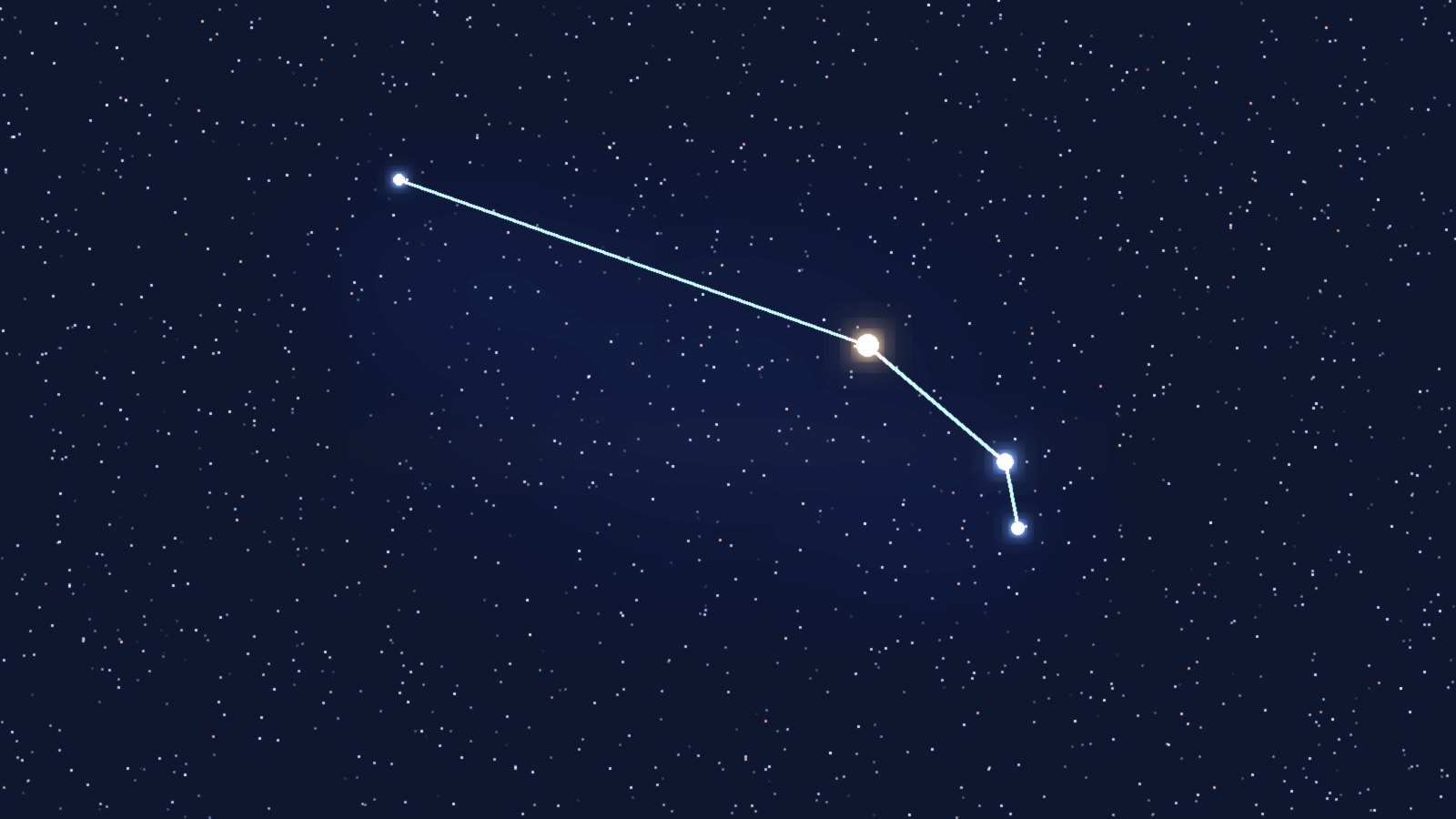
October – JanuaryAries, the Ram, is one of the oldest recognised constellations, tracing its origins back to Babylonian astronomy around 1800 BCE when it marked the vernal equinox. This ancient zodiacal constellation lies between Taurus and Pisces, a region of the autumn and winter sky rich with mythology and visual treasures. Though modest in brightness, Aries contains the beautiful golden-orange giant Hamal, the elegant double star Mesarthim (the first to be resolved with a telescope), and a wealth of faint galaxies waiting for patient observers.
Aries nestles neatly between the much brighter Taurus (marked by Aldebaran and the Pleiades) to the west, and the fainter Pisces to the east. In November, it climbs high in the south around 10pm.
The constellation forms a gentle arc or sickle shape. Spot Hamal (the orange star) as your anchor point, then trace rightward along Sheratan and Mesarthim — a subtle but graceful pattern.
The Pleiades cluster in nearby Taurus lies to the west (right) of Aries. If you see that famous seven-star cluster, look slightly east (left) to find Aries's brighter stars.
Hamal (magnitude 2.00) is unmistakably the brightest star in Aries and has a warm, orange tint — quite distinctive among the blue-white stars surrounding it. Make it your primary landmark.
| Month | Position | Altitude at Midnight | Notes |
|---|---|---|---|
| September | ESE, rising | ~25° | Low, evening appearances begin |
| October | SE, climbing | ~40° | Improving visibility, good binocular views |
| November | South | ~50° | BEST MONTH — highest in the sky, excellent telescopic conditions |
| December | SW, still good | ~48° | Still well-placed, visible most of the night |
| January | WSW, sinking | ~35° | Evening object, sets by midnight |
The brightest star in Aries and one of the four ancient "royal stars" of Mesopotamian astronomy. Hamal means "head of the ram" in Arabic. This giant star is 44 times the Sun's diameter and shines with a warm, golden-orange hue. Most remarkably, Hamal harbours a confirmed exoplanet (Hamal b) — a Jupiter-mass world orbiting at 1.2 AU. When you gaze at Hamal through binoculars, you're looking at a star with its own planetary system.
The second-brightest star in Aries and a close, difficult-to-split binary system. Its name comes from the Arabic "two signs," referring to Sheratan and Mesarthim as twin marker stars of the constellation. As a blue-white A-type star, Sheratan lies on the ecliptic — the Moon and planets regularly occult it, making it a useful reference point for lunar observations. A challenging but rewarding double-star target for larger amateur telescopes.
A historic gem of the night sky: the first double star ever discovered through a telescope, by Robert Hooke in 1664. Mesarthim consists of two nearly identical blue-white stars separated by 7.5 arcseconds — easily split in any small telescope at 30× magnification. The sheer historical significance of this elegant pair makes observing them a profound connection across 350+ years of telescopic astronomy. A "must-observe" double star.
The eastern extension of the ram figure, marking the lower belly (its name literally means "belly" in Arabic). Botein is an orange K-type giant — cooler and redder than Hamal, though fainter. It sits on the eastern border of the constellation, near the boundary with Taurus. A good comparison target for colour observation: alongside Hamal's golden-orange, Botein shows a slightly deeper, more amber hue.
A rapidly rotating blue-white B-type star, part of the family of Be stars characterised by emission lines in their spectra. Named Bharani in Vedic astronomy (from the lunar mansion), 41 Arietis sits near the constellation's eastern edge close to Taurus and the Pleiades. Its rapid spin (one rotation in fewer than 12 hours) is believed responsible for an equatorial disc of ejected material. An interesting comparison to the slower rotation of standard B stars.
A lovely wide binocular double star featuring a pale yellow F-type primary and a fainter companion. The pair is separated by a considerable angle and resolved easily at low power, making it ideal for beginning observers who want a successful double-star experience. The colour contrast — yellow primary, fainter companion — adds aesthetic appeal. Perfect for scout nights or group observing sessions.
In Greek mythology, Aries represents the golden ram sent by the gods to rescue the mortal siblings Phrixus and Helle from their cruel stepmother Ino. The miraculous ram, with fleece of pure gold, flew them across the sea to the distant land of Colchis. Phrixus survived the journey and sacrificed the ram in gratitude, hanging its golden fleece in a sacred grove — the same fleece that the hero Jason and his Argonauts would later quest to retrieve. Zeus immortalised the noble ram in the night sky as a reward.
In ancient Babylonian texts, Aries was known as the "Hired Worker" (LU.HUN.GA) — a farm labourer, not a shepherd's ram. Around 1800 BCE, Aries marked the position of the vernal equinox, making it the herald of spring and the symbolic beginning of the astronomical year. This celestial significance embedded it into Mesopotamian culture and the earliest zodiacal systems. The constellation's prominence in spring ceremonies and agricultural timing made it one of the four cardinal constellations.
The ancient Egyptians associated the constellation with Amun-Ra in his ram-headed form — the ram being a symbol of power and virility in Egyptian religion. The city of Thebes (Waset) was home to the great Temple of Amun, guarded by impressive avenues of ram-headed sphinx statues. The vernal equinox's position in Aries aligned with New Year celebrations and the flooding of the Nile, tying the constellation to renewal and rebirth in Egyptian thought.
In Persian astronomical tradition, Aries was known as Barah — a symbol of fertility, newness, and the beginning of the year. The importance of Aries to Persian culture is embedded in Nowruz, the Persian New Year festival, traditionally celebrated around the vernal equinox when the Sun enters the constellation Aries. This ancient holiday (celebrated for over 2,500 years) marks the moment of cosmic renewal and the triumph of light over darkness.
In Vedic astronomy, Aries is called Mesha — the first sign of the Hindu zodiac, embodying new beginnings and untamed potential. The constellation contains the lunar mansion Ashvini (the two divine physicians) and Bharani (associated with Yama, the god of death and duty). These nakshatras held profound importance for timing religious ceremonies, auspicious dates, and life transitions. Aries remained central to Hindu astrology and timekeeping for millennia.
A stunning galaxy with one unusually extended spiral arm, likely the result of tidal interaction with the nearby galaxy NGC 770. This "one-armed" morphology makes NGC 772 visually distinctive. Through a 20cm telescope under dark skies, it appears as a faint oval glow with hints of spiral structure. The extended arm requires patience and careful observation but rewards the patient observer with a view of cosmic violence and gravitational dance frozen in light.
One of the most vigorous star-forming galaxies in the local universe. NGC 1156 is almost entirely composed of young, hot blue stars — an extremely active stellar nursery. Visually, it's a challenging naked telescope object, but as a photographic target, it reveals brilliant blue coloration and an energetic morphology. Long exposures with modern cameras capture the intense star formation that drives this little galaxy's evolution.
The most historically significant double star in the sky: the first to be discovered through a telescope by Robert Hooke in 1664. Two nearly identical blue-white A-type stars separated by 7.5 arcseconds — trivially split at 30× or higher. Observing Mesarthim connects you directly to the birth of telescopic astronomy and one of history's greatest scientific achievements. Every amateur astronomer should experience this pair at least once.
Part of an interacting galaxy pair, NGC 877 shows subtle tidal distortions from gravitational interaction with its neighbour. Best captured photographically, where long exposures reveal the twisted morphology and star-formation regions triggered by the gravitational encounter. A fine target for imaging enthusiasts exploring the dynamics of galaxy interactions.
While observing Hamal with the naked eye, binoculars, or telescope, you're literally looking at a star known to harbour a planetary companion. Hamal b was confirmed via radial-velocity measurements in 2011 — an invisible but very real world orbiting at 1.2 AU. This orange giant's exoplanet stands as proof that planets form around evolved stars, challenging old assumptions about planetary architecture.
A large, relatively face-on spiral galaxy in the eastern part of Aries — excellent for astrophotography. Modern wide-field imaging reveals its spiral structure and colourful star-forming regions. The face-on orientation and relative brightness make it a rewarding photographic target for imaging campaigns seeking to build a personal galactic atlas.
At 60× magnification, study the two Mesarthim components carefully. Both are A-type stars, but subtle differences in temperature and spectral subclass can be discerned with extended viewing. The primary is slightly hotter; the secondary shows a fractionally deeper blue. This is advanced visual spectroscopy available to any observer with a small telescope and patience.
While Hamal b cannot be directly imaged from Earth, you can contemplate its existence: a Jupiter-mass world orbiting every 380 days at 1.2 AU from an orange giant 44 times the Sun's size. This challenges our understanding of planetary formation around evolved stars and invites philosophical reflection on the hidden worlds orbiting the stars we observe.
With a 250mm+ telescope under dark skies, the extended tidal arm of NGC 772 can be glimpsed as a faint whisper extending from the main body. This requires excellent seeing, a dark site, and averted vision. Spotting it is a triumph — direct evidence of gravitational interaction sculpting galaxies across billions of years.
Due to precession, the vernal equinox point (♈) has drifted into Pisces, yet the symbol still refers to Aries historically. Observers interested in the mechanics of precession and the slow wobble of Earth's axis can use Aries as a gateway to understanding this 26,000-year cycle that subtly reshapes our understanding of the zodiac.
Hamal is an evolved K-type giant — the Sun's future. At magnitude 2.00 and 44 times the Sun's diameter, it represents a star in the later stages of life. Observing it is observing the future: in roughly 5 billion years, our own Sun will swell to similar dimensions, engulfing the inner planets. Hamal is that dark mirror.
Amateur spectroscopy is within reach of modern DSLRs with diffraction gratings. Hamal's K-type spectrum shows strong calcium (Ca II K and H lines) and cooler atomic lines compared to Sheratan's A-type spectrum. A homemade spectroscope reveals the elemental chemistry of stars — bringing the laboratory into the telescope.
The symbol ♈ (Aries) marks the vernal equinox in astronomical tradition, even though precession has shifted the actual equinox point into Pisces. When the Sun reaches Aries on your charts, you're observing one of the four cardinal moments of the year — a profound reminder that the sky is a calendar written in light and geometry.