Key Takeaways
- Tonight (26 March) the 64%-lit Moon passes just 3.9° from Jupiter — easily visible to the naked eye
- Look south-southwest after sunset — the pair will be at 57° altitude, high and unmistakable
- Jupiter shines at magnitude –2.3, making it the brightest 'star' near the Moon
- Binoculars will show Jupiter's four Galilean moons as tiny dots beside the planet
- The pair stays visible until after 2 a.m., so there's no rush — step outside any time this evening
📑 Table of Contents
If you only look up once this week, make it tonight. The waxing gibbous Moon is gliding past Jupiter in the constellation Gemini — the two brightest objects in the evening sky sitting side by side, high above the horizon, perfectly placed for a casual glance or a proper observing session. You don't need a telescope. You don't need to stay up late. Just step outside after sunset, face south, and look up.
What's Happening Tonight
A conjunction happens when two celestial objects appear close together in the sky as seen from Earth. Tonight, the Moon and Jupiter reach their closest apparent separation — just 3.9 degrees apart — at around 12:12 UTC (just after noon in the UK, while both are below the horizon). But don't worry: by the time darkness falls this evening, the pair will still be sitting comfortably close, with the 64%-illuminated Moon glowing just a few degrees from Jupiter's steady, brilliant light.
Both objects are currently in the constellation Gemini, the Twins. Jupiter has been camped out here since late 2024, slowly drifting eastward among the stars. Tonight the Moon passes through on its monthly orbit, creating a temporary but striking visual pairing that will be obvious to anyone who glances at the sky.
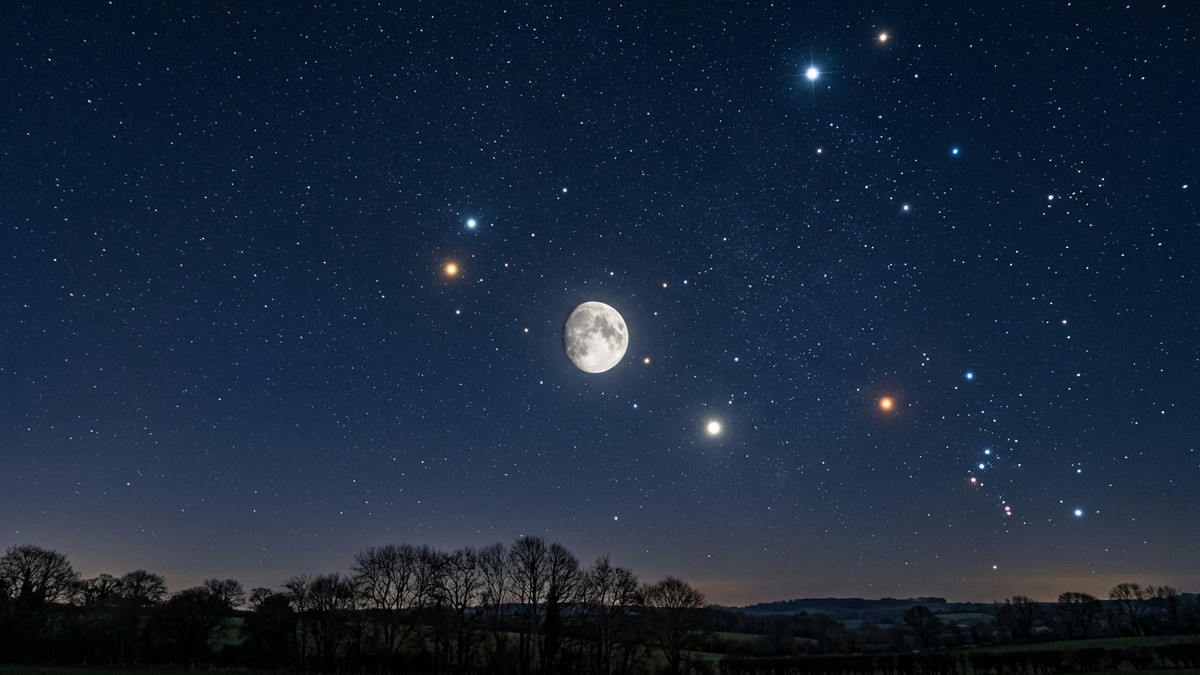
The Moon will appear roughly between Jupiter and the bright star Pollux — one of the two "twin" stars that crown Gemini. It's a beautiful three-way arrangement: the golden Moon, the steady cream-white glow of Jupiter, and the warm orange tint of Pollux, all within a relatively small patch of sky.
When and Where to Look
This is one of those events where the instructions are genuinely simple. Here's your plan for tonight:
Time: Any time from about 19:00 GMT (sunset) onwards. The pair will be highest and best placed around 19:00–20:00, sitting at roughly 57 degrees above the south-southwestern horizon — that's more than halfway up the sky, well clear of buildings and trees.
Direction: Face south-southwest. The Moon will be the unmistakable bright object. Jupiter is the very bright "star" sitting a few degrees away from it. Nothing else in that part of the sky comes close to matching Jupiter's brightness.
Duration: The pair will be visible all evening, slowly sinking toward the west-northwest as the hours pass. They don't set until around 02:14 GMT, so there's absolutely no pressure to catch them early. Even if you don't get outside until 23:00, they'll still be well above the horizon in the west.
Weather: This being the UK in March, cloud is always possible. If it's overcast at sunset, keep checking — gaps can open up later in the evening. Even thin high cloud won't hide objects this bright; you'll still see the Moon and Jupiter through a milky veil of cirrus.
What You'll See With the Naked Eye
With nothing more than your own eyes, here's what to expect tonight:
The Moon will be a fat waxing gibbous — 64% illuminated, more than half-lit but not yet full. The terminator (the shadow line between the lit and dark sides) will be clearly visible, running roughly down the middle of the disc. If you look carefully, you can see dark maria (the "seas") on the lit portion, including Mare Serenitatis and Mare Tranquillitatis — the Sea of Serenity and the Sea of Tranquillity.
Jupiter shines at magnitude –2.3 tonight — brighter than any star in the sky. It has a distinctly steady light compared to the stars around it, which twinkle. That's because Jupiter is a disc (a planet), not a point source, so atmospheric turbulence doesn't make it flicker the way stars do. Once you know to look for it, you'll notice the difference immediately.
The stars of Gemini frame the scene beautifully. Pollux (magnitude 1.1, slightly orange) sits just 3.3 degrees from the Moon tonight. Its twin Castor (magnitude 1.6, white) is a little further north. Below Jupiter, you'll find the fainter stars that form Gemini's body stretching toward the south.
Also visible nearby: bright Capella in Auriga to the upper right, and the orange-red Betelgeuse in Orion further to the south. On a clear night, the whole scene is framed by some of the finest stars the sky has to offer.
What Binoculars and Telescopes Reveal
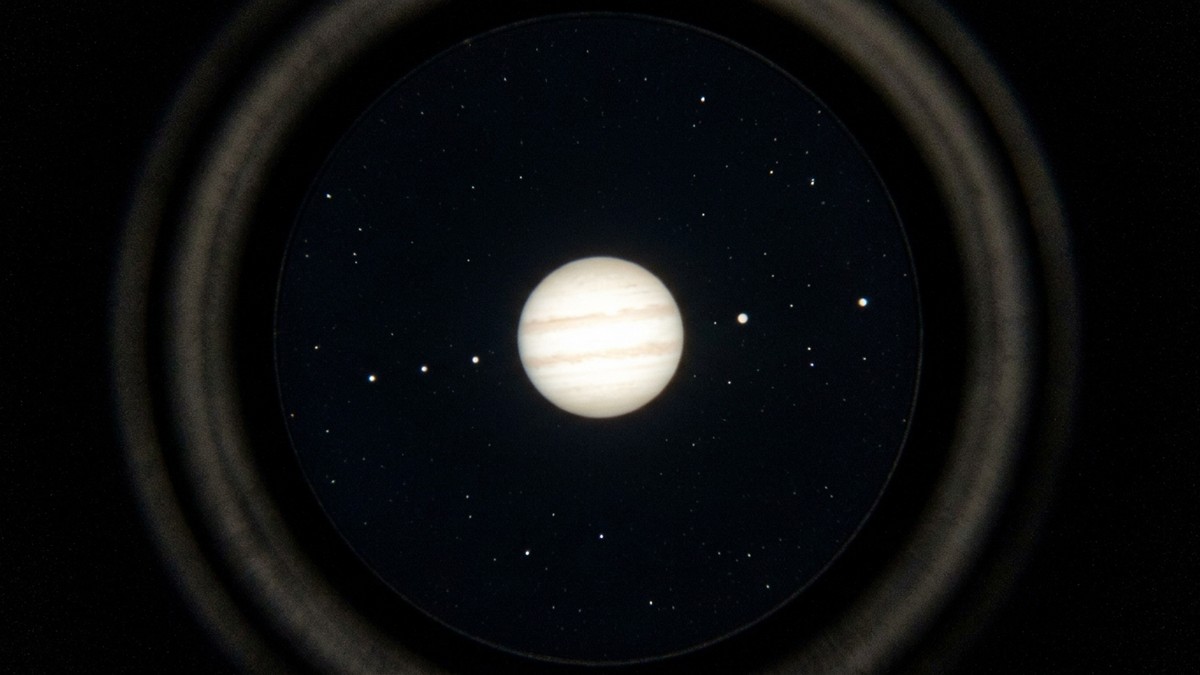
The Moon and Jupiter are too far apart tonight (3.9°) to fit in the same telescope eyepiece, but they'll sit together beautifully in a wide-field binocular view. Here's what each step up in equipment reveals:
Binoculars (any size, even 8×42): Point them at Jupiter and you'll immediately see tiny pinpoints of light lined up beside the planet — these are Jupiter's four Galilean moons: Io, Europa, Ganymede, and Callisto. They shift position from night to night (and even hour to hour), so what you see tonight will be different tomorrow. Swing across to the Moon and the craters along the terminator will leap out at you — the terminator is always the most dramatic part of the Moon to observe because the long shadows make the terrain look three-dimensional.
Small telescope (60–80mm, 50–100× magnification): Jupiter's disc becomes clearly visible — a tiny cream-coloured oval. You should be able to make out the two main equatorial cloud belts running across the planet as dark stripes. The Galilean moons will be crisp and obvious. On the Moon, dozens of craters will be visible along the terminator, and you'll see the smooth dark floors of the maria contrasting with the rugged bright highlands.
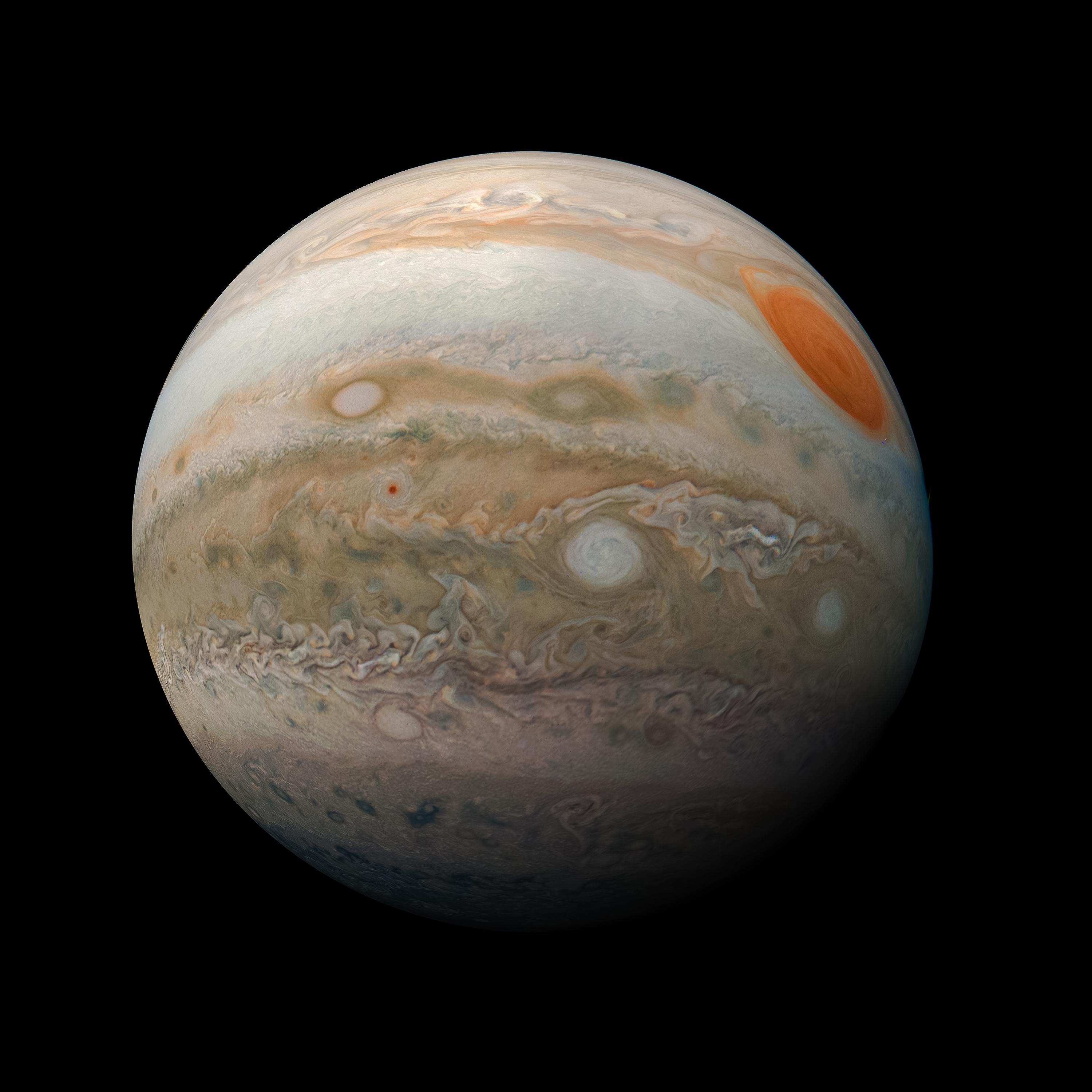
Larger telescope (150mm+ reflector, 150–200×): Jupiter really opens up. The cloud belts show internal structure — festoons, barges, and if the timing is right, the Great Red Spot. Tonight Jupiter's disc spans about 39 arcseconds, which is still generous enough for good detail. The Moon will be almost overwhelming — try a neutral density filter or simply reduce magnification to take in the broader landscape of mountain ranges, rille valleys, and flooded impact basins.
Why Jupiter Is So Good Right Now
Jupiter has been one of the highlights of the evening sky all winter, and March 2026 is still a fine month to observe it. Here's why:
High altitude: Jupiter is currently in Gemini, one of the most northerly zodiac constellations. For UK observers, this means Jupiter passes almost directly overhead — reaching altitudes above 55 degrees when it transits (crosses due south). High altitude means you're looking through less of Earth's atmosphere, which means sharper views, less atmospheric shimmer, and better contrast on planetary detail.
Still bright: At magnitude –2.3, Jupiter is dimming only slowly as Earth pulls ahead of it in their respective orbits. It was at opposition last autumn, but it remains a commanding presence. Its disc tonight spans 39 arcseconds — smaller than at opposition but still large enough for a telescope to show serious detail.
Galilean moon activity: Jupiter's four large moons are endlessly dynamic. They orbit fast enough that their positions change visibly over a single evening. Occasionally one will pass in front of Jupiter (a transit), behind it (an occultation), or through its shadow (an eclipse). These events are fascinating to watch in real time through a telescope, and they happen several times a week.
If you enjoy tonight's view, Jupiter will remain well-placed in the evening sky right through to June, when it reaches opposition and is at its absolute best. Our full guide — Observing Jupiter Throughout 2026 — has month-by-month detail on what to watch for.
How to Photograph the Conjunction
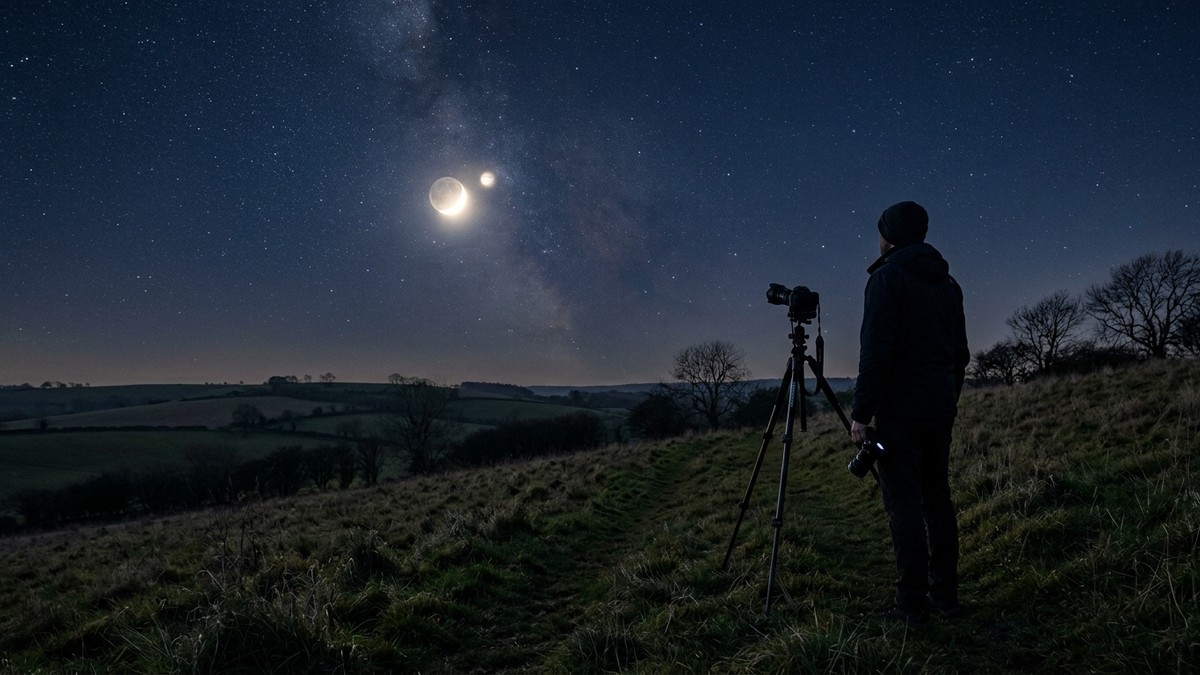
The good news is that this conjunction is one of the easiest things in astronomy to photograph. The Moon is extremely bright and Jupiter is unmistakable, so even a phone camera can get a decent result.
Smartphone: Use Night Mode if your phone has one. Prop the phone against something solid (a fence post, a wall, a car roof) to keep it steady. Tap to focus on the Moon, then hold your finger on the screen to lock the exposure. The Moon should show some surface detail and Jupiter will appear as a bright dot nearby. If your phone has a 2× or 3× zoom, try it — the results can be surprisingly good.
Camera with a zoom lens (70–200mm or similar): Mount it on a tripod. Use manual exposure: try ISO 400, f/5.6, and 1/250s as a starting point for the Moon's surface detail. Jupiter will be overexposed at these settings but will show as a bright companion. For a more balanced shot showing both the Moon's surface and Jupiter's disc, take two exposures (one for each) and blend them in post-processing.
Wide-angle scene shot: This is often the most satisfying approach. Use a wide lens (24–35mm), set ISO 800–1600, f/2.8 or wider, and try a 2–4 second exposure on a tripod. Include a foreground — trees, a church spire, a hillside — and you'll capture the Moon and Jupiter together with the stars of Gemini, creating a beautiful scene shot that tells the story of the conjunction.
What's Coming Next
Tonight's conjunction is a lovely event, but the sky has plenty more in store over the coming days:
Venus–Jupiter conjunction (29 March): In just three days, Venus and Jupiter will appear close together in the evening sky as Venus continues to climb higher after sunset. Venus is even brighter than Jupiter, so this will be a dazzling pairing — keep an eye on the western sky after sunset on Saturday evening.
Full Pink Moon (1 April): The Moon continues waxing toward full, reaching 100% illumination on April 1 — the first full Moon of spring. It's called the Pink Moon after the early-blooming phlox wildflowers, not because it appears pink (though a rising full Moon near the horizon can take on warm colours from the atmosphere).
Artemis II crewed Moon launch (1 April): In a remarkable coincidence, NASA's Artemis II mission is scheduled to launch on the same day as the full Moon, sending four astronauts on the first crewed flight to the Moon since Apollo 17 in 1972. We'll have full coverage on the blog.
Clear skies tonight — and if you catch a good view or a great photo, we'd love to see it. Tag us @watchthestarsuk on Instagram.