How to Find Orion
Orion is the perfect starting point for any new stargazer. It's bright, distinctive, and leads you to some of the other great winter constellations once you know where to look.
★ Start with the Belt
Look for three bright stars in a short, straight row — tilted slightly, roughly east–west. These are Orion's Belt: Alnitak, Alnilam, and Mintaka. They're impossible to miss on a clear winter night. Once you have the Belt, you have Orion — the rest of the figure fans out from there.
🧭 Where to Look
- Face south on a winter evening (in the Northern Hemisphere)
- Orion rises in the east around sunset from October onwards
- It climbs to its highest point due south around midnight in January
- From the UK, the Belt is roughly 30° above the southern horizon at its peak
- In the Southern Hemisphere, look north — Orion appears "upside down"
🌟 Using the Belt as a Pointer
Orion's Belt is one of the great navigational tools in the sky. Follow the Belt stars to the left (east): they point almost directly to Sirius, the brightest star in the night sky, about 20° away. Follow the Belt to the right (west) and they lead to Aldebaran in Taurus, the red eye of the Bull. Both stars are unmissable once you know where to aim.
🔴 Spot Betelgeuse
Once you have the Belt, look for a distinctly orange-red star above and to the left — this is Betelgeuse, marking Orion's right shoulder. Its warm colour is visible even to the naked eye and makes it one of the most recognisable individual stars in the sky. It's one of the largest stars known, so luminous it would engulf the orbit of Jupiter if placed where our Sun is.
💡 Spot the Sword
Below the Belt, look for a short vertical line of three fainter stars — Orion's Sword. The middle "star" isn't a star at all. It has a fuzzy, soft appearance even to the naked eye on a dark night. That's the Orion Nebula (M42), a stellar nursery 1,344 light-years away. It's one of the most spectacular objects in the entire sky and visible without any equipment.
| Month | Rises | Highest in South | Sets | Visibility |
|---|---|---|---|---|
| October | ~11pm | ~5am | ~11am | Good — late-night viewing |
| November | ~9pm | ~3am | ~9am | Good — evening/early morning |
| December | ~7pm | ~1am | ~7am | Excellent — all-night access |
| January | ~5pm | ~11pm | ~5am | Best — high and brilliant all evening |
| February | ~3pm | ~9pm | ~3am | Excellent — perfectly placed at dusk |
| March | ~1pm | ~7pm | ~1am | Good — visible early evening |
| April–May | Daytime | Near sunset | ~11pm | Fading — low in west at dusk |
| Jun–Aug | — | Crosses sky with Sun | — | Invisible — below horizon at night |
Times approximate for 51°N (UK). Orion is absent from evening skies from roughly May to September.
Key Stars of Orion
Orion contains seven main stars that define the Hunter's outline — two shoulders, a belt of three, and two feet. Each one is a giant or supergiant many times larger and brighter than our Sun.
One of the most discussed stars in the sky, Betelgeuse is a red supergiant nearing the end of its life. Its distinctly orange-red colour is visible with the naked eye. It varies in brightness over roughly 400-day cycles and will one day explode as a supernova — bright enough to be visible in daylight. The Great Dimming of 2019–20, when it faded dramatically, caused considerable excitement before being attributed to an outburst of surface gas.
Despite being designated Beta, Rigel is Orion's brightest star — one of the ten brightest in the entire night sky. Its blue-white colour provides a stunning contrast to Betelgeuse on the opposite shoulder. Rigel is 100,000 times more luminous than the Sun; if it were as close as Sirius, it would cast visible shadows at night. A small telescope reveals Rigel B, a companion star that appears blue-white at high magnification.
Known as the "Amazon Star", Bellatrix is the third brightest star in Orion and one of the hottest naked-eye stars in the sky. At 21,500K it shines hot blue-white. Relatively close at 250 light-years, it's actually intrinsically one of the less extreme supergiants in the constellation but packs a punch due to its proximity. It marks Orion's right shoulder as seen in the sky (to our left).
The three Belt stars are among the most recognisable asterisms in the sky and known across virtually every culture on Earth. They are called the "Three Kings" or "Three Sisters" in many traditions. All three are massive, hot blue-white stars vastly more luminous than the Sun. Alnitak (east) sits beside the Flame Nebula; Alnilam (centre) is the most luminous of the three; Mintaka (west) sits almost exactly on the celestial equator.
Saiph appears fainter than Rigel opposite it, but in terms of actual luminosity it's a similarly extreme blue supergiant. Its apparent dimness is partly due to distance and partly because it radiates much of its energy as ultraviolet light invisible to the eye. Saiph marks Orion's left knee, completing the familiar four-star outline of the Hunter's body alongside Betelgeuse, Bellatrix, and Rigel.
The Myth of Orion
Few constellations have inspired as many stories. Orion appears in the mythologies of ancient Greece, Rome, Egypt, Babylon, and dozens of indigenous cultures on every inhabited continent.
In Greek mythology, Orion was the greatest hunter who ever lived — a giant of superhuman stature, the son of Poseidon. He was said to be so skilled that he boasted he would hunt every creature on Earth, prompting Gaia, the Earth goddess, to send a great scorpion to kill him. Zeus intervened, placing both Orion and the Scorpion (Scorpius) in opposite parts of the sky so they would never meet — which is why Orion sets in the west just as Scorpius rises in the east each year, the Hunter forever fleeing his nemesis.
Other versions of the myth tell of Orion's love for the Pleiades, the seven daughters of Atlas. He pursued them relentlessly, and Zeus placed them both in the sky — the Pleiades cluster sits nearby in Taurus, with Orion seeming to pursue them perpetually across the heavens. The Belt stars, often called the Three Kings, are central to the winter star lore of many cultures, from the "Three Marys" of Catholic tradition to the "Three Wise Men" who follow the star of Bethlehem eastward.
In ancient Egypt, Orion was identified with Osiris, god of the afterlife and resurrection, while the Belt stars aligned with the three pyramids of Giza — a connection that continues to inspire debate. The Nile itself was said to mirror the Milky Way, the river of the heavens, with Orion watching over both.
The Babylonians called the constellation "The True Shepherd of Anu", their sky god, depicting a heroic figure guarding the celestial flock. Their astronomical records, some of the earliest in history, meticulously tracked Orion's appearance above the horizon as a herald of winter and the flooding seasons of the rivers.
Deep-Sky Objects in Orion
Orion sits in one of the most richly nebulous regions of the sky. The entire constellation lies within or near a vast complex of gas and dust known as the Orion Molecular Cloud, a stellar nursery spanning hundreds of light-years.
 NASA / ESA / Hubble
🔍 Click to enlarge
NASA / ESA / Hubble
🔍 Click to enlarge
The showpiece of the winter sky. Visible to the naked eye as the fuzzy middle "star" of Orion's Sword, it's a spectacular region of glowing gas where new stars are being born right now. In binoculars it shows striking nebulosity; a small telescope reveals its fan shape and the four young Trapezium stars at its heart. One of the best objects in the sky for any instrument.
 ESO / VLT
🔍 Click to enlarge
ESO / VLT
🔍 Click to enlarge
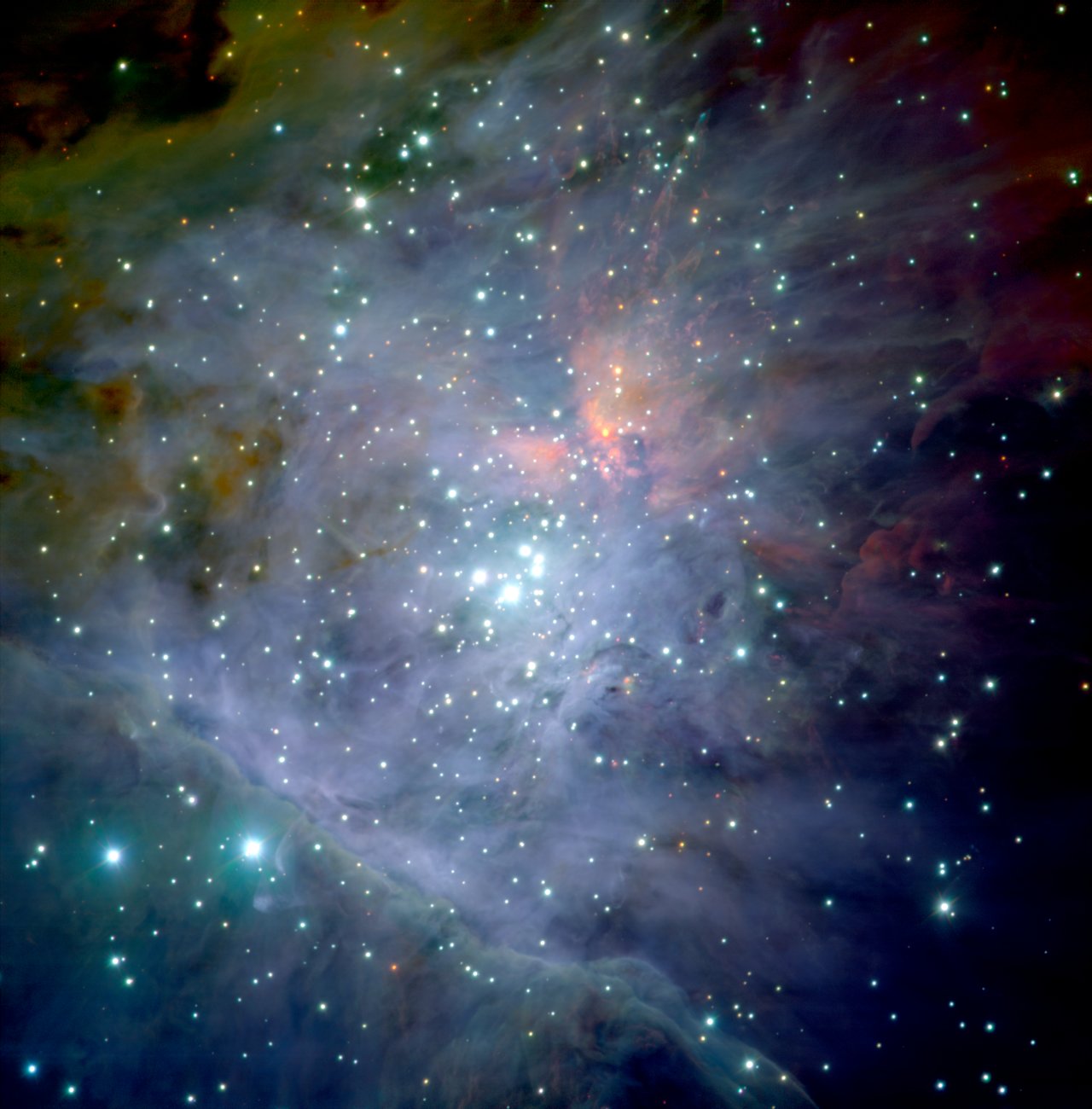
Hidden within the heart of M42, the Trapezium is a tight cluster of four (and with good seeing, six) extremely young, hot stars that light up the entire surrounding nebula. At 100–150× magnification, a small telescope easily splits the four main components into their distinctive trapezoidal arrangement. These stars are fewer than a million years old — stellar infants compared to our 4.6-billion-year-old Sun.
 NASA / ESA / Hubble
🔍 Click to enlarge
NASA / ESA / Hubble
🔍 Click to enlarge
Often overlooked because it sits right beside M42, de Mairan's Nebula is a detached extension of the Orion Nebula complex, separated by a dark dust lane. It has a distinctive comma or teardrop shape in small telescopes, with a single bright star at its centre. A patient observer with binoculars on a dark night can pick out its glow. It was discovered separately from M42 by the French astronomer Jean-Jacques de Mairan in 1731.
 ESO
🔍 Click to enlarge
ESO
🔍 Click to enlarge
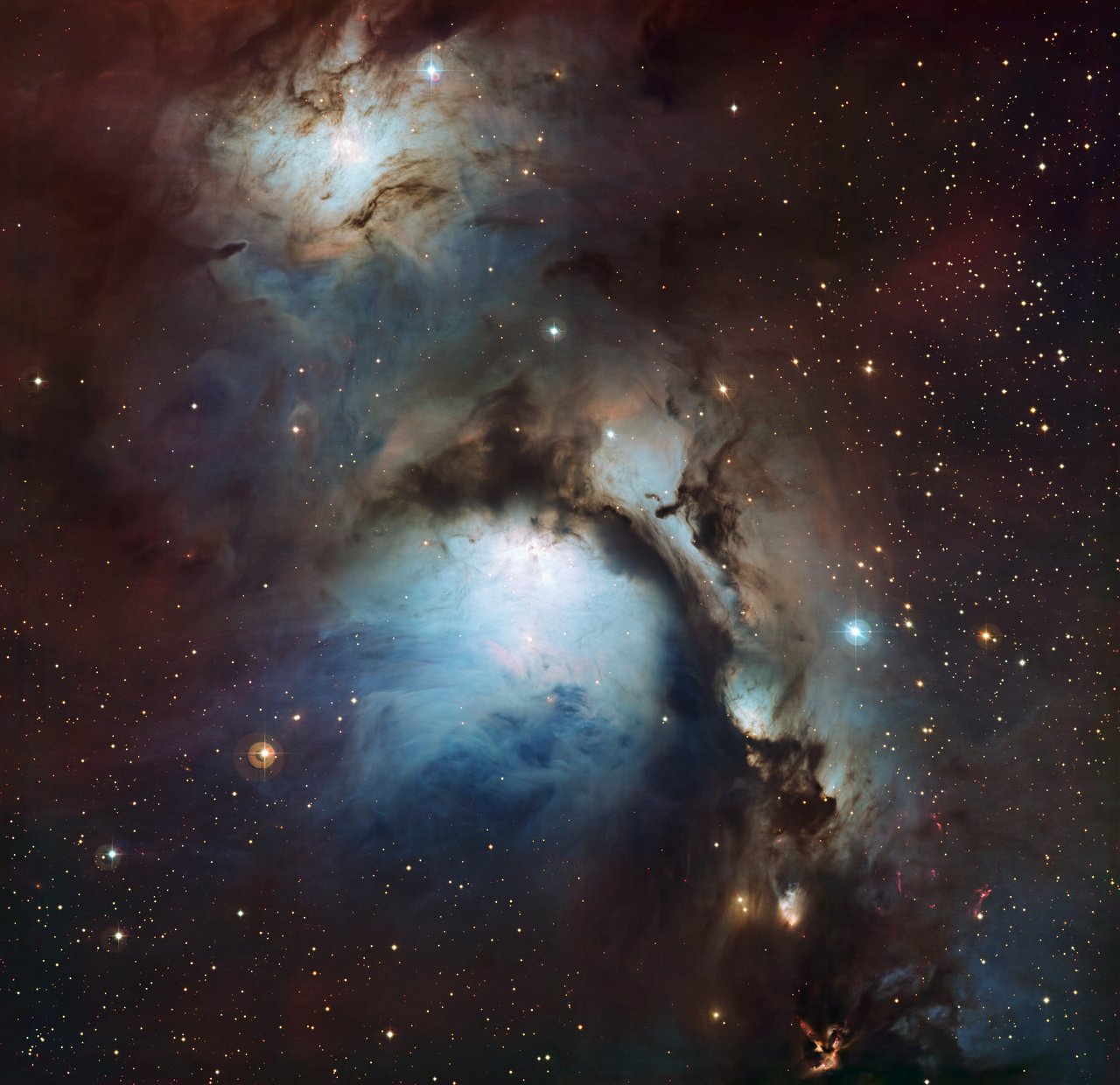
The brightest reflection nebula in the sky. Unlike emission nebulae (which glow from ionised gas), M78 shines by reflecting starlight from embedded hot blue stars — giving it a cool, blue-white hue in photographs. In binoculars on a dark night it appears as a small, misty glow with two faint stars embedded. A 100mm telescope at low power shows its roughly rectangular shape. Look about 2.5° north-east of Alnitak.
 NASA / ESA / Hubble
🔍 Click to enlarge
NASA / ESA / Hubble
🔍 Click to enlarge
Perhaps the most photographed nebula in the sky, the Horsehead is a dark pillar of dust silhouetted against the glowing red emission nebula IC 434. The horse's head shape is unmistakable in photographs but extraordinarily difficult to see visually — it requires a large aperture telescope (250mm+), perfectly dark skies, and a hydrogen-beta narrowband filter. It's a prize target for astrophotographers with even modest camera equipment on a tracking mount.
 ESO / VISTA
🔍 Click to enlarge
ESO / VISTA
🔍 Click to enlarge
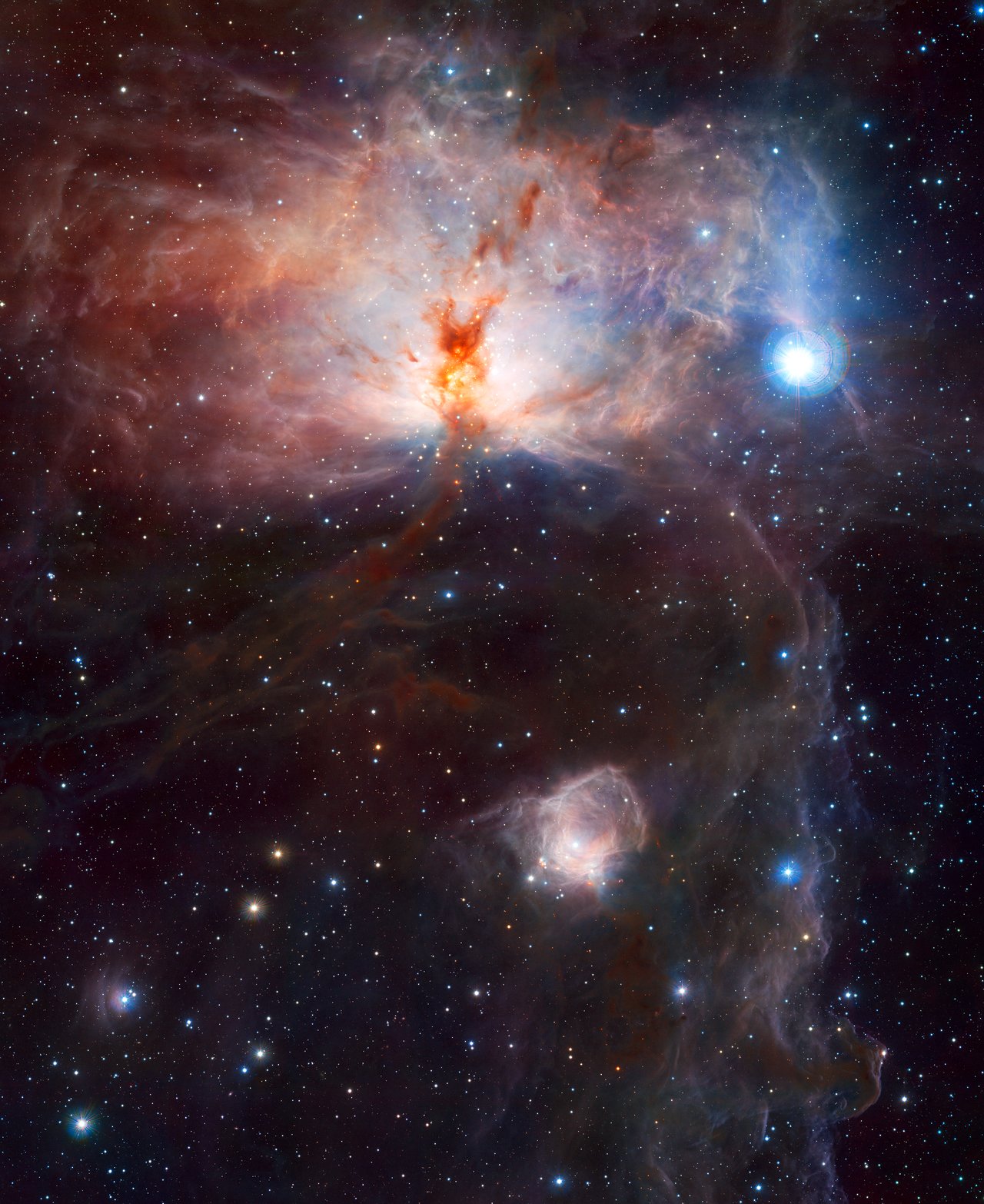
Sitting immediately beside the bright star Alnitak (east belt star), the Flame Nebula glows orange-red in photographs due to hydrogen emission energised by Alnitak's intense ultraviolet output. Visually it's very difficult because Alnitak's glare overwhelms it. In photographs it reveals intricate dark dust lanes creating the "flame" structure. For astrophotographers, a single wide-field shot can capture both the Horsehead and the Flame in the same frame — one of the most popular targets in astrophotography.
 ESO / B. Tafreshi
🔍 Click to enlarge
ESO / B. Tafreshi
🔍 Click to enlarge
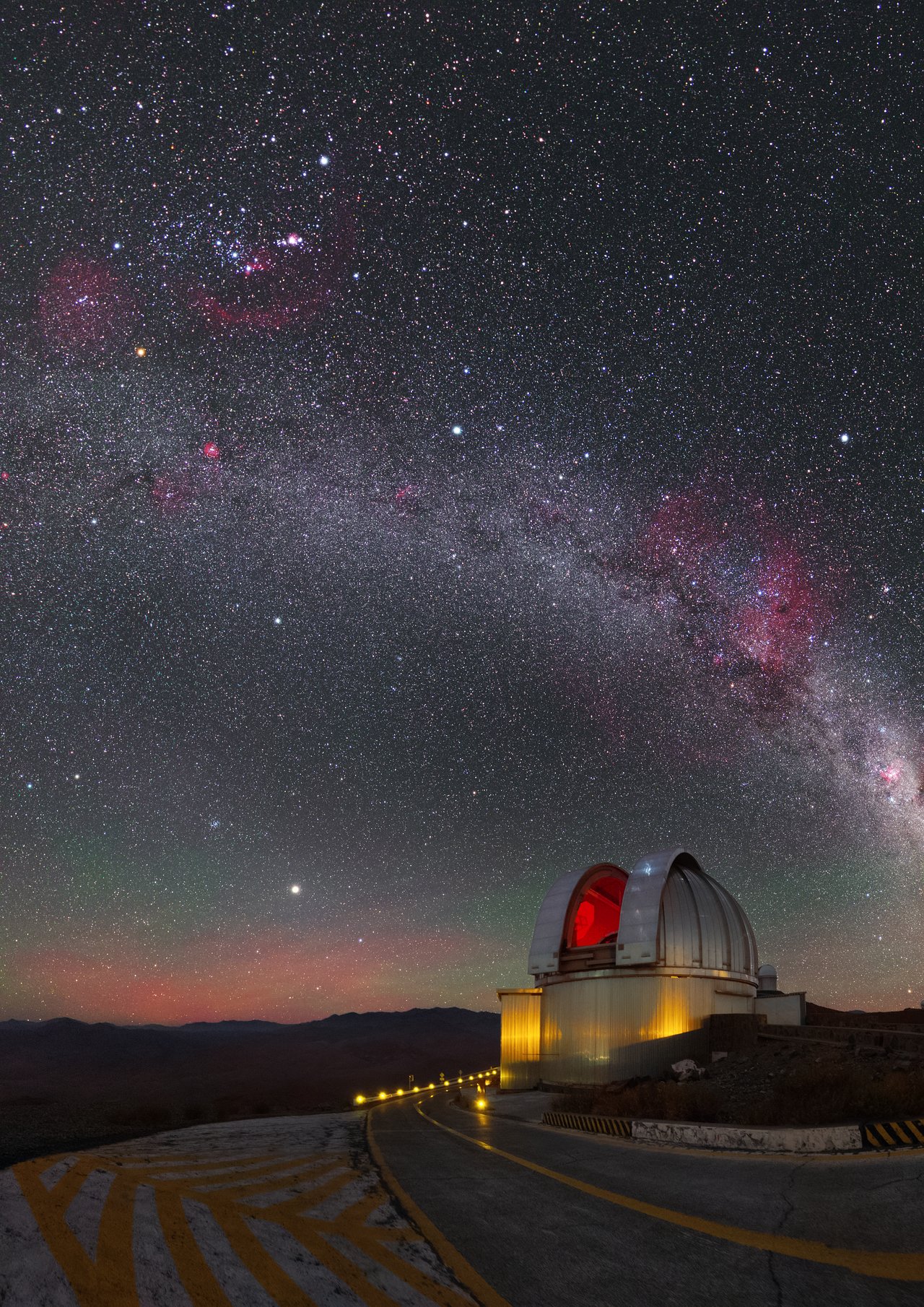
An enormous arc of glowing hydrogen gas that sweeps around the eastern side of the Orion constellation — if it were visible to the naked eye it would be 14 degrees across, larger than your fist at arm's length. Invisible without photography, it reveals itself dramatically in long-exposure images as a sweeping red/pink curve. It's thought to be the remnant of a supernova that occurred around two million years ago. Wide-field astrophotography with a modified camera reveals it in breathtaking detail alongside the whole Orion complex.
Your Beginner's Observing Guide
You don't need any equipment to enjoy Orion — but knowing a few simple techniques will transform your experience of the winter sky.
Let your eyes adapt
Your eyes take around 20–30 minutes to fully dark-adapt once you go outside. During this time, avoid looking at any bright lights (including your phone screen — use a red torch if you need light). You'll be amazed how many more stars become visible as your night vision kicks in. Fainter stars that seemed invisible will gradually emerge, and you'll see the Orion Nebula in the Sword much more clearly with fully adapted eyes.
Find a dark spot
Even moving a short distance from streetlights makes a real difference. You don't need to travel to the middle of nowhere — a garden with the porch light off, a local park, or a field on the edge of town all improve the view significantly. Face south and make sure there's no bright light source in your direct field of view. Check for weather forecasts that include "cloud cover" and "astronomical seeing" — cold, dry, still nights are usually best.
Start with the Belt, then the colour contrast
Lock onto the Belt stars first — they're your anchor. Then look at Betelgeuse (top-left of the figure) and Rigel (bottom-right) and compare their colours. Betelgeuse has a warm orange tint; Rigel looks ice-blue by comparison. This colour difference is real — Betelgeuse is a cool red supergiant (surface temperature ~3,500K) while Rigel is a scorching blue-white star (~12,000K). This colour contrast is one of the most striking naked-eye observations you can make.
Find the Sword — and the Nebula within it
Drop your gaze below the Belt and look for the three fainter stars of the Sword. The middle one should look distinctly "soft" or fuzzy on a clear, dark night — that's M42, the Orion Nebula. Use your peripheral vision (look slightly to the side of it rather than directly at it — a technique called averted vision) and you'll see it more clearly. Even with no equipment whatsoever, you're looking at a nebula 1,344 light-years away where stars are being born right now.
Use the Belt as a pointer to find other stars
Once you're comfortable with Orion, use it as a jumping-off point. Extend the Belt line down and to the left — about 20° — and you'll land on Sirius, the brightest star in the night sky (and the brightest star visible from Earth). Extend the Belt line up and to the right and you reach Aldebaran, the orange eye of Taurus the Bull. Now you're navigating the winter sky like a pro.
What Each Instrument Reveals
Naked Eye
The full constellation outline, colour contrast between Betelgeuse and Rigel, the Belt stars, the Orion Nebula as a soft glow in the Sword, and the Pleiades in nearby Taurus. In dark skies, hints of Barnard's Loop photographically.
Binoculars (7×50 or 10×50)
M42 with clear fan-shaped nebulosity, M78 as a misty glow, the Sword region in full glory, star clusters in Orion's head (λ Ori / Collinder 69), and fine detail in the Belt star region including the faint glow around Alnitak.
Telescope (80–200mm)
The Trapezium cluster (4 stars easily, 6 with good seeing), rich M42 structure, M43 separately, M78 in full, NGC 1981 open cluster, early attempts at the Horsehead with H-beta filter. Outstanding views on nights of good seeing.
Taking It Further
For those with larger telescopes, tracking mounts, or dedicated astrophotography rigs, Orion opens up into one of the richest and most rewarding regions of sky to explore.
Astrophotography Targets
- Wide field (50mm lens): Barnard's Loop, entire constellation, M42 and neighbouring nebulae in context
- Medium field (200mm lens): M42 + M43 + Horsehead + Flame in single frame
- Narrow field (telescope): M42 core (expose carefully to avoid blowing out), Horsehead + Flame detailed
- Narrowband (Ha/OIII/SII): Full Barnard's Loop arc, IC 434 emission against which the Horsehead silhouettes, NGC 2024 intricate dust lanes
- Modified (astro) camera or dedicated cooled CMOS sensor strongly recommended for nebulosity
Telescope Challenges
- Horsehead Nebula: 200mm+ aperture, H-beta filter, excellent dark skies. One of the great visual challenges
- Flame Nebula (visual): 150mm+, UHC or OIII filter, mask Alnitak to reduce glare
- M43 separation: Spot the dust lane dividing M42 and M43 at 100×+
- Trapezium 5 and 6: Stars E and F visible at 200×+ under excellent seeing with 100mm+
- Rigel B: Close white companion at high magnification — challenging split at about 9"
- NGC 1981: Open cluster just north of M42 — check for faint nebulosity around it
Betelgeuse: A Star to Watch
Betelgeuse is a semi-regular variable star, changing in brightness over cycles of roughly 400 and 2,100 days. You can estimate its brightness by comparing it to nearby stars: at its brightest it rivals Rigel; at its faintest it drops to near magnitude +1.3. During the Great Dimming of late 2019–early 2020, it faded to magnitude +1.64, its dimmest in modern recorded history. Monitoring its slow changes over a winter season with just the naked eye is a real contribution to variable star science — the AAVSO (American Association of Variable Star Observers) welcomes estimates from amateur observers worldwide.
The Orion Molecular Cloud
Orion sits within one of the nearest and most active star-forming regions in the Milky Way. The Orion Molecular Cloud complex contains millions of solar masses of gas and dust spread across hundreds of light-years. M42 and M43 are merely the brightest pockets of ionised gas lit by young stars within this vast structure. The Belt stars, M78, the Horsehead, the Flame, and Barnard's Loop are all parts of the same physical complex. At roughly 1,300–1,600 light-years, it's our nearest large stellar nursery — a unique opportunity to observe star formation in action at relatively close range.
Pro tip: On nights of exceptional transparency, try sweeping slowly through the entire Orion region with 7×50 or 10×50 binoculars from a truly dark site. The amount of faint nebulosity visible, once your eyes are fully adapted, is genuinely astonishing — wisps and tendrils of glowing gas filling the whole area between the Belt stars and the Nebula. You're seeing the edge of one of the Milky Way's great stellar nurseries with your own eyes.