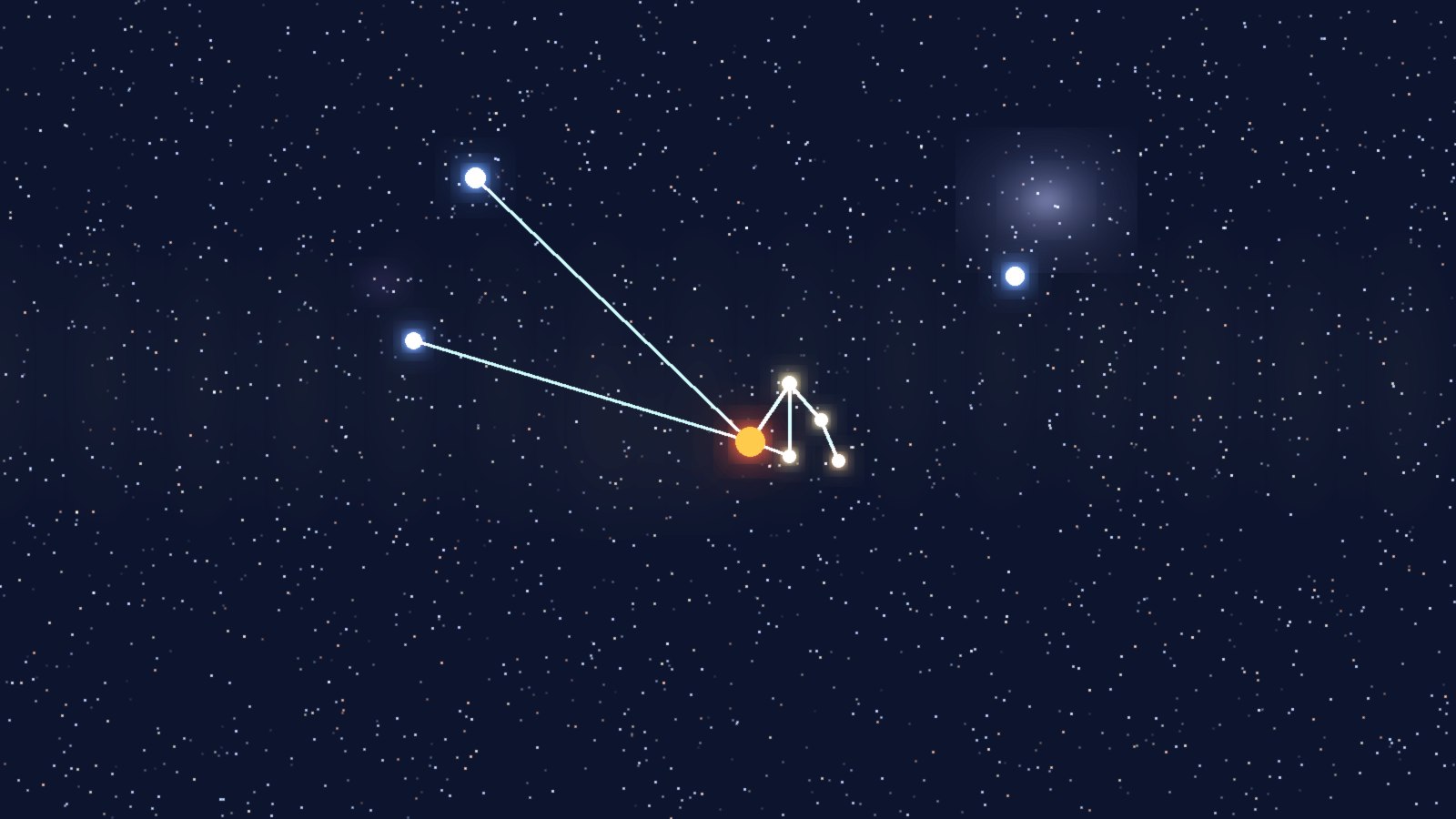
Taurus
The Sacred Bull of the Winter Sky
October – February
The Sacred Bull of the Winter Sky
October – FebruaryTaurus, the Bull, is one of the most magnificent and historically significant constellations of the night sky. Home to the brightest red giant Aldebaran, the nearest open cluster the Hyades, and the most famous naked-eye cluster the Pleiades, Taurus offers unparalleled treasures to both naked-eye and telescopic observers. This zodiacal constellation has captivated humanity for over 4,000 years, from Mesopotamian temples to the mythology of ancient Greece. Its bright stars, rich double-star systems, and spectacular deep-sky objects make it a winter-sky essential.
Taurus is unmissable in winter: locate the brilliant Orion constellation (the most obvious winter figure), then look upper-right (northwest in the evening sky) to find Taurus rising above it. The orange Aldebaran is your primary landmark.
The brilliant orange-red Aldebaran (magnitude 0.87) is the brightest star in Taurus and unmistakable when you know what to look for. Its warm colour contrasts beautifully with the surrounding blue-white stars. This is the eye of the bull, watching over the winter sky.
Below and around Aldebaran lies the V-shaped Hyades cluster. Trace the V: from Ain at the top down through Prima Hyadum, then to Aldebaran at the apex. This is the bull's face. The entire V fits in a binocular field and is a beautiful sight.
To the upper left (north-northwest from Aldebaran), spot the Pleiades cluster M45 — seven bright stars grouped tightly together. These are the most famous of all star clusters, visible to the naked eye and spectacular through binoculars. The Pleiades are "north" of the Hyades, forming the bull's front legs.
| Month | Position | Altitude at 9pm | Notes |
|---|---|---|---|
| October | ESE, rising | ~25° | Evening object, emerging from twilight |
| November | SE, climbing | ~45° | Good visibility, improving conditions |
| December | South, excellent | ~55° | BEST MONTH — highest in the sky, optimal for observing |
| January | SW, still good | ~50° | Still well-placed, visible most of the night |
| February | WSW, sinking | ~35° | Evening object, sets by midnight |
The eye of the bull and the 14th-brightest star in the entire sky. Aldebaran's name means "follower" in Arabic — it follows the Pleiades across the sky. This orange giant shines with a warm, distinctive red-orange hue, immediately recognisable among the cool blue-white stars surrounding it. One of the four ancient royal stars of Mesopotamian astronomy. The Moon frequently occults it, providing dramatic moments of disappearance and reappearance to observe.
The brightest star in the bull's northern horn, marking the top of Taurus's head. Elnath is shared with the constellation Auriga — it was once catalogued as γ Aurigae before being officially assigned to Taurus. This blue-white giant is 5.6 times the Sun's mass and 170 times more luminous. It's a fine comparison star for colour perception, showing the cool blue tint characteristic of B-type stars.
The brightest star in the legendary Pleiades cluster M45 — one of the most famous star clusters in human history. Alcyone is a blue-white giant with an unusual gaseous circumstellar disc, making it a unique stellar laboratory. The Pleiades cluster as a whole is ~100 million years old, visible to the naked eye (the "Seven Sisters"), and transforms through binoculars into a glittering jewel box of hundreds of stars. An essential observation for every observer.
The tip of the bull's southern horn, a Be-type star that rotates so rapidly its equatorial region is nearly at the break-up velocity. This creates a disc of hot, ejected material around the star's equator — a Be-star signature. The rotation period is fewer than 12 hours, making Tianguan a laboratory for studying extreme stellar rotation and circumstellar discs. A challenging but rewarding astrophysical target.
The "eye" of the bull in some interpretations, marking the top vertex of the Hyades V-shape. Ain is an orange giant and, remarkably, a confirmed exoplanet host — Ain b (ε Tau b), a Jupiter-sized world orbiting every 595 days. This makes Ain one of the few host stars in an open cluster that we know harbours a planet. When you observe Ain, you're looking at a star system with its own worlds.
One of the brightest members of the famous Hyades open cluster — the nearest star cluster to Earth at only 153 light-years. "Prima Hyadum" means "first of the Hyades." It's an orange giant, one of the ~200 stars bound gravitationally to the Hyades system, an 800-million-year-old stellar congregation slowly dispersing across the galaxy. The Hyades cluster offers a unique window into stellar evolution and galactic dynamics.
In Greek mythology, Taurus represents the white bull sent by the gods to abduct the mortal princess Europa. Zeus disguised himself as this magnificent bull with a coat of pure white and lured Europa onto his back with flowers, then swam her across the sea to the distant land of Crete. Their union produced Minos, the legendary king. The Pleiades are the seven daughters of the Titan Atlas and the nymph Pleione; the Hyades are their half-sisters, placed in the sky weeping for their brother Hyas. Both clusters are thus forever embedded in the bull's form.
Taurus is one of the oldest identified constellations, known as the "Bull of Heaven" (GU.AN.NA) in Sumerian texts dating to circa 4000 BCE. It appears in the Epic of Gilgamesh, where Anu sends the Bull of Heaven to destroy Gilgamesh at the request of the goddess Ishtar. Gilgamesh and his companion Enkidu slay the bull, an act that provokes divine retribution. In ancient Mesopotamia, Taurus held supreme importance, marking the vernal equinox around 4000 BCE.
The bull held sacred significance in Egyptian religion as a fertility symbol and representation of divine power. The Apis Bull was the most venerated; each pharaoh was believed to embody bovine strength and virility. The Pleiades were known to the Egyptians as "The Sailors" and held profound importance in navigation and timekeeping — their heliacal rising marked the start of the sea sailing season. The constellation was woven into Egyptian religious calendars and temple rituals.
In Vedic astronomy, the Pleiades are revered as the Krittikas — the six (sometimes seven) divine mothers who nursed Kartikeya (Skanda), the god of war. Aldebaran is the nakshatra Rohini, one of the most auspicious lunar mansions, traditionally associated with the Moon's favourite wife and symbolising fertility and motherhood. The Hyades contain the nakshatra Mrigashira. These lunar mansions remain central to Hindu astrology, timekeeping, and the scheduling of auspicious dates.
The Pleiades were known to Norse and Germanic peoples as Syvstjernen (the Seven Stars), crucial for agricultural timekeeping. Farmers planted by the Pleiades' rising in spring and harvested by their setting in autumn — an agricultural calendar written in the stars. The constellation was known by various "eye of the ox" names throughout Germanic languages. In Norse cosmology, celestial cattle held symbolic importance, and Taurus featured prominently in seasonal festivals and farming practices that sustained northern communities.
The most famous star cluster in the night sky — visible to the naked eye as a tight grouping of seven bright stars (though myth suggests nine, with two "lost" Pleiades). Through binoculars, dozens of stars emerge; long-exposure astrophotography reveals the blue reflection nebula surrounding the brightest members. An essential target for every observer, and a touchstone of human cultural history spanning over 3,000 years of mythology and astronomy. Observe it at least once every winter.
The nearest open cluster to our solar system — a nearby stellar neighbourhood spanning several degrees of sky. The famous V-shaped "face" of the bull is formed by the Hyades members, containing ~200 stars distributed over a region 15 light-years across. Aldebaran appears to be part of this V but is actually a foreground star unrelated to the cluster. Through binoculars, the Hyades reveal themselves as a beautiful stellar population, each star a potential world-bearing sun. Remarkable science and beauty combined.
The most studied object in the sky — the expanding remnant of a supernova explosion seen on Earth in 1054 CE (recorded by Chinese and Arab astronomers). At its heart spins a neutron star pulsar rotating 30 times per second, powering the nebula's luminosity. Visible in binoculars as a faint smudge; 20cm telescopes reveal its oval structure and internal detail. The Crab Nebula is a direct window into stellar death and relativistic physics — a profound observation linking us to medieval astronomy.
A scattered open cluster east of Aldebaran, easily resolved in binoculars at low power. Contains ~200 stars spread across a wide area, offering a splendid binocular field. One of the more overlooked clusters in a constellation rich with treasures, NGC 1647 deserves more attention. Its loose, sprawling structure makes it ideal for wide-field observing and astrophotography.
A relatively bright planetary nebula with a warm white central star visible within the nebular glow — a rare feature in planetary nebulae. The central star is itself a binary system, adding astrophysical interest. Under dark skies with 15cm+ telescopes, the nebular glow around the central star becomes visible, creating an ethereal appearance. A challenging but rewarding target for intermediate observers seeking something different from open clusters.
A fascinating reflection nebula illuminated by T Tauri, the prototype T Tauri variable star. The nebula is notoriously unpredictable — sometimes easily visible, sometimes vanishingly faint — as the young star's luminosity fluctuates erratically. This dramatic variability makes it an exceptional photographic target. Capturing NGC 1555 over multiple observing seasons creates a record of stellar youth and the violent processes within young stellar objects. A unique opportunity to observe stellar birth in real-time.
The Moon regularly occults Aldebaran — it passes directly in front of the star as seen from Earth. The bright star disappears behind the Moon's dark limb in less than 0.02 seconds, an event easily timed with a telescope. This dramatic disappearance proves Aldebaran has no visible disc (it's too distant), and provides a visceral connection to the Moon's orbital mechanics. Predicting and observing occultations is an advanced but accessible astrophysical exercise.
Long-exposure astrophotography reveals blue reflection nebulae surrounding the brightest Pleiades stars (especially Merope). These wisps of gas, illuminated by the young hot stars, can be captured with even basic DSLR equipment on a tracking mount. Over multiple observing nights, the Pleiades transforms from a tight cluster of stars into a region of cosmic beauty wreathed in nebulosity. This is accessible to amateur astronomers with patience and a decent camera.
The Hind's Variable Nebula (NGC 1555) changes brightness erratically as the young T Tauri star fluctuates in power. Building a personal photometric database of this nebula across the season documents stellar youth and the violent processes in young stellar objects. Multiple exposures over weeks/months reveal the dynamic nature of stellar birth — a direct window into the mechanisms that shaped our own solar system 4.6 billion years ago.
Ain (ε Tauri) hosts a confirmed exoplanet, Ain b, with a minimum mass of 7.6 Jupiter masses orbiting every 595 days. While the planet cannot be directly imaged, you can observe the host star knowing it harbours an invisible world. This connects visual observation to the broader exoplanet science: planet detection, orbital mechanics, and the ubiquity of planetary systems around evolved stars — a humbling perspective on how common worlds are.
At the heart of the Crab Nebula spins a neutron star pulsar rotating 30 times per second. While visual observation cannot resolve this object, knowing it's there transforms the view: you're watching the remnant of a stellar explosion, a laboratory of extreme physics frozen in light 6,500 light-years away. Advanced observers can attempt pulsar timing photometry — capturing the pulsar's flickering output — a sophisticated amateur astrophysics project.
The diverse stellar types in Taurus offer excellent opportunities for colour-based spectroscopy and photometry. Aldebaran (K5 orange giant), Elnath (B7 blue-white), and Alcyone (B7) provide a range of temperatures and spectra. Using colour filters or basic spectroscopes, amateur astronomers can measure these differences quantitatively, building a personal catalogue of stellar properties and connecting visual observation to spectroscopic science.
Taurus is the radiant of the Taurids meteor shower, peaking around November 5. The shower is actually split into two branches (North and South Taurids), creating an extended peak from late October through early November. Watching meteors radiate from Taurus connects you to the orbits of comets and asteroids — fragments of the solar system's birth. On a clear November night, lie under the constellation and watch the universe rain down around you.