Key Takeaways
- An M2.7 solar flare from sunspot region AR4392 launched a CME directly at Earth on 16 March
- NOAA has issued a G2 Geomagnetic Storm Watch for 19–20 March, with an outside chance of G3
- Scotland and northern England have a genuine chance of seeing the northern lights tomorrow night
- The spring equinox effect makes March one of the best months of the year for aurora
- Best viewing window is 22:00–02:00 local time — face north, find dark skies
📑 Table of Contents
If you live in Scotland, northern England, or Northern Ireland, clear your evening tomorrow. A solar eruption two days ago sent a billion-tonne cloud of charged particles racing toward Earth at roughly two million miles per hour — and it is expected to arrive on 19 March, potentially lighting up the northern sky in green and purple.
What Happened on the Sun
At 12:15 UTC on Sunday 16 March, a moderate M2.7 solar flare erupted from active sunspot region AR4392 on the Sun's surface. The flare itself lasted only a few minutes, but the explosion was powerful enough to hurl a coronal mass ejection (CME) — a vast bubble of magnetised plasma — directly toward Earth.
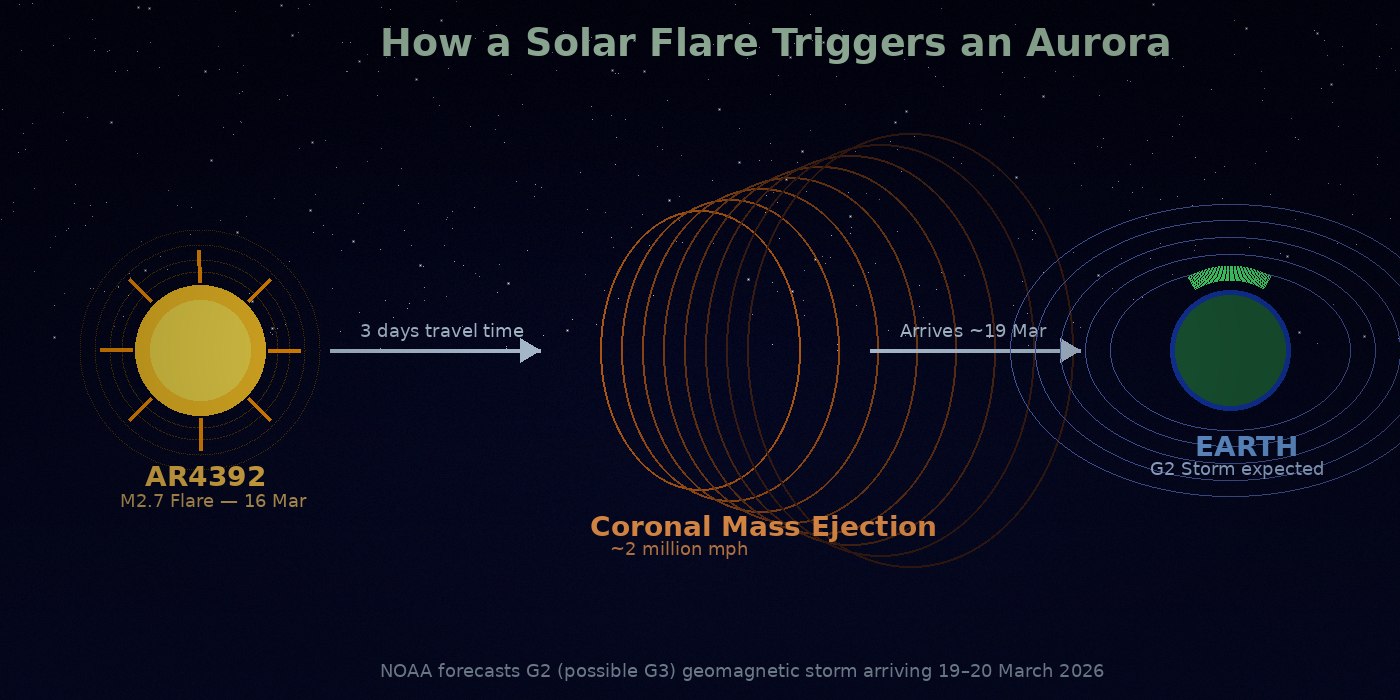
NOAA's Space Weather Prediction Center has since revised its estimate upward, suggesting that as many as four CMEs may have been launched in quick succession — a phenomenon known as a "CME cannibal," where faster ejecta catch and merge with slower ones ahead, potentially amplifying the impact when the combined cloud strikes Earth's magnetic field.
The official forecast is a G2 Moderate Geomagnetic Storm, with an outside chance of brief G3 Strong conditions. On the five-point NOAA storm scale, G2 is comfortably sufficient for aurora visibility across Scotland and northern England. G3 would push the visible zone south into the Midlands and, in theory, parts of Wales.
The Equinox Effect
There is something quietly remarkable about the timing of this event. March 20 — just one day after the CME arrives — is the spring equinox, and it turns out that the weeks around both equinoxes are consistently the best times of year for aurora activity, even accounting for the solar cycle.
The reason has to do with geometry. Around the equinoxes, the angle between Earth's magnetic field and the solar wind is particularly favourable — a configuration called the "Russell-McPherron effect." When the orientation lines up just right, the incoming solar wind couples more efficiently to Earth's magnetosphere, funnelling more energy into the polar auroral zones. Statistically, geomagnetic storm rates double near the equinoxes compared to the solstices, even when solar activity is otherwise equivalent.
In plain terms: if you are going to get an aurora alert, you want it in March or September. This week delivers both.
Where in the UK Can You See It?
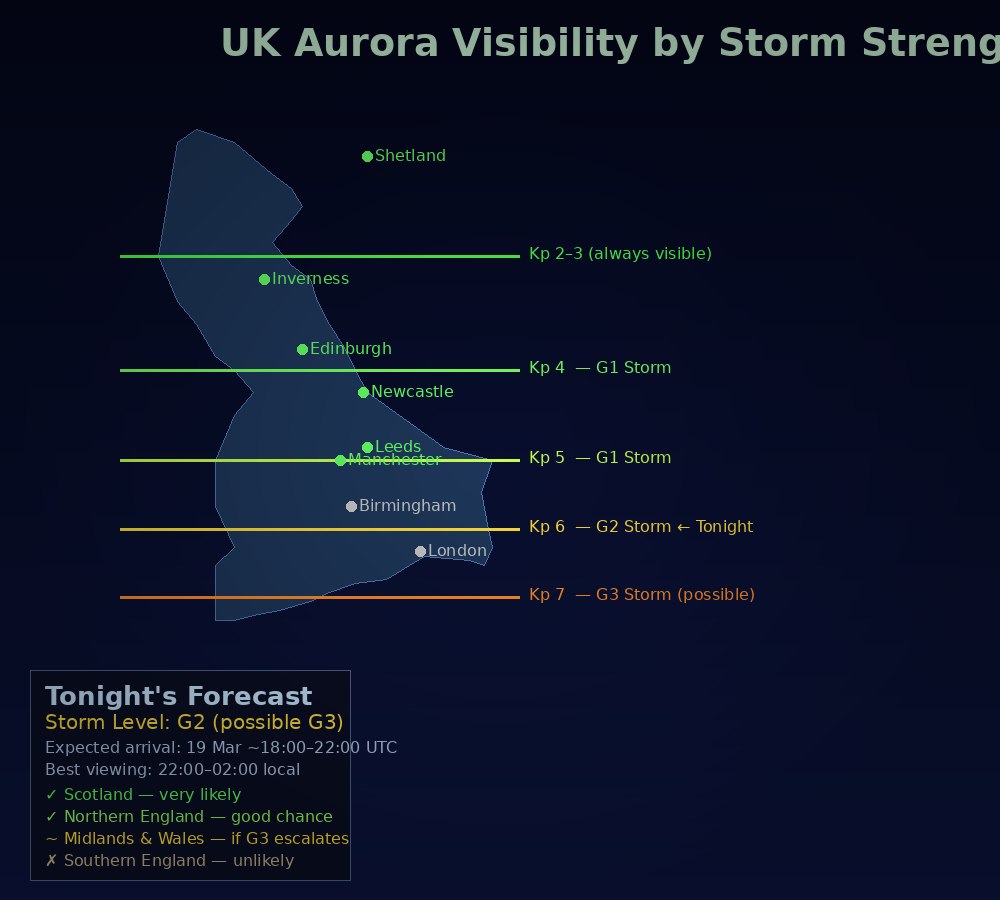
Aurora visibility depends on two things: your latitude and how strong the storm gets. Here is a straightforward guide for UK locations at the expected G2 level, with notes on a G3 upgrade:
Scotland (all regions) — Very likely. Under G2, the whole of Scotland sits comfortably within the auroral zone. The Highlands, Orkney, and Shetland offer the best combination of latitude and (relative) darkness. Even city-dwellers in Edinburgh or Glasgow may see a green glow on the northern horizon if the storm peaks strongly.
Northern England and Northern Ireland — Good chance. Newcastle, Cumbria, Yorkshire, and Belfast all have realistic prospects under G2. Get away from town light pollution and face north for the best chance.
Midlands and Wales — Possible if G3 develops. Birmingham, Manchester, and Cardiff are marginal at G2 but would come into range under G3 conditions. Worth stepping outside and checking the northern horizon even if you are in these areas.
Southern England — Unlikely under G2. London and the south coast are outside the expected visibility zone for a standard G2 storm. However, aurora cameras and long-exposure phone shots have surprised people further south before — it is never entirely impossible, especially if the storm escalates overnight.
When to Watch
The CME is expected to arrive during the late afternoon or evening of 19 March, with geomagnetic activity ramping up through the evening hours UTC. The best viewing window for most of the UK will be 22:00 to 02:00 local time on the night of 19–20 March — late enough for astronomical darkness, early enough that you are not entirely sleep-deprived.
A second CME may arrive later on 20 March, potentially extending activity into a second night. If cloud cover spoils Thursday, it may be worth trying again on Friday.
The key practical checklist before you go out:
- Check cloud cover for your location — this is as much a weather forecast as an astronomy one
- Drive or walk away from town, towards open northern horizon
- Give your eyes 20–30 minutes to dark-adapt before concluding the aurora isn't there
- Face roughly north to north-west
- Look for a green or white-ish glow sitting on the horizon — it often looks faint to the eye but vivid on camera
How to Photograph the Aurora
One of the best-kept secrets of aurora photography: your camera will almost always see more than your eyes. Even a modest DSLR or a modern smartphone in night mode can capture aurora displays that look faint or invisible to the naked eye. The northern lights are worth photographing even if you are not sure you can see them.
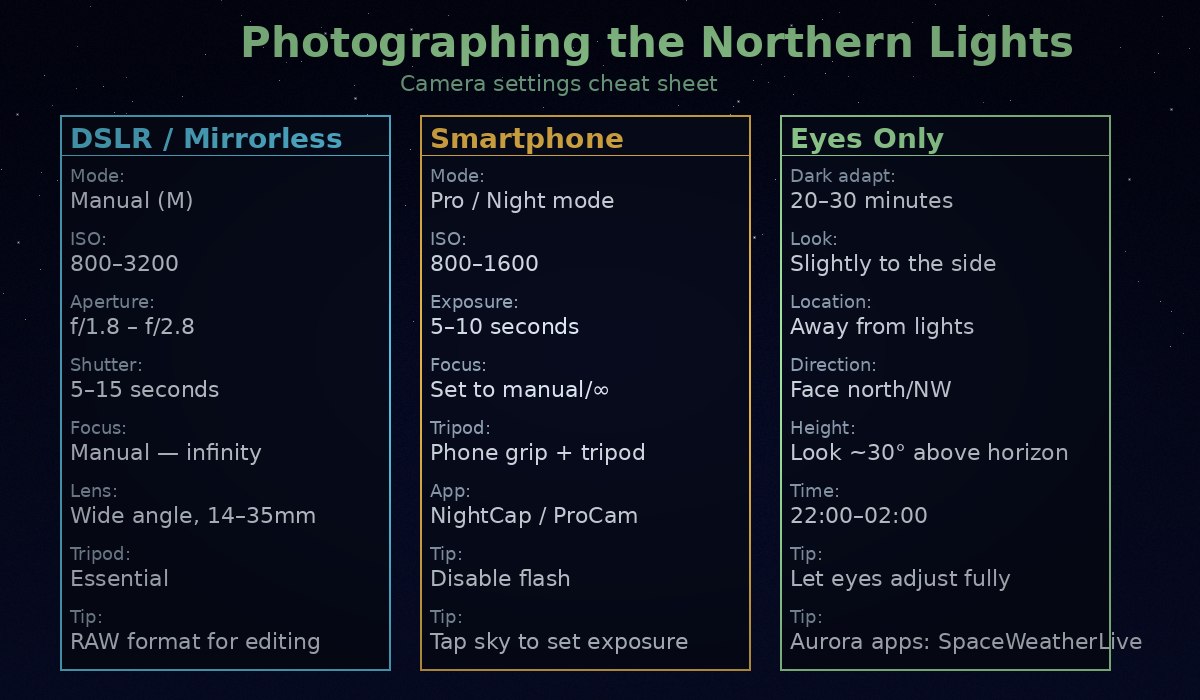
For a DSLR or mirrorless camera, the basic starting point is ISO 1600, aperture f/2, and a shutter speed of 10 seconds — then adjust from there. Shoot in RAW if you can, as it gives you far more latitude when pulling out the greens and purples in post. A wide-angle lens (14–35mm) maximises how much of the sky you capture, and a tripod is non-negotiable at these shutter speeds.
For smartphones, open your camera app's Pro or Night mode, set the exposure to around 8 seconds, and focus manually to infinity. Place your phone on something stable — a wall, a rucksack, or a small tripod. Samsung, iPhone, and most modern Android phones are capable of capturing a striking aurora image in these conditions.
How to Watch With Just Your Eyes
You do not need any equipment to enjoy the northern lights. But your eyes do need time. After arriving at your dark-sky location, resist the urge to check your phone — every time you look at a bright screen, you reset the dark adaptation clock back to zero. Give yourself a full 20–30 minutes of genuine darkness and you will be surprised at how much more you can perceive.
The aurora often appears first as a whitish haze or an arc sitting just above the northern horizon — people sometimes mistake it for distant cloud or light pollution. Watch for movement. Genuine aurora shifts, ripples, and occasionally dances rapidly. The green colour becomes much more obvious once the display intensifies.
One useful trick: look slightly to the side rather than directly at where you expect the aurora to be. The rods of the eye — responsible for low-light vision — are more densely packed away from the direct line of sight, so averted vision often reveals faint structure that stares straight at you without revealing itself.
How to Stay Updated
Aurora forecasts can change rapidly as the CME approaches and its exact parameters become clearer. The best sources to bookmark right now are the SpaceWeatherLive aurora alert page, the NOAA Space Weather Prediction Center, and the Met Office space weather forecast, which now includes regular aurora probability updates for UK latitudes.
For mobile alerts, the SpaceWeatherLive app (iOS and Android) lets you set a Kp threshold notification — set it to Kp 5 and it will ping you the moment conditions hit the level needed for northern England. That way you do not need to stay up watching a website.
Good luck out there — and if you manage to capture something, it is always worth sharing to the @watchthestarsuk Instagram.