Key Takeaways
- A metallic sphere roughly football-sized and weighing ~2kg landed in Buga, Colombia on 2 March 2025 after being filmed flying erratically over the town.
- X-ray analysis revealed three concentric metal layers, nine internal microspheres, and no visible welds or joints anywhere on the surface.
- Controversial ufologist Jaime Maussan controls the object, raising significant credibility concerns — the same figure behind the debunked 'Nazca alien mummies'.
- Mainstream scientists including Stanford's Dr. Garry Nolan assess it as '99% likely a terrestrial artifact', while others suggest it may be elaborate art.
- Until independent labs analyse it under peer-reviewed conditions, the Buga Sphere remains genuinely unexplained — but healthy scepticism is warranted.
📑 Table of Contents
The Day a Sphere Fell on Buga
On the morning of 2 March 2025, residents of Buga — a colonial city in Colombia's Valle del Cauca department, roughly 70 kilometres north of Cali — reported something unusual moving through the sky. Multiple witnesses filmed a small, dark, spherical object behaving in a way that struck them as wrong. It wasn't drifting like a balloon. It moved with purpose, changing altitude abruptly, zigzagging, and occasionally pausing mid-flight before continuing in a new direction.
Within hours, the object came down in a field on the outskirts of town. A local resident named Jose Arias was among the first on the scene. What he found resting in a circular patch of scorched grass was a perfectly smooth metallic orb, roughly the size of a football. It was cold to the touch — witnesses described it as having "the temperature of a refrigerator" — and there was no apparent damage from its landing, no radiation, and no chemical residue detected in the surrounding soil.
Within days, the story had spread globally, and the object had been collected for analysis. The question everyone was asking: what exactly had landed in Buga?
What Does the Sphere Look Like?
The physical description of the Buga Sphere is, admittedly, striking. Based on reports from researchers who have handled or examined the object:
Size and weight: Roughly the size of a football (American), weighing approximately 2 kilograms (around 4.5 pounds). Some later reports claimed the weight had changed, which no independent source has verified.
Surface: Smooth metallic exterior with no visible seams, joints, or weld marks anywhere. The surface features a honeycomb-like texture under magnification, and most notably, a series of etched symbols covering parts of the exterior. These include geometric shapes — circles, triangles, crescent-like figures, and what some researchers have described as unknown alphabetic characters that don't correspond to any known writing system.
Colour and temperature: Described as silver-grey metallic. It was ice-cold on discovery, which is unusual if it had been travelling through the atmosphere at speed.
No radiation: Multiple independent checks found no radiation signature, ruling out any nuclear or radioactive material.
Video Evidence From the Scene
Several videos emerged in the days following the sighting. The most widely shared shows a woman filming from what appears to be a residential street, pointing her finger toward a small dark object hovering against an overcast sky. The object is distant and small in frame — it's impossible to make out surface details — but its behaviour is clearly not consistent with a weather balloon or a casual drone flight. It appears to hover, move laterally without obvious wind-driven drift, and then change direction.
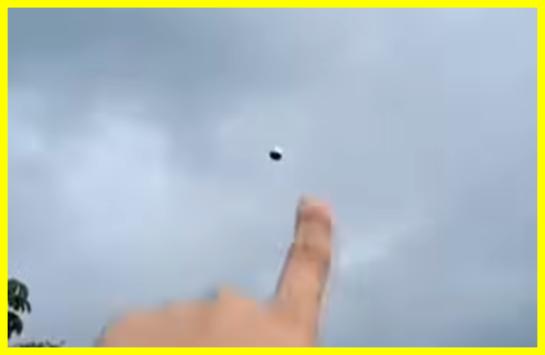
What the videos do not show — and this is important — is any clear footage of the object's recovery, or of the sphere sitting on the ground at the impact site before it was collected. The scorched grass was photographed, and the object was swiftly taken by what witnesses described as a small group including local researchers. No government agency or official authority appeared to take custody of it.
What the X-Rays Showed
The most technically interesting claims about the Buga Sphere come from a radiologist named José Luis Velázquez, who was given access to the object for preliminary analysis. His X-ray examination reportedly revealed:
Three concentric layers: The sphere is not solid. X-rays show it consists of three distinct metal-like layers nested inside one another, with no obvious mechanical joining between them.
Nine microspheres: Inside the outermost layer, nine smaller spherical objects are arranged symmetrically around a central nucleus. Velázquez described this geometry as difficult to achieve with conventional manufacturing techniques.
No welds or joints: Velázquez stated emphatically that there are no weld marks or joined parts visible anywhere in the structure — not on the exterior surface and not in the internal architecture revealed by X-ray.
Fibre optic content: A later, more detailed technical report claimed to find 52 fibre-optic filaments of varying diameters inside the object, reportedly comprising around 42% of its internal composition.
Titanium-based alloy: A portable spectrometer analysis allegedly identified the exterior as a titanium-based alloy. Some sources have claimed elements were present that are "not on the periodic table", though this claim has not been independently verified and should be treated with considerable scepticism.
It is worth emphasising that none of these findings have been published in a peer-reviewed scientific journal. All analysis so far has been conducted by researchers associated with, or given access by, the object's current custodians.
The June 2025 Press Conference
On 20 June 2025, a press conference was held to present the initial findings to a wider audience. The event was organised by Jaime Maussan, a Mexican television journalist and longtime ufologist, and featured appearances by Dr. Steven Greer — founder of the Disclosure Project and a major figure in American UAP activism — alongside U.S. Congressman Eric Burlison, who has been actively involved in Congressional UAP oversight hearings.
The press conference presented the sphere as a sophisticated technological device of potentially non-human origin, citing the X-ray findings and the claimed absence of manufacturing seams. Carbon-14 dating was mentioned, with a claim that organic material associated with the sphere dated to approximately 12,500 years ago — though no documentation from any accredited institution has been produced to support this specific claim.
A second, more detailed report was presented on 30 May 2025, concluding that the object is "a sophisticated technological device." This report remained under the control of Maussan's team.
Why Jaime Maussan Is a Red Flag
Here is where serious caution is required. Jaime Maussan is not a scientist. He is the host of Tercer Milenio (Third Millennium), a long-running Mexican television programme dedicated to UFOs, paranormal events, and fringe science. He has a documented track record of presenting objects and claims as extraterrestrial that were subsequently debunked.
Most infamously, in September 2023, Maussan presented two small mummified figures before Mexico's Congress, claiming they were "non-human beings" discovered in Peru. The objects — widely referred to as the "Nazca alien mummies" — were later analysed by independent scientists and found to be assemblages of human and animal bones, consistent with artificially modified ancient remains rather than any genuinely unknown biological entity. The episode was an embarrassment for serious UAP research and undermined the credibility of legitimate investigators.
The fact that the Buga Sphere is currently under Maussan's control, has not been submitted to any major research institution for independent analysis, and is being presented at self-organised press conferences rather than through peer-reviewed channels, follows a familiar pattern. That does not automatically mean the object is fake — but it does mean extraordinary caution is warranted before accepting extraordinary claims.
Dr. Julia Mossbridge, a physicist at the University of San Diego who reviewed publicly available information about the sphere, was direct: "It looks so human made to me." She suggested the object may be "a really cool art project" and recommended that anyone serious about its origins submit it to rigorous independent analysis through organisations like the Galileo Project before drawing any conclusions.
What Sceptics Say
The mainstream scientific view is concisely captured by Dr. Garry Nolan, an immunologist and Stanford University professor who has analysed numerous alleged UAP materials over the years. Nolan assessed the Buga Sphere as being "99% likely to be a terrestrial artifact."
His reasoning centres on the materials identified: fibre optics, titanium alloys, and geometric internal structures are all within the realm of current human manufacturing technology. The techniques of superplastic forming and magnetic pulse welding — both in commercial use — can produce seamlessly joined metallic objects with no visible seam. The honeycomb surface texture and etched symbol-like patterns are also achievable with precision CNC machining or electro-etching.
The hypothesis floated by Mossbridge and others is that the Buga Sphere may be a deliberately constructed art object designed to test how people respond to apparent anomalies — a kind of social experiment about belief, media, and the UAP community. It would not be the first time such a thing has happened; the phenomenon of hoaxed "UAP artefacts" has a long history in Latin America particularly.
Other possibilities that haven't been ruled out:
A drone component or experimental device. The Valle del Cauca region, like much of Colombia, has seen significant expansion in aerial drone use for both agricultural and surveillance purposes. A sphere with internal microspheres and fibre optics is consistent with an advanced sensor payload or experimental airborne system.
A marketing stunt. Some analysts have noted that the timing, spectacle, and media saturation of the Buga Sphere story bears hallmarks of a carefully managed rollout. The object's association with high-profile figures like Greer and Maussan ensures maximum global coverage.
Genuine unknown technology. This remains on the table — the least likely explanation given current evidence, but not one that can be definitively eliminated without independent analysis.
The Verdict: Where Does This Leave Us?
The Buga Sphere is a genuinely interesting case that deserves serious attention — and serious scrutiny in equal measure.
The object exists. Multiple witnesses filmed it in flight. A physical object was recovered. It has been subjected to some form of technical analysis. These are real data points that separate it from a pure fabrication.
What is missing is everything that would allow a reliable conclusion to be drawn. The sphere has not been submitted to an independent, accredited laboratory. No peer-reviewed paper has been published. The carbon dating claim lacks documentation. The "elements not on the periodic table" claim has not been substantiated. Every analysis so far has been filtered through Maussan's organisation.
The UAP Research community would benefit enormously from the object being submitted to institutions like the Galileo Project, the Scientific Coalition for UAP Studies, or a university materials science department with no prior involvement in the case. Until that happens, the Buga Sphere sits in an uncomfortable middle ground: too anomalous to dismiss outright, but too poorly documented — and too associated with a figure of questionable credibility — to accept at face value.
What we can say with confidence is that something landed in Buga on 2 March 2025. What it was, and where it came from, remains genuinely unknown.
Are you following UAP disclosures? Read our analysis of The Truth Behind Trump and UFO Disclosure and explore how religious belief systems may be influencing the pace of official transparency.