Key Takeaways
- 3I/ATLAS is only the third interstellar object ever detected — and the most chemically complex by far.
- NASA's Swift Observatory detected water vapour pouring off it at 40 kilograms per second — the first water ever found in an interstellar visitor.
- ALMA found it contains more methanol than almost any comet in our own solar system, a 'fingerprint from another star system'.
- JWST detected deuterated water with a ratio three times higher than Earth's oceans, hinting at a very different origin environment.
- On 16 March 2026 (this Sunday), it passes within 53.6 million km of Jupiter before heading permanently out of our solar system.
📑 Table of Contents
What Is 3I/ATLAS?
In the entire history of astronomy, we have detected exactly three objects that did not originate in our solar system. The first, 'Oumuamua, slipped through in 2017 — a strange, elongated, tumbling rock that puzzled scientists for years because it showed no sign of outgassing. The second, Borisov, arrived in 2019 — a more conventional comet that felt almost familiar. And then, in July 2025, came 3I/ATLAS.
The "3I" designation is shorthand for the third interstellar object. Unlike its two predecessors, 3I/ATLAS has turned out to be a scientific goldmine. It carries water ice. It is saturated with an organic molecule called methanol in concentrations that don't exist in any comet we've studied from our own solar system. It has a chemical signature — a ratio of deuterium to hydrogen — that marks it as unambiguously foreign. And before it disappears permanently from the reach of our telescopes, it has one more act to perform: this Sunday, 16 March 2026, it passes Jupiter.
Discovery: Caught by a Sky Survey in Chile
3I/ATLAS was first spotted on 1 July 2025 by the ATLAS (Asteroid Terrestrial-impact Last Alert System) survey telescope operating in Rio Hurtado, Chile. ATLAS is a NASA-funded sky survey designed primarily to catch asteroids that might threaten Earth — yet on this occasion it netted something far more extraordinary.
The moment astronomers examined its orbital path, it was clear this was no ordinary comet. Its trajectory was wildly hyperbolic, meaning it was travelling far too fast to have come from anywhere in our solar system. It had not swung in from the Oort Cloud. It had not looped around Jupiter. It had arrived from interstellar space, and it was passing through.
Within days, observatories around the world — and in orbit — swung to face it.
Speed, Size and Trajectory
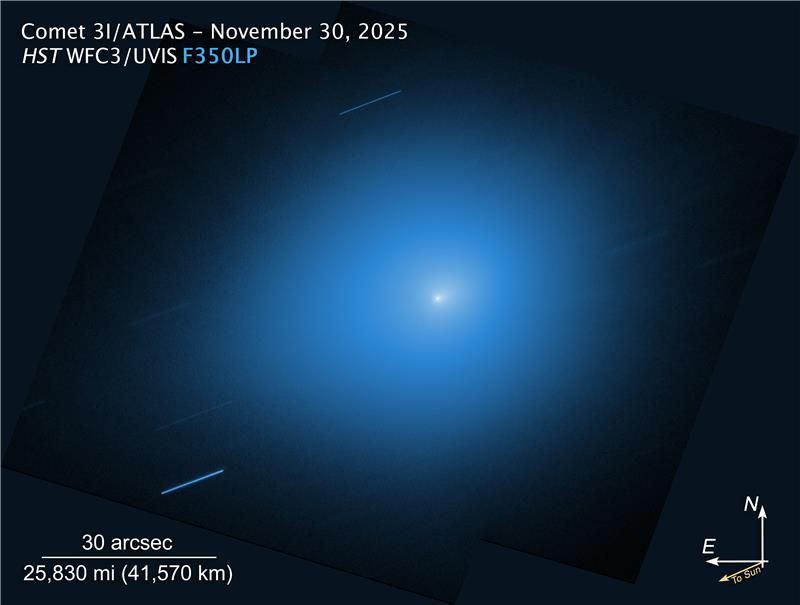
At the moment of discovery, 3I/ATLAS was travelling at roughly 137,000 miles per hour (221,000 km/h). As it was drawn closer to the Sun by gravity, that speed increased to around 153,000 mph (246,000 km/h) at perihelion — its closest approach to the Sun — on 30 October 2025. To put that in perspective, the fastest human-made object ever launched, the Parker Solar Probe, has reached around 430,000 mph near the Sun; but Parker had the benefit of multiple gravity assists over years. 3I/ATLAS arrived from the void at that speed on its own.
The nucleus — the solid icy core at the centre of the coma — is estimated to be somewhere between 440 metres and 5.6 kilometres across. That's a wide uncertainty, but it reflects the challenge of measuring something so bright in its own outgassed envelope. At closest approach to Earth on 19 December 2025, it came within 1.8 astronomical units (roughly 170 million miles). At no point did it pose any risk to our planet.
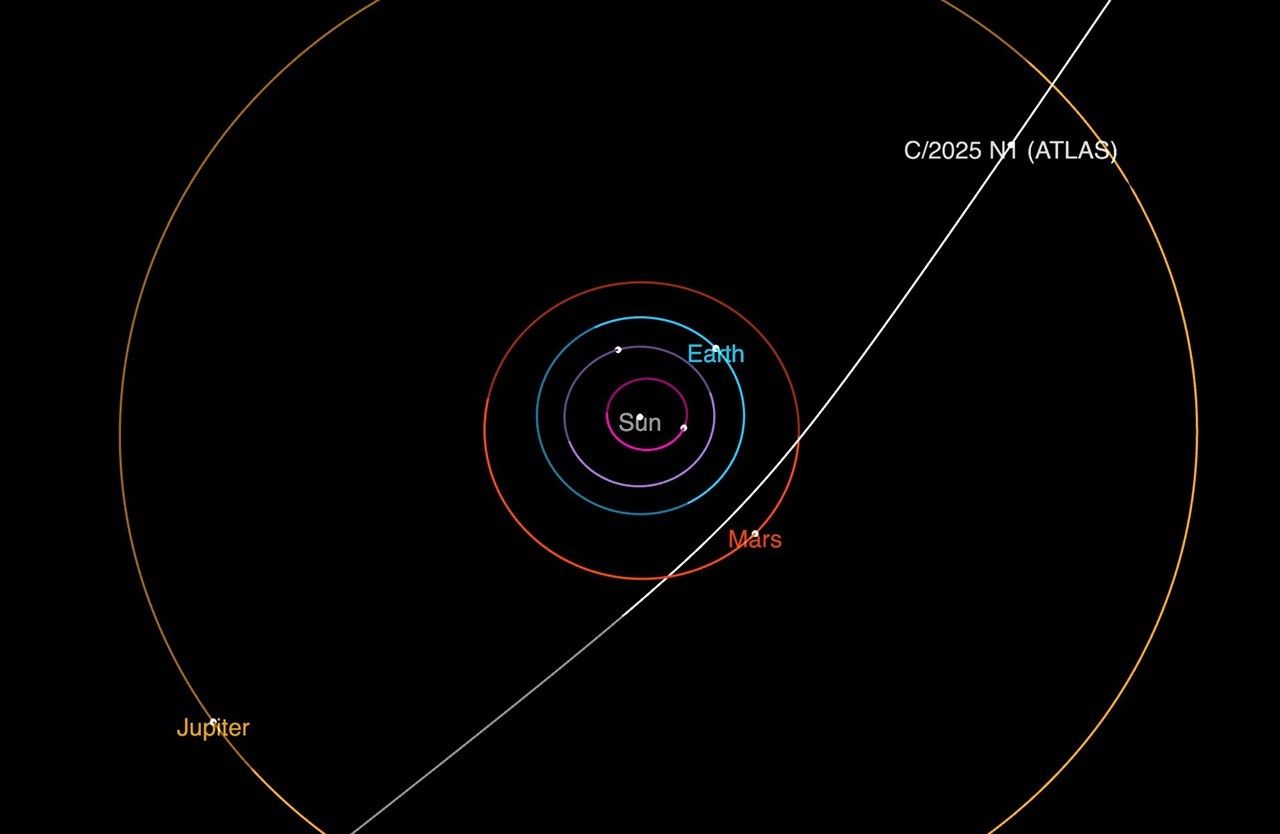
Its path is an open hyperbola. Unlike the elliptical orbits of solar system comets, it will not return. Once it passes Jupiter this Sunday, it will accelerate outward and vanish permanently into the dark between the stars.
Water From Another Solar System
The single most significant finding from 3I/ATLAS — at least in terms of what it might mean for life in the universe — was made by NASA's Neil Gehrels Swift Observatory.
Swift observed the comet in July and August 2025 using its Ultraviolet/Optical Telescope. Ground-based telescopes cannot detect the ultraviolet signatures of water vapour because Earth's atmosphere absorbs them, but Swift operates above all that. What it found was hydroxyl (OH) — the chemical byproduct of water vapour breaking down in sunlight. At the time of observation, 3I/ATLAS was ejecting approximately 40 kilograms of water per second. That's roughly equivalent to a fully opened fire hose. And it was doing this at a distance nearly three times further from the Sun than Earth — far enough out that most solar system comets would barely be stirring.
This was the first time water had ever been detected in an interstellar object.
Dennis Bodewits of Auburn University put it simply: "When we detect water, we're reading a note from another planetary system." Lead researcher Zexi Xing went further: "Each one is rewriting what we thought we knew about how planets and comets form around stars."
The significance here is hard to overstate. Water is one of the fundamental prerequisites for life as we understand it. Finding it in a comet that formed around a completely different star — in a solar system we will never visit — tells us that water-bearing bodies are not a quirk of our particular corner of the galaxy.
Packed With Alien Alcohol
If the water discovery wasn't enough, the Atacama Large Millimetre Array (ALMA) in Chile added another remarkable chapter. When ALMA turned its 66 radio telescopes toward 3I/ATLAS, it found the comet is saturated with methanol — an organic molecule that is essentially a simple alcohol.
The methanol-to-hydrogen cyanide ratio measured by ALMA sits between 70 and 120, placing 3I/ATLAS among the most methanol-rich objects ever studied — more methanol-rich than almost any comet in our own solar system. Lead researcher Nathan Roth described it plainly: "It's bursting with methanol in a way we just don't usually see in comets in our own solar system."
For planetary scientists, this isn't just a curiosity — it is a diagnostic. Methanol forms in the icy mantles of dust grains in the cold outer regions of a forming solar system. The extraordinary concentration in 3I/ATLAS suggests it spent a very long time in a cold, chemically rich environment, possibly the outer disc of a star far larger or more active than our Sun. As Roth put it, the ALMA findings represent "a fingerprint from another solar system" — a chemical signature baked into this object billions of years ago, when it first solidified around a star we will never identify.
What JWST and SPHEREx Found
Two of NASA's newest observatories have also trained their instruments on 3I/ATLAS, adding further layers to an already extraordinary picture.
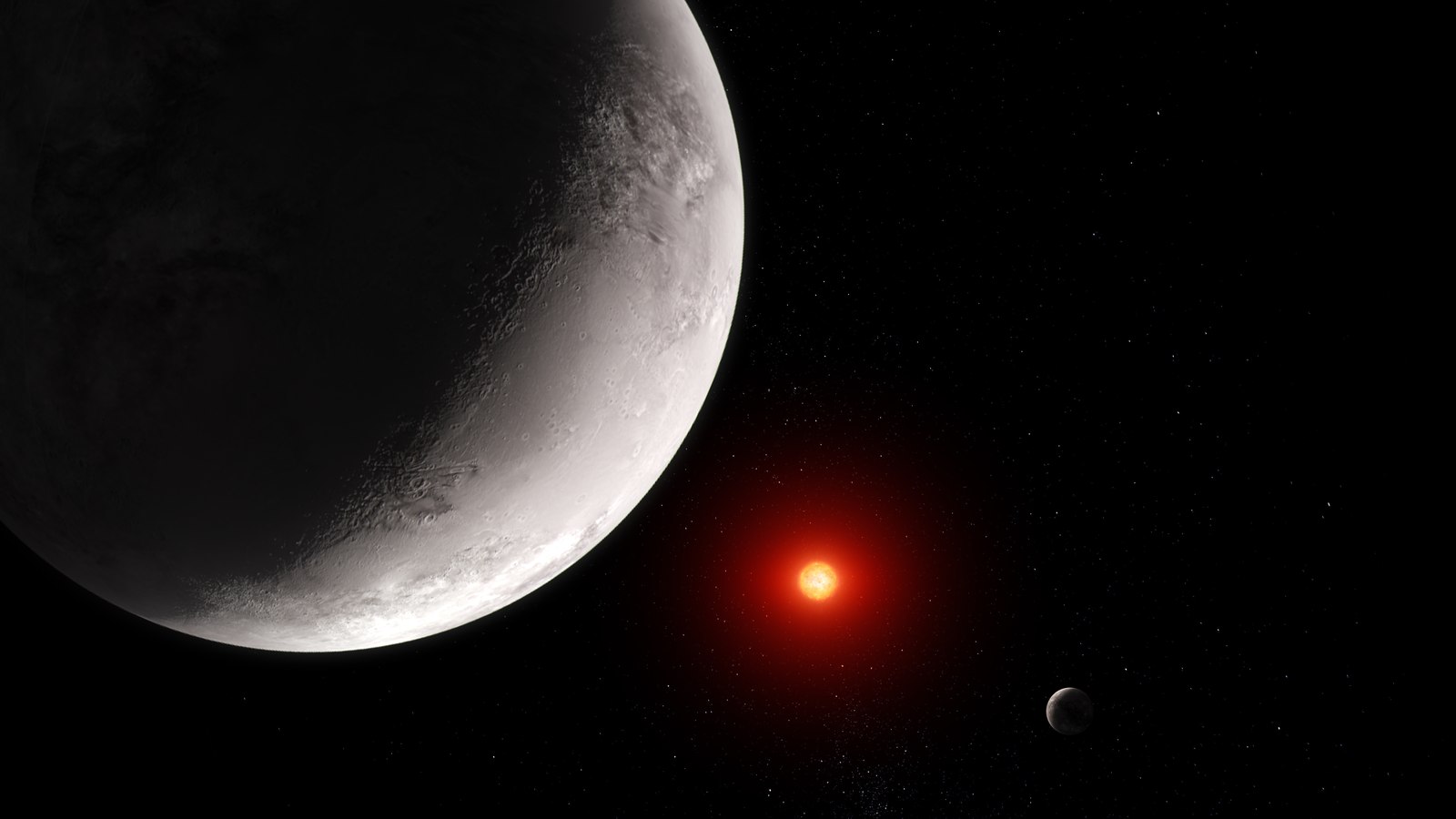
The James Webb Space Telescope observed the comet in late January 2026 and detected something extraordinary: deuterated water (HDO). Deuterium is a heavy isotope of hydrogen, and the ratio of deuterium to ordinary hydrogen (known as the D/H ratio) in a comet's water is one of the most reliable ways of tracing where it formed. In our solar system, the D/H ratio in comets varies but clusters around a known range. In 3I/ATLAS, JWST measured a D/H ratio roughly three times higher than found in Earth's ocean water — well outside the range of any solar system comet studied. It is another unmistakable sign that this object formed under conditions utterly unlike those that shaped our own neighbourhood.
Meanwhile, NASA's SPHEREx mission — launched in early 2025 specifically to map the infrared sky — tracked 3I/ATLAS from December 2025 onward, detecting emissions from dust, water, organic molecules, and carbon dioxide in the coma. The Keck Observatory, pre-perihelion, measured an unusual nickel-to-iron ratio of 3.2, compared to the solar system average of roughly 1.0 — yet another alien fingerprint.
Between them, Swift, ALMA, JWST, SPHEREx and Keck have given us more information about 3I/ATLAS than we have about many comets that formed right here in our own solar system.
The Jupiter Flyby: This Sunday
On 16 March 2026 — this coming Sunday — 3I/ATLAS will make its closest pass of Jupiter, approaching within 0.358 AU (approximately 53.6 million kilometres) of the gas giant.
Jupiter's gravity won't capture the comet or significantly alter its escape from the solar system, but the flyby has two important effects. First, the tidal forces of Jupiter's immense gravitational field could trigger fresh outbursts of activity from the comet's nucleus, potentially brightening it temporarily and giving scientists a fresh opportunity to study its chemistry. Second, precise tracking of the gravitational deflection will allow astronomers to refine their estimates of the comet's mass and density — two values that are extremely difficult to measure directly.
NASA's Juno spacecraft, currently in orbit around Jupiter, may be able to capture imagery of 3I/ATLAS during the closest approach, which would make this the first time an interstellar object has been photographed from within the orbit of another planet.
After the Jupiter flyby, the timeline for observation is short. The comet will fade below magnitude 18 by late April 2026, ending amateur observation opportunities. Within a few years, it will be beyond the reach of even the largest ground-based telescopes.
What It Tells Us About Other Solar Systems
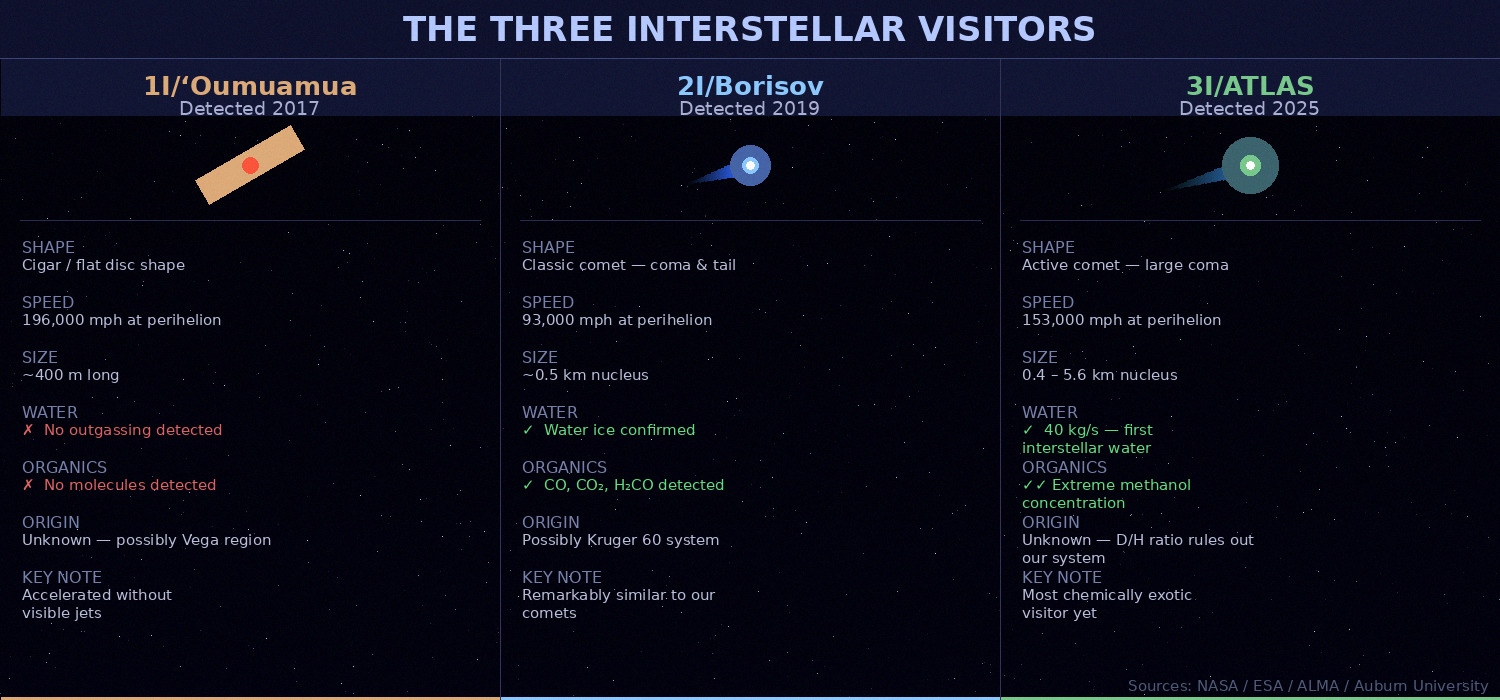
We have now observed three interstellar visitors: 'Oumuamua, Borisov, and 3I/ATLAS. Each has been startlingly different from the others.
'Oumuamua showed no outgassing at all, had a weird elongated or flat disc shape, and was accelerating in a way that water-ice sublimation couldn't fully explain. It behaved like nothing we'd seen before, and even now scientists debate its true nature. Borisov, by contrast, was remarkably similar to our solar system's comets — almost reassuringly normal. 3I/ATLAS is a third data point entirely: rich in water, saturated with organics, chemically extreme, and clearly the product of a very different formation environment.
The fact that all three are different tells us something important: the variety of chemistry that can produce planetary systems is enormous. The ingredients for water — and therefore potentially for life — exist in at least some other solar systems. The molecular building blocks for organic chemistry exist in others. We are not looking at our neighbourhood and assuming it is unique; we are now receiving physical samples from the broader galaxy, and they are confirming that the universe is chemically rich in ways we had hoped but not proven.
As Zexi Xing put it, "each one is rewriting what we thought we knew."
Can You See It From the UK?
The honest answer is: not easily. As of March 2026, 3I/ATLAS shines at around magnitude 16.7 — far beyond the reach of the naked eye (which tops out around magnitude 6) and binoculars (around magnitude 10). Even a standard amateur telescope will struggle.
To observe it, you'd need a telescope with at least an 8-inch (200mm) aperture, a CCD or CMOS camera attached, and the patience to stack multiple long-exposure frames in software. With that setup, the comet is currently in the constellation Gemini, near the stars Castor and Pollux, at coordinates roughly RA 7h 15m, Dec +22°. It is approximately 3.5 AU from the Sun and moving away from us at about 58 km/s.
If you do have the equipment, this Sunday's Jupiter flyby is the last significant event in the comet's inner solar system journey. After April 2026, observation windows will close, and 3I/ATLAS will fade into the dark — carrying its alien chemistry back to the interstellar medium from which it came.
For most of us, the science itself is the spectacle. A comet born around another star, carrying its water and its alcohol and its deuterium ratios across light-years of empty space, dropping into our solar system for a brief visit and then departing forever. The universe, it turns out, sends messages. We just need to know how to read them.