Key Takeaways
- Two peer-reviewed papers published in Nature's Scientific Reports and the Publications of the Astronomical Society of the Pacific found anomalous transient objects in 1950s Palomar sky survey photos
- The mysterious light flashes appeared years before Sputnik — when no human-made orbital objects existed
- Transients were 45% more likely to appear within 24 hours of an above-ground nuclear test
- One alignment of objects showed 3.9 sigma statistical significance — well above the threshold for scientific credibility
- Researchers say they've ruled out many prosaic explanations, and cannot rule out artificial objects of unknown origin
📑 Table of Contents
The Photographs That Started It All
In the late 1940s and throughout the 1950s, astronomers at the Palomar Observatory in California were doing something remarkable: systematically photographing the entire northern sky on large glass photographic plates, building the most comprehensive map of the heavens ever attempted. They were looking for galaxies, nebulae, variable stars — the deep machinery of the universe.
They weren't looking for UFOs.
But buried in those plates, now digitised and searchable for the first time, something strange has turned up. Mysterious points of light — appearing and then vanishing — that don't match any known astronomical object. Objects that appeared in aligned formations. Objects that were present in one exposure and completely absent in the next.
And here is the detail that makes this story genuinely extraordinary: these photographs were taken before humanity had put a single object into orbit. Sputnik wasn't launched until 4 October 1957. Whatever these things were — they were moving through Earth's skies at a time when nothing artificial should have been up there at all.
Two peer-reviewed papers published in late 2025 have now drawn serious scientific attention to these anomalies. The conclusions are carefully worded, the scepticism is considerable, and the debate is fierce. But the researchers themselves say they cannot rule out that what they've found is evidence of artificial objects — of unknown origin — orbiting Earth more than seventy years ago.
The First Palomar Sky Survey
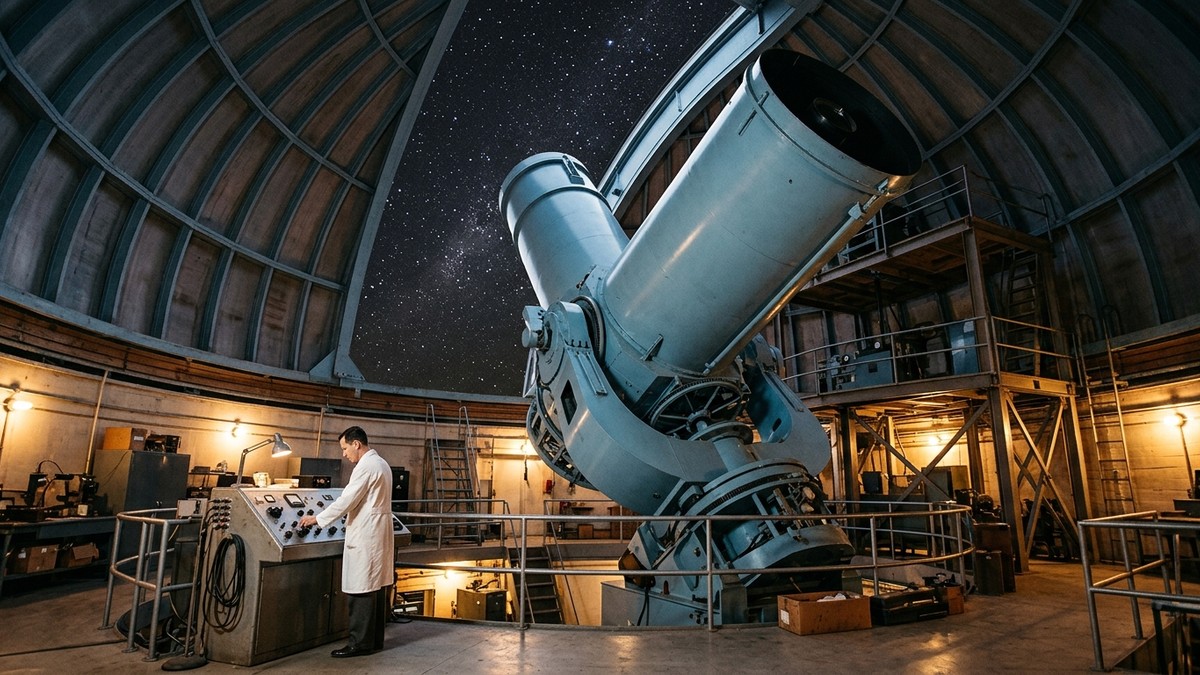
The Palomar Observatory sits atop Palomar Mountain in San Diego County, California — far enough from city lights, in the 1940s at least, to offer genuinely dark skies. Its centrepiece was the 48-inch Samuel Oschin Schmidt telescope, a wide-field instrument purpose-built for sky surveys. Starting in 1949 and continuing through 1958, the telescope was used to photograph the entire sky visible from the northern hemisphere, producing what became known as POSS-I: the First Palomar Sky Survey.
Each field of the sky was photographed twice — once on blue-sensitive plates, once on red-sensitive plates — to help identify different types of objects based on their colour. In total, the survey produced nearly 1,900 pairs of glass plates, each covering a 6.5° × 6.5° patch of sky. It was the most ambitious astronomical imaging project of its era, and it became the foundational reference map used by professional astronomers for decades.
Those original glass plates — fragile, irreplaceable, and historically precious — now live in the Palomar archive. Over the past decade, many have been digitised as part of the Digitized Sky Survey project, making them searchable by computer for the first time.
This is what allowed researchers to do something the original astronomers never could: systematically hunt through nearly a decade's worth of sky photographs looking for objects that appear in one exposure but not in another.
What the Researchers Actually Found
The research was led by Dr Beatriz Villarroel, an astronomer with affiliations at the Nordic Institute for Theoretical Physics and the Instituto de Astrofísica de Canarias, alongside Dr Stephen Bruehl, an anesthesiologist at Vanderbilt University Medical Center with a serious interest in anomalous phenomena research. Their team — fourteen researchers in total — published two companion papers almost simultaneously in October 2025.
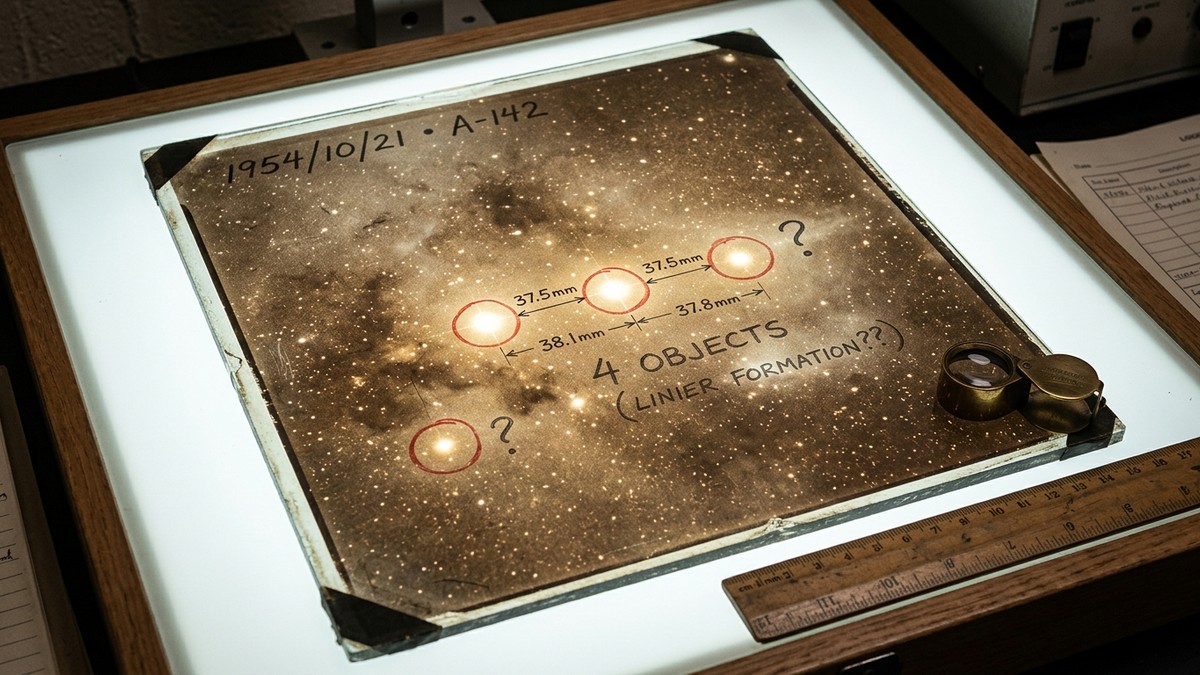
The first, appearing in the Publications of the Astronomical Society of the Pacific, documented what they called "aligned, multiple-transient events": cases where several brief point-like flashes appeared together along a narrow band of sky, then vanished completely. These alignments are particularly significant because they suggest objects moving in formation — not random noise or isolated plate defects. The most striking example showed 3.9 sigma statistical significance, a level that would be considered strong evidence in most fields of science.
The second paper, published in Scientific Reports (a Nature journal), took a broader look at the full catalogue of transient objects found in the Palomar plates — single flashes as well as grouped ones — and analysed their statistical relationship with two external datasets: the dates of above-ground nuclear tests, and historical UAP reports from the same era.
What they found was striking. The transients weren't randomly distributed across the nine years of plates. They clustered. They showed patterns. And those patterns correlated with things happening on the ground.
"We've ruled out some of the prosaic explanations," said Bruehl in comments reported by The Hill, "and it means we have to at least consider the possibility that these might be artificial objects from somewhere."
It's worth pausing on the phrase "from somewhere." The researchers are careful not to claim these were alien craft. What they're saying is that something artificial — something not in any catalogue, not matching any known astronomical phenomenon — appears to have been up there. And they don't know where it came from.
The Nuclear Testing Connection
One of the most provocative findings in the research is the correlation between the transient objects and nuclear testing.
Between 1945 and 1963, the United States and the Soviet Union conducted hundreds of above-ground nuclear weapons tests. Many of those tests took place at the Nevada Test Site, roughly 250 miles north of Palomar Observatory — close enough that the light from above-ground detonations was visible from Los Angeles on clear nights. The timing of these tests is precisely documented in public records, down to the day.
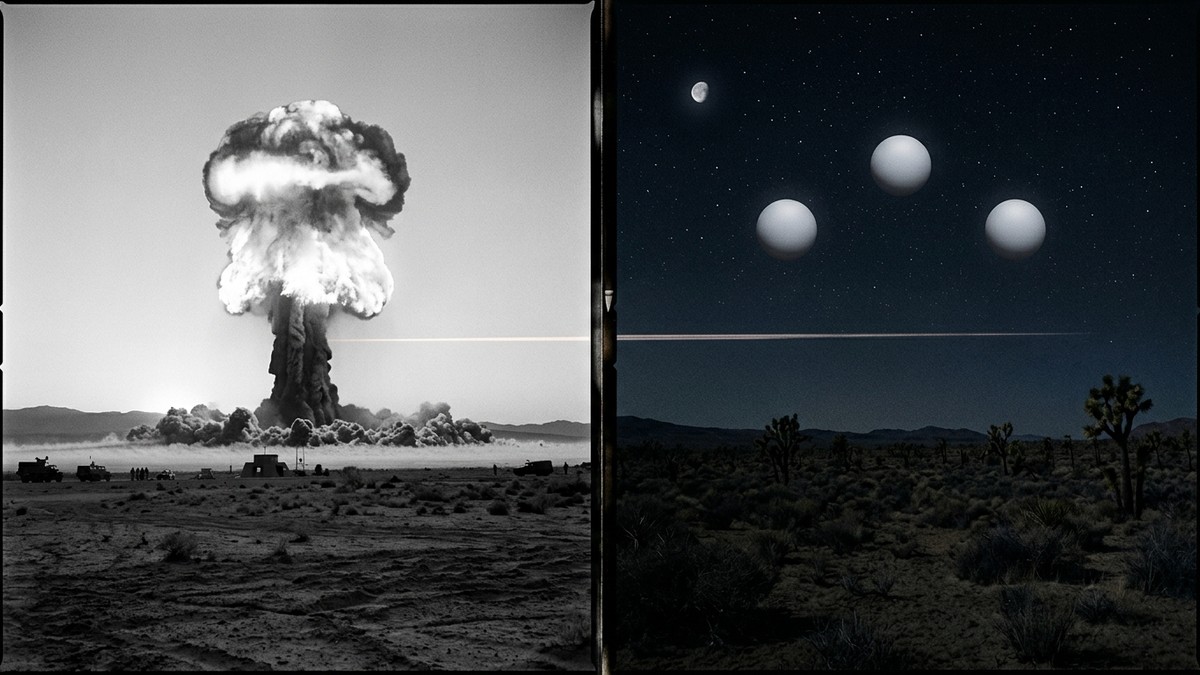
When Villarroel, Bruehl, and their team cross-referenced the dates of the Palomar transient detections against the nuclear test record, the correlation was striking: the transient objects were approximately 45% more likely to appear on dates within 24 hours of an above-ground nuclear test.
This is not a small effect. And it raises two very different interpretations.
The first is purely physical: nuclear detonations produce intense bursts of ionising radiation, electromagnetic pulses, and charged particle showers. Some of these effects reach the upper atmosphere and beyond. It is at least theoretically possible that extreme radiation events could affect photographic plates in unexpected ways, producing artefacts that look like transient objects — even though the plates were stored in shielded vaults and the exposures were taken in controlled conditions. Critics favour this explanation.
The second interpretation is more unsettling, and maps directly onto a pattern that UAP researchers have documented for decades: unidentified craft appear to be disproportionately interested in nuclear events. From the green fireballs over Los Alamos in 1948, to the UAPs over Malmstrom Air Force Base in 1967 (where missile launch sequences were reportedly disabled), to the RAF Woodbridge / Rendlesham Forest incident in 1980 (adjacent to a nuclear weapons storage facility), the overlap between unexplained aerial phenomena and nuclear infrastructure is one of the most consistent threads in UAP research.
The paper found that, for days with at least one detected transient, every additional UAP report on that date corresponded to an 8.5% increase in the number of transients identified. Whether that's a meaningful signal or a statistical artefact in imperfect historical data is exactly what is now being debated.
The Sceptics Respond
It would be dishonest to present this research without also presenting the significant scientific criticism it has received — and there is quite a lot of it.
Several physicists and astronomers have taken issue with both the methodology and the conclusions. Michael Wiescher, a nuclear physicist at the University of Notre Dame, has questioned whether nuclear test radiation could realistically cause the effects described, but also whether the team has adequately ruled out more mundane causes for the plate artefacts. Nigel Hambly, an astronomer at the Royal Observatory Edinburgh who has worked extensively with historical photographic surveys, has raised concerns about the quality of the image analysis and whether some transients might simply be plate defects, emulsion flaws, or optical artefacts.
Kevin Knuth, a physicist at the State University of New York at Albany who has himself published peer-reviewed UAP research, offered the bluntest assessment: the correlation with nuclear testing may be real but could reflect a shared confounding variable — for instance, periods of high Cold War activity may have led to both more nuclear tests and more unusual aircraft movements, both of which left different types of traces in different records.
The Metabunk forum — a respected venue for evidence-based sceptical analysis — has also posted detailed threads picking apart the statistical methodology, suggesting that the 3.9 sigma result may not be as robust as it appears once you account for the multiple comparisons made during the analysis.
None of this necessarily means the research is wrong. It means the research is contested, as good science often is at the frontier of knowledge. Both papers survived peer review — a process that, while imperfect, does filter out the most obvious errors. The editors of Scientific Reports and the Publications of the Astronomical Society of the Pacific are not known for publishing credulous nonsense.
What the sceptics are doing — correctly — is demanding a higher evidentiary bar before accepting an extraordinary conclusion. That's exactly how it should work.
Why This Matters Now
This research didn't emerge in a vacuum. It arrives at a moment when the official position on UAP has shifted more dramatically in a few years than in the previous seven decades.
In 2017, the US government admitted that the Pentagon had been running a secret UAP research programme. In 2021, the Office of the Director of National Intelligence released its first public UAP report, acknowledging 144 cases it could not explain. In 2023, whistleblower testimony to Congress included claims of recovered non-human craft and materials. In February 2026, President Trump issued a directive to declassify UAP files. And just last week, the House Oversight Committee heard testimony from Luis Elizondo — former director of the Pentagon's Advanced Aerospace Threat Identification Program — claiming that technologies "not manufactured by any known government" have been monitoring military and nuclear installations.
Against that backdrop, a peer-reviewed study finding evidence of anomalous aerial objects near nuclear test sites in 1950s photographic data feels less like fringe speculation and more like one more data point accumulating in an increasingly coherent picture.
The 1950s were, it bears remembering, the golden age of UFO sightings. Kenneth Arnold's famous "flying saucer" sighting over Mount Rainier was in 1947. The Roswell incident was in 1947. The green fireballs over New Mexico's nuclear facilities ran from 1948 through the early 1950s. The US Air Force ran Project Blue Book from 1952 to 1969, cataloguing thousands of reports — of which roughly 700 were officially classified as unexplained.
What Villarroel, Bruehl, and their team have done is go back to the physical record of that era — not eyewitness testimony, not classified documents, but hard photographic data taken by professional astronomers using calibrated scientific instruments — and found that something was happening in the sky above that period that we don't yet have a full explanation for.
What Happens Next
The research team has called for further investigation using modern digitisation technology and more sophisticated image analysis algorithms. Better software can distinguish between true astronomical transients and plate artefacts more reliably than human visual inspection or older scanning processes. If the transients survive that analysis, the case for genuine anomalous objects becomes considerably stronger.
Independent astronomers with access to the original POSS-I plates have been invited — implicitly, by the papers' publication — to attempt replication. In science, replication is everything. If other teams working independently find the same objects in the same places on the same dates, the phenomenon becomes very hard to dismiss.
Meanwhile, the UAP-nuclear connection highlighted in the research feeds directly into one of the most pressing questions in the current disclosure debate: if non-human craft have been monitoring our nuclear capabilities since the 1940s, what does that mean, and who — if anyone — knows about it? The congressional hearings happening right now in Washington are, at least in part, trying to answer exactly that question.
For now, what we have is this: glass plates made at one of the world's great observatories, in the decade when humanity first split the atom and first reached for space, show something anomalous that seventy years of subsequent astronomy haven't explained away. The researchers who found it are peer-reviewed scientists publishing in credible journals. The sceptics who challenge it are doing exactly what good science requires.
And somewhere in a Californian archive, those original glass plates still exist — each one a photograph of a night sky that, by rights, should have been completely empty of artificial objects, but apparently wasn't.
The two papers are published as "Aligned, Multiple-transient Events in the First Palomar Sky Survey" (Publications of the Astronomical Society of the Pacific, October 2025) and "Transients in the Palomar Observatory Sky Survey (POSS-I) may be associated with nuclear testing and reports of unidentified anomalous phenomena" (Scientific Reports, October 2025).