Key Takeaways
- Comet MAPS reaches perihelion at 14:22 UTC on 4 April — it is already visible in SOHO's LASCO C3 coronagraph at magnitude 4.2 and brightening.
- Three outcomes are possible: pre-perihelion breakup, survival followed by a naked-eye spectacle (magnitude −2 to −5), or post-perihelion fragmentation leaving a ghostly 15° dust tail.
- If it survives, UK observers should look low on the western horizon after sunset from 7–10 April onward — binoculars recommended, clear western horizon essential.
📑 Table of Contents
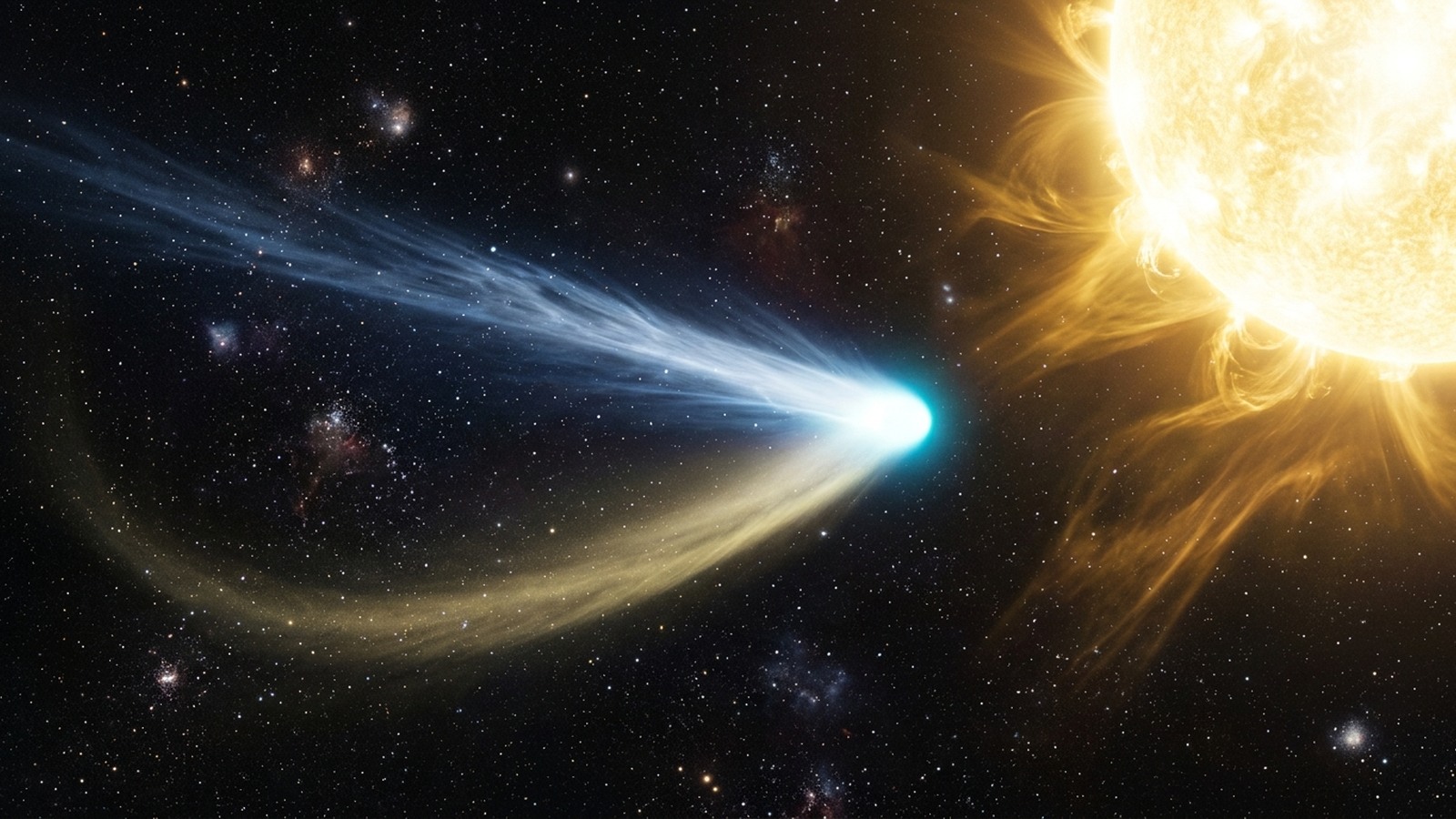
The clock is ticking for Comet MAPS.
At 14:22 UTC tomorrow (4 April 2026) — that is 15:22 BST — Comet C/2026 A1 (MAPS) will skim just 161,000 kilometres above the Sun's surface, travelling at roughly 500 km/s. Within hours, we will know whether it emerges as one of the brightest comets in years — or whether it quietly tears itself apart in the solar furnace.
Right now, the comet is already visible in data from the SOHO spacecraft, and it is brightening fast. Here is everything you need to know about what happens next — and how to spot MAPS if it makes it through.
SOHO Is Already Watching
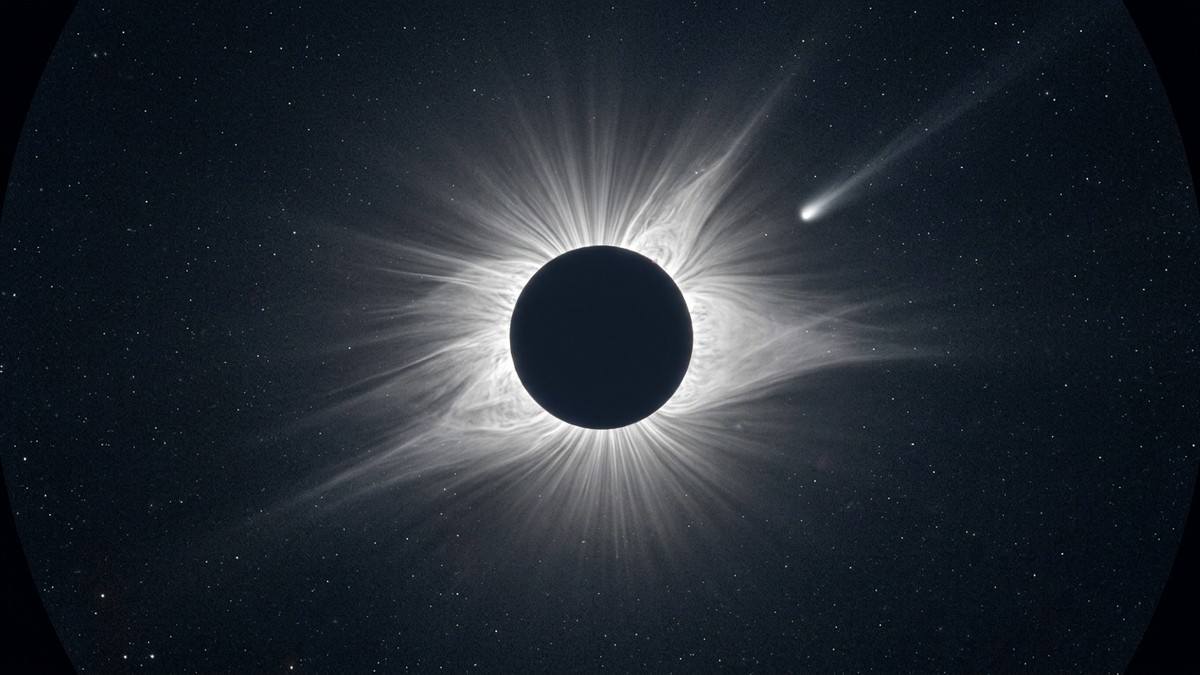
We cannot see Comet MAPS from the ground right now. It is lost in the Sun's glare, far too close to our star for any Earth-based telescope to pick it up safely. But we have the next best thing: spacecraft with coronagraphs — instruments that block the Sun's blinding disc and reveal what is happening in the space around it.
The ESA/NASA SOHO (Solar and Heliospheric Observatory) spacecraft has been tracking MAPS since 2 April, when the comet entered the field of view of its LASCO C3 coronagraph. By 3 April, it also appeared in the narrower-field CCOR-1 camera.
As of the latest LASCO C3 images, MAPS is at approximately magnitude 4.2 and still brightening — a steady, encouraging sign. For context, magnitude 4.2 is roughly the brightness of a faint naked-eye star, but remember that this measurement is being taken from space, close to the Sun's corona. The comet is performing broadly as expected for a Kreutz sungrazer of its size.
The critical hours begin tomorrow morning. As MAPS closes in on perihelion, its brightness should increase sharply — unless the nucleus breaks apart first.
The Three Scenarios
Astronomers are watching for three possible outcomes, each of which has happened to previous Kreutz sungrazers:
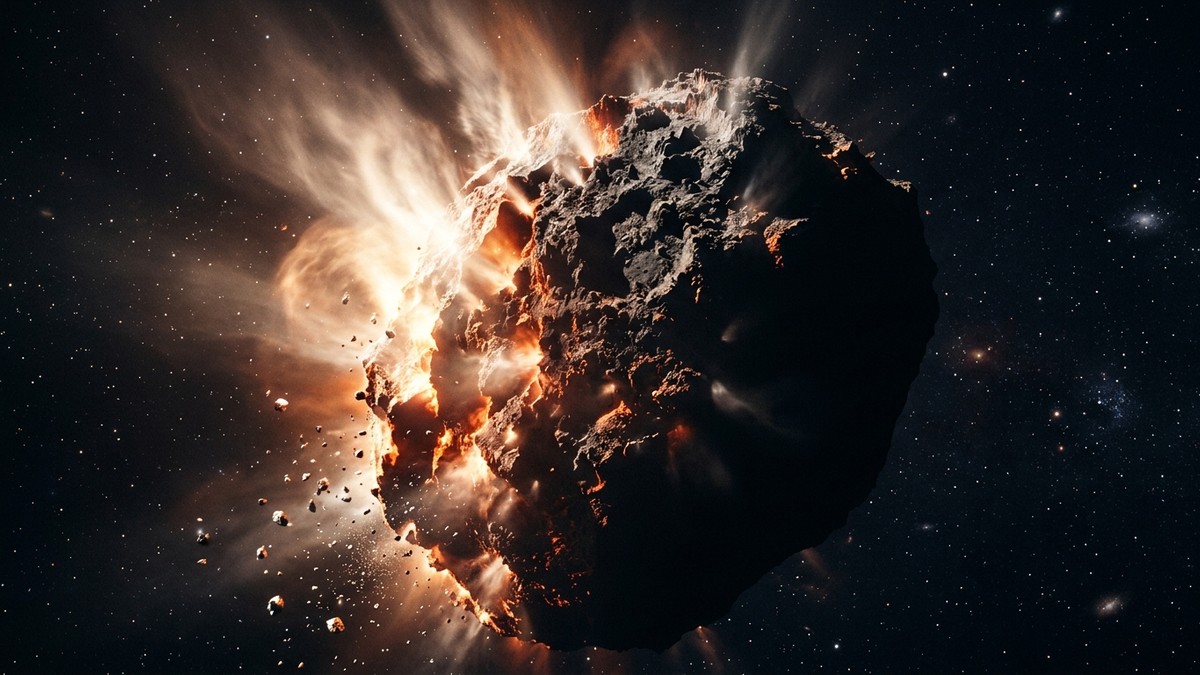
Scenario 1: Pre-perihelion breakup. The comet's nucleus crumbles before it even reaches closest approach, overwhelmed by the escalating heat and tidal forces. This is what happened to Comet ISON (C/2012 S1) in November 2013 — it brightened promisingly, then faded and disintegrated as it rounded the Sun. In SOHO imagery, ISON emerged as a diffuse smudge with no surviving core. If MAPS follows this path, we would see it fade and spread in the coronagraph images over the next 24 hours.
Scenario 2: Survival and spectacle. The nucleus holds together through perihelion and emerges on the other side, freshly outgassing and blazing with reflected sunlight. This is the Comet Lovejoy (C/2011 W3) outcome — in December 2011, Lovejoy survived a perihelion pass just 140,000 km from the solar surface (even closer than MAPS will go) and emerged with a magnificent tail visible to the naked eye from the Southern Hemisphere. If MAPS survives, it could reach magnitude −2 to −5 — brighter than Jupiter, potentially brighter than Venus — and become visible in the evening sky from around 7 April.
Scenario 3: Post-perihelion fragmentation. The nucleus technically survives perihelion but is fatally weakened. It emerges from behind the Sun and then breaks apart over the following days, producing a bright but headless dust tail stretching up to 15 degrees across the sky. This is actually what happened to Lovejoy eventually — it survived its perihelion passage but its nucleus fragmented within weeks.
All three scenarios will produce good SOHO footage. But only scenarios 2 and 3 give us something to look at from the ground.
Why the Nucleus Size Matters
The survival odds come down to one number: how big is the nucleus?
JWST measured MAPS at roughly 400 metres across. That is small — about the length of four football pitches laid end to end. A recent paper published by the American Astronomical Society raised concerns that a nucleus this size may not be large enough to survive. The general rule for Kreutz sungrazers is that a comet needs a nucleus radius of at least 2–3 km to virtually guarantee survival. Below that, it becomes a coin toss.
The hopeful comparison is Lovejoy, which had a similarly-sized nucleus (~400 m) and did survive — but only just. And Lovejoy passed slightly closer to the Sun's surface (140,000 km vs MAPS' 161,000 km), which means MAPS actually faces marginally less extreme conditions.
Against that: more than 5,000 Kreutz sungrazers have been discovered by SOHO since 1995. Apart from Lovejoy, none of them survived perihelion. Most were tiny — house-sized fragments that simply evaporated. MAPS is larger, but the historical record is sobering.
The lightcurve data from March has been mixed. MAPS brightened steadily to about magnitude 8.5 by late March, but with punctuating flare-ups and pauses — a pattern that can signal internal fracturing. Astronomers have noted that several previous sungrazers showed similar erratic brightness changes before disintegrating.
How to Watch the Perihelion Live
You can follow the perihelion passage in near-real time through SOHO's publicly available coronagraph images:
SOHO LASCO Real-Time Images: Visit soho.nascom.nasa.gov/data/realtime-images.html and look at the LASCO C3 and LASCO C2 cameras. C3 has the wider field of view; C2 will show the comet if it gets close enough to the Sun. New images are posted roughly every 20–30 minutes.
Helioviewer: The Helioviewer tool lets you browse SOHO imagery interactively, with zoom and overlay options.
Timeline:
- Now through tonight (3 April): MAPS visible in LASCO C3, brightening as it approaches. Watch for any sudden fading or spreading — that would signal breakup.
- 4 April, morning (UTC): The comet enters the LASCO C2 field of view for its closest approach to the Sun.
- 4 April, 14:22 UTC (15:22 BST): Perihelion. The moment of truth.
- 4 April, evening onwards: If MAPS survived, it should reappear in C2/C3 imagery on the other side of the Sun, moving away. A bright, compact coma means survival. A fading, diffuse cloud means it did not make it.
- 5–6 April: The comet exits the SOHO field of view. If it survived, ground-based observers in the Southern Hemisphere may catch a first glimpse very low in the western sky after sunset.
If It Survives: Your UK Observing Guide
If MAPS comes through perihelion intact, here is what to look for from the UK:
When to look: From approximately 7 April onwards, in the 30–45 minutes after sunset. The comet's angular distance from the Sun increases each evening — from about 7° on 5 April to 21° by 10 April — so patience pays off. Mid-April (12–17 April) should offer the best balance of brightness and sky separation.
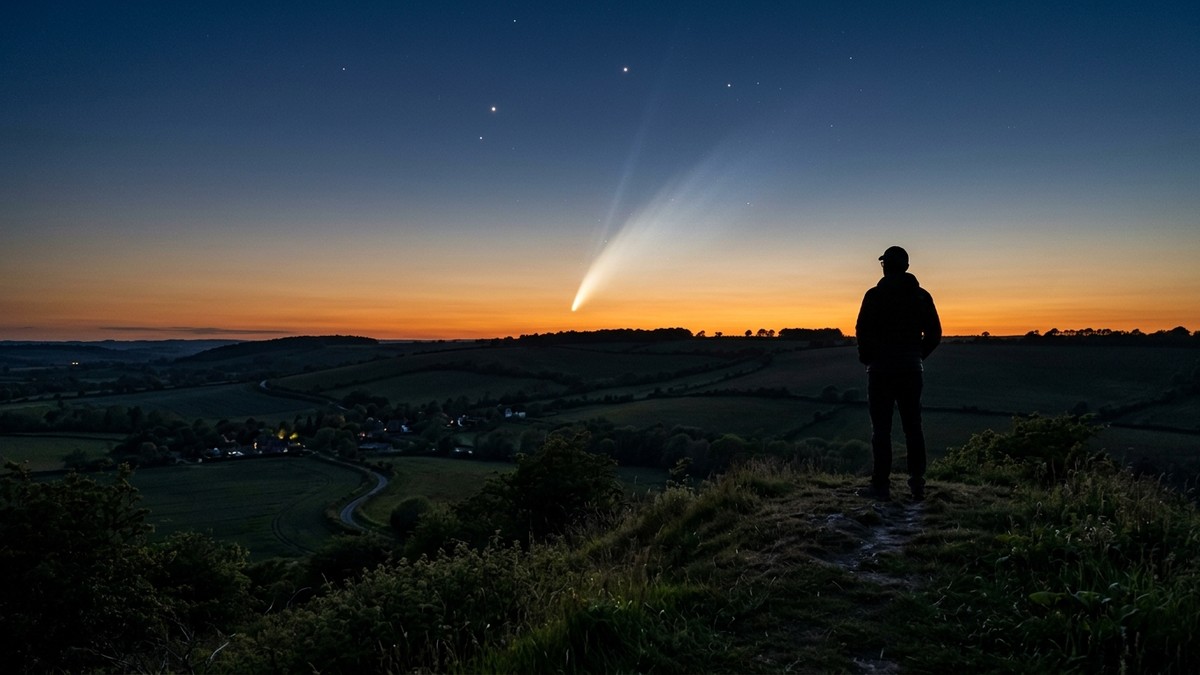
Where to look: Low on the western to west-southwest horizon. You need a completely unobstructed view toward the sunset point — hilltops, coastlines, and open fields are ideal. The comet will set roughly 30–40 minutes after the Sun.
What you will see: A fuzzy star-like object with a tail pointing upward and to the left (away from the Sun). In binoculars, the tail structure should be clearly visible. At its brightest, MAPS could rival Venus — you would not need any equipment at all.
Equipment: If MAPS reaches magnitude 0 or brighter, it is a naked-eye object. Binoculars (10×50 recommended) will dramatically improve the view. For photography, a camera on a tripod with a 50–200mm lens at ISO 800–1600, 2–8 second exposures, should capture the comet beautifully against the twilight.
Southern England advantage: The further south you are in the UK, the better your view. Cornwall, Devon, the Channel Islands, and the south coast have a few extra degrees of altitude to work with. From Scotland, it will be very challenging.
Safety warning: The comet will be close to the Sun in the sky, especially in the first few days after perihelion. Never point binoculars or a telescope toward the Sun — even at sunset, the concentrated light can cause instant, permanent eye damage. Wait until the Sun is fully below the horizon before scanning for the comet.
What to Watch For This Weekend
The next 72 hours will tell the story. Here is a quick guide to reading the tea leaves:
Encouraging signs: MAPS continues to brighten steadily in SOHO imagery through 3–4 April. After perihelion, a bright, compact coma appears on the outbound side. The comet maintains a well-defined head with a structured tail.
Warning signs: Brightness plateaus or drops before perihelion. The coma becomes elongated or diffuse — this suggests the nucleus is spreading out (fragmenting). After perihelion, only a faint smear or headless tail appears.
Whatever happens, this is a rare event. Kreutz sungrazers large enough to be observed from the ground come along perhaps once or twice a decade. MAPS has already given astronomers months of data — far more than most sungrazers, which are only spotted days before they meet the Sun.
If it survives, we could be looking at the best comet since NEOWISE in 2020 — possibly better, given the predictions of Venus-level brightness. If it does not, we will have watched a 2,000-year-old fragment of Aristotle's comet make its final journey.
Either way, keep an eye on those SOHO images tomorrow afternoon. And if you hear that MAPS made it through — get yourself to a hilltop with a clear western horizon.
We will update with the outcome as soon as it is known. Follow us on Instagram @watchthestarsuk for real-time updates.