Key Takeaways
- Comet C/2026 A1 (MAPS) will pass just 161,000 km from the Sun's surface on 4 April — close enough to be vaporised or emerge as a spectacular naked-eye comet.
- If it survives, MAPS could reach magnitude −2 to −5, rivalling Venus or brighter, and become visible in the evening sky from around 7 April — just in time for Easter.
- MAPS is a Kreutz sungrazer, part of a family of comets that all trace back to a single parent body that broke apart over 2,000 years ago.
📑 Table of Contents
There is a comet falling toward the Sun right now, and by this weekend we will know whether it becomes one of the most spectacular sights in the night sky this decade — or whether it quietly tears itself apart in the solar furnace.
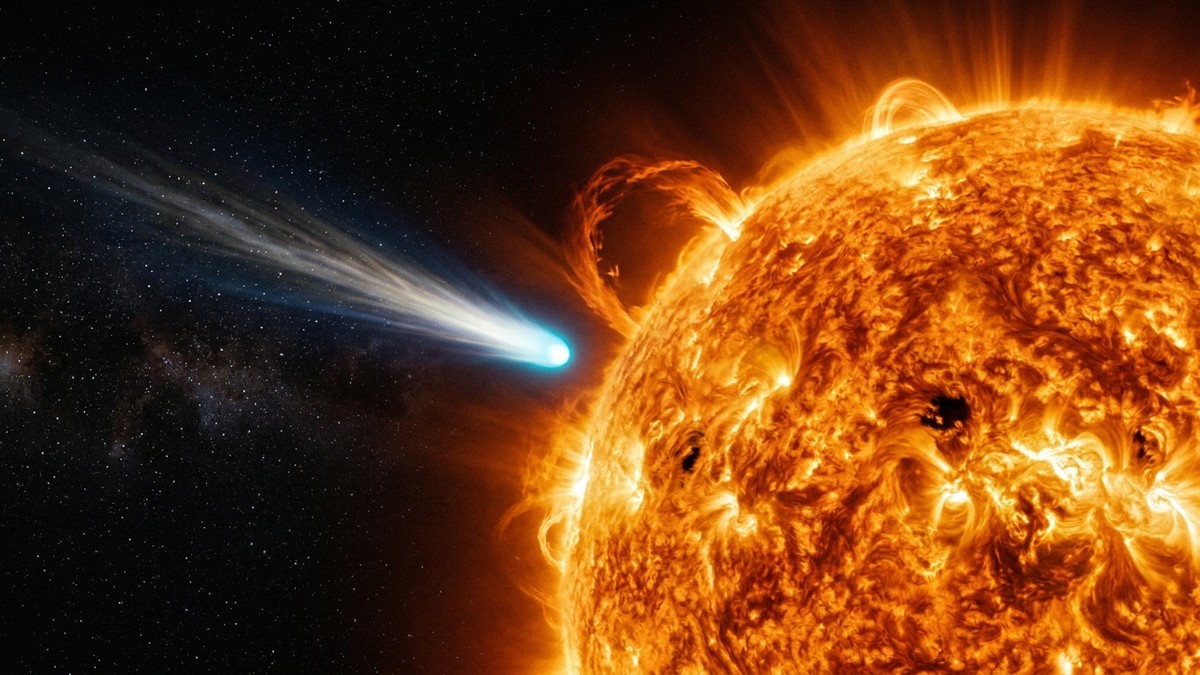
Comet C/2026 A1 (MAPS) reaches perihelion on 4 April 2026 at around 14:22 UTC, passing just 161,000 kilometres from the Sun's surface. To put that in perspective, the Sun is 1.4 million kilometres across — so MAPS will skim barely a tenth of a solar diameter above the photosphere. At that distance, surface temperatures on the comet's sunlit side will exceed 2,000°C.
If the nucleus holds together, MAPS could emerge from the solar glare as a bright naked-eye comet — possibly visible by Easter weekend. If it doesn't, it joins the long list of sungrazers that never came home.
Either way, this is a story worth following.
What Is Comet MAPS?
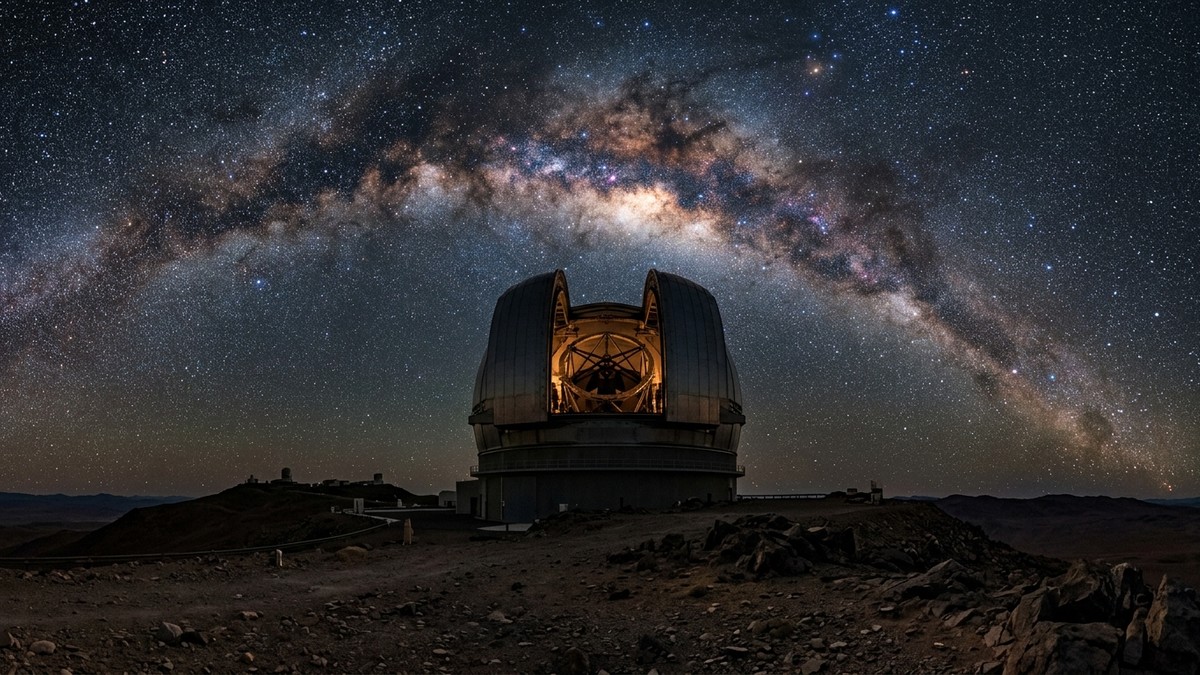
C/2026 A1 (MAPS) was discovered on 13 January 2026 by a team of four astronomers — Alain Maury, Georges Attard, Daniel Parrott, and Florian Signoret — using the AMACS1 Observatory in Chile's Atacama Desert. The comet's name comes from their initials: Maury, Attard, Parrott, Signoret.
What immediately caught the astronomical community's attention was the distance at which MAPS was found: 2.056 AU (307.6 million km) from the Sun. That is the farthest any Kreutz sungrazer has ever been discovered — a record that exists because most sungrazers are only spotted weeks or days before perihelion by solar observatories like SOHO and STEREO, when they are already deep inside the inner solar system.
Finding one this far out gave astronomers months of lead time. The James Webb Space Telescope turned its Mid-Infrared Instrument (MIRI) on the comet in February 2026, pinning the nucleus diameter down to roughly 400 metres — comparable in size to C/2011 W3 (Lovejoy), the last Kreutz sungrazer to survive a close solar passage.
That comparison matters. Lovejoy made it through. Most sungrazers do not.
The Kreutz Sungrazers: A Family of Fragments
MAPS is not just any comet. It belongs to the Kreutz sungrazer group — a family of comets that all share remarkably similar orbits because they are all fragments of a single parent body.
The story begins over two thousand years ago. Around 371 BC, the Greek philosopher Aristotle recorded a brilliant comet visible in the sky. Modern orbital calculations suggest that this was the original Kreutz progenitor — a large comet that passed dangerously close to the Sun and broke apart. One of the main fragments returned as the Great Comet of 1106, which was recorded across Europe, East Asia, and the Islamic world. That comet fragmented again, spawning a cascade of daughter comets that have been arriving at the Sun ever since.
The family's greatest hits include some of the most spectacular comets in recorded history. C/1843 D1, the Great March Comet, had a tail stretching over 300 million kilometres. C/1965 S1 (Ikeya-Seki) reached an estimated magnitude of −10 at perihelion — bright enough to see in broad daylight next to the Sun. And in December 2011, C/2011 W3 (Lovejoy) stunned astronomers by surviving its perihelion passage intact, emerging from behind the Sun with a magnificent tail visible to the naked eye from the Southern Hemisphere.
NASA's SOHO spacecraft has discovered more than 4,000 Kreutz sungrazers since 1995. The vast majority are tiny — house-sized chunks that silently evaporate as they approach the Sun. Only a handful have been large enough to be observed from the ground. MAPS is one of them.
Will It Survive? The Make-or-Break Moment
This is the question everyone is asking, and the honest answer is: nobody knows.
When a comet passes this close to the Sun, it faces two existential threats. The first is thermal stress — the intense heat vaporises surface ice and can fracture the nucleus if internal gas pressure builds faster than it can escape. The second is tidal forces — the Sun's gravity pulls harder on the near side of the comet than the far side, stretching the nucleus apart. At 161,000 km from the solar surface, both forces are extreme.
The comet's recent lightcurve — the graph of how its brightness has changed over time — has astronomers nervous. MAPS brightened steadily through most of March, reaching about magnitude 8.5 by late March. But the brightening has been punctuated by flare-ups and pauses, a pattern that is often a warning sign. When a comet's nucleus is fracturing beneath its surface, escaping gas and dust can cause sudden brightness spikes followed by periods of stalling. Several previous sungrazers showed similar behaviour before disintegrating at perihelion.
The comparison with Lovejoy offers cautious hope. Lovejoy had a nucleus of roughly the same size (~400 metres) and survived its 2011 perihelion, though it passed slightly farther from the Sun (about 140,000 km from the surface versus MAPS' 161,000 km). But Lovejoy's nucleus did eventually fragment after perihelion, and the comet dissolved within weeks.
The SOHO and STEREO solar observatories will be watching MAPS in real time as it rounds the Sun on 4 April. If the comet survives, it should become visible in coronagraph images within hours of perihelion. If it does not, we will see its remnants — a fading dust tail — drift away from the Sun without a head.
What Happens If It Does Survive?
If MAPS emerges intact from behind the Sun, the next few days could be extraordinary.
The best-case scenario, modelled on Comet Ikeya-Seki's 1965 performance, would see MAPS reach a peak brightness of around magnitude −5 to −10 near perihelion. At −10, it would be visible in broad daylight as a brilliant point of light near the Sun — though you would need to block the Sun itself (never look directly at it) to spot it.
A more likely scenario, based on Lovejoy's 2011 performance, would see MAPS emerge from the solar glare at around magnitude −2 to +1 by 7 April, fading gradually over the following two weeks. At magnitude −2, it would be brighter than Jupiter and clearly visible to the naked eye in twilight.
The timing is remarkable. MAPS would become visible in the evening sky from around 7 April, with its angular distance from the Sun increasing rapidly — from about 7° on 5 April to 21° by 10 April. By Easter weekend (5–6 April), keen observers might catch a first glimpse very low on the western horizon just after sunset, with conditions improving dramatically through the following week.
The comet makes its closest approach to Earth on 5–6 April at a distance of 0.96 AU (about 144 million km) — quite far as comet encounters go, but the combination of a fresh, actively outgassing nucleus and forward-scattering of sunlight through the dust tail could still produce a stunning visual.
How to See Comet MAPS From the UK
If MAPS survives, here is what UK observers should plan for:
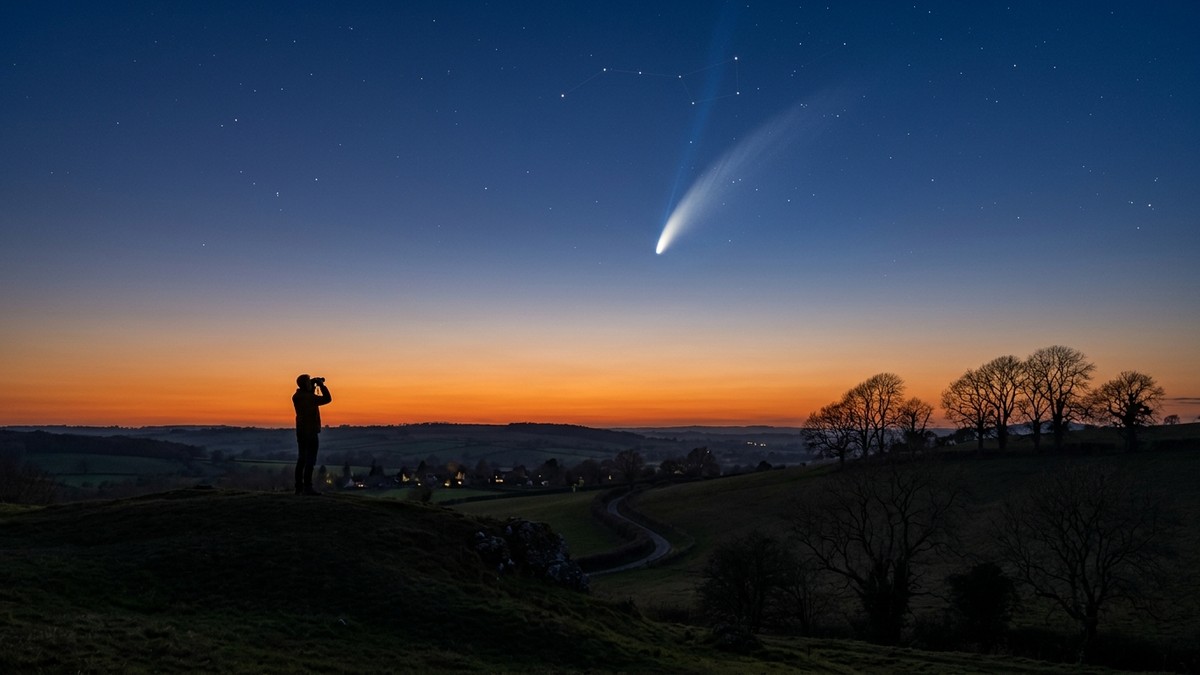
When: From approximately 7–8 April onwards, look west-southwest in the 30–45 minutes after sunset. The comet's elongation from the Sun increases each day, making it progressively easier to spot. Mid-April (around 12–17 April) should offer the best combination of brightness and sky separation.
Where in the sky: Low on the western horizon after sunset. You will need a clear, unobstructed western horizon — hilltops, coastlines, or open fields away from trees and buildings. The comet will be at its highest roughly 30–40 minutes after sunset before following the Sun below the horizon.
What to look for: A fuzzy star-like object with a tail pointing upward and to the left (away from the Sun). In binoculars, the tail should be clearly visible. In a telescope, you may see structure in the dust tail and possibly a secondary ion tail.
Equipment: If MAPS reaches magnitude 0 or brighter, it will be a naked-eye object — no equipment needed, though binoculars will dramatically improve the view. A pair of 10×50 binoculars will show the tail structure beautifully. If it is fainter (magnitude 2–4), binoculars become essential.
Photography: A DSLR or mirrorless camera on a tripod with a 50–200mm lens, ISO 800–1600, exposures of 2–8 seconds, should capture the comet and its tail against the twilight sky. Shoot in RAW for maximum flexibility in post-processing.
Important caveat: Northern Hemisphere observers are at a disadvantage compared to those in the Southern Hemisphere, as the comet's declination will be relatively low. From southern England (latitude ~51°N), the comet will be at a modest altitude above the horizon during prime viewing time. The further south you are (Cornwall, Channel Islands), the better your view.
What If It Doesn't Make It?
Even if MAPS disintegrates at perihelion, the story is not necessarily over.
When Kreutz sungrazers break apart near the Sun, they can leave behind a "headless" dust tail — a ghostly fan of debris that lingers in the sky for days or even weeks after the nucleus is gone. Comet C/2024 S1 (ATLAS), a Kreutz sungrazer that disintegrated at perihelion in October 2024, left behind exactly this kind of remnant, visible in SOHO coronagraph images for several days.
Whether such a remnant from MAPS would be visible to the naked eye from Earth depends on how much dust was released before and during the breakup. It is unlikely but not impossible.
Either way, the SOHO, STEREO, and Solar Orbiter spacecraft will capture the event in exquisite detail. If MAPS breaks apart, the footage will be scientifically valuable — each fragmentation event teaches us more about the internal structure and composition of these ancient icy wanderers.
And that is the deeper point. MAPS is a fragment of a fragment of a comet that Aristotle may have seen in 371 BC. Whether it survives this weekend or not, it is carrying a piece of history that stretches back over two millennia — and that alone makes it worth watching.
We will update this post as soon as the outcome of the perihelion passage is known. Follow us on Instagram @watchthestarsuk for real-time updates.