Key Takeaways
- Comet C/2025 R3 (PanSTARRS) reaches perihelion on 19 April at just 0.499 AU from the Sun, and closest approach to Earth on 26 April at 0.49 AU — it could brighten to magnitude 3 or better, making it visible to the naked eye.
- The comet is currently around magnitude 6 and visible in binoculars in the predawn eastern sky. Your best UK viewing window is 13–19 April, before the comet dips too close to the Sun's glare.
- A phenomenon called forward scattering could make the comet appear up to 100 times brighter than expected when sunlight shines through its dust tail at just the right angle — potentially creating a spectacular show in late April.
📑 Table of Contents
The last time this comet visited the inner Solar System, Homo sapiens were sharing Europe with Neanderthals. There were no cities, no agriculture, no written language. The ice sheets were advancing across Britain, and the night sky looked almost exactly the same as it does now — except that this faint smudge of light was also there, drifting slowly among the stars.
Now it's back. And this time, we have binoculars.
Comet C/2025 R3 (PanSTARRS) is a long-period comet with an orbital period of roughly 170,000 years. It is currently brightening in the predawn sky, already visible through binoculars at around magnitude 6, and heading for its closest approach to the Sun on 19 April 2026. If things go well, it could become the first naked-eye comet of 2026 — and possibly a genuinely spectacular one.
Here's everything you need to know to see it.
What Is Comet C/2025 R3?
C/2025 R3 was discovered on 8 September 2025 by the Pan-STARRS survey — a pair of 1.8-metre reflector telescopes perched on top of Haleakalā volcano in Hawaii. Pan-STARRS (the Panoramic Survey Telescope and Rapid Response System) was originally designed to detect near-Earth asteroids, but it has a habit of finding comets too. This is one of its best finds yet.
At the time of discovery, the comet was still deep in the outer Solar System, giving astronomers months to track its orbit and refine brightness predictions. Those early observations revealed something exciting: C/2025 R3 is on a trajectory that brings it unusually close to both the Sun and the Earth in quick succession.
On 19 April, the comet reaches perihelion — its closest point to the Sun — at a distance of just 0.499 AU (74.6 million km). That's closer than Earth's orbit, and closer than Venus. One week later, on 26 April, it makes its closest approach to Earth at 0.489 AU (73.2 million km).
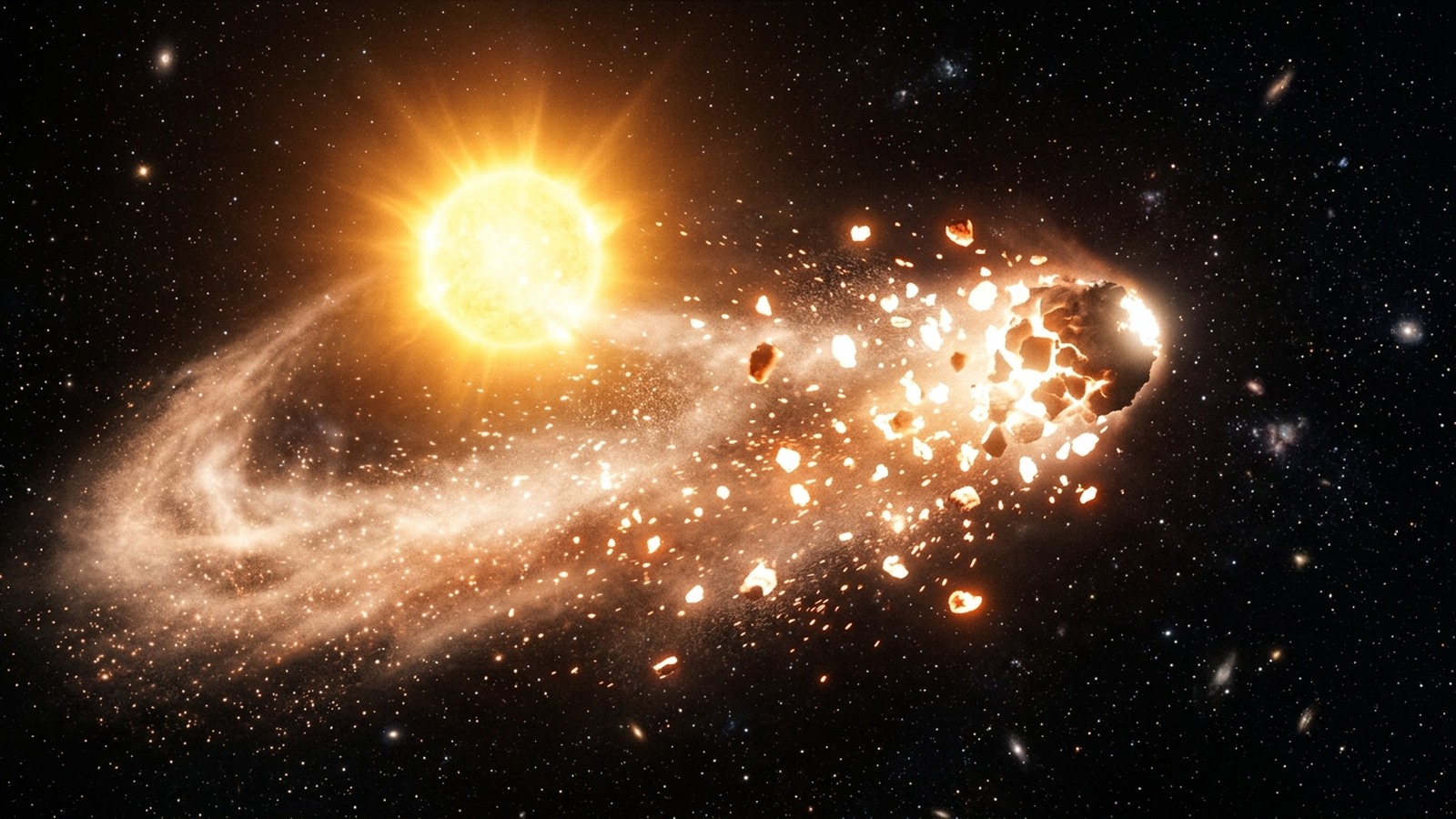
That one-two punch of solar heating followed by proximity to Earth is exactly the combination that produces bright comets. The Sun's heat vaporises ices in the nucleus, producing the coma and tail, and the short Earth distance means we get a front-row seat.
The comet's outbound trajectory suggests it may be ejected from the Solar System entirely after this pass — meaning this could be the last time anyone, anywhere, ever sees it.
How Bright Will It Get?
This is the question everyone is asking — and the honest answer is that nobody knows for certain. Comets are famously unpredictable, and brightness predictions depend on how actively the nucleus outgasses as it approaches the Sun.
As of early April, C/2025 R3 is sitting at around magnitude 6 — right on the edge of naked-eye visibility under perfect conditions, and easily visible through binoculars or a small telescope. It has been brightening steadily and tracking close to the more optimistic predictions.
The forecasts break down into three scenarios:
Conservative (magnitude 7–8): The comet underperforms, perhaps because the nucleus is smaller than hoped or the gas production plateaus. You'd still see it through binoculars, but it wouldn't make headlines. It would look like a fuzzy smudge among the stars — interesting, but not dramatic.
Most likely (magnitude 3–4): The comet brightens to roughly the same level as the stars of the Plough. Clearly visible to the naked eye from a dark site, with a noticeable tail in binoculars. This would be a lovely comet — the kind of sight that makes you glad you got up early.
Optimistic (magnitude 0 or brighter): If the comet is especially active and the geometry works in our favour, C/2025 R3 could briefly rival the brightest planets. Some models put the ceiling as high as magnitude −0.5, which would make it brighter than any star in the sky. This scenario depends heavily on a phenomenon called forward scattering — more on that in a moment.
For context, Comet MAPS — which we followed closely here on WatchTheStars before it disintegrated in early April — never had this kind of potential. C/2025 R3 is a much more substantial object, and its geometry is far more favourable for Northern Hemisphere observers.
The Forward Scattering Wild Card
There is a specific reason some astronomers think this comet could overperform: forward scattering.
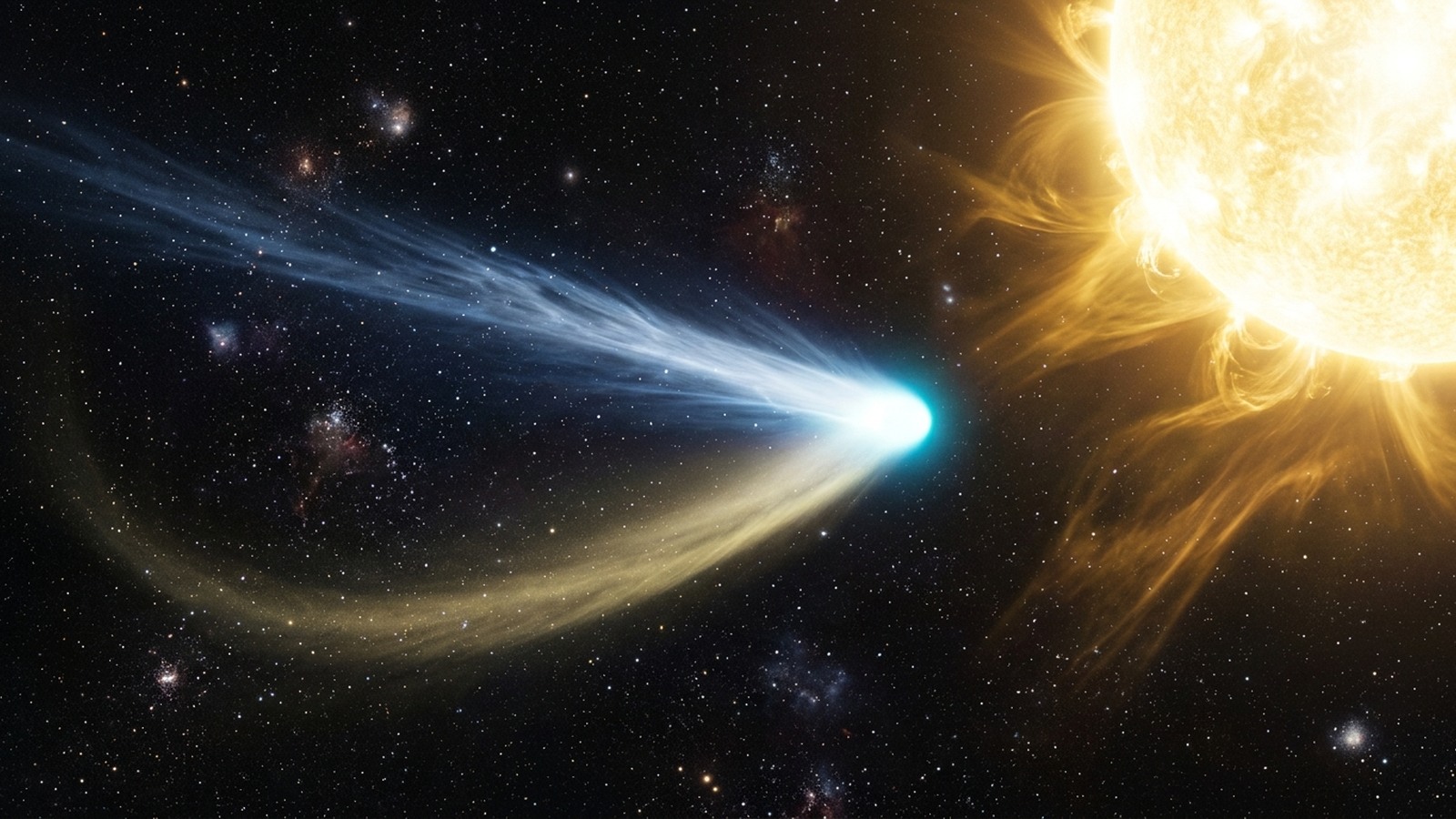
When sunlight hits the tiny dust particles in a comet's tail from behind — that is, when the comet passes between us and the Sun — the light doesn't just bounce off. It scatters forward, toward us, in a way that can make the tail appear dramatically brighter. Think of it like looking at dust motes in a shaft of sunlight: they practically glow when the light comes from behind them, but they're nearly invisible when lit from the front.
The geometry of C/2025 R3's orbit means that around 20–25 April, shortly after perihelion, the comet will be positioned almost directly between Earth and the Sun. The angle will be nearly perfect for forward scattering.
If the comet has produced a substantial dust tail by then — and early signs suggest it is a reasonably dusty comet — this effect could boost its apparent brightness by a factor of up to 100 times. That is not a typo. Forward scattering is the mechanism that turned Comet McNaught (C/2006 P1) from a moderately bright comet into the most spectacular comet of the 21st century.
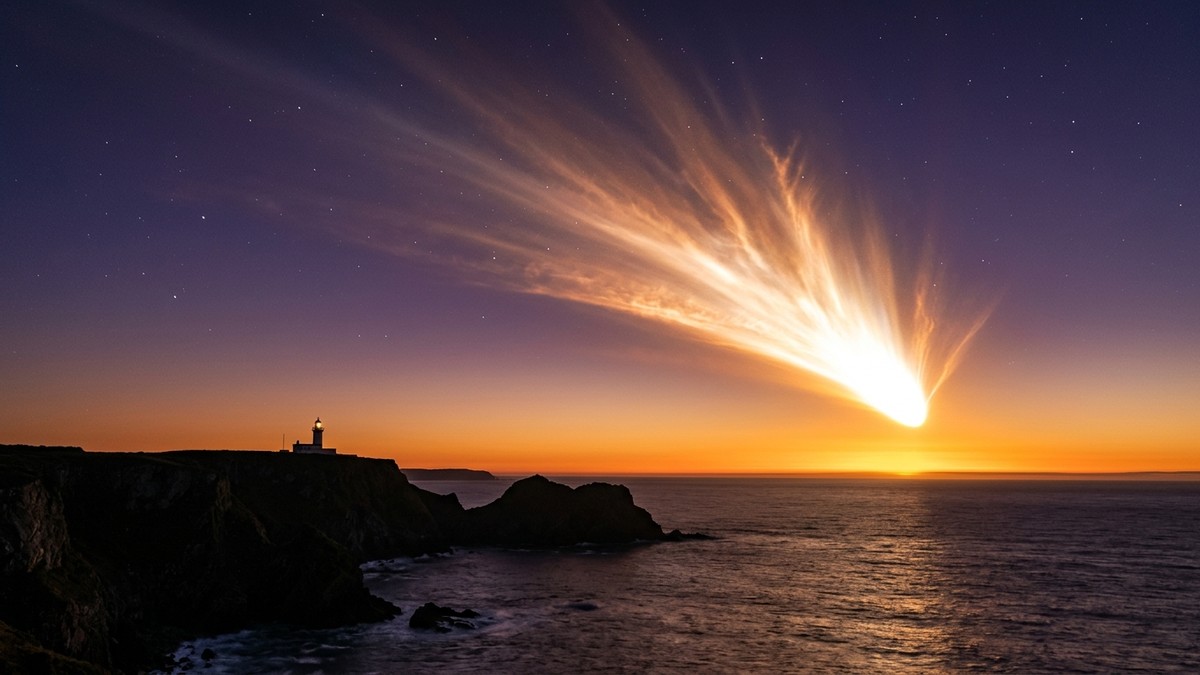
The catch? The comet will also be very close to the Sun in the sky at that point — it reaches solar conjunction on 25 April, passing just 3.5° from the Sun. So even if it becomes spectacularly bright, you may need to look for it in the twilight glow very close to the horizon. It's a classic comet dilemma: the brightest phase and the hardest observing conditions arrive at the same time.
How to See It From the UK
Here's your UK observing plan, broken into three phases:
Phase 1: Now Through 17 April — Predawn Eastern Sky (Best Phase)
Right now, the comet is a predawn object, visible in the eastern sky before sunrise. From the UK, your best window is roughly 90 minutes to 30 minutes before sunrise — so roughly 4:30 a.m. to 5:30 a.m. BST in mid-April (sunrise is around 6:15 a.m.).
Look east to east-northeast, roughly 10–20° above the horizon. In the week of 13–17 April, the comet will be tracking through Pisces, near the Great Square of Pegasus. It should be easy to find with binoculars — look for a fuzzy smudge with a slight elongation (the beginnings of a visible tail).
The new Moon on 17 April means no moonlight interference during this critical period. This is your darkest, clearest window. If you only go out once, make it one of these mornings.
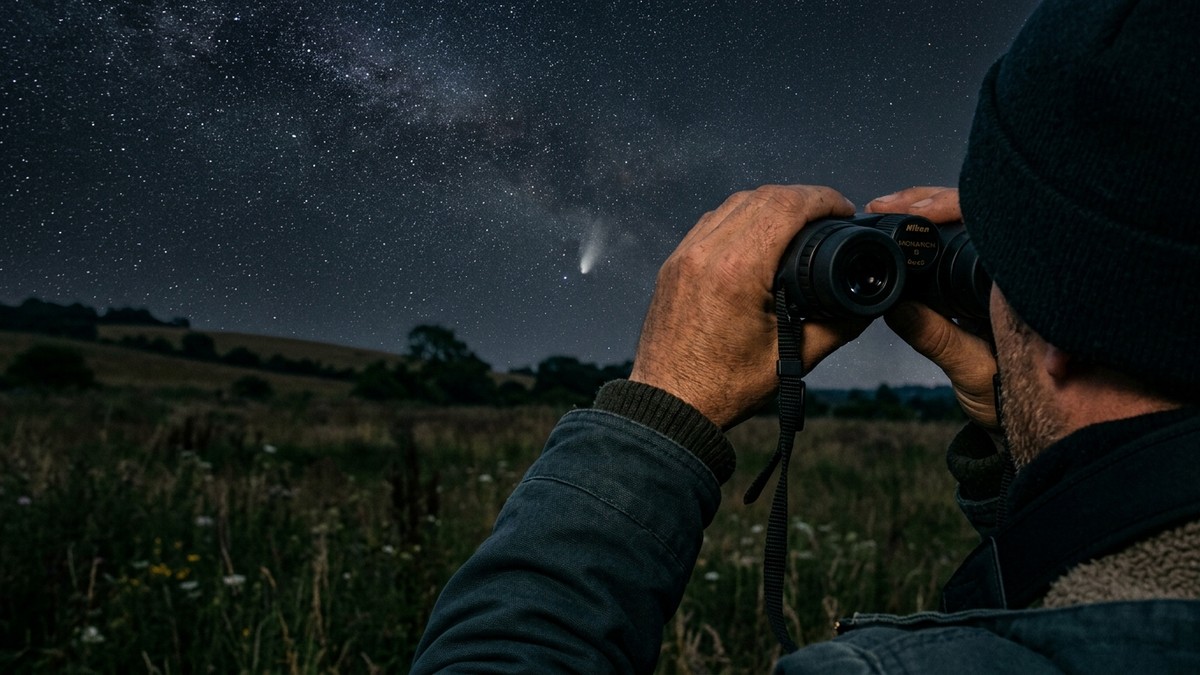
What you'll see: Through 10×50 binoculars, expect a softly glowing fuzzy patch — brighter at the centre, fading at the edges — with perhaps a short fan-shaped tail pointing away from the dawn. If the comet has reached magnitude 4 by this point, you should be able to spot it with the naked eye as a faint smudge.
Phase 2: 18–22 April — Perihelion and the Twilight Challenge
As the comet approaches perihelion on 19 April, it will be getting brighter but also sinking toward the horizon and into the Sun's glare. Each morning it will be a little lower and a little harder to see in the brightening twilight.
This is the most unpredictable phase. If the comet brightens rapidly, you may be able to catch it in the dawn glow even though it's close to the horizon. Binoculars are essential. A location with a clear, unobstructed eastern horizon — ideally a hilltop, coast, or open field — will make the difference between seeing it and missing it.
Phase 3: Late April Into May — Evening Sky Transition
After solar conjunction around 25 April, the comet reappears as an evening object, low in the western sky after sunset. This is when forward scattering may boost its brightness significantly.
From the UK, this will be challenging — the comet will be very low, and you'll be fighting against the long spring twilight. Southern Hemisphere observers have a much better view during this phase. But if the comet is as bright as the optimistic forecasts suggest, even UK observers may catch a bright fuzzy object near the western horizon 20–30 minutes after sunset. Worth a look.
Essential Kit
You don't need a telescope for this. Here's what will help:
- 10×50 binoculars — the single most useful piece of equipment. Bright optics gather enough light to show the coma and tail clearly. If you own binoculars, use them.
- Clear eastern horizon — the comet is low, so buildings and trees will block it. Scout a location in advance.
- A star chart or app — Stellarium (free, stellarium-web.org) will show you exactly where the comet is each morning. Search for "C/2025 R3".
- Warm layers — predawn April in the UK is cold. Dress for standing still outdoors for 20+ minutes.
Photography Tips
Comet C/2025 R3 is a rewarding target even with modest camera equipment.
Smartphone: If the comet reaches magnitude 3 or brighter, a modern smartphone in night mode can capture it. Hold the phone steady against something solid (a fence post, car roof) and use a 3–5 second exposure. The comet will appear as a bright smudge. Including the horizon and landscape makes a far more interesting photo than just sky.
DSLR or mirrorless camera: Use a tripod. Set your lens to its widest aperture (f/2.8 or wider if possible), ISO 1600–3200, and start with 4–8 second exposures. A wide-angle lens (24–35mm) captures the comet in context with the landscape; a telephoto (100–200mm) will resolve the tail structure. Focus manually on a bright star first, then recompose. Shoot RAW for maximum flexibility in processing.
Through a telescope: If you have a small refractor or reflector on a tracking mount, you can capture stunning detail in the coma and tail. Use a camera adapter and aim for 15–30 second sub-exposures, stacking multiple frames. The comet will be moving against the background stars, so keep individual exposures short enough to avoid trailing.
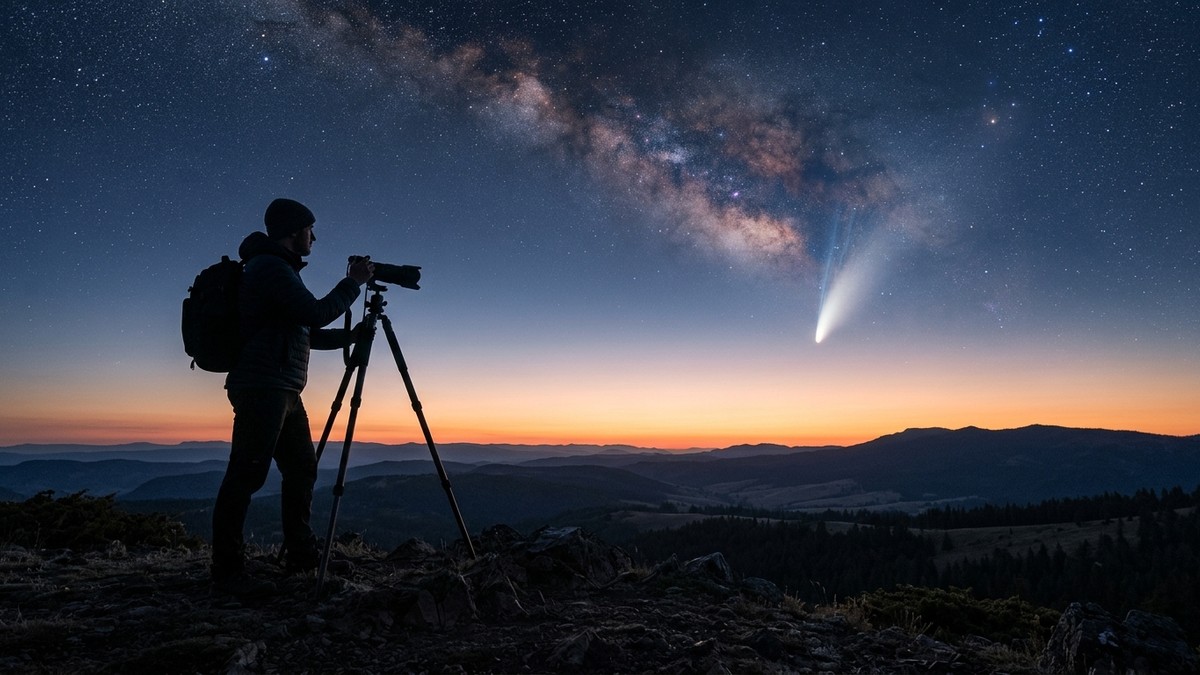
The most important photography tip: go out early and go out often. Comets change from night to night — the tail shifts, the brightness evolves, the landscape context differs. Your best shot might come on a morning you almost didn't bother.
Key Dates at a Glance
| Date | Event | What It Means |
|---|---|---|
| 13–17 April | Best predawn viewing window | Comet near Pegasus, ~mag 5–4, new Moon on 17th — darkest skies |
| 17 April | New Moon | No moonlight — ideal conditions for faint objects |
| 19 April | Perihelion (0.499 AU) | Closest to the Sun — maximum heating and gas production |
| 20–24 April | Peak brightness expected | Possibly mag 3 or brighter — but low and in twilight |
| 25 April | Solar conjunction (3.5° from Sun) | Lost in the Sun's glare — forward scattering may peak |
| 26 April | Closest to Earth (0.489 AU) | 73.2 million km — nearest it will ever be to us |
| Late April–May | Evening sky transition | Reappears low in the west after sunset — fading |
The bottom line: if you want to see this comet, the next week is your best chance. Get up before dawn, look east, and bring binoculars. You'll be looking at something that last visited this part of the Solar System when our species was young — and that may never come back again.
We'll update this post if the comet does anything unexpected. Follow us on Instagram @watchthestarsuk for real-time alerts.