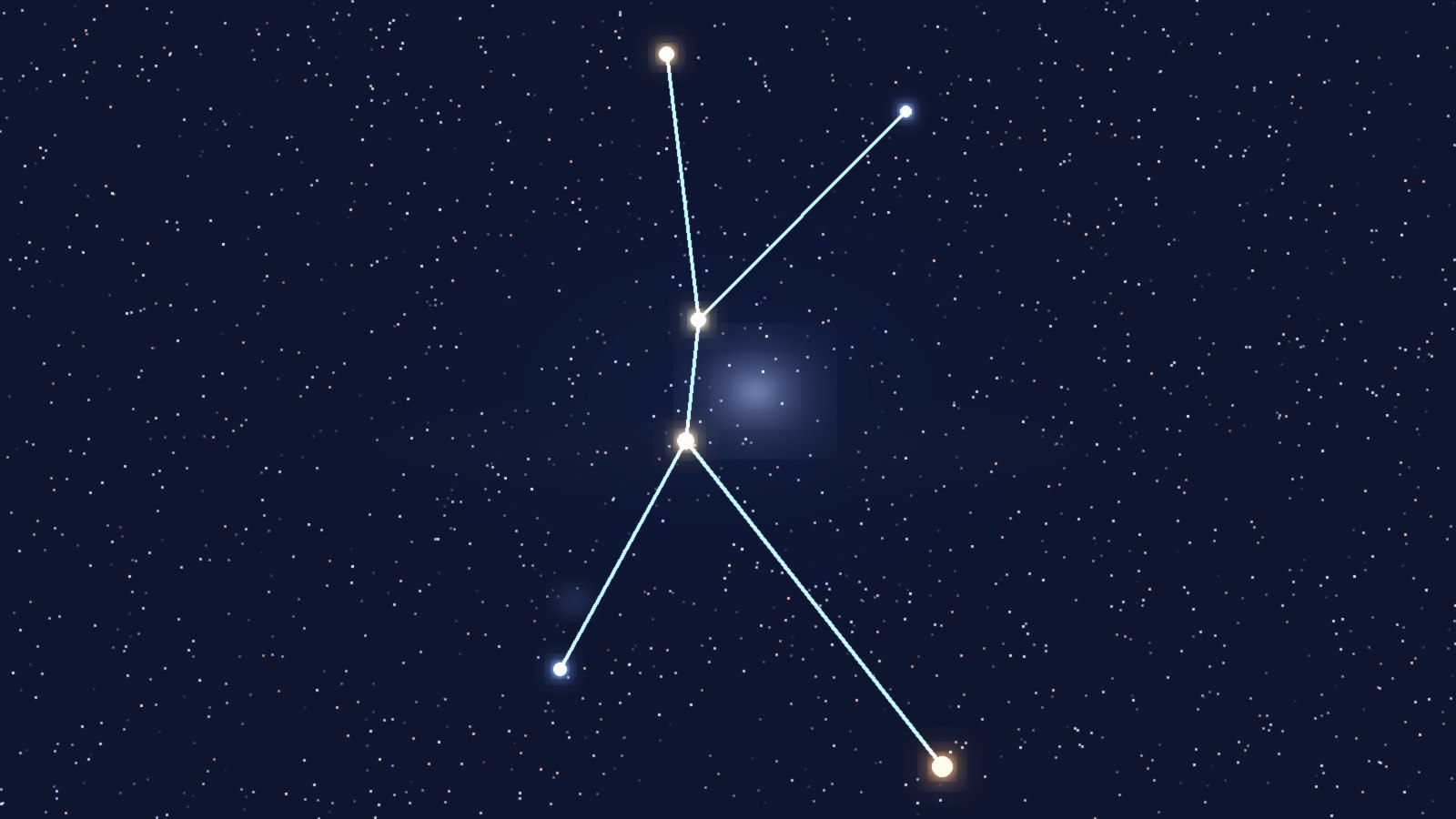
Cancer is the faintest of the zodiacal constellations, yet it harbors one of the most famous star clusters in the night sky — the Beehive Cluster (M44). Often overlooked because it lies between the prominent asterisms of Gemini and Leo, Cancer rewards patient observers with deep-sky treasures, beautiful double stars, and a planetary system with five confirmed exoplanets. From mythological significance tied to Hercules to modern exoplanet discoveries, Cancer offers a fascinating blend of ancient tradition and contemporary astronomy.
Cancer lies between Gemini (to the west) and Leo (to the east). It is one of the faintest zodiacal constellations — no bright naked-eye stars dominate, so look for a faint Y-shape or asterism roughly midway between the prominent stars of its neighbors.
M44 is the key to finding Cancer. Under dark skies it appears as a fuzzy glow; binoculars resolve it into dozens of glittering stars. This is literally the central feature of the constellation — the "manger" between the two donkey-stars.
Asellus Borealis (γ, northern) and Asellus Australis (δ, southern) flank M44 to the north and south. These two stars mean "the northern and southern donkey colts" — the donkeys eating from the manger (M44) in ancient tradition.
Cancer is best visible from January through April in the UK. February offers the highest altitude (~50°) at mid-evening. The constellation is easy to miss if you're not looking for M44 specifically — use binoculars to sweep the region between Gemini and Leo.
| Month | Position & Visibility |
|---|---|
| November | ESE, very low on horizon; not yet well-positioned |
| December | SE, rising; ~35° altitude by midnight |
| January | SE, climbing; excellent visibility |
| February | Due south, ~50° altitude — BEST viewing month |
| March | SW, still good; ~45° altitude in early evening |
| April | WSW, sinking; visible early evening but lower |
The brightest star in Cancer, yet only 3rd magnitude — reflecting how faint this constellation is overall. Its name may derive from Arabic meaning "the glance" or "the end." Despite its orange color and giant classification, it is barely visible to the naked eye from light-polluted sites. It hosts a distant 14th magnitude red dwarf companion.
The "Southern Donkey Colt" — one of two Aselli flanking M44, the Beehive Cluster. This orange giant has a debris disc, suggesting it may harbor planetary material. Occasionally occulted by the Moon, providing precise position measurements for occultation observers.
The "Northern Donkey Colt" — the fainter and whiter of the two Aselli framing M44. Occasionally occulted by the Moon. The contrast between the cool orange Australis and the hot white Borealis illustrates the diversity of stellar properties in our cosmic neighborhood.
The name means "the claw" — appropriately for a crab constellation. The primary star is a peculiar A-type metallic-line star with anomalously strong iron and rare-earth element abundance patterns. Paired with a distant red dwarf companion.
One of the most beautiful coloured double stars visible in small telescopes. A warm golden-orange K supergiant is paired with a cool blue-white A star — the color contrast is immediately obvious even at low magnification (30×). A showpiece for telescope users.
A naked-eye star hosting one of the most remarkable exoplanet systems known — FIVE confirmed planets. The system includes 55 Cnc e, a super-Earth with one of the shortest orbital periods ever recorded (0.74 days), and 55 Cnc d, a Jupiter-like giant in a 14-year orbit. A real-world demonstration of planetary diversity.
The crab was sent by the goddess Hera to distract Hercules during his second labour — his battle with the Lernaean Hydra. The small crab nipped Hercules' foot, but he crushed it. Hera placed it in the sky in recognition of its service, despite the outcome. The gesture illustrates how even small sacrifices are remembered by the divine.
The Babylonians called this constellation the "Crayfish" (AL.LUL) and associated it with the underworld and the gate through which souls passed. The Summer Solstice occurred in Cancer around 2000 BCE — the solar turning point — making this constellation astronomically significant for ancient calendars and religious practices.
In Egyptian star lore this region was sometimes depicted as two turtles and associated with the goddess Isis and concepts of regeneration. The crab and turtle both symbolize protection and cycles of renewal in Egyptian mythology.
The nakshatra Pushya (the nourisher) lies here, associated with nourishment, abundance, and growth. Also contains Ashlesha (the embrace) — associated with Naga serpents and the cycles of creation. These lunar mansions were important for timing agriculture and ceremonies.
This region was associated with the Ghost (Gui) lunar mansion — important in Chinese divination and fortune-telling. The Chinese called M44 "Jishi" — a haunting name meaning "cumulative corpses" or a "ghost" asterism. Despite the ominous name, it was prized for its visibility and stellar abundance.
One of the most famous naked-eye clusters in the sky. Under dark skies it appears as a fuzzy glow between two bright stars (the Aselli). Binoculars resolve it into dozens of sparkling stars arranged in loose arcs and lines. The Romans called it Praesepe (the manger). Contains over 1,000 stars all formed together 700 million years ago — a time capsule of stellar youth.
EasyOne of the oldest known open clusters — 3.2 to 5 billion years old, similar to our Sun's age. Contains sun-like stars nearing the end of their main-sequence lives. Visible in binoculars; a telescope shows hundreds of similar-brightness stars — all evolved at the same rate. A time-travel comparison with M44's young stars.
EasyA showpiece double: warm golden-orange K supergiant paired with a cool blue-white A star. The color contrast is immediately obvious even at low magnification. One of the finest coloured doubles for small telescopes — a perfect introduction to binary star observing.
EasyA beautiful flocculent (patchy) spiral with a very smooth, featureless outer disc — a textbook "smooth outer ring" spiral. Visible in 15cm as an oval glow. 30cm+ reveals the delicate spiral structure and inner shell. A photographic target rewarding long exposures.
MediumOne of the most complex planetary systems known — 5 confirmed exoplanets. 55 Cnc e is a super-Earth with an orbital period of only 0.74 days (completing one orbit every 18 hours). 55 Cnc d is a Jupiter-mass giant orbiting every 14 years. Visible to the naked eye from dark sites — real worlds around a real star.
EasyA spiral and elliptical galaxy in a gravitational embrace, showing tidal distortion. The spiral's outer regions are pulled into long streams. A challenging but rewarding photographic target with 20cm+ aperture and long exposures.
PhotographyLocate Cancer between Gemini and Leo — Between Gemini (west) and Leo (east), look for a faint scattered asterism. Even in dark skies, no star exceeds magnitude 3.5. Cancer is often overlooked because it's so faint.
Find the Beehive Cluster M44 with naked eye or binoculars — M44 is the key. Under dark skies it appears as a fuzzy haze midway between Gemini and Leo. Binoculars transform it into a sparkling field of dozens of stars — one of the most satisfying binocular targets.
Identify the two Aselli stars — Asellus Borealis (γ, northern) and Asellus Australis (δ, southern) flank M44 to the north and south. In mythology, these "donkey colts" eat from the manger (M44). Australis is the brighter and more orange.
Observe M67 in a telescope — hunt down M67 in the southern part of Cancer. It appears as a dense, compressed cluster of similar-brightness stars. All these stars are the same age as our Sun — 3–5 billion years old.
Split the Iota Cancri double — at 30×, this pair cleanly separates: golden-orange and blue-white. The color contrast is striking. A perfect introduction to binary star observing.
M44 haze from dark sites
M44 resolution, M67 hint
M44, M67, Iota double
NGC 2775 galaxy, M67 detail
M44 wide-field, NGC 2535/36
February, 10pm local time
All stars in M44 share the same proper motion — they move together through space. Long-term photographic comparisons reveal this as a "river of stars" drifting slowly across the celestial sphere. Over decades, M44's stellar pattern visibly shifts. An excellent advanced project for dedicated observers.
55 Cnc e is a super-Earth completing one orbit every 18 hours — one of the shortest exoplanet periods known. The dayside temperature may exceed 2,500 K. Some models suggest liquid rock oceans on the nightside. This is a real planetary system 41 light-years away — modern astronomy at its finest.
M67 is ideal for photometry: all stars are at the same distance (2,700 ly), so differences in brightness directly reflect differences in intrinsic luminosity. With CCD imaging and photometry software, you can plot the Hertzsprung-Russell diagram yourself — watching stellar evolution unfold across a diagram.
At 20cm+ with high magnification and careful viewing, NGC 2775's delicate spiral arms become visible. Long-exposure imaging with narrowband filters reveals the fainter outer regions. The smooth outer disc and inner shell provide insights into galaxy formation and density-wave theory.
Pro Tip: Cancer is often called the "faintest zodiac constellation" — but don't let that discourage you! M44 is one of the finest clusters in the night sky, visible to the naked eye under dark skies and spectacular through binoculars. February offers the best viewing altitude. Combine Cancer with Leo and Gemini for a magnificent zodiac tour.