Finding & Observing
Gemini · The Twins
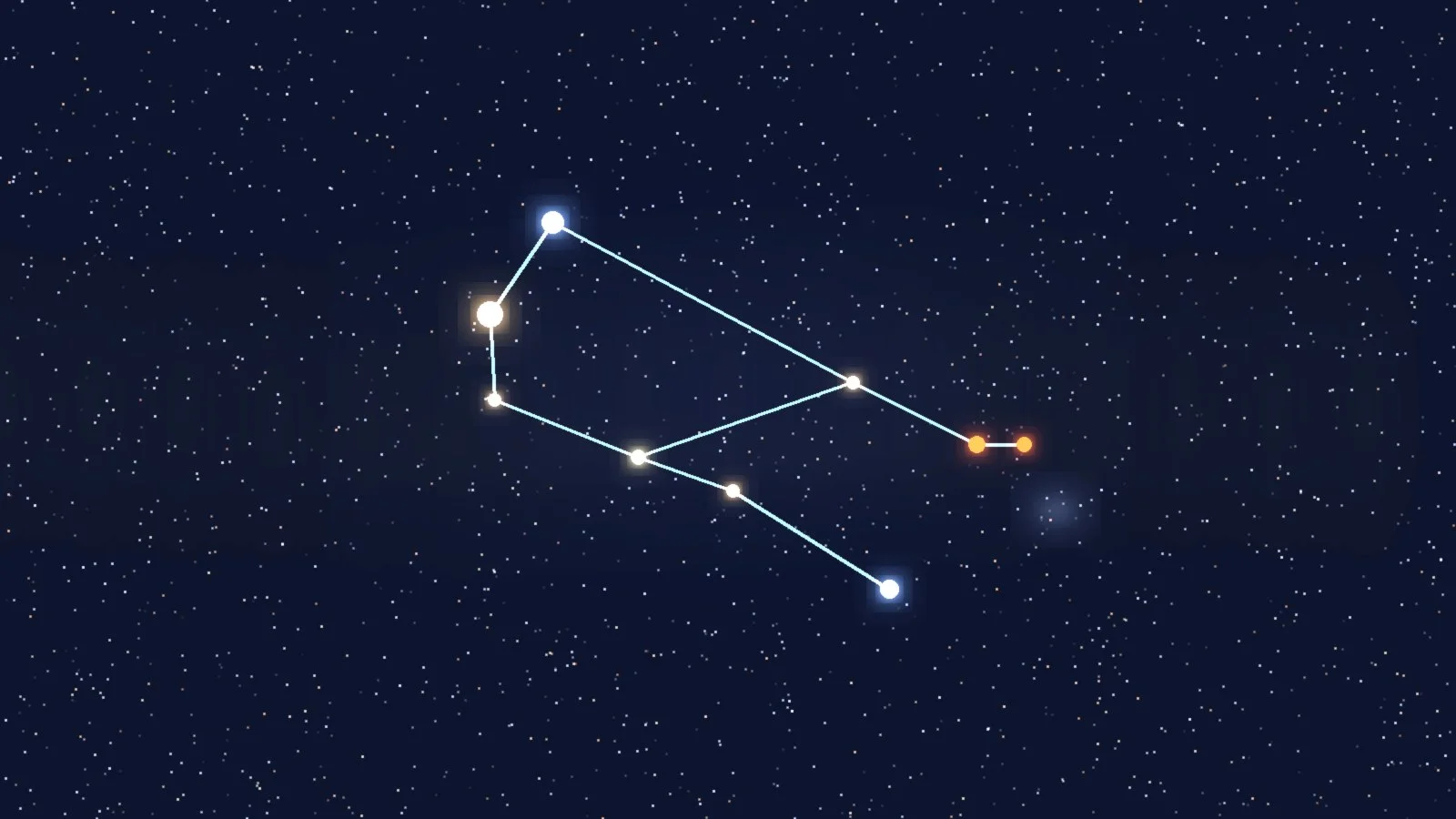
Gemini, the Twins, is one of the most distinctive constellations of winter. Its brightest stars, Castor and Pollux, have been landmarks in the sky since antiquity, and there's far more to find beyond them. Flanked by Taurus and Cancer, Gemini offers winter observers a good mix of bright stars, clusters, and nebulae. Whether you're a naked-eye observer or a deep-sky hunter, Gemini is worth your time.
The TwinsJump to section 6 sections
How to Find Gemini
Step 1: Locate Orion
In January, face south and find Orion with his bright belt and shoulders. Gemini is directly above and to the left (east) of Orion: the bright pair of Castor and Pollux are unmistakable.
Step 2: Identify the Twins
The two brightest stars in Gemini are Castor (slightly dimmer, white) and Pollux (slightly brighter, orange-tinted). They are about 4.5° apart, just over a fist-width at arm's length.
Step 3: Trace the Bodies
From Castor, trace downward through Wasat to Tejat and Propus, forming one "twin column." From Pollux, trace down through Kappa and Mebsuda to Alhena, forming the other.
Step 4: Find M35
Use binoculars to locate M35, a glittering open cluster in the lower-left area of the constellation. It appears as a fuzzy glow to the naked eye, but binoculars resolve dozens of stars.
| Month | Position & Visibility |
|---|---|
| November | Rising in the southeast ~35° by midnight; beginning of viewing season |
| December | Southeast to south, climbing steadily; ~55° altitude at midnight |
| January | Due south, ~60° altitude, BEST viewing month; excellent for all observing |
| February | Southwest, still excellent; ~55° altitude in early evening |
| March | West-southwest, sinking; visible in early evening but getting lower |
Key Stars of Gemini
Pollux β Geminorum
The brighter of the twins despite its Greek letter designation. Pollux is an orange giant and one of the nearest giant stars to Earth. It hosts a confirmed exoplanet (Pollux b, also called Thestias) with an orbital period of 590 days, making this a potential target for future exoplanet imaging missions.
Castor α Geminorum
Actually six stars in three binary pairs, all gravitationally bound: the naked eye sees one blue-white star, a small telescope at 100× shows two, spectroscopy reveals a third binary pair, and the red dwarf binary YY Geminorum orbits at wider separation. A true multiple system hiding in plain sight.
Alhena γ Geminorum
The third brightest star in Gemini, marking the southern foot of Pollux. Blue-white and nearly on the ecliptic: the Moon and planets regularly pass near it. Its name means "the brand on the neck of the camel" in Arabic, reflecting an ancient desert tradition.
Mebsuda ε Geminorum
A yellow supergiant in Pollux's body, remarkably distant despite moderate brightness. The name means "outstretched paw." It is a semi-regular variable star, fluctuating slightly in brightness over weeks to months, a compelling target for variable star observers.
Wasat δ Geminorum
Nearly exactly on the ecliptic, making it historically significant. Pluto was discovered in 1930 less than a degree from this star by Clyde Tombaugh, a perfect example of how comets and planets pass through fixed stellar signposts. Resolvable as a binary in larger amateur telescopes.
Tejat μ Geminorum
A red giant variable near Castor's foot, displaying obvious ruddy colour through binoculars. Its brightness fluctuates periodically, a compelling target for visual variable star observers to track over the winter season.
Mythology & History
Greek & Roman
Castor and Pollux were the Dioscuri: divine twin sons of Leda and Zeus. Castor was mortal, Pollux immortal. When Castor was killed, Pollux asked Zeus to share his immortality; Zeus placed both in the sky, where they alternate between Olympus and Hades. They became patron saints of sailors and travelers. St. Elmo's Fire, the blue electrical glow in storms, was believed to be their protective sign.
Mesopotamian
The Babylonians called Gemini the "Great Twins" (MASH.TAB.BA.GAL.GAL), associated with underworld deities Lugalirra and Meslamtaea. The constellation marked a major solar position: Jupiter's annual passage through Gemini was carefully tracked by Babylonian astronomers for both astrological prediction and calendar keeping.
Egyptian
The two bright stars were depicted as twin goat-kids or sprouting plants in Egyptian tradition. In the famous Dendera zodiac carved into the temple ceiling, Gemini is shown as a couple holding hands, a beautiful symbol of divine twinship and partnership.
Hindu & Vedic
Gemini contains the nakshatra Mrigashira (the deer's head) and Ardra (the moist one). In Vedic astronomy, the twin bright stars were sometimes identified with the Ashvins: the divine twin horsemen who appear at dawn, representing duality and partnership in cosmic balance.
Chinese
Chinese astronomy divided Gemini among several lunar mansions. Castor and Pollux were part of Jǐng (the Well): the 22nd lunar mansion. This region was important for weather prediction and agricultural timing, with observations carefully logged by imperial astronomers.
Deep-Sky Objects
M35: Open Cluster
A spectacular cluster just visible to the naked eye under dark skies. Binoculars immediately resolve dozens of bright stars in a glittering field. A small telescope shows hundreds. NGC 2158, a much more distant (16,000 ly) compressed cluster, sits in the same field: the visual contrast is stunning.
EasyNGC 2392: Eskimo/Clown Face Nebula
One of the finest planetary nebulae in the winter sky. A 20cm telescope reveals a bright central star surrounded by a greenish disc with a fainter outer halo. High magnification reveals intricate structure: the "eyes" and "mouth" that give it its colloquial names.
MediumCastor System
Not a traditional deep-sky object, but the most complex naked-eye star system visible. With a 10cm+ telescope at 100×, the bright Castor pair cleanly separates (~5" separation). Historically, Castor was the first-ever telescopically resolved star system, observed by Galileo.
EasyNGC 2158: Compressed Cluster
Visible in the same field as M35, NGC 2158 is one of the richest and most distant clusters viewable in a small telescope. The 16,000 ly distance means these stars formed long after M35, a time-travel comparison of stellar populations and ages.
MediumNGC 2371-72: Twin Jet Planetary
A bipolar planetary nebula resembling twin jets ejected from a dying star. 20cm aperture reveals its distinctive lobed structure. Good target for astrophotographers using narrowband filters (Hα, OIII).
PhotographyGeminid Meteor Shower
The most reliable annual meteor shower, radiating from near Castor in mid-December. Unlike most showers, Geminids are active even early in the night. Peak nights can produce 100+ bright meteors per hour under dark skies. Unique because it originates from an asteroid (3200 Phaethon) rather than a comet.
EasyBeginner Observing Guide
-
In January, face south: Orion is prominent and high in the south. Gemini is above and to Orion's left (east). The bright pair of Castor and Pollux are easy to identify with the naked eye.
-
Identify Castor and Pollux: they are about 4.5° apart (just over a fist-width at arm's length). Castor is white, Pollux is slightly orange. Pollux is the brighter of the two (magnitude 1.14 vs 1.58).
-
Trace the twin columns: from Castor, trace downward through Wasat to Tejat and Propus. From Pollux, trace down through Kappa and Mebsuda to Alhena. This forms the distinctive "two columns" that give Gemini its character.
-
Find M35 with binoculars: scan the lower-left (eastern) corner of the constellation. Look for a fuzzy glow that binoculars resolve into a glittering field of dozens of stars.
-
Look for the Eskimo Nebula: with a telescope at 20cm and 200× magnification, hunt down NGC 2392 south of Tejat. It appears as a tiny greenish disc: planetary nebulae are among the most striking colors in the night sky.
Essential Kit
Castor + Pollux, main twin figures
M35 glitter, Tejat red color
M35 detail, NGC 2392 nebula
Castor split, Eskimo detail
Twin Jet nebula, M35+NGC2158
January, 9pm local time
Recommended equipment for observing Gemini
Kit we've reviewed in full
Gemini is particularly rewarding through a telescope: Castor is a beautiful double star, M35 is a rich open cluster, and the Eskimo Nebula is one of the more detailed planetary nebulae accessible in a small scope.

M35 at low power is a classic binocular cluster: a compressed splash of stars with a rich background. You can frame both Castor and Pollux together and notice their different colours (Castor blue-white, Pollux warmer yellow-orange). The twin stars of the Gemini figure are a satisfying naked-eye and binocular target.
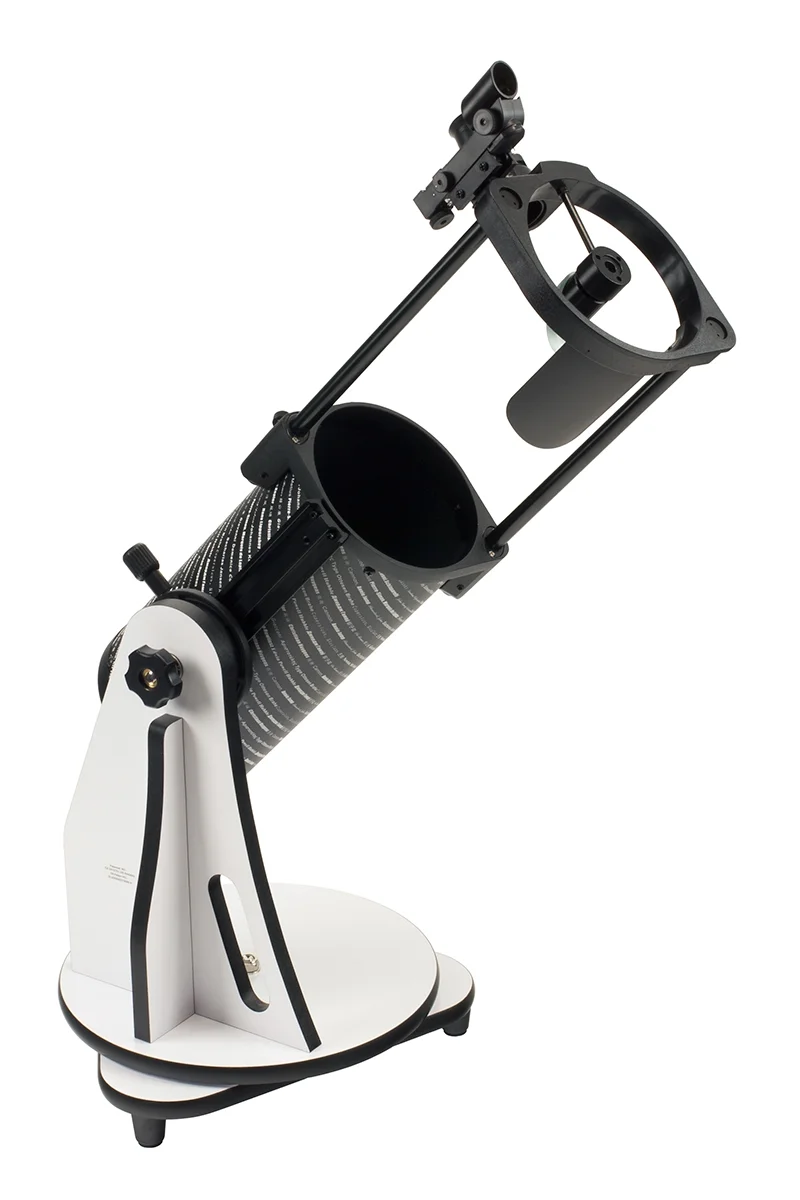
Castor splits cleanly into two equally bright white stars at 100×: one of the most satisfying doubles in the winter sky. M35 fills the field at low power with NGC 2158 visible as a background haze. The Eskimo Nebula (NGC 2392) shows as a blue-green disc with a brighter central star at 150×.
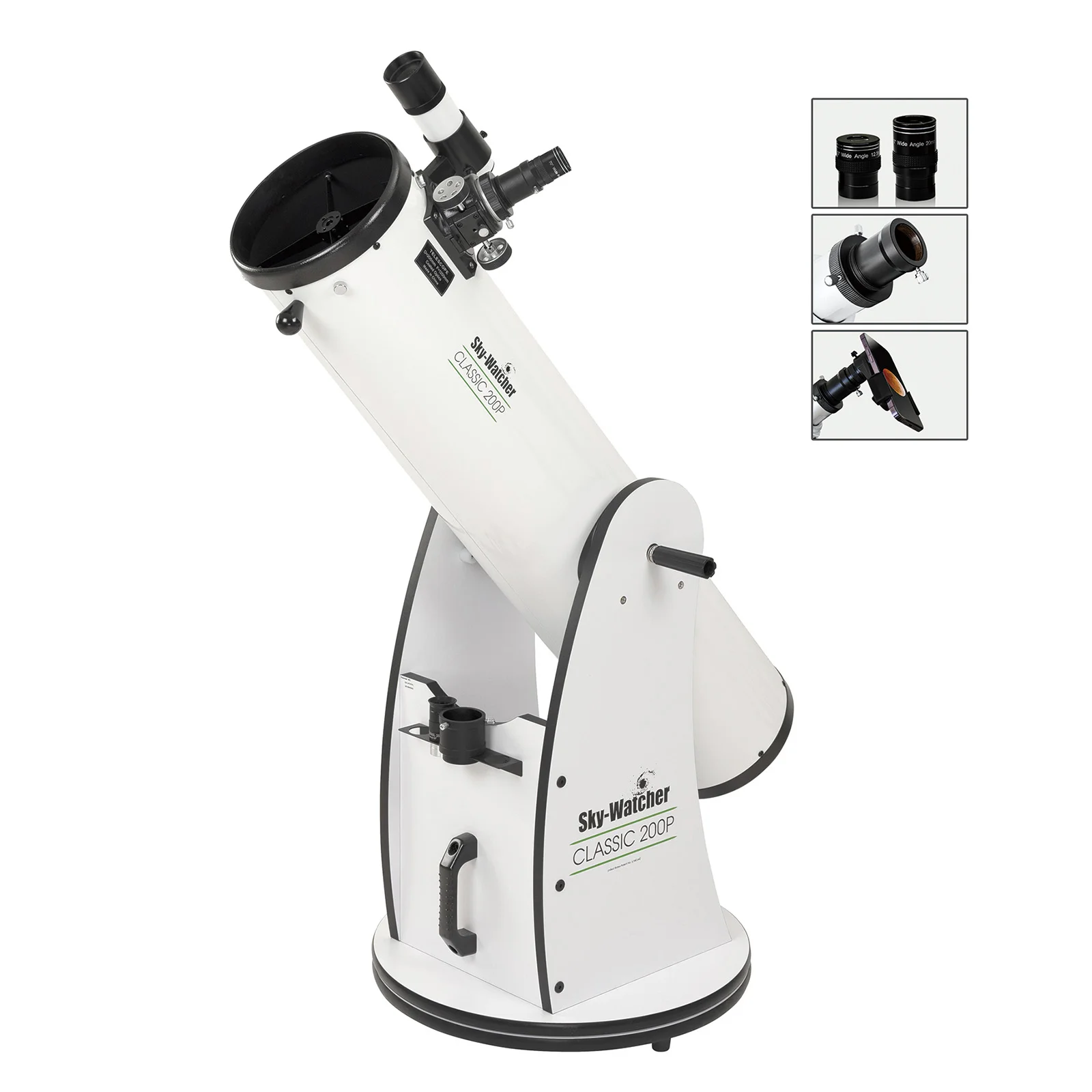
The Eskimo Nebula at 200× is one of the highlights of the winter sky through a Dobsonian: the "fur" of the eskimo's hood (the outer shell) starts to show with averted vision. NGC 2158 resolves from background haze into individual faint stars. Castor's six-star system, though only two are visible, becomes a meditation on stellar multiplicity.
Affiliate links: you pay the same price, we earn a small commission that helps keep WatchTheStars free.
Need help choosing? See our binoculars and telescope guides.
Advanced Observing
Castor Sextuple Resolution
At 100×, Castor A and B cleanly separate (~4–5" in 2026). The primary (Castor A) itself is actually a close binary of magnitude 2.0 and 2.9, beyond amateur splitting. Spectroscopy reveals Castor B is also binary. YY Geminorum (the red dwarf at ~95") is unrelated, just lined up by chance.
Eskimo Nebula Morphology
At 200×, the inner disc is visibly distinct from the outer halo. High-resolution narrowband photography (Hα, OIII, Hβ) reveals intricate shell structure and the "eye" formations that give NGC 2392 its name. Summer imaging expeditions reward patience.
Pluto Discovery Spot
Clyde Tombaugh discovered Pluto on January 18, 1930, less than 0.5° east of Wasat. This is a historically significant observing location: point your telescope at this exact spot and contemplate how a patient observer changed planetary science with a simple systematic search.
Geminid Radiant Mapping
Unlike all other major meteor showers, Geminids originate from an asteroid (3200 Phaethon), not a comet. Plot meteor trails during the Dec 13–14 peak to confirm convergence at the radiant near Castor. Peak activity occurs around 2 AM local time.
Pro Tip: Gemini is one of the winter sky's best constellations: bright stars, good clusters, and a decent planetary nebula. December brings the Geminid meteor shower (up to 120/hr at peak). January offers the most stable seeing for deep-sky work.