Key Takeaways
- Alpha Centauri is the closest star system to Earth at just 4.37 light-years — and within it, Proxima Centauri is the single closest star to our Sun at 4.24 light-years
- The system contains three stars: Alpha Centauri A (a near-twin of our Sun), Alpha Centauri B (a slightly smaller orange star), and the faint red dwarf Proxima Centauri orbiting far beyond them
- Proxima Centauri hosts at least one confirmed exoplanet, Proxima b, within its habitable zone — making it the nearest known potentially habitable world, though intense stellar flares pose serious challenges to any life there
Table of Contents
Our Nearest Stellar Neighbours
4.37 light-years. In cosmic terms, that is almost nothing — a step across the room. In human terms, it is an almost incomprehensible gulf. Yet Alpha Centauri, the brilliant star system that blazes low in the southern sky from the tropics and Southern Hemisphere, is as close as stars get. No other star system comes closer to our own Solar System. It is our nearest neighbour in the galaxy.
And it is not one star, but three. The naked-eye object "Alpha Centauri" is actually two Sun-like stars — Alpha Centauri A and Alpha Centauri B — orbiting each other every 79.9 years at distances between 11 and 36 AU. They appear as a single blazing point of magnitude −0.27 to the unaided eye, the third brightest object in the night sky after Sirius and Canopus. A third companion, the dim red dwarf Proxima Centauri, circles this pair at a vast distance and holds the record as the single closest star to our Sun.
Alpha Centauri captivates astronomers and science fiction writers alike. It is close enough that a sufficiently fast spacecraft could theoretically reach it within a human lifetime. One of its members is so similar to our Sun that astronomers use it as a benchmark for stellar physics. And Proxima Centauri — the closest star of all — appears to have at least one rocky planet in its habitable zone: the nearest known candidate for another world capable of supporting liquid water.
Vital Statistics
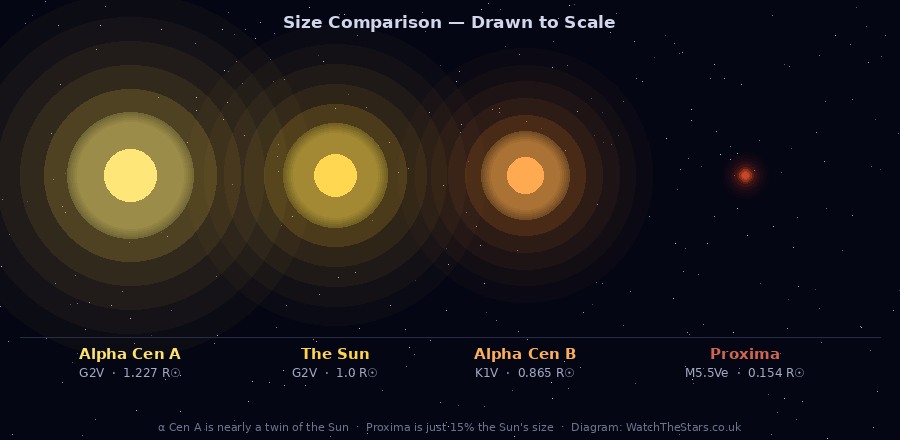
The three members of the Alpha Centauri system span an extraordinary range of stellar types — from a near-solar twin to a faint, ancient red dwarf — yet all share roughly the same age of around 5–6 billion years, suggesting they formed together from the same molecular cloud.
| Property | α Cen A | α Cen B | Proxima | Our Sun |
|---|---|---|---|---|
| Spectral type | G2V | K1V | M5.5Ve | G2V |
| Distance from Earth | 4.37 light-years | 4.24 light-years | 8.3 lt-min | |
| Mass | 1.100 M☉ | 0.907 M☉ | 0.122 M☉ | 1.0 M☉ |
| Radius | 1.227 R☉ | 0.865 R☉ | 0.154 R☉ | 1.0 R☉ |
| Luminosity | 1.519 L☉ | 0.500 L☉ | 0.00155 L☉ | 1.0 L☉ |
| Surface temperature | ~5,790 K | ~5,260 K | ~3,042 K | ~5,778 K |
| Apparent magnitude | +0.01 | +1.33 | +11.13 | −26.74 |
| Age | ~5.3–6.0 billion years | ~4.6 billion years | ||
Alpha Centauri A — The Sun's Near-Twin
Of all the stars within a dozen light-years, Alpha Centauri A is the one most like our own Sun. Classified G2V — identical to the Sun's spectral type — it is just 10% more massive, 23% wider, and 52% more luminous. Its surface temperature of 5,790 K is barely warmer than the Sun's 5,778 K. It is older than our Sun by perhaps 700 million years, which means it has burned through more of its hydrogen, accounting for its slightly larger and brighter state as it begins the long slow drift towards its eventual red giant phase billions of years from now.
The close match to the Sun makes Alpha Centauri A a valuable calibration target for stellar physicists — by comparing their detailed models against a star almost identical to the Sun but independently measurable, they can test and refine their understanding of how stars like ours work. It is also the reason Alpha Centauri A has long attracted astrobiological interest: if planets orbited this star at the right distance, they would receive almost exactly the same warmth as Earth receives from the Sun.
From Alpha Centauri A, our own Sun would appear as a magnitude 0.5 star — among the twenty brightest in the sky — sitting in the constellation Cassiopeia.
Alpha Centauri B — The Orange Companion
Alpha Centauri B is a K1V star — slightly cooler, smaller, and less luminous than the Sun, with a distinctly more orange-yellow hue. At 0.91 solar masses it lies close to the boundary between G and K spectral classes, and it outputs exactly half the Sun's luminosity. Its smaller size means it will live longer on the main sequence than either the Sun or Alpha Centauri A — K dwarfs generally have main-sequence lifetimes of 15–30 billion years, compared to about 10 billion for a Sun-like star.
Alpha Centauri A and B orbit their common barycentre every 79.9 years in an elliptical orbit with an eccentricity of 0.52 — meaning their separation varies considerably, ranging from about 11 AU at closest approach (periapsis) to 36 AU at maximum separation (apoapsis). At the moment, they are in an intermediate phase of their orbit. From Earth, their separation on the sky ranges from a minimum of about 2 arcseconds at periastron to a maximum of around 22 arcseconds — comfortably split in any small telescope.
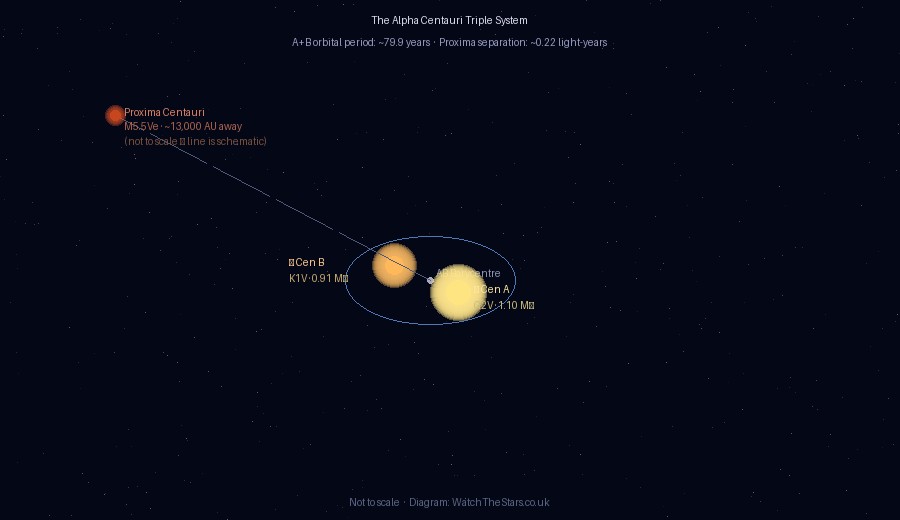
Proxima Centauri — The Closest Star to Earth
Proxima Centauri holds a record that sounds like it should be Alpha Centauri A or B's claim to fame: it is the single closest known star to our Solar System, lying just 4.244 light-years away — about 0.13 light-years closer than the AB pair. Yet it is so faint — apparent magnitude 11.13, nearly 100 times below naked-eye visibility — that it was not even discovered until 1915, when Scottish astronomer Robert Innes identified it at the Union Observatory in Johannesburg by comparing photographic plates.
Proxima is classified M5.5Ve — a cool, dim red dwarf with surface temperature around 3,042 K. Its luminosity is just 0.155% of the Sun's. Yet despite being so faint, it is a magnetically active flare star (denoted by the 'e' in its classification), capable of producing intense ultraviolet and X-ray flares many times more powerful, relative to its size, than anything the Sun emits. These flares are the defining challenge for any life on its known planet.
Whether Proxima is truly gravitationally bound to the AB pair is debated, but current orbital models suggest it orbits the AB system at roughly 13,000 AU — so far that one complete orbit takes an estimated 550,000 years. All three stars share similar ages and space velocities, which strongly points to a common origin in the same stellar nursery.
Proxima Centauri is 4.24 light-years away — meaning light from it takes 4.24 years to reach us. The fastest human-made objects, the Voyager probes, travel at around 17 km/s. At that speed, reaching Proxima would take approximately 74,000 years. The New Horizons spacecraft is faster at about 16.3 km/s — still around 77,000 years. Alpha Centauri is genuinely close by galactic standards. It is simultaneously close enough to seem tantalisingly reachable, and far enough that no conventional spacecraft will arrive in any foreseeable human timeframe.
The Search for Planets
Proxima Centauri b — The Nearest Exoplanet Candidate
In August 2016, a team of astronomers led by Guillem Anglada-Escudé at Queen Mary University of London announced the discovery of a planet orbiting Proxima Centauri. Published in Nature, the finding was based on radial velocity measurements from the HARPS spectrograph at the ESO La Silla Observatory in Chile, combined with archival data stretching back years. The planet — Proxima Centauri b — has a minimum mass of about 1.07 Earth masses and an orbital period of 11.2 days. It orbits at just 0.0485 AU from Proxima, placing it squarely within the habitable zone where liquid water could theoretically exist on a rocky surface.
The detection has been confirmed by subsequent independent analyses and is considered robust. Proxima b is the nearest known exoplanet to Earth. Whether it is truly Earth-like depends on factors we cannot yet measure from this distance — its actual mass (not just minimum mass), whether it has an atmosphere, its surface composition, and critically, how well it can resist the relentless bombardment of stellar flares from Proxima itself.
Proxima Centauri d — A Second Candidate
In 2022, a team using the ultra-precise ESPRESSO spectrograph announced a tentative second planet candidate: Proxima d, with a minimum mass of just 0.26 Earth masses and an orbital period of 5.1 days, placing it well inside the habitable zone at 0.029 AU. If confirmed, it would be one of the lightest exoplanets ever detected. As of 2026, Proxima d remains a candidate requiring further confirmation.
Alpha Centauri B b — A Retracted Claim
In October 2012, a paper in Nature announced the detection of an Earth-mass planet orbiting Alpha Centauri B with a period of just 3.24 days — far too hot for life, but scientifically significant as the closest exoplanet to Earth, if real. The claim attracted enormous attention, including a formal observation campaign. By 2015, a reanalysis of the same data by independent teams concluded that the signal was most likely a statistical artefact arising from the way the data had been processed to remove the dominant influence of Alpha Centauri B's companion. The planet was retracted. The search for planets around the Alpha Centauri AB pair continues, including with the Toliman space telescope, a dedicated small mission funded by Breakthrough Initiatives and NASA launched in 2023 specifically to look for transiting planets around Alpha Centauri A and B.
Could Life Exist Here?
Proxima b is in the right place — but the right place around a very dangerous star. Proxima Centauri emits powerful flares that would periodically bathe any nearby planet in lethal ultraviolet and X-ray radiation. Its habitable zone sits at just 0.05 AU — so close that any planet there would almost certainly be tidally locked, with one hemisphere in permanent daylight and the other in permanent darkness. The atmospheric and climate implications of this are still poorly understood.
Magnetic field protection could play a key role. If Proxima b has a strong internal magnetic field — which requires it to have a partially molten metallic core and to be rotating relative to Proxima — it might deflect much of the charged-particle radiation from flares. Some models suggest that even a tidally locked world with the right atmospheric composition could maintain a climate habitable in a temperate band between the two hemispheres. But these are models, not measurements.
The prospects for Alpha Centauri A and B are more interesting in some ways, if frustratingly undefined. Either star could in principle host a rocky planet in a stable orbit and habitable zone — A at roughly 1.2 AU, B at roughly 0.7 AU. The binary nature of the system constrains where stable orbits can exist (roughly within 3 AU of each individual star, or beyond roughly 70 AU of the system as a whole), but this still leaves room for potentially habitable worlds. We simply do not yet know whether any such planets exist.
Breakthrough Starshot: Reaching Alpha Centauri
In April 2016 — coincidentally the same year Proxima b was announced — Russian-Israeli billionaire Yuri Milner and physicist Stephen Hawking unveiled Breakthrough Starshot: a $100 million research programme to develop a practical concept for reaching Alpha Centauri within a generation. The scheme involves launching thousands of gram-scale "nanocraft" — postage-stamp-sized lightsails carrying miniaturised instruments — and accelerating them with an enormous ground-based laser array to approximately 20% of the speed of light.
At 20% of light speed, the journey to Alpha Centauri would take about 20 years. The nanocraft would fly through the system at enormous velocity, capturing images and measurements in a brief flyby of hours before transmitting them back to Earth — a transmission that would itself take 4.37 years to arrive. The total time from launch to data receipt: roughly 25 years.
The engineering challenges are immense. The laser array needed — approximately a square kilometre of phased lasers producing gigawatts of power — does not yet exist. The nanocraft must survive interstellar space, including collisions with dust grains at 20% of the speed of light, which would carry the energy of a small explosive. The lightsail must reflect the laser beam without absorbing enough energy to vaporise. Each individual problem is being studied by teams around the world, but no launch timeline has been set.
A Breakthrough Starshot nanocraft arriving at Alpha Centauri would fly through the system at 60,000 km/s — about 1/5 the speed of light. It would pass through the entire Alpha Centauri system in a matter of hours. In that window, its camera would capture images of Proxima b at resolutions comparable to early Hubble telescope views — enough to detect whether the planet has an atmosphere, major surface features, or liquid water. Even if the nanocraft cannot decelerate, a single flyby image of the nearest potentially habitable world would be one of the most consequential photographs in human history.
Observing Alpha Centauri
Not Visible from the UK
Alpha Centauri A and B sit at a declination of approximately −60° 50′, which places them permanently below the horizon for observers anywhere north of roughly 29°N latitude. The entire United Kingdom — which ranges from about 50°N to 61°N — never sees Alpha Centauri rise above the southern horizon. Neither does most of continental Europe, Canada, or the northern United States.
If you are in the UK and want to see the closest star system to Earth, you need to travel. From the Canary Islands (28°N), Alpha Centauri skims the southern horizon briefly, barely 1° above it at best. From Cyprus, Crete, or southern Spain (around 35–38°N), it still does not clear the horizon. You need to go to Egypt (30°N at a stretch), the Caribbean, Florida, southern California, Australia, South Africa, or anywhere else south of about 29°N for a meaningful view.
Southern Hemisphere Observing
From Australia, New Zealand, South Africa, and South America, Alpha Centauri is one of the most spectacular objects in the night sky. The combined light of Alpha Centauri A and B reaches apparent magnitude −0.27, making the naked-eye "star" the third brightest in the night sky after Sirius and Canopus. From latitudes such as Sydney (34°S) or Cape Town (34°S), it transits high overhead — reaching 55° above the horizon — and is easily visible even through significant light pollution.
In a small telescope (60mm refractor or larger), the AB pair is one of the most beautiful double stars in the sky: a bright yellow star and a slightly dimmer orange companion separated by up to 22 arcseconds at maximum orbital separation, fitting comfortably in the same field of view at low magnification. Their colour contrast — warm yellow versus warm orange — is subtle but lovely under good seeing conditions.
Proxima Centauri, the actual closest star, requires a telescope of at least 100mm aperture and a good star chart to locate — at magnitude 11.13 it is entirely invisible to the naked eye and binoculars. It lies about 2° south-west of the AB pair in the sky, in a sparse field in Centaurus. The Aladin Sky Atlas provides digitised sky survey images showing its exact position for any given year.
| Location | Visibility | Best Months |
|---|---|---|
| UK / northern Europe (50–60°N) | Never rises | — |
| Mediterranean / southern Europe (35–40°N) | Does not clear horizon | — |
| Canary Islands / Caribbean (28°N) | Barely skims horizon (~1°) | May–June |
| Florida / southern Texas (26°N) | Marginal (2–3° alt.) | May–June |
| Egypt / UAE (24–26°N) | Low but visible (~5°) | May–June |
| Australia / South Africa / New Zealand (30–45°S) | ⭐ Outstanding — high in sky | April–June |
| South America / Patagonia (50°S+) | ⭐ Circumpolar (never sets) | Year-round |