Key takeaways
- The Sun contains 99.86% of all mass in the Solar System. All the planets combined make up just 0.14%
- Light from the Sun takes 8 minutes 20 seconds to reach Earth. If the Sun vanished, we would not know for over 8 minutes
- The Sun's core reaches 15 million°C and fuses 620 million tonnes of hydrogen into helium every single second
Jump to section 7 sections
What Type of Star Is the Sun?
The Sun is a yellow dwarf: a G-type main-sequence star, classified G2V. It is the only star in our Solar System and the closest star to Earth. It sits at the centre of everything: a vast sphere of plasma that has kept life going on Earth for over 4.6 billion years. Without it there would be no warmth, no light, no weather and no seasons. Everything we know depends on this one, fairly ordinary star.
In the G2V label, G is the Sun's temperature class and V marks it as a main-sequence star. "Main sequence" means it is in the long, stable middle phase of its life, fusing hydrogen into helium in its core. It is neither young nor old, comfortably middle-aged by stellar standards, and will carry on much as it is today for another five billion years. Despite the "yellow dwarf" label, the Sun is actually white; it only looks yellow, orange or red when our atmosphere scatters its light low in the sky.
Is the Sun the hottest star? Not even close. As a G2V star its surface sits around 5,500°C, but the hottest known stars, blue O-type giants, blaze past 40,000°C. Even Sirius, the brightest star in our night sky, is hotter at around 9,700°C. The Sun is a medium-sized, medium-temperature star, which is exactly why it makes such a steady, life-friendly home star.
The Sun's formal astronomical designation is Sol, from the Latin. This is why our planetary system is called the Solar System (from sol, sun), and why the study of the Sun is called heliophysics (from the Greek helios). A star that closely resembles Sol is called a "solar twin". The nearest Sun-like star is Alpha Centauri A, just 4.37 light-years away. See our full guide to the night sky's most notable stars for others like it.
Vital Statistics
The Sun is enormous by any human scale. Its diameter of 1,392,700 km is 109 times that of Earth. If the Sun were hollow, you could fit approximately 1.3 million Earths inside it. Its mass is 1.989 × 10³⁰ kg, about 333,000 times the mass of Earth, and it accounts for 99.86% of the total mass of the entire Solar System. All the planets, moons, asteroids, and comets combined make up just 0.14%.
| Property | Value |
|---|---|
| Spectral type | G2V (yellow dwarf) |
| Age | ~4.603 billion years |
| Diameter | 1,392,700 km (109× Earth) |
| Mass | 1.989 × 10³⁰ kg (333,000× Earth) |
| Average distance from Earth | 149.6 million km (1 AU) |
| Light travel time to Earth | 8 minutes 20 seconds |
| Surface temperature (photosphere) | ~5,500°C |
| Core temperature | ~15,000,000°C |
| Corona temperature | 1–3 million°C |
| Rotation period (equator) | ~25 Earth days |
| Rotation period (poles) | ~35 Earth days |
| Composition | ~73% hydrogen, ~25% helium |
Unlike a solid body, the Sun does not rotate at the same speed everywhere. Its equator completes a rotation in about 25 days, while its polar regions take around 35 days. This differential rotation plays a key role in generating the Sun's magnetic field and driving solar activity cycles.
The Sun's Layers
The Sun is not a uniform ball of fire. It has distinct layers, each with very different properties.
The Core
Deep within the Sun, temperatures reach 15 million°C and pressures are 250 billion times that of Earth's atmosphere at sea level. Under these extreme conditions, nuclear fusion occurs: four hydrogen nuclei (protons) are fused together to form a single helium-4 nucleus. The helium nucleus is slightly lighter than the four protons, and that missing mass is converted directly into energy via Einstein's famous equation, E=mc². Every second, the Sun converts around 620 million tonnes of hydrogen into 615.5 million tonnes of helium, with the remaining 4.5 million tonnes converted into pure energy.
The Radiative Zone
Energy produced in the core moves outward through the radiative zone, but the journey is remarkably slow. A photon of light produced in the core bounces off particles so many times that it can take between 10,000 and 170,000 years to travel from the core to the base of the next layer. The Sun you see today is powered by fusion that happened during the time of early humans, or even the dinosaurs.
The Convective Zone
Above the radiative zone, the plasma becomes less opaque and energy is carried by convection: hot plasma rises, cools at the surface, and sinks again. This produces the characteristic granulation visible on the solar surface: a boiling, churning texture of convection cells each roughly 1,000 km across.
The Photosphere
This is the visible "surface" of the Sun, though the Sun has no solid surface. The photosphere is a layer about 500 km thick where the plasma becomes thin enough to be transparent, allowing light to escape into space. Its temperature is around 5,500°C, which gives sunlight its characteristic warm white-yellow colour. Sunspots, temporary dark patches cooler than the surrounding plasma (around 3,500°C), appear on the photosphere and are a key indicator of solar magnetic activity.
The Chromosphere
Above the photosphere lies the chromosphere, a thin, reddish-pink layer about 2,000 km thick. It is normally invisible, but can be seen during a total solar eclipse as a brilliant crimson ring around the Moon's silhouette. Solar prominences, enormous arcs and loops of plasma following magnetic field lines, erupt from the chromosphere, sometimes extending hundreds of thousands of kilometres into space.
The Corona
The outermost layer of the Sun's atmosphere is the corona, a vast, pearly halo of plasma extending millions of kilometres into space. The corona is one of astronomy's great unsolved mysteries: despite being so far from the energy-producing core, it is dramatically hotter than the photosphere below it, reaching temperatures of 1–3 million°C. The corona is only visible to the naked eye during a total solar eclipse, when the Moon blocks the blinding photosphere.
Solar Activity
The Sun is far from a passive, unchanging sphere. It follows an approximately 11-year solar cycle, swinging between periods of quiet (solar minimum) and intense activity (solar maximum). This cycle is driven by the Sun's complex, twisting magnetic field.
Sunspots
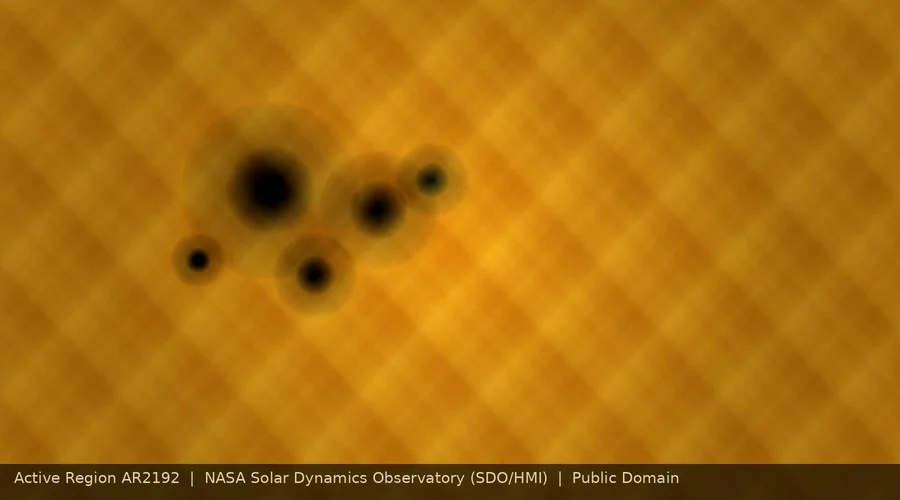
Sunspots are temporary regions of reduced surface temperature caused by concentrations of magnetic flux. They appear dark against the brighter photosphere because they are cooler, typically around 3,500°C compared to the surrounding 5,500°C. Sunspot activity peaks at solar maximum and is near-absent at solar minimum. Galileo Galilei first systematically observed sunspots in 1610, and continuous sunspot records have been kept since 1749.
Solar Flares
Solar flares are sudden, intense bursts of radiation caused by the release of magnetic energy. They can last from minutes to hours and emit X-rays and ultraviolet radiation that reach Earth in just 8 minutes. Strong flares can disrupt radio communications, damage satellites and, at their most extreme, pose a radiation hazard to astronauts outside Earth's magnetic protection.
Coronal Mass Ejections (CMEs)
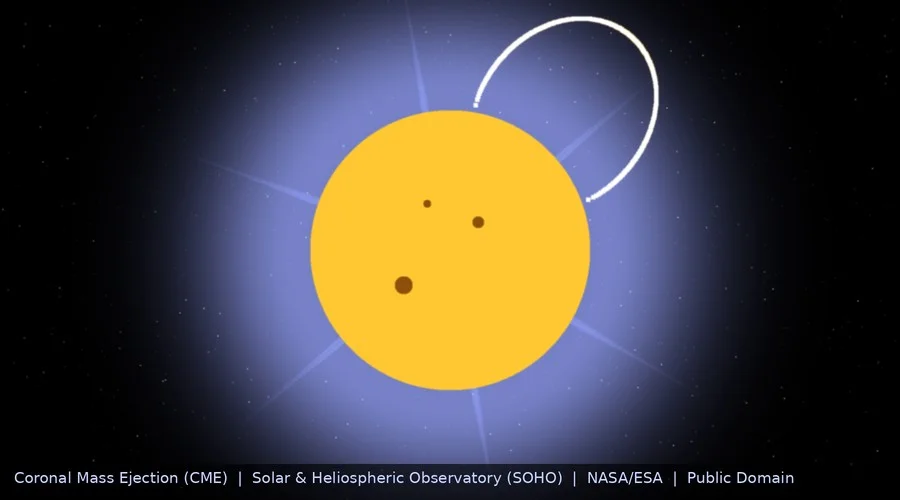
CMEs are enormous eruptions of magnetised plasma from the corona, releasing billions of tonnes of charged particles into space. When a CME is directed toward Earth, it can arrive within 1–3 days and trigger geomagnetic storms. These storms are responsible for the aurora borealis (Northern Lights) and aurora australis (Southern Lights), as the particles interact with Earth's magnetic field and upper atmosphere.
On 1–2 September 1859, the most powerful geomagnetic storm in recorded history struck Earth. Telegraph systems failed worldwide, some causing electric shocks to operators. The aurora was visible as far south as Cuba and Hawaii. A storm of the same size today would cause serious disruption to power grids, satellites and global communications. It is a sobering reminder of what the Sun can do.
The Solar Wind and Space Weather
The Sun constantly streams charged particles (electrons and protons) outward through the Solar System in every direction. This solar wind travels at 400–800 km per second and fills the entire heliosphere, a vast bubble of space extending well beyond Neptune. All the planets, including Earth, are immersed in it.
Earth's magnetic field (the magnetosphere) deflects most of this solar wind, protecting our atmosphere and life below. Where this protection weakens at the poles, charged particles funnel in and collide with atmospheric gases, producing the glow of the aurora. Because the aurora is driven directly by the Sun's activity, space weather forecasting has become an important science.
The UK Met Office Space Weather Operations Centre (MOSWOC) issues space weather alerts and aurora forecasts for the UK, using data from satellites monitoring solar wind conditions in real time. We track the same data on our UK aurora forecast page.
How to Observe the Sun Safely
The Sun is the only star we can observe in detail, but it must be treated with great care. Never look at the Sun without proper filtration. Unfiltered viewing, even briefly, can cause permanent blindness. The methods below are a summary; our full guide to observing the Sun safely covers each one step by step.
Safe Methods
Solar eclipse glasses: Rated to ISO 12312-2, these block 99.99%+ of sunlight and are safe for naked-eye viewing. They let you see the solar disk and large sunspot groups. Only use glasses from reputable suppliers. Damaged or counterfeit glasses are dangerous. The next chance to use them from the UK is the partial solar eclipse of 2 August 2027. See our astronomy events calendar for every other date worth knowing about before then.
Full-aperture solar filters: These fit over the front of binoculars or telescopes and use Baader AstroSolar film or glass. They reduce sunlight to safe levels while allowing you to see sunspot groups, solar granulation, and the limb in detail.
Dedicated solar telescopes: Hydrogen-alpha (Hα) telescopes, such as those made by Lunt or Coronado, use a narrow-band filter centred on the hydrogen-alpha wavelength (656nm). They reveal spectacular prominences at the solar limb, filaments, flares, and surface detail invisible in white light. It is the closest thing to a professional observatory view an amateur can get.
Projection method: A classic beginner technique: point a telescope at the Sun and project the image onto a white card held behind the eyepiece. Safe and effective for sunspot viewing with groups, though not all telescope designs are suitable (avoid compound telescopes/SCTs for projection).
Even with eclipse glasses and clear skies, sunspot groups are often visible to the naked eye when activity is high. With binoculars and a proper filter, you can track their movement across the disk day by day. With an Hα telescope, solar prominences (glowing red arcs leaping off the limb) are among the most striking sights in amateur astronomy: slow-moving loops of plasma, sometimes the size of Earth, hanging against the solar disc in real time. In August 2026 the Inouye Solar Telescope captured the sharpest image of the Sun ever taken, which shows what that surface looks like close up.
The Sun's Future
The Sun is currently in the middle of its main-sequence life, having burned through roughly half of its core hydrogen supply over 4.6 billion years. It will continue in this stable phase for about another five billion years.
As it ages, the Sun will gradually brighten. In about one billion years it will be roughly 10% brighter, enough to boil away Earth's oceans and end most surface life. In around five billion years the core will run out of hydrogen and the Sun will swell into a red giant, perhaps 200 times its current size, almost certainly swallowing Mercury and Venus. Whether Earth survives this expansion is still debated by astronomers.
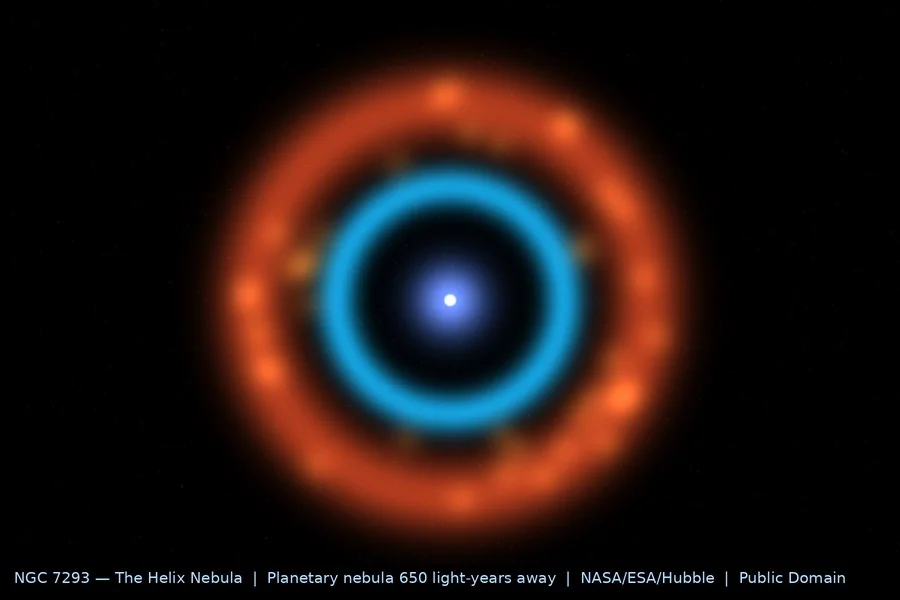
Eventually the Sun will shed its outer layers as a planetary nebula, like the Helix Nebula pictured above, leaving behind a cooling white dwarf: a dense stellar remnant about the size of Earth, slowly fading over billions of years.
Our Sun is easy to take for granted, but it is a changing, life-giving and ultimately finite star. Understanding it means understanding where our world came from and where it is going.
Equipment for solar observing
Kit we've reviewed in full
The Sun is the only star close enough to show real surface detail, but it demands dedicated kit. Never use an unfiltered telescope or binoculars. With the right filter you can watch sunspots change day by day and follow the 11-year activity cycle. Our solar observing guide explains how to fit and check each one.
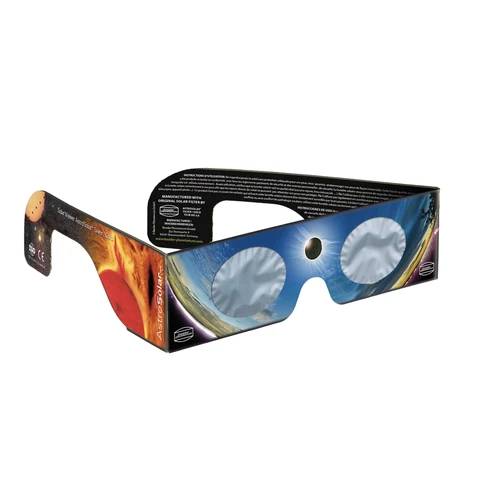
Baader Solar Eclipse Observing Glasses
ISO 12312-2 rated glasses that make naked-eye sunspot watching safe. At solar maximum the largest active regions are visible with nothing more than these and a clear sky.

Baader AstroSolar Telescope Filter (ASTF)
A sheet of Baader AstroSolar film turns whatever optics you already own into a solar instrument. Mount it in a cell at the front of the tube (never at the eyepiece) and you can track sunspot groups across the disc day by day.
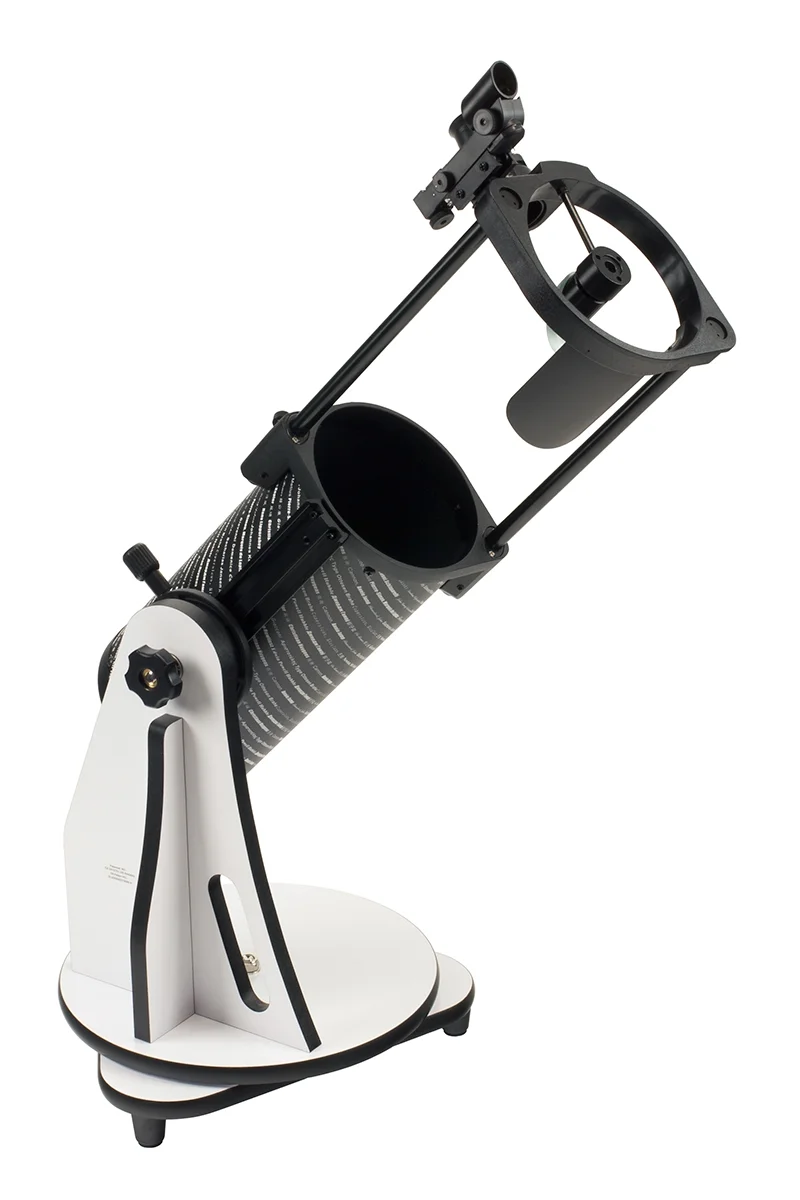
A 130P with a front-mounted Baader filter shows sunspot umbrae and penumbrae, the granulation texture of the photosphere and limb darkening clearly at 100×. Follow active regions as they rotate across the disc over a week.
Browse all our equipment reviews
Honest, research-based recommendations for every budget.
Browse all →Affiliate links: you pay the same price, we earn a small commission that helps keep WatchTheStars free.