Key Takeaways
- Barnard's Star is the closest single star to our Solar System — just 5.96 light-years away — and the second closest star system after Alpha Centauri
- It holds the record for the fastest proper motion of any known star: 10.36 arcseconds per year, moving one full Moon's width across the sky roughly every 175 years
- Despite decades of confident planet claims — including a 2018 Nature paper — Barnard's Star has no confirmed planets, with all proposed companions failing subsequent verification
Table of Contents
The Fastest Star in the Sky
Look towards Ophiuchus on a summer night through binoculars, and somewhere in that rich starfield is a star that is doing something none of the others are. It is moving. Not dramatically — you would not see it shift in a single night, or even in a year — but given a photograph taken a decade ago and one taken today, you would see the difference clearly. It has drifted across the frame. Barnard's Star is, by a wide margin, the fastest-moving star in the sky.
It is also our nearest stellar neighbour in the single-star sense. The Alpha Centauri system, 4.24 light-years away, is closer, but it contains three stars bound together. Barnard's Star — at 5.96 light-years — is the next nearest individual star to our Sun, and there is nothing quite like it in the local cosmic neighbourhood. It is ancient, it is dim, it moves with remarkable speed, and for nearly a century it has been at the centre of some of astronomy's most compelling — and ultimately cautionary — stories about planet detection.
E.E. Barnard first identified the star's extraordinary motion in 1916, comparing photographic plates taken between 1894 and 1916 at the Yerkes Observatory. He found that this unassuming red point of light in Ophiuchus had moved farther across the sky than any star ever measured. The star now bears his name.
Vital Statistics
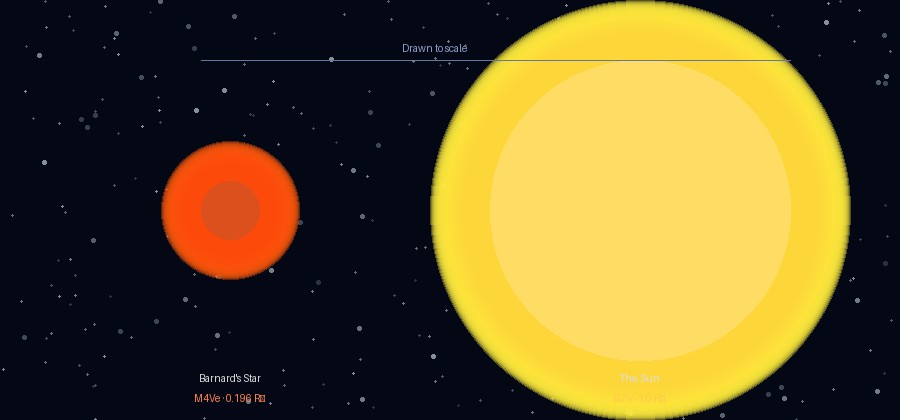
Barnard's Star belongs to the M-dwarf family — the coolest, faintest, and most numerous class of star in the Milky Way. Compared to our Sun it is dramatically smaller in every dimension: barely one-fifth the diameter, one-seventh the mass, and producing less than four thousandths of the Sun's total light output.
| Property | Barnard's Star | Our Sun |
|---|---|---|
| Spectral type | M4Ve | G2V |
| Distance from Earth | 5.96 light-years | 8.3 light-minutes |
| Age | 7–12 billion years | ~4.6 billion years |
| Mass | 0.144 M☉ | 1.0 M☉ |
| Radius | 0.196 R☉ | 1.0 R☉ |
| Luminosity | 0.00352 L☉ | 1.0 L☉ |
| Surface temperature | ~3,134 K | ~5,778 K |
| Apparent magnitude | 9.51 (binoculars needed) | −26.74 |
| Proper motion | 10.36″/year (record) | N/A |
| Radial velocity | −110.6 km/s (approaching) | N/A |
| Constellation | Ophiuchus | — |
The Star in Detail
A Dim Red Dwarf — But an Extremely Ancient One
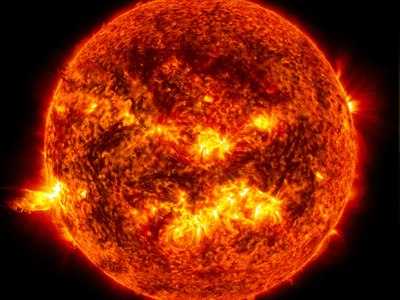
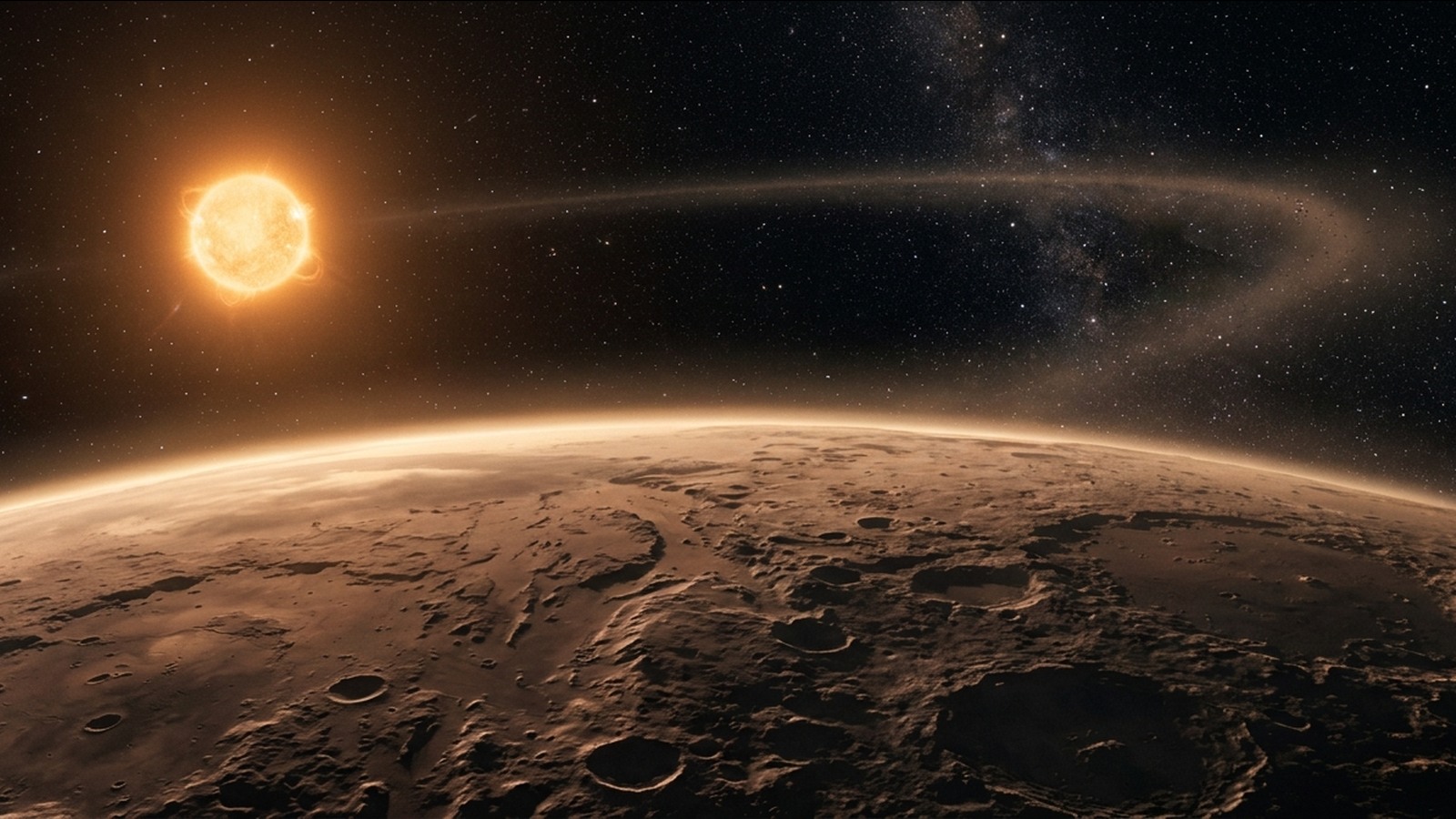
Barnard's Star is classified M4Ve: a red dwarf on the main sequence (V), with emission lines in its spectrum (e) that indicate ongoing magnetic activity. At a surface temperature of around 3,134 K — barely more than half the Sun's — it glows a deep, muted red. Were you to stand beside it and look at the sky, it would appear as a dull ember, not the blinding white disc our Sun presents.
Despite its modest dimensions, Barnard's Star has something our Sun cannot claim: extreme age. Estimates range from 7 to 12 billion years old — the star was probably already middle-aged when Earth was formed. This makes it one of the oldest known stars in the solar neighbourhood, a Population II object with very low metallicity. Its ancient chemistry speaks to origins in an era when the Milky Way itself was young and heavy elements were far less abundant than they are today.
Flares and Magnetic Activity
The 'e' in Barnard's Star's spectral classification is significant. It means the star occasionally produces stellar flares — eruptions of intense ultraviolet, X-ray, and energetic particle radiation driven by the sudden release of magnetic energy in its atmosphere. The most notable flare ever recorded from Barnard's Star occurred in 1998, observed simultaneously in ultraviolet by the Hubble Space Telescope and in the near-infrared from ground-based observatories. For a brief period during that event, its UV output spiked to levels that would be lethal to unshielded life on any nearby planet.
Barnard's Star is considered a relatively mild flare star by M-dwarf standards — it does not erupt constantly like some of its wilder cousins such as Proxima Centauri or AD Leonis. But even occasional high-energy flares pose a serious long-term challenge to the habitability of any world orbiting close enough to receive warmth from such a faint star.
A Record-Breaking Proper Motion
Proper motion is the steady drift of a star across the sky relative to the background of more distant stars — the result of both the star's own velocity through space and the changing perspective caused by Earth's movement around the Sun. Every star has some proper motion; Barnard's Star has more than any other known star.
Its proper motion of 10.3578 arcseconds per year means it travels roughly 10.4 arcseconds — about 0.003 degrees — across the sky annually. That sounds tiny, but over the timescales astronomers work with, it is enormous. The full Moon covers about 1,800 arcseconds in diameter. At Barnard's Star's pace, it crosses that distance in approximately 175 years. Compare that to nearby stars like Sirius, which takes more than 1,400 years to cross the same angular distance.
Two factors combine to give Barnard's Star this extraordinary angular speed. First, it is very close — at 5.96 light-years, perspective effects are large. Second, it is moving through space at high velocity relative to the Sun: its total space velocity is approximately 140 km/s, and it is approaching us at a radial velocity of 110.6 km/s. In astronomical terms, it is heading straight for us — though at that rate, it will reach its closest approach of about 3.75 light-years in around the year 9,700.
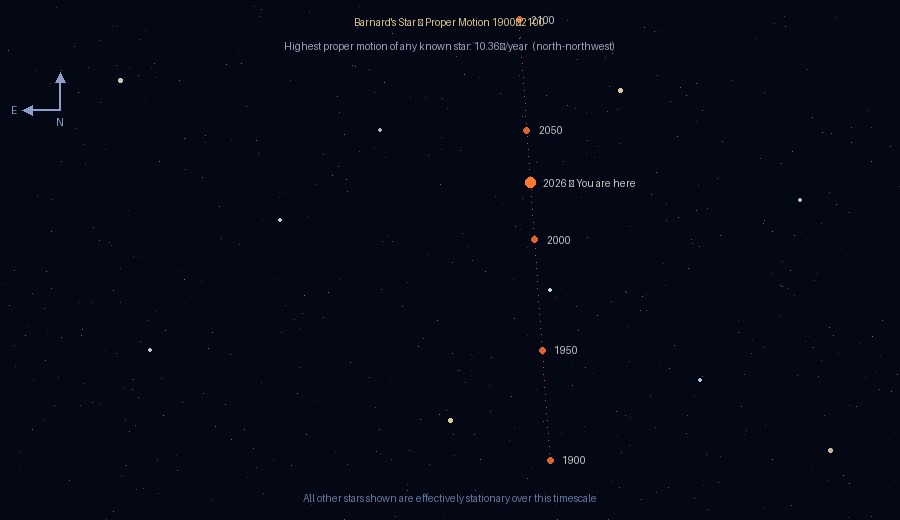
At this rate, Barnard's Star covers one degree of sky — roughly twice the diameter of the full Moon — in about 350 years. In a 20-year time-lapse of a wide-field telescope image of Ophiuchus, it would visibly stand out as the one point of light that moves. Amateur astronomers with access to archived DSS (Digitized Sky Survey) images from the 1950s and 1990s can actually confirm the star's displacement themselves — it is one of the few stars whose proper motion is measurable with decades-old photographs.
The Long Search for Planets
Van de Kamp and the Great Astrometric Controversy
Barnard's Star has a long and fascinating history as the site of claimed — and ultimately unconfirmed — planetary discoveries. The story begins with Peter van de Kamp, a Dutch-American astronomer who joined the Sproul Observatory in Pennsylvania in 1937 and dedicated much of his career to measuring the star's precise position year after year, using the astrometric method: looking for tiny wobbles in the star's path across the sky that would betray the gravitational tug of unseen planets.
In 1963, van de Kamp announced that Barnard's Star showed just such a wobble, consistent with the presence of a Jupiter-sized companion orbiting it in about 24 years. In 1969 he revised his findings, suggesting instead two planets, each roughly Jupiter's mass. The claim attracted widespread scientific and popular interest — Barnard's Star briefly became the most famous candidate for a nearby planetary system in the world.
The problem emerged when other observatories tried to reproduce the results. Astronomer John Hershey examined data from the same Sproul telescope and found that the apparent wobbles in Barnard's Star's motion coincided suspiciously precisely with dates when the telescope's objective lens had been adjusted — in 1949 and 1957. The wobbles were instrumental artifacts, not planets. A comprehensive 1973 re-analysis confirmed it. Van de Kamp never fully accepted the conclusions, and continued to publish revised planetary models until near the end of his career, but the scientific consensus had moved firmly against him.
Barnard's Star b: A 21st Century Claim
In November 2018, the planetary controversy was reignited. A team led by Ignasi Ribas at the Institute of Space Sciences in Barcelona published a paper in the journal Nature reporting evidence for a super-Earth orbiting Barnard's Star, with an orbital period of about 233 days, at a distance of 0.4 AU — near the "snow line" where water turns to ice. The candidate planet, dubbed Barnard's Star b, was estimated to be at least 3.2 times the mass of Earth. The paper combined radial velocity data from multiple instruments over 20 years, including the HARPS, UVES, CARMENES, and PFS spectrographs, making it one of the most extensive multi-instrument searches ever conducted for any star.
The announcement was cautious — the authors themselves described the signal as a "candidate" requiring independent confirmation — but the publicity was significant. A planet at 0.4 AU from such a faint star would be far too cold for liquid water, with a surface temperature around −170°C. Nevertheless, the proximity to Earth and the multi-instrument nature of the detection made it immediately compelling.
Confirmation never came. A 2021 study using new ESPRESSO data from the Very Large Telescope — the most precise radial velocity instrument available — found no convincing signal at the proposed period. The 233-day signal, when examined with better data, appeared most consistent with stellar activity cycles rather than a planetary orbit. By 2022–2023, the broader astrophysical community had largely concluded that Barnard's Star b is not a planet. As of 2026, Barnard's Star has no confirmed planetary companions.
Could Life Exist at Barnard's Star?
Even before the question of confirmed planets arises, the habitability outlook at Barnard's Star faces fundamental challenges rooted in what it is: a dim, old, magnetically active red dwarf.
The habitable zone — the range of distances where a planet could maintain liquid water on its surface — sits very close to Barnard's Star, between roughly 0.05 and 0.1 AU (compared to 0.95–1.37 AU around the Sun). A planet in this zone would almost certainly be tidally locked, with one hemisphere in permanent daylight and the other in permanent night. Whether a locked world can sustain a stable, hospitable climate depends on atmospheric circulation models that remain deeply uncertain.
The flare problem is perhaps more serious. A planet close enough to receive warmth from Barnard's Star would also be close enough to receive intense bursts of ultraviolet and X-ray radiation during flare events. Over billions of years, this bombardment could strip away atmospheric gases and subject any surface life to repeated UV spikes. Magnetic field protection and atmospheric thickness might mitigate this — but these properties depend on the planet's size and composition, which we cannot measure for worlds that have not yet been confirmed to exist.
Barnard's Star's very low metallicity and extreme age also work against complex planets. With fewer heavy elements available when the system formed, rocky planets — if they exist — are likely to be smaller and geologically less active than Earth. A world without plate tectonics and volcanism would struggle to cycle carbon between the atmosphere and rocks, potentially destabilising its long-term climate.
None of this rules out life entirely. Red dwarfs are by far the most common stars in the galaxy, and their extreme longevity — Barnard's Star will continue fusing hydrogen for perhaps another 40 billion years — gives any life that survives its early turbulent period an enormous window in which to develop. But the odds at Barnard's Star, specifically, are not considered favourable by current astrobiological thinking.
Project Daedalus: A Mission to Barnard's Star
In 1973, the British Interplanetary Society launched a five-year engineering study with an audacious goal: design a credible unmanned spacecraft capable of reaching another star within a human lifetime. They chose Barnard's Star as the target.
The result, published in 1978, was Project Daedalus — a design for a two-stage fusion rocket propelled by nuclear pulse detonation. Pellets of deuterium and helium-3 fuel would be ignited by electron beams 250 times per second in a magnetic reaction chamber, generating thrust through the exhaust plasma. The spacecraft, roughly 54,000 tonnes at launch (mostly fuel), would accelerate to approximately 12% of the speed of light over the first four years of flight, then coast to its destination.
At 12% of the speed of light, the journey to Barnard's Star — then thought to have planets — would take approximately 50 years. The probe would carry no braking fuel; it would fly through the Barnard's Star system in a matter of hours, taking measurements and transmitting data back to Earth (which would take another six years to arrive). The entire mission, from launch to final data receipt, would span about 56 years.
Project Daedalus was never meant to be built immediately; it was a proof-of-concept exercise to demonstrate that interstellar travel was not physically impossible, only enormously difficult. Its engineering legacy influenced all subsequent serious interstellar mission design, including the 2009 Project Icarus study and the more recent Breakthrough Starshot laser-sail initiative. The principal technical constraint it identified remains the same today: the difficulty of producing and storing the enormous quantities of helium-3 fuel that such a mission would require.
Project Daedalus would have required approximately 30,000 tonnes of helium-3 — a rare isotope almost entirely absent from Earth's atmosphere and crust. The study proposed mining it from Jupiter's atmosphere using robotic balloon platforms. Helium-3 is produced continuously in the outer layers of Jupiter's hydrogen atmosphere by cosmic ray interactions, but harvesting it on an industrial scale remains science fiction even by 2026 standards. This single supply problem illustrates why interstellar travel, while physically possible in principle, is extraordinarily far beyond current technology.
How to Observe Barnard's Star
Barnard's Star sits in Ophiuchus at right ascension 17h 57m 48.5s, declination +04° 41′ 36″ — fairly close to the celestial equator, which means it is accessible from the UK, though it never climbs particularly high in the sky. From southern England, it reaches a maximum altitude of around 40° when crossing the meridian. From Scotland, it barely clears 30°.
The best time to look is around its opposition — it transits due south at midnight in mid-June and at twilight in August, making June and July the prime months. By September it begins sinking into the western evening sky.
| Month | Conditions (UK) | Notes |
|---|---|---|
| June | ⭐ Best | Transits at midnight, ~40° altitude from south England |
| July | ⭐ Excellent | Transits before midnight, good altitude; shorter nights begin |
| August | Good | Transits in early evening; still well-placed |
| May | Good | Rising after midnight; short astronomical nights in UK |
| Sep–Oct | Fair | Sinking into western sky after sunset |
| Nov–Apr | Poor | Below the horizon or too low at darkness |
Equipment You'll Need
At magnitude 9.51, Barnard's Star is invisible to the naked eye but easy in binoculars. A pair of 7×50 or 10×50 binoculars will show it without difficulty once you know where to look. A small telescope (60–80mm refractor) makes identification even easier. The star itself appears as a faint reddish-orange point — its distinctly warm colour compared to the blueish-white stars nearby makes it stand out once you have located it.
How to Find It
Barnard's Star lies roughly 1.5° north of the naked-eye star 66 Ophiuchi (magnitude 4.6). Start from the recognisable "kite" shape of Ophiuchus and identify the relatively sparse eastern side of the constellation near the boundary with Serpens Cauda. Use a planetarium app (Stellarium, SkySafari, or similar) to get the precise position for your date — because of its motion, star charts more than a decade old will show it in a noticeably different location.
Tracking Its Proper Motion — A Rewarding Long-Term Project
For the most scientifically satisfying Barnard's Star observation, compare your image with a digitised photograph from the 1950s or 1990s POSS (Palomar Observatory Sky Survey) plates, available free through the Aladin Sky Atlas at CDS Strasbourg. In even a 20-year baseline, the star's displacement against background stars is clearly visible at normal telescope magnifications — making it one of the very few cases where the sky genuinely, measurably changes on a human timescale.