Key Takeaways
- Polaris is the current North Star — the closest bright star to the celestial north pole — making it the pivot point around which the entire northern sky appears to rotate throughout the night
- Polaris is actually a triple star system: the supergiant Polaris Aa is orbited by a close dwarf companion Ab (every 29.6 years) and a more distant companion Polaris B, visible in small telescopes
- Polaris is a Cepheid variable star — its brightness pulses with a period of about 3.97 days — making it one of the most important calibration objects in all of distance astronomy
Table of Contents
The North Star
Step outside on any clear night in the UK, face north, and look up about halfway between the horizon and the point directly overhead. There, hanging steadily while every other star in the sky slowly wheels around it, you will find Polaris — the North Star. It is not the brightest star in the sky, nor the closest, nor the most massive. What makes Polaris extraordinary is where it sits: less than one degree from the celestial north pole, the invisible point in the sky directly above Earth's geographic North Pole.
Because of this near-perfect alignment, Polaris appears almost motionless. Every other star in the northern sky traces a circular arc around it over the course of a night — some close to the pole making tight circles, others sweeping in vast arcs that carry them from east to west. But Polaris stays put. A long-exposure photograph aimed at the north celestial pole reveals hundreds of star trails curving around a single, barely-moving point of light: that point is Polaris.
This fixedness has made Polaris the single most useful star in the history of human navigation. For millennia — long before the magnetic compass, let alone GPS — travellers, sailors, and explorers found north by finding this star. It told them their latitude, oriented their maps, and guided them across featureless oceans. No other star in the sky has shaped human exploration so directly.
But Polaris is far more than a navigational beacon. To modern astronomers, it is a fascinating object in its own right: a triple star system, a Cepheid variable whose gentle pulsations helped calibrate the cosmic distance ladder, and a yellow supergiant shining with the power of nearly 2,500 Suns. It is also a temporary pole star — Earth's wobbling axis will carry the pole away from Polaris over the coming centuries, as it has carried it towards Polaris over the past few thousand years.
Vital Statistics
Polaris Aa — the bright primary star that you see with the naked eye — is an F-type yellow-white supergiant. It is substantially larger, more massive, and more luminous than our Sun, though its surface temperature is only moderately hotter. The system also contains two smaller companions: the close dwarf Polaris Ab and the more distant Polaris B.
| Property | Polaris Aa | Polaris B | Our Sun |
|---|---|---|---|
| Type | F7Ib supergiant | F3V main-sequence | G2V main-sequence |
| Distance from Earth | ~430 light-years (system) | 8.3 light-minutes | |
| Age | ~50–80 million years | ~4.6 billion years | |
| Mass | 5.4 M☉ | 1.39 M☉ | 1.0 M☉ |
| Radius | ~46 R☉ | 1.04 R☉ | 1.0 R☉ |
| Luminosity | ~2,500 L☉ | 3.9 L☉ | 1.0 L☉ |
| Surface temperature | ~6,015 K | ~6,900 K | ~5,778 K |
| Apparent magnitude | +1.98 (variable) | +8.7 (telescope needed) | −26.74 |
| Pulsation period (Aa) | 3.97 days (Cepheid) | — | — |
A Triple Star System
The single point of light you see as Polaris is actually three stars. The dominant member, Polaris Aa, is an enormous yellow-white supergiant roughly 46 times the diameter of our Sun. If placed at the centre of our Solar System, its surface would extend almost to the orbit of Mercury. It is this star that produces virtually all the light we see.
Very close to Polaris Aa — too close to separate visually even with the largest telescopes — lurks Polaris Ab, a small F-type main-sequence star of about 1.26 solar masses. It orbits the supergiant every 29.6 years at an average distance of roughly 18.5 AU (about the distance of Uranus from the Sun). Its existence was long suspected from spectroscopic measurements of Polaris Aa's motion and was finally resolved directly in 2006 by the Hubble Space Telescope's Fine Guidance Sensors, making it one of the closest stellar companions ever imaged.
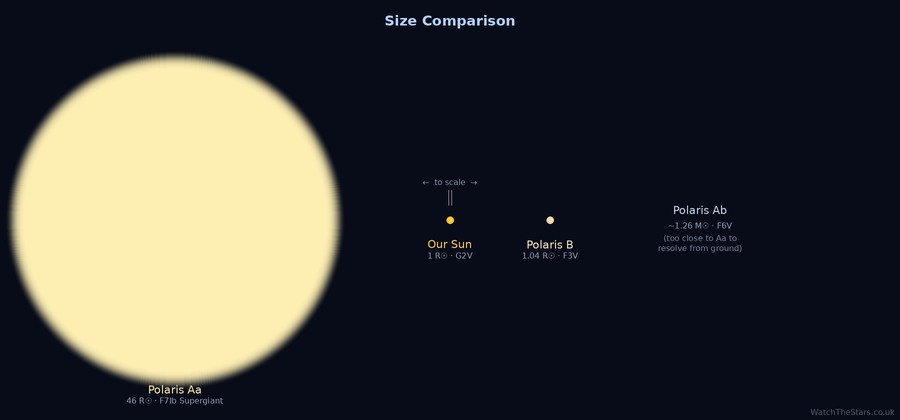
Much further out, at a projected separation of roughly 2,400 AU (about 18 arcseconds on the sky), sits Polaris B — an F3 main-sequence star shining at magnitude 8.7. Unlike the impossibly close Ab, Polaris B is readily visible in a small telescope and has been known since William Herschel first noted it in 1780. Despite being 430 light-years from Earth, the wide separation between Aa and B means even a 75mm refractor at moderate magnification can split them — making Polaris one of the most satisfying double stars for beginners.
Polaris the Cepheid Variable
Polaris Aa belongs to one of the most important classes of variable star in astronomy: the classical Cepheid variables. These are supergiant stars that pulsate rhythmically — expanding and contracting, heating and cooling — over periods that range from a few days to several months. Polaris pulsates with a period of about 3.97 days, during which its brightness changes by a small amount (currently about 0.03 magnitudes — far too little to notice by eye).
What makes Cepheids so critical to astronomy is the period-luminosity relationship, discovered by Henrietta Swan Leavitt in 1908 while studying variable stars in the Small Magellanic Cloud. Leavitt found that the longer a Cepheid's pulsation period, the more intrinsically luminous it is. This means that if you measure a Cepheid's period — something you can do from any distance — you immediately know its true luminosity. Compare that to how bright it appears, and simple mathematics gives you the distance. This technique, still in use today, has been fundamental to measuring distances across the Milky Way and to other galaxies.
Polaris is the nearest Cepheid variable to Earth. This makes it an anchor point for calibrating the entire Cepheid distance ladder — the chain of measurements that connects nearby stars to distant galaxies. Every refinement in our understanding of Polaris's distance, luminosity, and pulsation propagates outward through the cosmic distance scale, ultimately affecting our estimate of the expansion rate of the universe (the Hubble constant). For such a seemingly humble star, the scientific stakes are enormous.
Polaris's Cepheid pulsation has been declining over the past century. In the early 1900s, its brightness varied by about 0.12 magnitudes per cycle. By the 1990s, this had dropped to just 0.02 magnitudes — so small that some astronomers wondered if the pulsation might stop entirely. But since around 2000, the amplitude has stabilised and even slightly increased again. The cause remains debated: Polaris may be crossing the instability strip in the Hertzsprung-Russell diagram, or internal structural changes may be modulating the pulsation. Whatever the reason, this changing behaviour makes Polaris a fascinating test case for stellar evolution theory.
Polaris and Navigation
The practical value of Polaris is breathtakingly simple: its altitude above the horizon equals your latitude. Stand at the North Pole and Polaris is directly overhead at 90°. Stand at the equator and it sits on the horizon at 0°. From London (latitude 51.5° N), Polaris hangs about 51.5° above the northern horizon — always, at any time of night, in any season. No other star provides such a direct, constant, and reliable positional fix.
This relationship was understood at least as far back as the ancient Phoenicians, the great seafarers of the Mediterranean who are thought to have used Polaris (or at least the general direction of the pole) for open-water navigation as early as 600 BCE. The ancient Greeks certainly knew it — Thales of Miletus is credited with advising Greek sailors to navigate by the Little Bear (Ursa Minor) rather than the Great Bear (Ursa Major), because the former contained the star nearest the pole.
By the medieval period, Arab and European navigators were using the altitude of Polaris with simple instruments — the astrolabe, the cross-staff, and later the quadrant — to determine their latitude at sea. The technique was so reliable that Columbus used it on his 1492 voyage to the Americas, noting in his journal that Polaris appeared to move in a small circle around the true pole (a 3.5° radius in his era, larger than the current 0.7°). Later, the sextant refined these measurements to arcminute precision, and Polaris remained the primary latitude reference for maritime navigation right up until the GPS era.
Why Polaris Won't Always Be the Pole Star
Earth's rotational axis is not fixed in space. Like a slowly wobbling spinning top, the axis traces out a large cone once every 25,772 years — a phenomenon called axial precession, first described by Hipparchus around 130 BCE. This wobble means the celestial north pole sweeps through the constellations over millennia, and whichever bright star happens to lie near its current position gets the title of "pole star."
We are living through one of the best alignments in the entire precession cycle. Polaris currently sits just 0.7° from the true pole and will reach its closest approach — about 0.45° — around the year 2100. After that, the pole will slowly drift away. By 3000 CE, Gamma Cephei (Errai) will be the nearest reasonably bright star to the pole. By around 7500 CE, Alderamin (Alpha Cephei) takes over. And in roughly 12,000 years, the pole will lie near Vega — one of the brightest stars in the sky — though Vega will still be several degrees from the exact pole, making it a less precise pole star than Polaris is today.
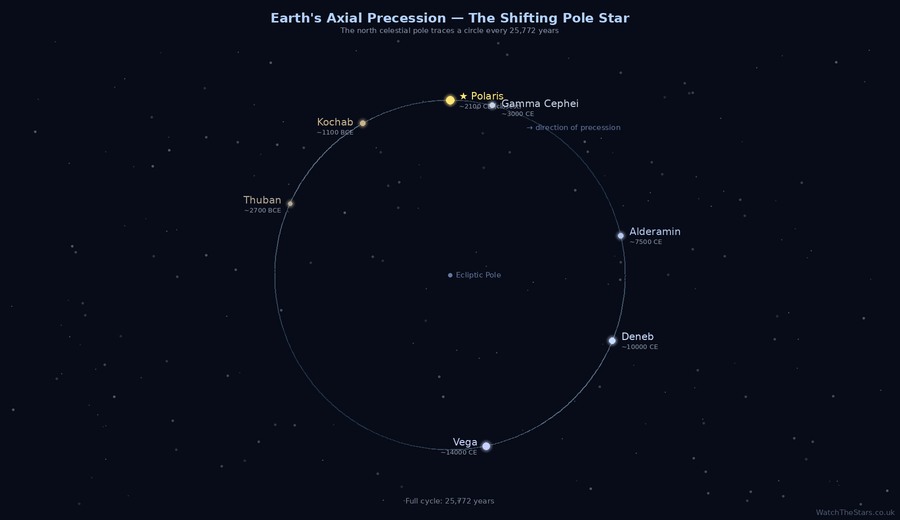
Looking backwards, when the Great Pyramid of Giza was built around 2560 BCE, the pole star was Thuban (Alpha Draconis) — a much fainter star than Polaris. Some archaeologists believe the descending passage in the Great Pyramid was aligned to point at Thuban. Before Thuban, there were long periods with no conveniently bright pole star at all. Future civilisations will face the same situation: the era of Polaris is a golden age for celestial navigation in the Northern Hemisphere.
Polaris Through Human History
The Unwavering Star
Across cultures and centuries, Polaris has been defined by its stillness. The Anglo-Saxons called it "scip-steorra" (ship star). Old English texts refer to it as the star that "never moves." The Norse knew it as the "nail of the world" — Veraldar Nagli — the cosmic spike around which the sky revolved, as if the heavens were pinned in place by a single bright point.
Eastern Traditions
In Chinese astronomy, Polaris held supreme cosmic significance. Known as Tianshu (天樞), it was identified with the Celestial Emperor — the immovable ruler around whom the entire court of heaven rotated. Chinese star catalogues placed it at the centre of the Purple Forbidden Enclosure, the most important asterism in the Chinese sky, mirrored on Earth by the Forbidden City in Beijing. This metaphor — the emperor as the unmoving centre — shaped Chinese political philosophy for over two thousand years.
In Hindu tradition, Polaris is Dhruva — named after a young prince in the Vishnu Purana who, through intense devotion, was granted the highest and most permanent seat in the heavens by Lord Vishnu. The Dhruva story emphasises steadfastness and unwavering purpose, qualities projected onto the star itself. In Sanskrit, "dhruva" means "fixed" or "immovable."
Indigenous North American Traditions
Many Indigenous peoples of North America incorporated Polaris into their cosmologies. The Pawnee of the Great Plains called it the "Star That Does Not Walk Around" and considered it the chief of the stars. Several Inuit groups used it for orientation during the long Arctic winter, when it hangs high in the sky. The Navajo associated it with the central fire of the hogan — the still centre of the home around which life revolved.
The Underground Railroad
In one of the most powerful chapters of American history, Polaris served as a guide to freedom. Enslaved people escaping the American South in the 18th and 19th centuries followed the North Star as a reliable indicator of the direction to the free states and Canada. The song "Follow the Drinking Gourd" is believed to contain coded instructions for finding the Big Dipper (the Plough) and using its pointer stars to locate Polaris. Frederick Douglass named his abolitionist newspaper The North Star — a symbol of hope, direction, and liberation that endures to this day.
How to Observe Polaris from the UK
One of the great advantages of Polaris is that it is circumpolar from the UK — meaning it never sets below the horizon. Unlike Sirius or Orion, which are seasonal objects, Polaris is visible on every single clear night of the year, in every season, from dusk to dawn. It is always in the north, always at the same altitude above the horizon (equal to your latitude), and always easy to find.
The classic method: find the Plough (the seven bright stars of Ursa Major, high in the northern sky). Identify the two "pointer stars" at the front edge of the Plough's bowl — Dubhe and Merak. Draw a line from Merak through Dubhe and extend it roughly five times the Dubhe–Merak distance. That line leads straight to Polaris. It is the only moderately bright star in an otherwise sparse region of sky — you cannot mistake it.
| Season | Conditions (UK) | Notes |
|---|---|---|
| Spring | ⭐ Excellent | The Plough is nearly overhead, making the pointer-star method easiest |
| Summer | Good | Short nights limit observing time; Polaris is always visible but sky is lighter |
| Autumn | ⭐ Excellent | Long dark nights; Cassiopeia high in the sky provides an alternative pointer |
| Winter | ⭐ Excellent | Longest nights; both Plough and Cassiopeia well-placed for finding Polaris |
Altitude from UK Latitudes
Polaris sits at a declination of +89.3°, so from any location in the Northern Hemisphere, its altitude above the horizon is almost exactly equal to your latitude. From London (51.5° N), Polaris is about 51.5° up — roughly halfway between the horizon and the zenith. From Edinburgh (55.9° N), it climbs to nearly 56°. From the Shetland Islands (60.4° N), it is over 60° up. This consistency is precisely what makes it so useful for navigation — wherever you are, its height tells you where you are.
Splitting the Double Star
Polaris B, at magnitude 8.7, is separated from the bright primary by about 18 arcseconds — a generous gap for a double star. A 75–80mm refractor at 50–100× magnification will split them clearly on a steady night. The challenge is the brightness contrast: Polaris Aa shines at magnitude 2.0, roughly 400 times brighter than Polaris B. Using higher magnification helps by darkening the sky background and spreading out the glare. The companion appears as a delicate, slightly warm-white point beside the brighter golden primary — a beautiful sight and a rewarding target for beginners.
Polaris Ab, at only 18.5 AU from the primary, cannot be split visually by any ground-based telescope — it required the Hubble Space Telescope to resolve it in 2006. But its gravitational influence on Polaris Aa is detectable as a slow radial velocity drift in high-resolution spectra.
Star Trail Photography
Polaris is the go-to subject for star trail photography in the Northern Hemisphere. Point a camera north, set a long exposure (or stack many shorter exposures over 30–60 minutes), and every star in the frame traces a circular arc centred on Polaris. The result is one of the most visually striking images in all of astrophotography — concentric rings of light spiralling around a single nearly-stationary point. A wide-angle lens (14–24mm) at f/2.8, ISO 800–1600, with individual exposures of 20–30 seconds stacked using free software like Sequator or StarStaX, produces excellent results even from suburban locations.