Key Takeaways
- Sirius is the brightest star in the night sky at magnitude −1.46 — more than twice as bright as the second-brightest star Canopus — and easily visible from every inhabited continent on Earth
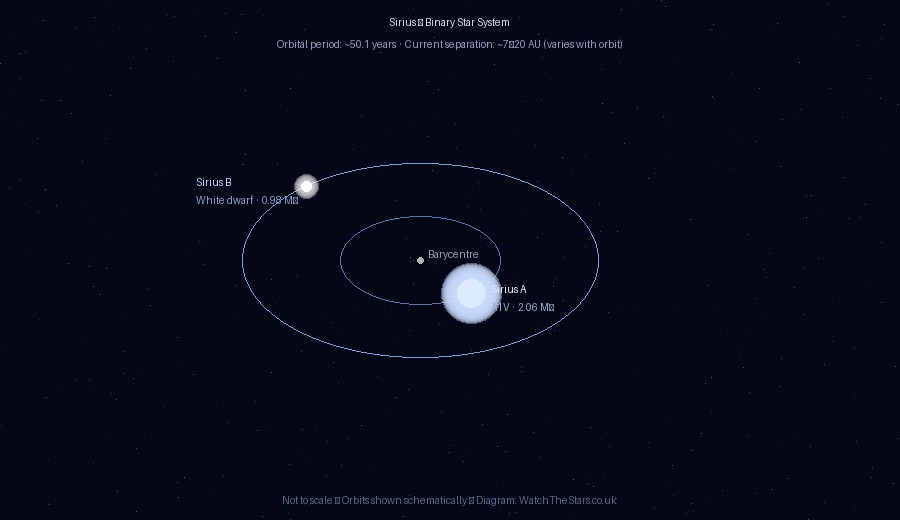
- Sirius is actually a binary system: the brilliant blue-white Sirius A is orbited by Sirius B, a white dwarf the size of Earth but nearly as massive as our Sun, completing one orbit every 50.1 years
- Ancient Egyptians built their entire civil calendar around Sirius — its annual reappearance in the dawn sky signalled the flooding of the Nile and was celebrated as the start of the new year
Table of Contents
The Brightest Star in the Night Sky
On any clear winter night from the UK, cast your eyes south and look for the unmistakeable point of intense blue-white light blazing low above the horizon. Nothing else in the night sky comes close to it in brightness. This is Sirius — Alpha Canis Majoris, the brightest star in the night sky — and it has been the most prominent star in human culture for almost as long as recorded history exists.
At apparent magnitude −1.46, Sirius outshines every star, every planet apart from Venus and occasionally Mars and Jupiter, and every object in the night sky except the Moon. It is so bright that sharp-eyed observers can spot it in full daylight if they know precisely where to look and shield their eyes from the Sun. Under very dark skies it even casts a faint shadow.
Two factors combine to make Sirius so dazzling. First, it is genuinely a very luminous star — about 25 times the Sun's total energy output, owing to its greater mass and higher surface temperature. Second, it is close: at 8.6 light-years it is the fifth nearest star system to our Solar System. Proximity and brilliance together produce the most spectacular naked-eye star in the sky.
What most casual observers do not know is that Sirius is actually two stars. The bright point of light they see — Sirius A — is in a slow gravitational waltz with a tiny, faint, ultra-dense companion called Sirius B: a white dwarf that orbits A every 50 years and is almost completely hidden in its glare.
Vital Statistics
Sirius A is an A-type main-sequence star — hotter, more massive, and more luminous than our Sun, but not in the extreme upper end of stellar masses. Its blue-white colour reflects a surface temperature nearly double the Sun's. It is a relatively young star, just a few hundred million years old, which means it formed long after the Solar System had already settled into its current configuration.
| Property | Sirius A | Sirius B | Our Sun |
|---|---|---|---|
| Type | A1V main-sequence | DA2 white dwarf | G2V main-sequence |
| Distance from Earth | 8.60 light-years (system) | 8.3 light-minutes | |
| Age | ~230–300 million years | ~4.6 billion years | |
| Mass | 2.063 M☉ | 0.978 M☉ | 1.0 M☉ |
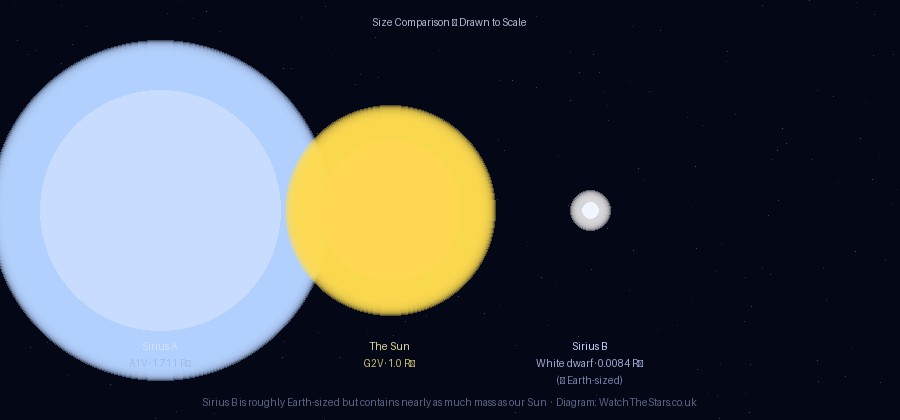
| Radius | 1.711 R☉ | 0.0084 R☉ (~Earth-sized) | 1.0 R☉ |
| Luminosity | 25.4 L☉ | 0.000056 L☉ | 1.0 L☉ |
| Surface temperature | ~9,940 K | ~25,200 K | ~5,778 K |
| Apparent magnitude | −1.46 (brightest star) | +8.44 (telescope needed) | −26.74 |
| Orbital period (A around B) | 50.1 years | — | |
Sirius A — The Star in Detail
Sirius A is classified A1V — a white main-sequence star roughly twice the mass of our Sun. The "A" spectral class denotes stars with surface temperatures between about 7,500 and 10,000 K, giving them their characteristic brilliant blue-white colour. At 9,940 K, Sirius A sits near the cooler end of that range, though it still burns far hotter than the yellow-orange Sun.
At 2.06 solar masses, Sirius A is living fast by stellar standards. More massive stars consume their hydrogen far more rapidly than smaller ones — the relationship is roughly mass cubed to luminosity. A star like Sirius A has a total main-sequence lifetime of only about one billion years, compared to the ten billion years available to our Sun. It has already used perhaps a quarter of that in its 230–300 million year existence. By the time complex life was emerging on Earth, Sirius had not even formed yet.
In about 660 million years, Sirius A will exhaust its core hydrogen, swell into a giant star, shed its outer layers as a planetary nebula, and collapse into a white dwarf — following exactly the same path that its companion Sirius B has already completed.
Sirius B — The Famous White Dwarf
Sirius B is one of the most historically important objects in stellar astronomy. Today it appears as a faint point of light at magnitude 8.44, lost in the glare of its brilliant companion and visible only through a good telescope under ideal conditions. But what it represents is extraordinary: a star nearly as massive as our Sun compressed into a sphere roughly the size of Earth — a density so extreme that a teaspoon of its material would weigh about five tonnes.
Prediction and Discovery
The story of Sirius B begins not with a telescope, but with mathematics. In 1844, German astronomer Friedrich Bessel was analysing careful measurements of Sirius's position stretching back decades and noticed something strange: the star was not moving in a perfectly straight line. Instead it followed a gentle, rhythmic wobble — as though something unseen was tugging at it gravitationally. Bessel correctly concluded that Sirius must have an invisible companion, and estimated its orbital period at about 50 years.
The companion remained hidden for nearly two decades. Then, in January 1862, American telescope-maker Alvan Graham Clark was testing a newly completed 18.5-inch refractor — the largest telescope in the world at the time — when he noticed a faint point of light beside Sirius. It was exactly where Bessel's predictions said the companion should be. Sirius B had been found.
The star's true nature only became clear decades later. In 1915, astronomer Walter Adams measured the spectrum of Sirius B and found that, despite being so faint, it had the spectrum of a hot A-type star — far hotter than its luminosity should allow if it were a normal star. The only explanation consistent with the data was that Sirius B must be an incredibly small, incredibly dense object: a "white dwarf," as these stellar remnants came to be called. It was the first white dwarf ever identified.
What a White Dwarf Is
Sirius B represents the fate of most stars in the galaxy, including our own Sun. When a star of less than about eight solar masses exhausts its core hydrogen, it swells into a giant, then sheds its outer layers as a beautiful glowing planetary nebula, leaving the dense core exposed. This core — a white dwarf — has no ongoing fusion to support it against gravity. Instead, it is held up by the quantum mechanical pressure of its electrons, packed so tightly that the laws of ordinary matter no longer apply.
Sirius B has a surface temperature of around 25,200 K — hotter than Sirius A, in fact — but because it is so small, its total luminosity is minuscule. It shines at just 0.0056% of the Sun's energy output. Over billions of years, with no energy source to sustain it, Sirius B will slowly cool and fade, eventually becoming a cold, dark cinder — a "black dwarf." But the universe is not yet old enough for any white dwarf to have cooled that far.
Sirius B contains nearly the mass of the Sun, yet the entire Sirius system is only about 230–300 million years old. How did Sirius B — which is clearly already at the end of its life — evolve so quickly? The answer is that it started out with much more mass than the Sun, perhaps 5–6 solar masses. Very massive stars consume their fuel at a ferocious rate and complete their entire life cycle in just tens to hundreds of millions of years. Sirius B was already born massive, burned bright, swelled into a giant, and shed its outer layers — all before the Sirius system was even 300 million years old. Sirius A, with half that original mass, is still on the main sequence today.
Sirius Through Human History
Ancient Egypt — The Star of the Nile
No star in human history has carried more cultural weight than Sirius. For ancient Egyptians, it was not merely a star — it was Sopdet, the goddess who brought life to Egypt. Each year, Sirius would spend approximately 70 days hidden below the horizon, lost in the Sun's glare. Its reappearance in the dawn sky just before sunrise — the heliacal rising — occurred in mid-July and preceded the annual inundation of the Nile by only a few weeks. This flood deposited the rich black silt that made Egyptian agriculture possible.
The Egyptians built an entire civil calendar of 365 days around this cycle, which they called the Sothic year (Sothis being the Greek name for Sopdet). Some temples were deliberately aligned so that the rising Sun would shine down the main axis on the morning of the heliacal rising of Sirius. The star was so central to Egyptian civilisation that the hieroglyph for "year" incorporated a star.
Greece, Rome and the Dog Days
The ancient Greeks called Sirius "Seirios," meaning "scorching" or "glowing" — a reference to its brilliance and to the intense heat that accompanied its summer appearance. Because Sirius lies in the constellation Canis Major (the Greater Dog), it was also known as the Dog Star. The period when Sirius rises with the Sun — roughly late July through August — became known as the "Dog Days of Summer," a phrase that persists in English today. The Greeks and Romans believed that the combined heat of Sirius and the Sun together caused the oppressive summer heat of that period. Scientifically incorrect, but culturally enduring.
Homer's Iliad uses Sirius as a metaphor for the terrifying brilliance of Achilles as he advances towards Troy: "like the star that rises in late summer," blazing and ominous. For the ancient Mediterranean world, Sirius was simultaneously a harbinger of harvest, drought, pestilence, and war.
Indigenous Traditions
Sirius features prominently in the traditions of cultures across the globe. Australian Aboriginal peoples — who have among the oldest astronomical traditions on Earth — variously identified Sirius as an eagle, as a source of wisdom, or as a seasonal marker. The Lakota Sioux associated it with the spirit of the wolf. In Polynesian navigation, Sirius (known as "A'a" in some traditions) was used as a steering star for open-ocean voyaging. Its brightness made it one of the most universally recognised and named stars in human history, appearing in the star catalogues of Babylonian, Chinese, Indian, and medieval Islamic astronomy.
Why Sirius Twinkles So Dramatically
If you have watched Sirius from the UK — especially when it is low in the southern sky — you will have noticed something distinctive: it does not just twinkle white like most stars. It flashes through colours — blue, then red, then green, then white — sometimes so rapidly and vividly that it is one of the most commonly reported UFO sightings in the country, particularly in winter.
This phenomenon is called scintillation, or atmospheric dispersion, and it is entirely a property of Earth's atmosphere rather than the star itself. Light from any star is refracted, scattered, and bent as it passes through pockets of air at different temperatures and densities. This bending splits white light into its component colours, like a prism — each colour arriving at the eye from a fractionally different direction. As the air currents move, these colour patches sweep across the pupil in rapid succession.
Sirius scintillates more dramatically than most stars for two reasons. First, it is so bright that even subtle atmospheric effects are clearly visible — the same reason a bright torch flickers more noticeably than a candle through heat haze. Second, from British latitudes Sirius never rises very high — at most about 25° above the horizon from southern England — meaning its light always travels through a thick slice of atmosphere. The lower the star, the more atmosphere in the way, and the more severe the scintillation. All stars near the horizon twinkle wildly; Sirius does so brilliantly.
Does Sirius Have Planets?
Despite intensive searches, no planets have been confirmed around either Sirius A or Sirius B. This is perhaps unsurprising given the system's youth — at 230–300 million years old, complex planet formation may still be underway or may have been disrupted by the system's eventful early history, particularly when Sirius B's progenitor star expanded into a giant and expelled its outer layers.
Infrared observations have found no evidence of a significant debris disc around Sirius A — the kind of dusty structure that would indicate ongoing planet-forming activity. Radial velocity surveys are complicated by the star's rapid rotation (about 16 km/s at the equator, compared to 2 km/s for the Sun), which broadens spectral lines and reduces sensitivity to small planetary signals.
In the longer term, any planet orbiting within the habitable zone of Sirius A would face a difficult future. In roughly 660 million years, Sirius A will swell into a giant and eventually shed its outer layers, dramatically disrupting any inner planetary system. For now, Sirius remains a spectacular spectacle, not a candidate for habitable worlds.
How to Observe Sirius from the UK
Finding Sirius from the UK is straightforward: it is the brightest point of light in the night sky in the winter months, unmistakeable even from light-polluted suburban gardens. The classic method is to follow Orion's Belt — the three equally-spaced stars in a short diagonal line. Extend that line to the lower-left (south-east) by roughly four times its own length, and you arrive at Sirius. It blazes blue-white and does not look quite like any other star.
| Month | Conditions (UK) | Notes |
|---|---|---|
| January | ⭐ Best | Transits due south around midnight; highest altitude of the year |
| February | ⭐ Excellent | Transits in early evening; Orion and Canis Major dominate the sky |
| March | Good | Still well-placed in early evening; sinking as the season progresses |
| December | Good | Rises in the late evening; dramatic winter sky backdrop |
| Apr–May | Fair | Low in the western sky at dusk; sets early in the evening |
| Jun–Sep | Poor | Hidden in the Sun's glare — the 70-day period ancient Egyptians noted |
Maximum Altitude from the UK
Sirius's declination of −16.7° means it never climbs particularly high from Britain. From southern England it reaches a maximum altitude of around 24° above the horizon — roughly a quarter of the way from horizon to zenith. From Scotland the situation is worse, barely topping 17°. This is why Sirius scintillates so dramatically: its light always arrives through a generous thickness of atmosphere. If you want to see Sirius truly steady and brilliant, you need to travel to the Mediterranean or further south.
Spotting Sirius B
Seeing Sirius B is a genuine challenge even for experienced observers. At magnitude 8.44, it is not faint in absolute terms — you can see it with a 100mm telescope in principle. The problem is that Sirius A outshines it by a factor of roughly 10,000, and their current separation is only about 11 arcseconds (and narrowing as they approach the closer part of their 50-year orbit). You need a telescope with at least 100–150mm of aperture, very steady atmospheric seeing, and ideally a high-magnification eyepiece to push Sirius A's diffraction rings away from B's position. The best time to try is when Sirius is highest in the sky — transit in January or February — and after midnight when the atmosphere has settled.