Key Takeaways
- Retired Maj. Gen. William Neil McCasland, 68, has been missing since 27 February 2026 after leaving his Albuquerque home on foot.
- McCasland commanded the Air Force Research Laboratory at Wright-Patterson — the base at the centre of decades of UFO lore, Project Blue Book, and Roswell speculation.
- He briefly worked with Tom DeLonge's To The Stars, Inc. after retiring, and his name appeared in the WikiLeaks Podesta emails in a UAP context.
- A US congressman has stated McCasland 'has a lot of information' on UAPs. His wife says he has no special knowledge of ET bodies or debris.
- Clothing and boots were found at his second home in Pagosa Springs, Colorado. The FBI is assisting the search.
📑 Table of Contents
- Who Is Maj. Gen. William Neil McCasland?
- The Disappearance: What We Know
- Wright-Patterson: The Base at the Heart of UFO Lore
- Project Blue Book and Hangar 18
- McCasland's UAP Connections: DeLonge, Podesta and To The Stars
- Congress Weighs In: 'He Has a Lot to Say'
- The Search: FBI, Colorado and a Mountain That Wouldn't Cool Down
- What His Wife Says
- The Bigger Picture: Disappearing Into the Disclosure Era
- What Happens Next?
In late February 2026, in a quiet neighbourhood on the north-east edge of Albuquerque, New Mexico, a retired US Air Force major general put on his hiking boots, picked up a .38-calibre revolver, and walked out of his front door. He left his phone on the kitchen counter. His prescription glasses. His watch. Three weeks later, nobody knows where he went.
The man is retired Maj. Gen. William Neil McCasland, 68. And the reason his disappearance is being followed so closely — by congressmen, by UAP researchers, by investigative journalists, and now by the FBI — is what he did during his military career, and who he spoke to afterwards.
McCasland commanded the Air Force Research Laboratory at Wright-Patterson Air Force Base. In the world of UAP research, that name carries enormous weight.
Who Is Maj. Gen. William Neil McCasland?
McCasland is not a peripheral figure. His career represents decades at the sharpest edge of America's classified aerospace and space weapons programmes.
He holds degrees from the US Air Force Academy, MIT, and Harvard's Kennedy School of Government — the kind of résumé that places a person in rooms that most military officers never enter. During his career he served as chief engineer on the Department of Defense's Global Positioning System programme, as system programme director of the Space Based Laser Project Office, and as director of special programmes at the Pentagon — a title that, in US military parlance, typically means black-budget work.
In May 2011, he was posted to his final command: the Air Force Research Laboratory (AFRL) at Wright-Patterson Air Force Base, Ohio. He held that position until his retirement in October 2013. The AFRL is the Air Force's primary science and technology hub — the place where classified research into propulsion, materials, directed energy and, reportedly, recovered anomalous materials has been conducted for decades.
Which brings us to the base itself.
Wright-Patterson: The Base at the Heart of UFO Lore
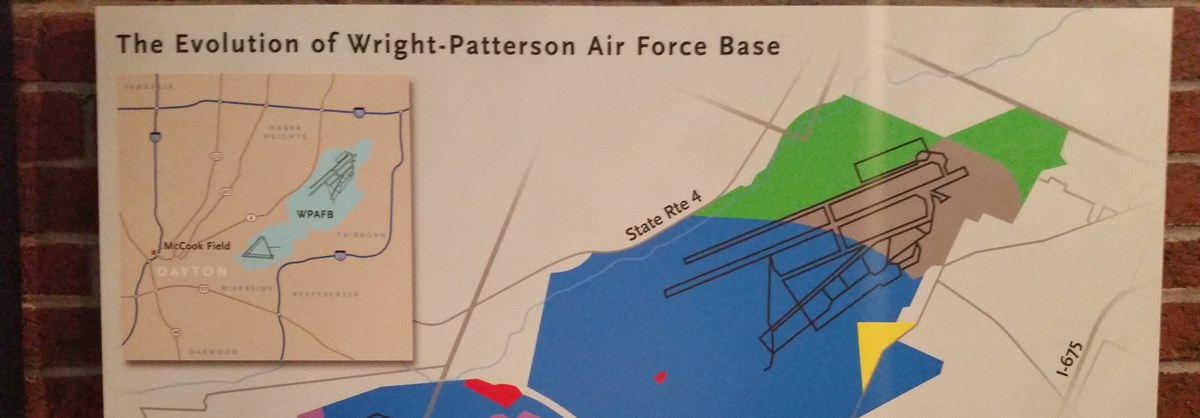
Wright-Patterson Air Force Base, sprawling across 8,000 acres near Dayton, Ohio, has been a central character in America's UFO story since 1947. When the US military needed a home for its most sensitive aerospace research, Wright Field — as it was then known — was the obvious choice. It housed some of the most advanced technical minds in the country, and it had the secure infrastructure to conduct work that the public was never meant to see.
After the Roswell incident in July 1947, rumours began to circulate that whatever had been recovered in the New Mexico desert — whether a weather balloon, a classified surveillance device, or something else entirely — had been transported to Wright Field. Former military pilot Oliver Henderson reportedly told his wife that he personally flew a cargo of debris and bodies from Roswell to Wright Field. The Air Force has always denied this categorically.
But the rumours never went away. And they gained a peculiar institutional legitimacy when it emerged that Wright-Patterson was also the home of Project Blue Book.
Project Blue Book and Hangar 18
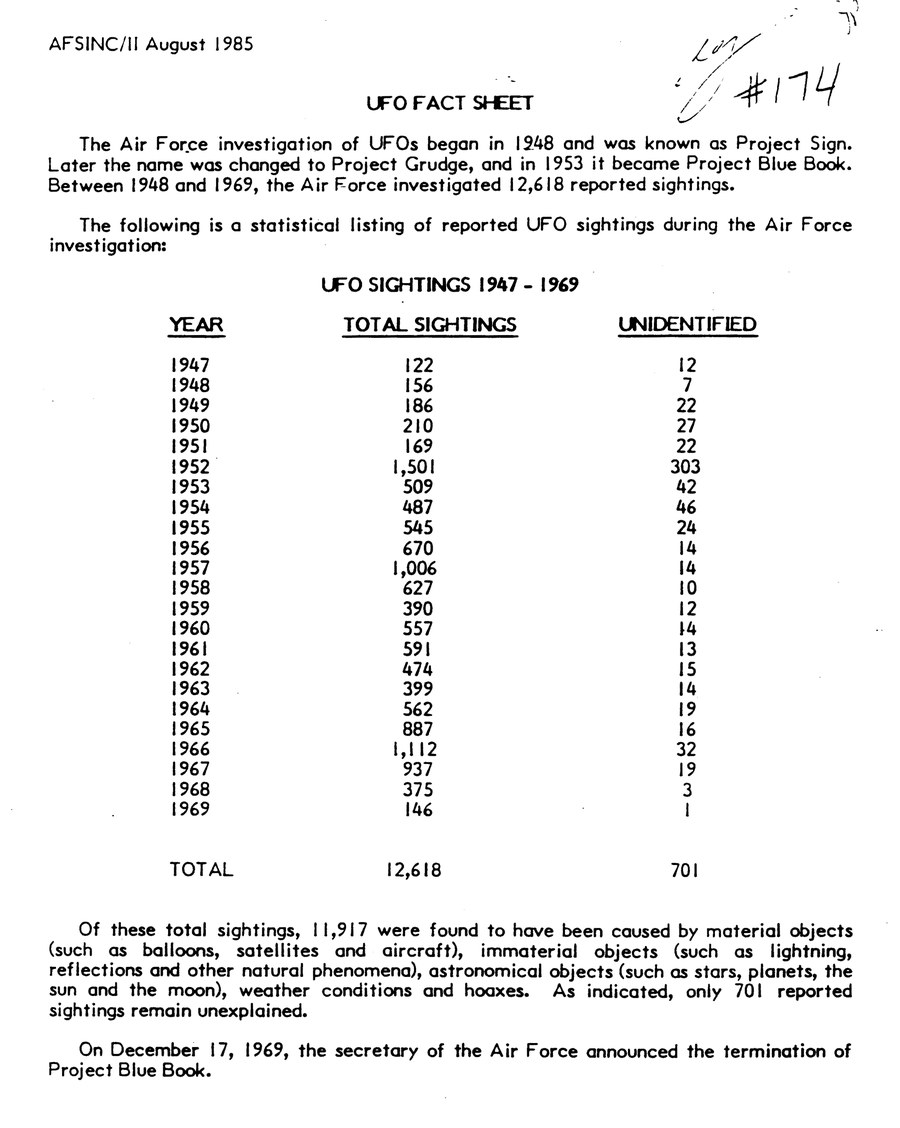
From 1952 to 1969, the US Air Force ran its official UFO investigation programme — Project Blue Book — out of Wright-Patterson. Over 17 years, the project catalogued more than 12,600 UFO sightings. Of those, 701 were officially classified as "unknown" — meaning investigators could not identify a conventional explanation. In 1969, the Air Force announced it was shutting the project down, declaring that UFOs posed no national security threat and that no evidence of extraterrestrial technology had been found.
Many researchers disputed both conclusions at the time, and they continue to do so.
The base is also associated with the legend of Hangar 18 — a name given by UFO researchers to a building alleged to contain recovered craft or biological material from non-human intelligence. The Air Force has consistently stated that no such hangar exists. There is, however, a Building 18 on the base — and the distinction between hangar and building has never fully satisfied those who believe the rumours have a basis in fact.
Whether or not Hangar 18 exists, the mythology around Wright-Patterson has made it one of the most watched military installations in the world among people who take the UAP question seriously. That McCasland commanded its most sensitive research arm is not a footnote. It is the central fact of the story.
McCasland's UAP Connections: DeLonge, Podesta and To The Stars
McCasland's involvement with the UAP topic did not end when he retired. According to his wife, after leaving the Air Force he briefly worked with Tom DeLonge — the Blink-182 musician turned UAP researcher who co-founded To The Stars, Inc., the organisation that later played a pivotal role in the 2017 public release of the now-famous US Navy UAP videos.
The extent of that relationship became public in an unexpected way. When WikiLeaks released the archive of Hillary Clinton campaign chairman John Podesta's emails in 2016 — obtained in a hack attributed to Russian military intelligence — McCasland's name appeared in the correspondence. The emails showed DeLonge discussing UAP-related advisors and sources, and McCasland was among the names mentioned in that context.
Podesta himself, of course, was no stranger to the UAP topic. He had publicly called for government disclosure on multiple occasions and later served as an informal bridge between UAP researchers and the Obama White House.
The Podesta email appearance confirmed what many had suspected: that behind the scenes, serious conversations about UAP research were happening between senior military figures and civilian researchers — conversations that crossed the usual boundary between public and classified worlds.
Congress Weighs In: 'He Has a Lot to Say'
When news of McCasland's disappearance broke in early March 2026, the reaction from some members of Congress was striking. One congressman, speaking to reporters, was direct: "General McCasland definitely is connected to the UAP topic. We believe that he has a lot to say about this topic."
The timing of that statement matters. McCasland vanished on 27 February — eight days after President Trump signed an executive order directing the Pentagon and other federal agencies to identify and release government files related to UAPs, including materials connected to "alien and extraterrestrial life." The ODNI subsequently confirmed on social media that declassification was coming "soon."
Whether that timing is coincidental, investigators have not said. But it has not been lost on those watching the case closely.
The Search: FBI, Colorado and a Mountain That Wouldn't Cool Down
The Bernalillo County Sheriff's Office issued a Silver Alert the day after McCasland failed to return home. As the days stretched into weeks, the search expanded and escalated.
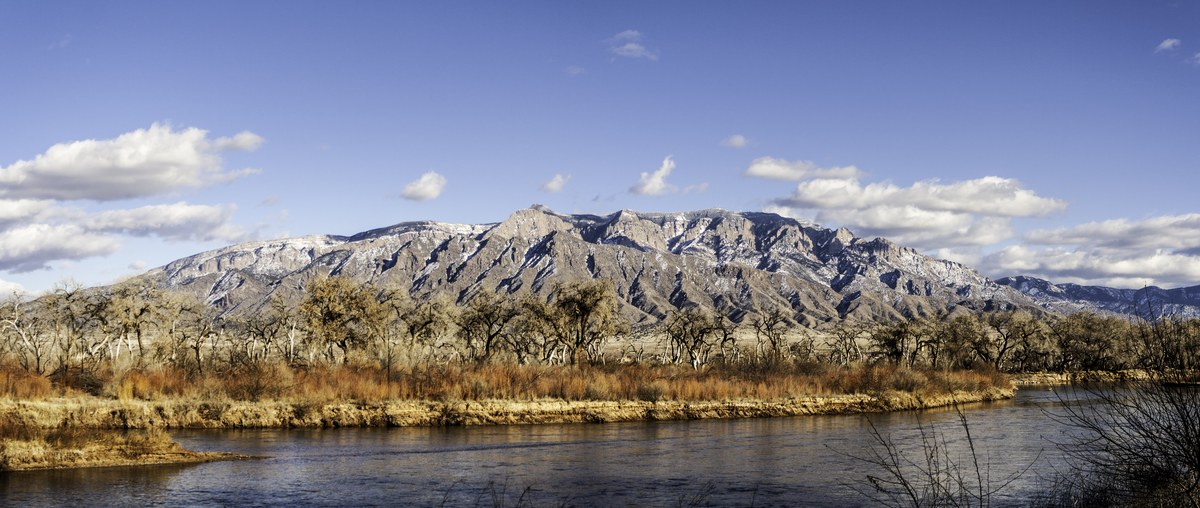
Authorities flew a helicopter equipped with infrared cameras over the cliffs and canyons near his Albuquerque home at night, hoping to detect his body heat against the cool desert terrain. The operation was frustrated by an unseasonably warm early spring. "The mountain was just lit up like a candle," said Lt. Kyle Woods of the Sheriff's Office at a press conference in mid-March. Distinguishing a single human heat signature from the thermally active landscape proved impossible.
The search then expanded to Colorado. McCasland has a second home in Pagosa Springs — a small mountain town about 200 miles north of Albuquerque and 35 miles north of the New Mexico border. Investigators recovered a light green long-sleeve button-up shirt and a pair of hiking boots there, though officials have not confirmed whether these definitively belong to McCasland or explained the circumstances of the find.
The FBI joined the search in its second week. Investigators stated that they had "not ruled anything out" regarding the possibility of foul play, while adding that nothing currently pointed to it either. Officials acknowledged that after this length of time, survival in a wilderness environment would be extremely unlikely.
McCasland had reportedly been experiencing mental fog in the weeks before his disappearance — a condition cited as the reason he had recently stepped back from various groups and commitments. His glasses, phone, and wearable devices were all left behind, suggesting the walk was either impulsive or planned in a confused state of mind.
What His Wife Says
McCasland's wife has been an active public presence during the search, posting updates and appeals for information. She has also offered a direct response to the more dramatic theories circulating in UAP research communities.
In a social media post, she wrote: "Neil does not have any special knowledge about the ET bodies and debris from the Roswell crash stored at Wright-Patt." She confirmed that he had worked briefly with Tom DeLonge's To The Stars after retiring, but characterised his involvement as limited.
She has not addressed the congressional statement about her husband having "a lot to say" about UAPs, nor the appearance of his name in the Podesta emails.
Her message was clearly aimed at separating the search for a missing person — a humanitarian emergency — from the speculation that has swirled around it. That is entirely understandable. Whether her characterisation of his knowledge is complete is a question nobody outside a small circle of classified-programme insiders can answer.
The Bigger Picture: Disappearing Into the Disclosure Era
The McCasland case is unfolding at a moment of genuine movement on the UAP disclosure question. The Pentagon's AARO has now catalogued over 2,400 UAP cases, with 171 remaining officially unexplained. Trump's executive order — the most explicit presidential directive on UAP declassification in history — is creating real pressure on agencies to act. And a new Whistleblower Protection Act introduced in the 119th Congress is specifically aimed at protecting individuals who come forward with UAP-related information.
Against that backdrop, the disappearance of a decorated Air Force general with classified programme experience, UAP research connections, and a congressional endorsement of his knowledge — eight days after the most significant UAP disclosure order ever signed — is, at minimum, a remarkable coincidence.
It is also, at maximum, something that demands to be taken seriously until proven otherwise.
Responsible UAP journalism requires holding both possibilities simultaneously. McCasland may have wandered into the New Mexico mountains in a state of medical confusion and met a tragic, entirely non-mysterious end. That is the most common explanation for Silver Alert disappearances among older adults experiencing cognitive difficulties. Or this may be a story that becomes considerably more significant as more facts emerge.
The search continues. The mountain is warming. And the people who most need to find William Neil McCasland — his family — are asking anyone with information to call the Bernalillo County Sheriff's Office tip line on 505-468-7070.
What Happens Next?
The search for McCasland remains active across two states. If he walked into the Sandia Mountains east of Albuquerque, search teams are working against time and terrain. If the Pagosa Springs lead develops further, investigators will need to explain how items associated with him reached a location 200 miles from where he was last seen.
For the UAP research community, the case raises harder questions. McCasland represented a generation of senior military figures who — through private conversations, post-retirement work with organisations like To The Stars, and participation in the Podesta email network — were gradually building a bridge between the classified world and the emerging public disclosure conversation. If he had knowledge relevant to that process, and if that knowledge died with him or was somehow suppressed, the loss would be irreversible in a very specific way.
The Bernalillo County Sheriff's Office continues to lead the investigation. Anyone who saw McCasland in the Albuquerque or Pagosa Springs areas after 27 February is urged to make contact.
We will update this article as developments emerge.