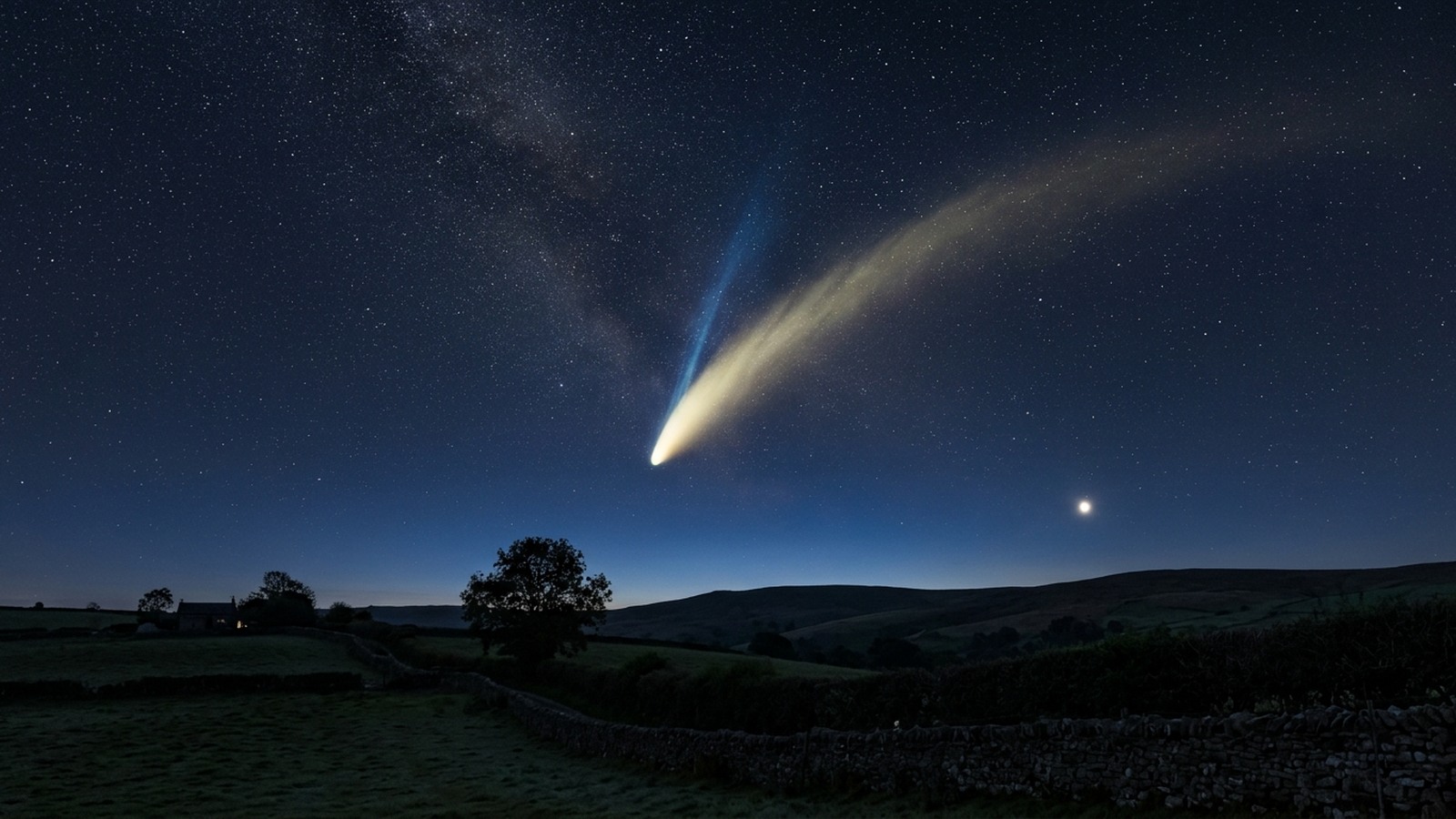
Key Takeaways
- Mars passes within just 0.5° of Neptune on the morning of 13 April — close enough to fit both planets in a single telescope eyepiece
- Mars is the easy one (magnitude 1.2, naked-eye), but Neptune (magnitude 7.9) needs binoculars or a small telescope to spot
- This is one of the best chances in 2026 to find Neptune — just look for the faint blue-grey dot next to bright orange Mars
- Best UK window: 04:45–05:30 BST, looking low above the eastern horizon in Pisces
📑 Table of Contents
If you've never seen Neptune, this morning might be your best chance all year. Mars — bright, obvious, and unmistakable — is sitting right next to the ice giant, acting as a signpost to one of the hardest planets in the Solar System to find.
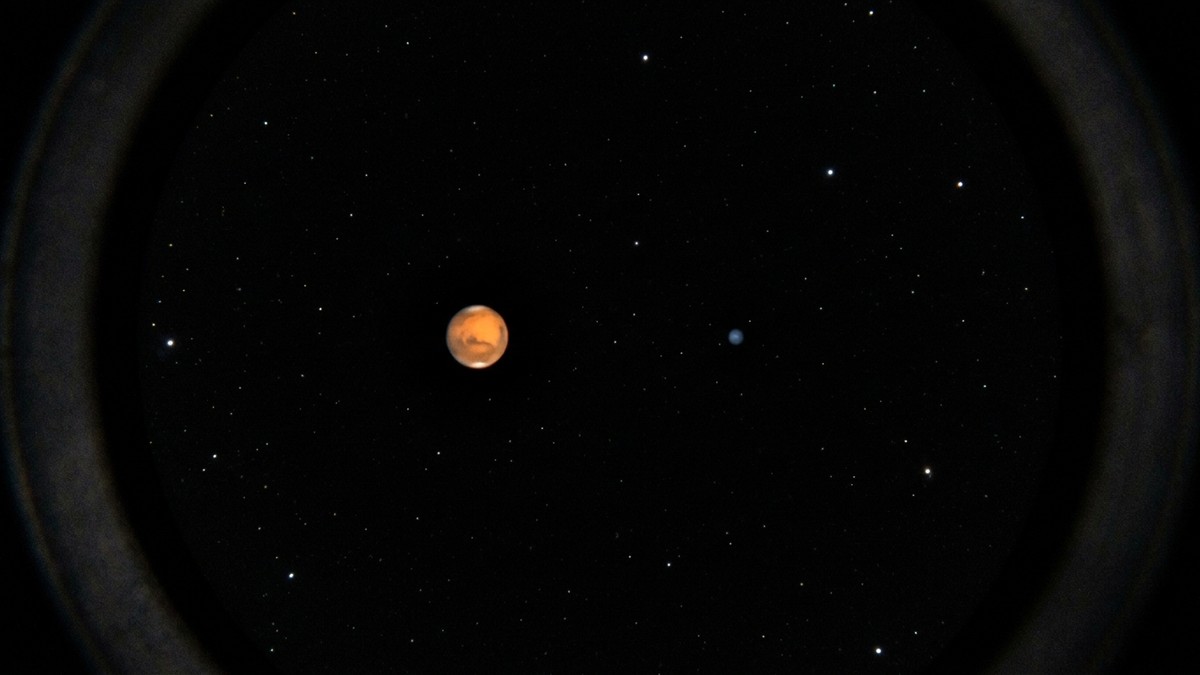
The two planets reach their closest apparent separation on the morning of 13 April 2026, passing within roughly half a degree of each other in the constellation Pisces. That's less than the width of a Full Moon. Through a telescope eyepiece, both worlds will be in the same field of view at the same time — a genuine rarity.
What Is a Conjunction?
A conjunction happens when two celestial objects appear close together in our sky. They're not actually near each other in space — Mars is currently about 2.4 AU from Earth (roughly 360 million kilometres), while Neptune lurks at about 30.9 AU (4.6 billion kilometres). That's a distance ratio of almost 13 to 1. But from our viewpoint on Earth, they line up along almost the same line of sight, creating a brief, beautiful pairing.
Planetary conjunctions happen regularly, but not all pairings are equal. Mars–Neptune conjunctions occur roughly every two years, but the geometry, timing, and visibility conditions are different each time. This one is particularly well-placed for predawn observers in the UK and northern Europe.
When and Where to Look
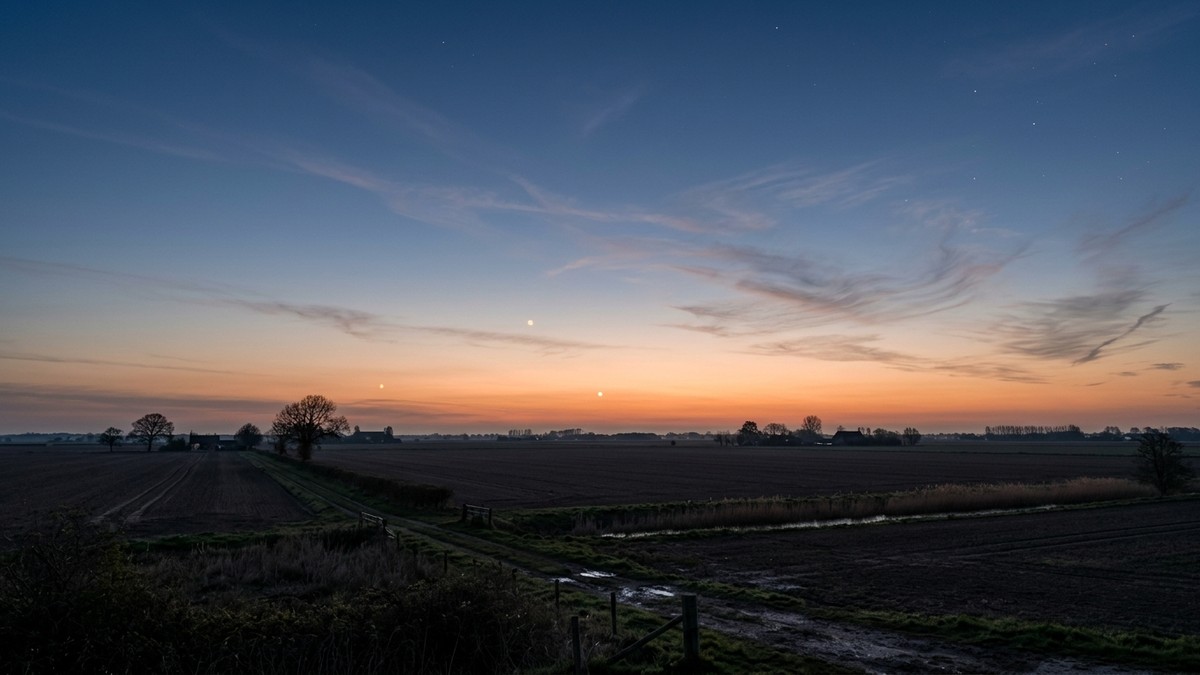
The conjunction reaches its tightest separation at approximately 05:31 BST (04:31 UTC) on 13 April. From the UK, here's your observing window:
Start looking: 04:45 BST — the pair will be low above the eastern horizon, roughly 10–12° up (about the width of your fist held at arm's length).
Best window: 04:50–05:15 BST — the sky is still dark enough to pick out Neptune, while Mars is already well clear of the horizon haze.
Ends: Around 05:30 BST — dawn twilight begins washing out fainter objects, and Neptune will be the first casualty. Mars will remain visible longer.
Direction: Look due east, slightly south of east. The pair sits in the constellation Pisces, below the Great Square of Pegasus.
You'll need a clear, unobstructed eastern horizon. Buildings, trees, and hills in that direction will make this much harder — or impossible. Scout your spot the evening before if you can.
What You'll See
Naked eye: You'll see Mars easily — it's a steady, slightly orange "star" at magnitude 1.2. Neptune, at magnitude 7.9, is invisible to the unaided eye. But knowing Mars is right there tells you exactly where to point your optics.
Binoculars (10×50 or similar): Centre Mars in your field of view and look for a tiny, faint point very close by. Neptune will appear as a slightly blue-grey "star" — not obviously different from a background star at first glance, but it's there. The colour is subtle but real: Neptune's methane-rich atmosphere absorbs red light and reflects blue.
Telescope (any size): This is where it gets rewarding. At 50–100× magnification, Mars shows a tiny orange disc. Neptune, even though it's over 12 times farther away, also shows a disc — a minuscule blue-grey dot, but distinctly non-stellar. Seeing both discs in the same eyepiece field is the highlight of this conjunction.
Why This Conjunction Matters
Neptune is the hardest planet to observe. It never gets brighter than magnitude 7.8, which means you can never see it without optical aid. It moves so slowly against the background stars (it takes 165 years to orbit the Sun) that it barely shifts position from month to month. And it looks like a star in all but the largest amateur telescopes.
All of this makes it genuinely difficult to find — which is why conjunctions with brighter planets are so valuable. Mars acts as a finder beacon. You don't need star charts, planetarium software, or experience. Just find Mars, point your telescope or binoculars at it, and Neptune is right there.
For anyone who has never knowingly seen Neptune, this is the easiest opportunity in 2026.
The Predawn Planet Parade
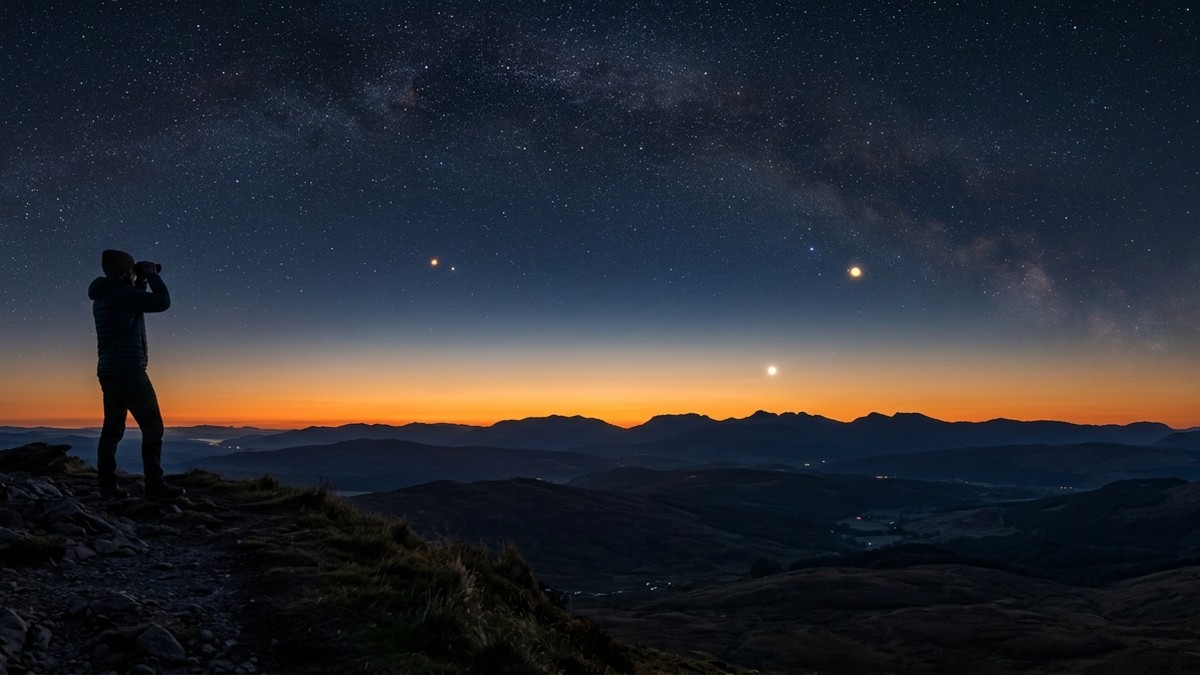
Mars and Neptune aren't alone this week. The predawn sky is hosting a mini planet parade through mid-April:
Saturn (magnitude 0.9) sits a little higher and to the right of Mars, also in the east-southeast. It's unmistakable — steady, yellowish, and bright.
Mercury (magnitude 0.1) is lower and closer to the horizon, in its best morning apparition of 2026. It reached greatest western elongation on 3 April and remains well-placed for early risers through mid-April.
So in one predawn session, you can tick off four planets: Mercury, Mars, Saturn, and — with a little optical help — Neptune. Add Venus and Jupiter from the evening sky, and you've got six planets in a single 24-hour period.
This predawn lineup improves further from 16–20 April, when the four morning planets form a tighter zigzag pattern across the eastern sky. The Mars–Neptune conjunction is the opening act.
Kit You'll Need
Minimum: A pair of 10×50 binoculars will show Neptune as a faint point next to Mars. Steady your elbows on a wall or fence.
Ideal: A small telescope (70mm refractor or larger) at 50–100× magnification. This will show both planetary discs and give you the "wow" moment of seeing two worlds side by side.
Helpful: A planetarium app (Stellarium, SkySafari, or Star Walk) set to your location and time. This will confirm exactly where to look and help you distinguish Neptune from nearby field stars.
Essential: An alarm clock. This is a predawn event — there's no getting around the early start. Set your alarm for 04:30 BST at the latest.
Warm layers. April mornings in the UK are cold, especially before dawn. Dress for standing still outdoors for 20–30 minutes.
If clouds defeat you on the 13th, don't despair — Mars and Neptune remain within 2° of each other through to about 15 April. The separation grows each day, but the pairing is still close enough to be useful as a Neptune-finder for the rest of the week.