Key takeaways
- Neptune reached opposition on 26 September 2026 in Pisces: best viewing runs August through October, and the next opposition is 28 September 2027.
- At magnitude +7.8, Neptune is never visible to the naked eye and needs at least binoculars to spot, and a telescope to confirm.
- Through a telescope it shows as a tiny blue-grey disk, about 2.4 arcseconds across, smaller than Uranus, and essentially featureless.
Jump to section 6 sections
Neptune is the hardest of the eight planets to observe. It never becomes naked-eye, it looks like an ordinary faint star in binoculars unless you know exactly what you're looking at, and even a large telescope shows a disk barely 2.4 arcseconds across. What it offers instead is a genuine challenge and, once you've confirmed it, the quiet satisfaction of seeing a world 4.3 billion kilometres away.
This guide covers how to find Neptune across 2026, what the September opposition delivers, and what different levels of equipment will actually show you.
Neptune in 2026: The Key Facts
Neptune moves incredibly slowly: it takes 165 years to orbit the Sun and barely creeps two degrees against the background stars per year. That glacial pace keeps it in Pisces for the whole of 2026, which is handy once you've located it.
The headline event is opposition on 26 September 2026. Around that date Neptune sits about 28.9 AU from Earth (roughly 4.33 billion km), shines at magnitude +7.8, its brightest for the year, though still far below naked-eye visibility, and shows a disk 2.4 arcseconds across. Solar conjunction falls on 22 March, so the planet is unobservable from roughly February through to late April.
Here's how the year breaks down:
- January to late April: Neptune lost in the Sun's glare around solar conjunction (22 March)
- May to June: back in the morning sky, low and challenging
- July: a genuine morning target, clearing the horizon decently before dawn
- August to October: the prime window; Neptune rises in the evening and is accessible at reasonable hours
- November to December: evening sky, fading slightly as Earth pulls away
What makes Neptune worth the effort is that it stays put. Find it once with a good finder chart, and you can return to the same area of Pisces all season.
How to Find Neptune
Neptune is faint and surrounded by background stars of similar brightness, so you cannot reliably identify it without a finder chart. That's not optional: it's the most important piece of kit you'll use.
Use planetarium software
Stellarium (desktop or mobile) and SkySafari are the standard tools. Print or screenshot a chart showing stars down to magnitude 9 or 10, marked with Neptune's position for your specific date. Note the orientation: north direction matters when you're at the eyepiece in the dark.
Neptune's 2026 position: in Pisces, drifting very slowly near the Circlet asterism. The nearest reference star of any note is Lambda Piscium at magnitude 4.5.
How to confirm it's Neptune
There are two reliable methods, and ideally you use both:
Colour check: at 200x or more, Neptune shows a distinctly blue-grey tint. Background stars look white, yellow or orange, not blue. If a faint point in the right location looks blue at high power, that's a very strong indicator.
Multi-night check: plot Neptune's position among nearby stars and return four or five nights later. The stars stay fixed; Neptune shifts. This is the definitive confirmation.
GoTo mounts
If your mount has GoTo, align it carefully and send it to Neptune. It will put Neptune in the field. Then use the colour and multi-night checks to verify: GoTo alignment errors do happen, so it's worth confirming.
Month-by-Month Viewing Guide
January to late April
Neptune is lost in the Sun's glare through this period. Solar conjunction falls on 22 March 2026, when Neptune passes behind the Sun from our perspective. There's nothing useful to see. Wait for May.
May 2026
Neptune returns to the morning sky, but it's very low in the east before dawn and in significant twilight. The conditions are genuinely poor: faint object, low altitude, bright sky background. You can attempt it if you're keen, but most observers will find it frustrating.
June 2026
Better, but still quite challenging. Neptune rises two or three hours before sunrise and clears the horizon a little before dawn. It appears as a very faint point through a telescope; the blue colour isn't detectable at low altitude. Worth a try if you're up early, but the main season is still a couple of months away.
July 2026
Now a realistic target. Neptune rises around midnight by month's end and climbs enough to observe before dawn without fighting the horizon. At 100x it's visible as a faint point; at 200x the blue tone starts to come through. A good month to begin your Neptune campaign if you prefer early mornings.
August 2026
Properly prime season. Neptune rises in the late evening and is well-placed for several hours through the night. The blue colour shows clearly at 150x and above, and the tiny disk is distinguishable from stars at high power on a steady night. If you've not observed Neptune before, this is a sensible month to start.
September 2026: opposition month
Neptune reached opposition on 26 September, the best the planet looks all year, and October is nearly as good. It rises at sunset and is up all night, reaching its highest point around midnight. Magnitude holds at +7.8 and the disk measures 2.4 arcseconds, as large and bright as it gets.
What to expect through various instruments:
4-inch telescope: Neptune shows as a faint point at 50x, indistinguishable from stars. At 100x it's clearly steadier than a star. At 150x+ there's a slight blue tint and the disk is just about detectable.
6 to 8-inch telescope: At 150x the blue colour is obvious and the disk shows clearly. Push to 200 to 300x on a steady night and Neptune's disk is unmistakable, small but plainly round and blue. Triton is possible at 8 inches under dark skies, showing as a magnitude 13.5 point about 17 arcseconds from Neptune.
10-inch and above: A very satisfying view. The disk is clear at 150x, the blue is rich and deep at 250 to 350x, and Triton is within reach on most decent nights from a dark site. You can track Triton's position over successive nights as it completes its 5.9-day retrograde orbit.
Photography: Neptune shows as a blue point in any shot that captures it. For wide-field shots, a 30-second exposure at ISO 1600 on a tracked mount shows Neptune clearly among the stars. Multi-night comparison shots are a satisfying way to watch it drift.
October 2026
Still excellent. Neptune remains a good evening object, setting progressively earlier but staying accessible into the small hours. All the detail visible at opposition is still there: disk, colour, and Triton for those with larger scopes.
November 2026
A solid evening target, though Neptune sets by 1 or 2am. The disk and blue colour remain visible at high power. Worth catching if you have clear skies.
December 2026
Neptune rounds off the year as an evening object, setting around 11pm by month's end. Views are still rewarding: the disk is obvious in a 6-inch scope at 200x, and it continues into early 2027 before disappearing toward the next conjunction. The following opposition falls in September 2027.
What You Can See
With the naked eye
Nothing. Neptune at magnitude +7.8 is well below the limit of unaided human vision, which tops out around magnitude 6.5. It was the first planet discovered through mathematical prediction rather than observation, and that discovery makes complete sense when you realise it's invisible without optical aid.
With binoculars (7x50 or 10x50)
Neptune is just within reach of a good pair of binoculars: it shows as an extremely faint star-like point if you know precisely where to look. You cannot see colour, you cannot see any disk, and it looks identical to surrounding background stars. Binoculars let you locate the right area of sky, but they're not enough for confident identification. A telescope is needed for that.
With a small telescope (60 to 90mm)
At 50x Neptune is a faint point, indistinguishable from stars. At 100 to 150x it starts to look slightly steadier than a true star, and at 150x+ there's a very faint blue hint. The disk is theoretically 2.4 arcseconds across but remains very subtle at this aperture. Small scopes can show Neptune, but it's genuinely difficult: a 4-inch is the practical minimum, and 6 inches is far more comfortable.
With a medium telescope (4 to 6-inch)
At 150x Neptune is a clear blue-grey point, distinct from the white or yellow background stars. At 200x the disk is real and obvious: you can see it's not a point source. The blue-grey colour is unmistakable at this magnification. This is the aperture range where Neptune stops being an exercise in faith and becomes a proper observation.
With a large telescope (8-inch and up)
The disk is obvious at 150x and beautifully deep blue at 250 to 350x. Neptune appears perfectly round and featureless: you won't see any surface detail or atmospheric banding, because it's simply too far away. What you will see is a rich blue colour and a disk that is plainly planetary.
Triton becomes realistic at 8 inches under dark skies. At 10 inches it's generally accessible on good nights. At 12 inches you can track its position across successive nights and watch it complete its orbit around Neptune.
Things you won't see, regardless of aperture: surface features, cloud bands, the Great Dark Spot (only detectable from space), rings, or any moon other than Triton.
Equipment Guide
What you need and why
Neptune is faint and tiny, so there are two priorities: enough aperture to show the disk and colour, and a way to get to the right position in the sky.
For serious Neptune observing you want at least 100mm (4 inches) of aperture. At 150mm (6 inches) the experience becomes genuinely satisfying: the disk is clear and the blue colour reliable. At 200mm (8 inches) you can also hunt for Triton.
A GoTo mount transforms Neptune hunting. Without one, you're relying on star-hopping with a detailed finder chart to a faint, featureless target surrounded by similar-brightness stars. It works, but it takes patience. GoTo slews straight to Neptune; you verify by colour and proceed.
Binoculars (for location, not identification)
Binoculars alone are not enough to identify Neptune: you can spot it as a faint star-like point with the Celestron SkyMaster Pro 20x80 if you have a detailed chart and steady hands, but you'll need a telescope to confirm what you're looking at. The Celestron SkyMaster 15x70 is usable for locating the right star field.
Telescopes by what you want to do
"I just want to find Neptune" (beginner/intermediate): The Celestron NexStar 6SE is arguably the most practical scope for this. Its GoTo mount slews directly to Neptune after a quick alignment, no star-hopping required. Once there, the 150mm SCT shows Neptune's blue colour clearly at 150 to 200x, and the disk is obvious. The Sky-Watcher Heritage 130P also just about qualifies at 4 inches, and gives a pleasing blue point at high power if you're willing to star-hop with a chart.
"I want good views" (intermediate/advanced): The Sky-Watcher Heritage 150P and Sky-Watcher Skyliner 200P show Neptune's disk clearly and make the blue colour unmistakable. The Skyliner 200P is also marginal for Triton, achievable under good conditions with dark skies. See our Mid-Range Visual setup guide for a full kit.
Eyepieces
- Finding and field orientation (50 to 100x): The Explore Scientific 68° 20mm gives a wide field to match your chart and hop into the right area
- Identification (150 to 200x): The BST StarGuider 12mm resolves the disk and makes the blue colour reliable
- Maximum detail (250x+): The BST StarGuider 8mm with the Astro Essentials 2x Barlow gives the best disk size, needs excellent seeing to be worth it
Filters and finder aids
Observe Neptune without filters. It's faint enough without one, and any filter will make things worse. The blue colour is inherent and visible at high magnification without assistance.
A detailed finder chart is the single most important accessory for Neptune. Print one from Stellarium showing stars to magnitude 9 or 10 for your specific date, and protect it from dew. On a Dobsonian, a Telrad Finder helps get you to the right area quickly.
Kit for observing Neptune
Kit we've tested and reviewed in full
Neptune rewards patience and the right aperture. A 6-inch scope and a good finder chart are the practical minimum for a satisfying session; GoTo removes most of the frustration.
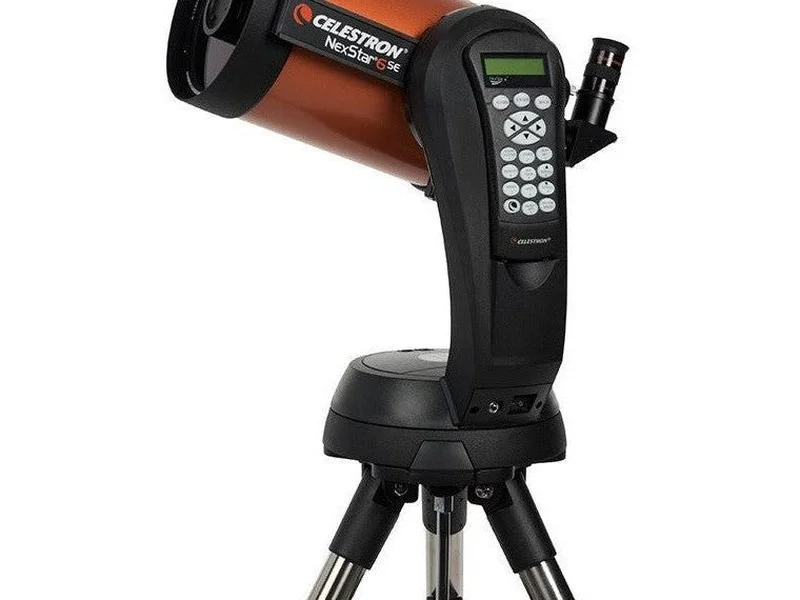
GoTo mount slews straight to Neptune after alignment; 150mm SCT shows the blue disk clearly at 150–200x.
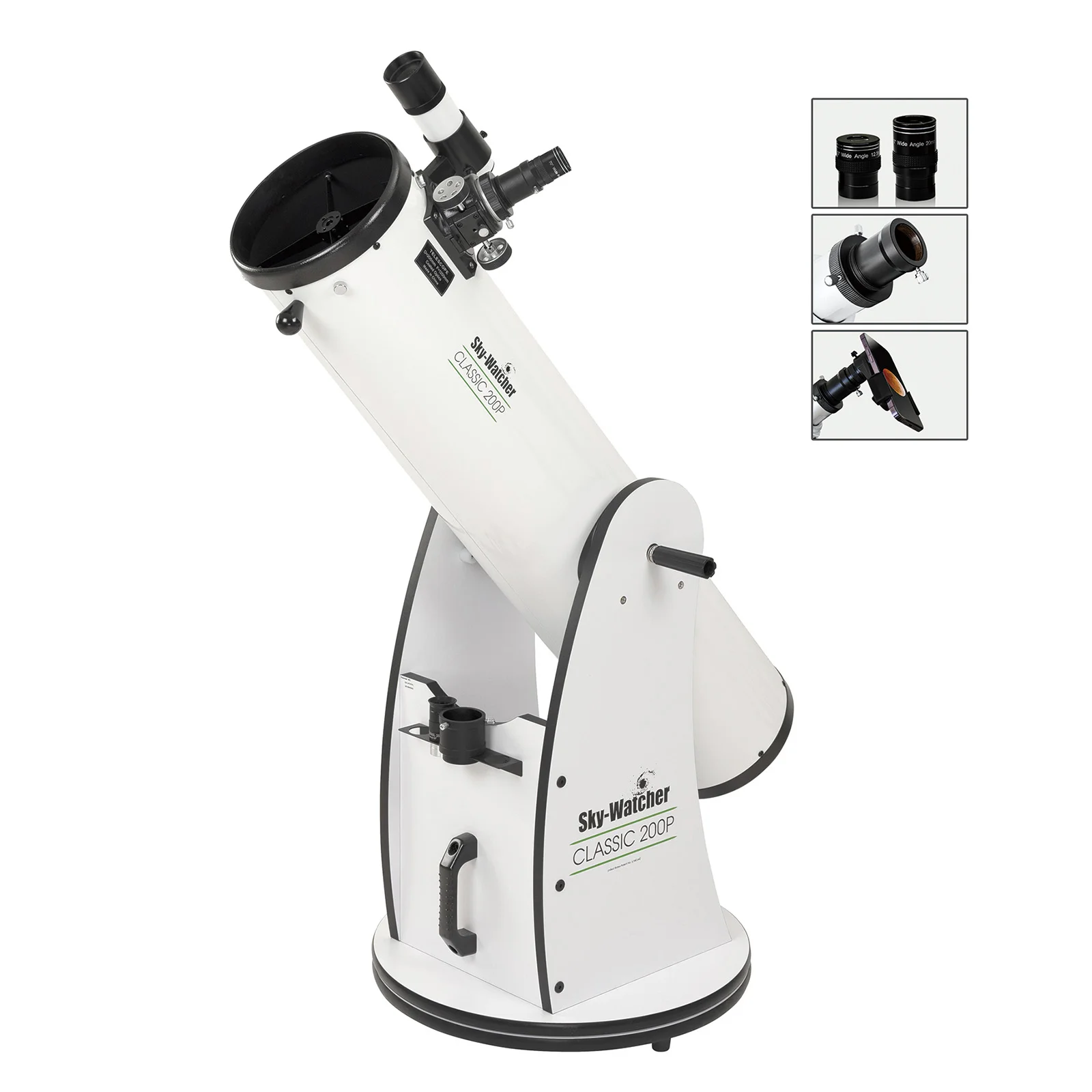
8-inch Dobsonian shows the disk easily and brings Triton within reach under dark skies.
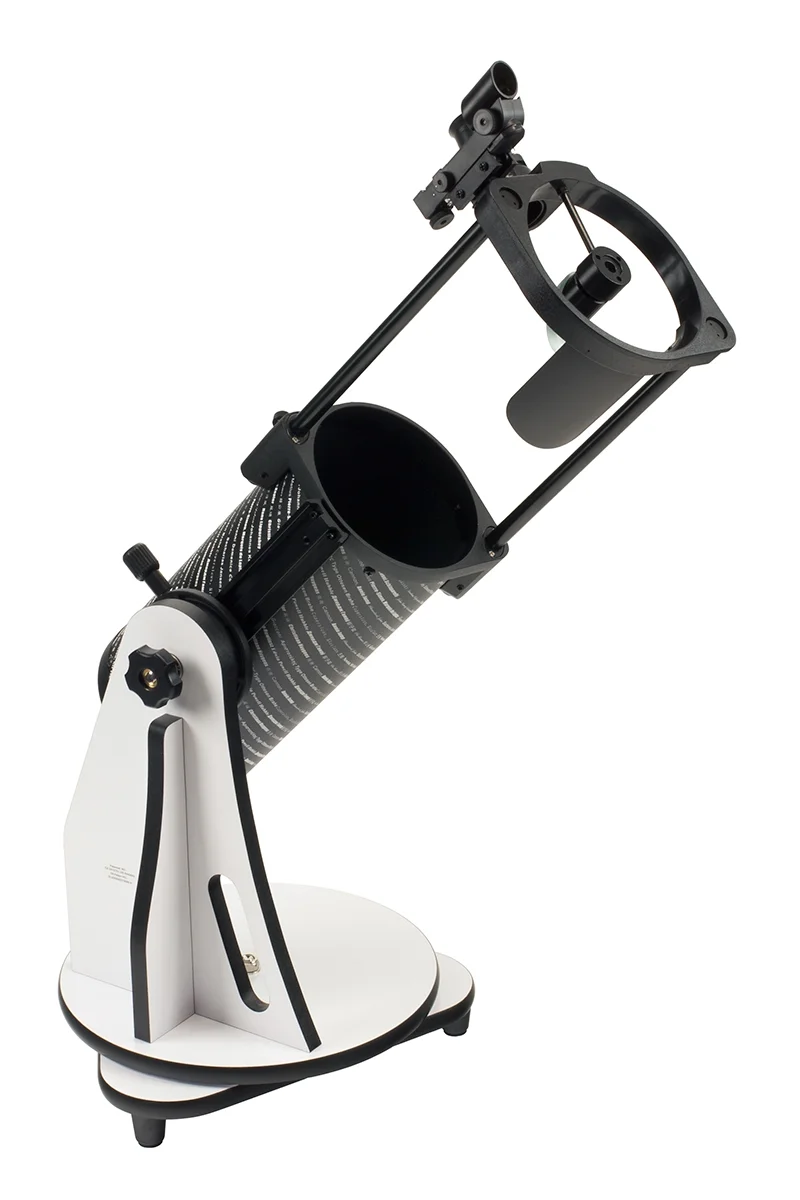
Just enough aperture to show Neptune as a faint blue pinprick at high power. A fine first scope.
Affiliate links: you pay the same price, we earn a small commission that helps keep WatchTheStars free.
Observing Tips
Finder charts are not optional. Neptune looks like any other faint star. Without a chart showing stars down to magnitude 9 or 10 for your specific date, you won't know which of the dozen similar-looking points in the eyepiece is the planet. Print from Stellarium, note north orientation, and keep it in a plastic sleeve to protect from dew.
Use high magnification. At 50x Neptune is invisible or a faint dot. At 100x it's a faint point. The blue colour and disk only come through at 150x and above: 200 to 300x is where Neptune reveals itself. You need steady air for this, so check the seeing forecast (Clear Outside or Metcheck) before you set up.
Observe when Neptune is high. Low objects look worse because of atmospheric turbulence. Around opposition the planet is highest near midnight: that's the best time. Don't bother trying when it's within 20 degrees of the horizon.
Confirm over multiple nights. The best proof you've found Neptune is watching it move. Sketch or photograph the star field, return four or five nights later, and compare. The stars stay fixed; Neptune shifts position.
Dark skies help, but aren't essential. Neptune is visible from a suburban garden with a good telescope. Dark skies are only truly necessary if you're chasing Triton: light pollution makes a magnitude 13.5 target almost impossible.
Hunting Triton (8-inch+ scope, dark skies required): Triton orbits Neptune every 5.9 days in a retrograde direction, appearing as a magnitude 13.5 point roughly 17 arcseconds from the planet. Use a chart from Stellarium showing Triton's position for your night (the app shows it), observe at 200 to 300x, and expect to spend time confirming you've found the right faint point. It's a genuinely rewarding advanced challenge.
Your 2026 Neptune calendar
Prime window: August through October, with the 26 September opposition as the peak.
Worthwhile but demanding: July (morning sky) and November to December (evening sky).
Challenging: May to June (low morning sky, emerging from conjunction).
Unobservable: January to late April (solar conjunction 22 March).
Neptune is not the easiest night's work. But tracking down a world nearly 4.3 billion kilometres away, confirming its pale blue disk, and watching it creep across the sky over a few nights: that's a genuinely satisfying piece of observing that stays with you. Clear skies.
Sources:
- EarthSky: Neptune at opposition, 26 September 2026
- In-The-Sky.org: Neptune at opposition
- In-The-Sky.org: Neptune at solar conjunction
Frequently Asked Questions
Equipment guides
Related topics

Ian ClaytonAmateur astronomer and founder of WatchTheStars.co.uk, dedicated to helping others explore the wonders of our universe. Full profile →