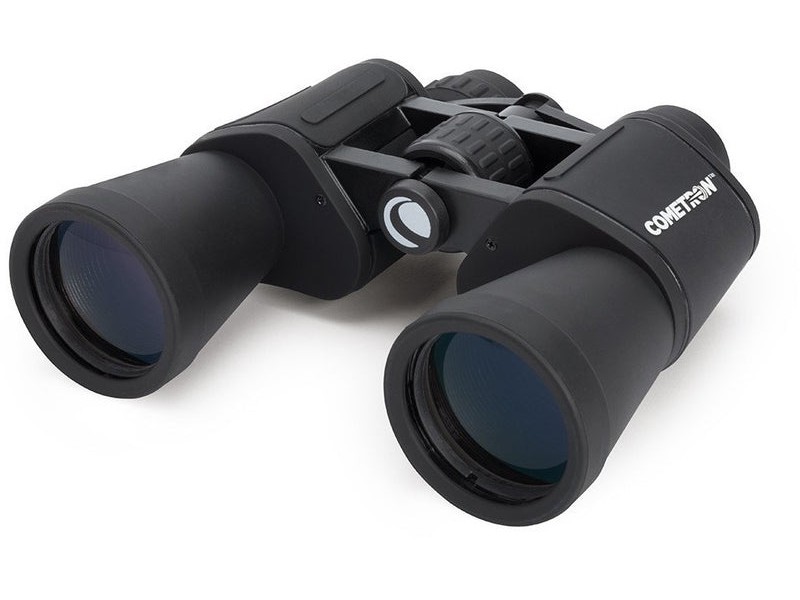
| Key Specifications | |
|---|---|
| Magnification | 7× |
| Objective Diameter | 50mm |
| Field of View | ~8.5° (widest of the group) |
| Exit Pupil | 7.1mm (excellent match for eye) |
| Weight | ~800g |
| Close Focus | ~2 metres |
| Prism Type | BAK-4 (standard) |
| Coatings | Multi-coated (basic) |
| Best For | Milky Way scanning, clusters, learning the sky |
The Cometron 7×50 is the binocular for people asking the same question they'd ask about a starter telescope: "Is this hobby for me?" At £35, it's cheap enough that a month of changed plans won't sting financially. Yet the optics are real — you'll see things through these that your naked eye cannot.
If you're a seasoned observer upgrading from nothing, you might want to skip straight to the Opticron Adventurer. But for testing the waters, these Cometrons are honestly difficult to beat pound-for-pound.
A 50mm objective gathers roughly 50× as much light as the dark-adapted human eye — that's a meaningful improvement for night-sky observing. At 7×, the field is wide, making sweeping and scanning easy.
This is where the Cometron shines. The wide 8.5° field lets you drink in vast sweeps of the Galactic spine — dust lanes, star fields, and nebulosity become visible.
The Pleiades is stunning — you see dozens of stars at once. The Double Cluster in Perseus, the Hyades, M11 — all show exceptional star density in these binoculars.
At 7×, you see the whole disc with easy crater recognition. At lower power, detail is softer than through a 10× or 15× binocular, but you get a beautiful full-moon view.
The Orion Nebula (M42) shows as a fuzzy cloud. The North America Nebula is visible under dark skies as a wispy extended region — barely visible, but real.
M31 Andromeda is visible as a large oval. The Whirlpool Galaxy (M51) appears as a smudge — you need a 10× or larger to see the spiral structure.
You'll see Jupiter as a disc and Saturn's rings, but planetary detail is minimal compared to binoculars above 10×. These are not ideal for planetary observing.
Note: All views depend on light pollution and atmospheric conditions. These observations are realistic from a reasonably dark UK site.
Excellent value for money. Stargazers Lounge threads consistently highlight the Cometron as "unbeatable at the price." Beginners report genuine surprise at how much they can see.
The 7× magnification is the right choice for a starter pair. Hand-held steadiness is effortless — no tripod needed, no arm tremor ruining the view. This removes friction from casual stargazing.
Chromatic aberration visible on bright objects. On the Moon or Jupiter, you'll see coloured fringes (red and blue fringes on stars). This is a known limitation of the basic optics. It doesn't ruin the view, but you're aware of it.
Good for learning the sky. The wide field makes these ideal "learning binoculars" — you can see constellations in context and learn patterns without tunnel-vision magnification.
Bayonet-style lens caps are fiddly. Several owners report the included caps don't always stay on during transport. Aftermarket generic caps fit and are more reliable.
These binoculars are minimal-accessory devices. You'll want:
The bundled neck strap works, but a padded harness (like a camera vest) distributes weight more comfortably during long sessions. Essential if observing for more than 20 minutes.
~£12–18The bayonet caps are fiddly. Standard lens caps (available anywhere) are cheaper and more reliable. Get a spare set for backup.
~£3–5Protects them in transport and keeps dust off the optics. A soft neoprene pouch is adequate; a hard case is overkill for a £35 pair.
~£8–15Binoculars only show you what's there — a map of where to look transforms the experience. Stellarium (free app) or a book like "Night Sky Almanac" are essential companions.
Free–£15The Cometron 7×50 is the entry point for binocular astronomy. It's not the cheapest binoculars money can buy (discount 7×35s exist for £20), but it's the smallest aperture that serious astronomers recommend for night-sky observing.
The next step is the Opticron Adventurer T WP 10×50 (~£100) — same aperture, higher magnification, better optics, waterproofing. Many people skip the Cometron and buy the Opticron directly. If you own a Cometron and want to upgrade, the Opticron is the natural choice.
Beyond that, the SkyMaster 15×70 (~£75) steps into tripod territory, offering significantly more light-gathering and detail. Or you might jump straight to a telescope if your main interest is planets or faint galaxies.
Many astronomers keep their first Cometron as a grab-and-go pair even after upgrading. They're reliable, light, and honestly — for a casual night under the stars — perfect.