| Key Specifications | |
|---|---|
| Sensor Type | Sony CMOS 1280×960 pixels |
| Pixel Size | 3.75µm |
| Connection | USB 3.0 (backward-compatible USB 2.0) |
| Max Frame Rate | 145 fps (USB 3.0), 30 fps (USB 2.0) |
| Barrel Size | 1.25" (standard eyepiece) |
| Cooling | None |
| Software Support | SharpCap, FireCapture, Siril, Autostakkert (all tested) |
| Weight | ~240g |
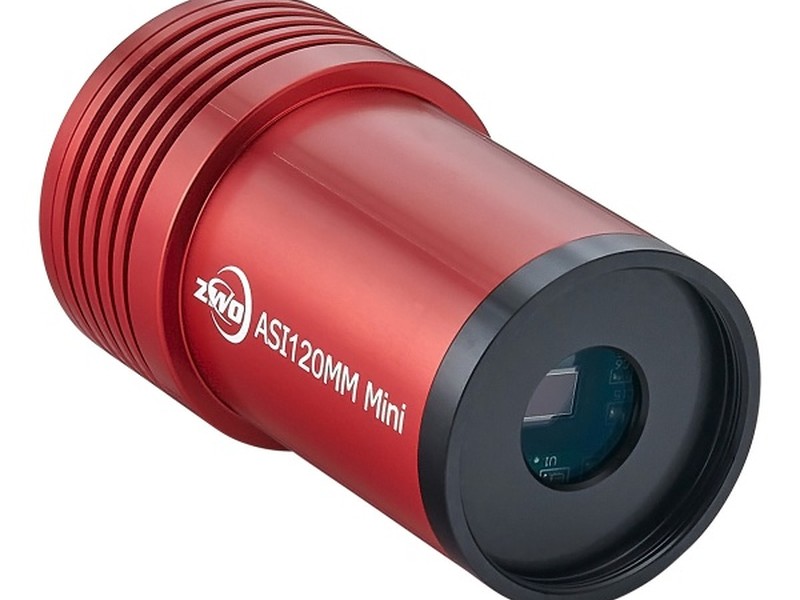
Who Is This For?
The ZWO ASI120MC-S is the planetary camera that serious amateur astronomers standardised on. It's the one everyone recommends.
- People ready to invest in planetary imaging. At £150 it's a real financial commitment, but it's a camera you'll keep for a decade.
- Those who want fast USB 3.0 recording. Twice as fast as USB 2.0, meaning you record 2000 frames in 15 seconds instead of 30. Faster processing pipeline.
- Community-minded astronomers. The ASI120MC-S has enormous community support — forums, tutorials, firmware updates, third-party software all built around this camera.
- People who also use telescopes for DSLR astrophotography. This camera doubles as an autoguider for deep-sky DSLR work, adding value beyond planetary imaging.
What Can You Capture?
The Moon
Professional-quality lunar detail. Craters, mountains, maria, and terminator effects. Stacked lunar mosaics can approach Hubble-quality images.
Jupiter
All four Galilean moons, Great Red Spot, subtle storms, polar ovals, and mid-latitude disturbances. The ASI120MC-S shines here — fast USB 3.0 recording means excellent material for stacking.
Saturn
Rings with Cassini Division crisp and clear. Cassini ring spokes visible on steady nights. Belts and zone detail on the ball of the planet itself.
Mars, Venus, Mercury
Mars opposition imaging reveals polar caps and albedo markings. Venus shows phase changes and cloud structure. Mercury is faint but possible.
Results rival professional observatories when atmospheric conditions are good. USB 3.0 speed makes it possible to capture more high-quality frames, which stacking algorithms reward with sharper final images.
The Imaging Workflow
Capture: SharpCap detects the ASI120MC-S automatically. Adjust gain and exposure, record video (15–30 seconds at 145 fps = excellent frame count), save as AVI.
Stacking: AutoStakkert analyses your video, ranks frames by sharpness, picks the best 10–15%, and stacks them into one sharp image. Takes 3–5 minutes per video.
Post-processing: Registax or Siril applies wavelets, sharpening, and colour balance. Final touches in GIMP or Photoshop if desired.
Why USB 3.0 matters: At 145 fps you capture 2000 frames in 14 seconds. The Svbony SV105 (USB 2.0, 60 fps max) takes 33 seconds. In that time, atmospheric seeing conditions can change dramatically. Faster capture = more consistent quality.
What the Community Says
The proven standard. Search "best planetary camera" in any forum and the ASI120MC-S appears in the first three results. It has years of real-world use and extensive documentation.
Excellent build quality. ZWO cameras are known for durability. Owners report 5–8 years of reliable service with minimal maintenance.
Software ecosystem is unmatched. Every planetary imaging software known to exist supports this camera. You're never locked into one tool.
USB 3.0 is genuinely worth the extra £110. Owners who've upgraded from USB 2.0 cameras consistently report that faster recording speed noticeably improves their final image quality.
Also works as an autoguider. If you later do DSLR deep-sky astrophotography, this camera works as a guide camera — you get dual purpose from one device.
Known Limitations & Tradeoffs
- No cooling. Thermal noise becomes visible in long exposures. For video capture (short exposures) it's irrelevant, but know the limitation.
- USB 3.0 port required. Modern laptops have USB 3.0, but if you're using an older computer, you lose the speed advantage (defaults to USB 2.0 compatibility).
- Requires laptop tethering. Like all USB planetary cameras, you need a computer at the eyepiece. Not ideal for remote sites.
- Price is higher than alternatives. The Svbony SV105 costs £40. You're paying £110 more for USB 3.0 speed and community support — both genuinely valuable, but not free.
- Limited by atmosphere and scope. The best camera in the world can't fix bad seeing or a poor telescope. Know that atmospheric turbulence is the limiting factor, not your hardware (usually).
Pairs Well With
USB 3.0 Hub
An active USB 3.0 hub lets you power the camera and connect other devices. Makes laptop setup cleaner.
~£20High-Quality Eyepiece
Your image is only as good as your eyepiece. A Explore Scientific 5mm 68° or similar high-end eyepiece transforms your planetary images.
~£80–£150Filter Wheel & Colour Filters
Colour filters enhance planetary detail (red filters show Jupiter's belts, blue filters show Venus cloud detail). Advanced but optional.
~£50–£100Dark Sky Site
Atmospheric seeing is king. Drive 30 minutes to dark sky and the difference is dramatic — sharper planetary detail, less haze.
TravelThe Upgrade Path
Long-term planetary specialist: Stay here. The ASI120MC-S is such a capable camera that most planetary imagers don't upgrade for 5+ years. When they do, it's usually to the ZWO ASI290MM Mini (much smaller, better for tight spaces) or the ASI174MC (higher resolution).
Want to try deep-sky imaging too: Keep this camera as a guide camera and buy the Canon EOS 2000D (£450) for wide-field Milky Way and nebula work.
Serious deep-sky imaging: Move to a cooled camera like the ZWO ASI294MC Pro (£750) for long-exposure galaxy and nebula work. The ASI120MC-S becomes your guide camera.