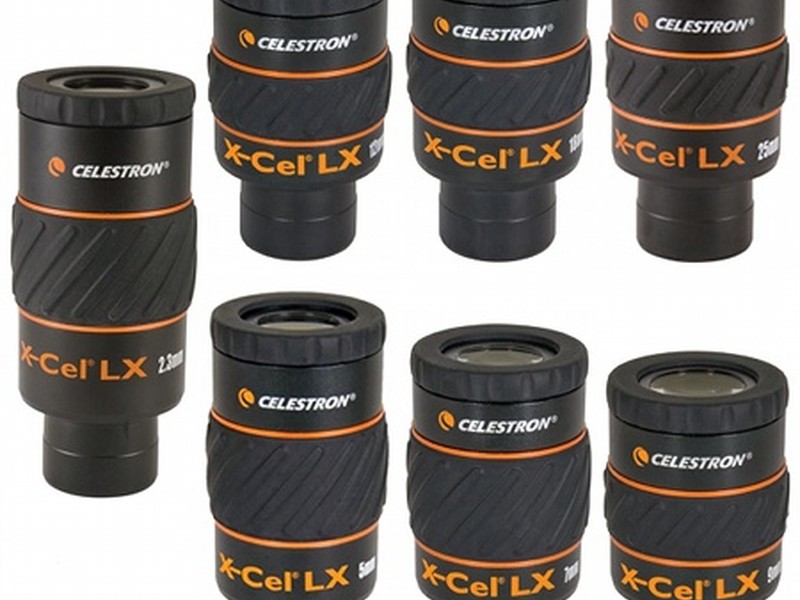
| Key Specifications | |
|---|---|
| Focal Length | 9mm |
| Apparent Field of View | 60° |
| Eye Relief | 20mm |
| Lens Elements | 6 (fully multi-coated) |
| Barrel Size | 1.25" |
| Weight | ~195g |
| Features | Rubber grip, twist-up eyecup |
| Waterproof | No |
| Available From | First Light Optics, Amazon UK |
The Celestron X-Cel LX 9mm is for observers who've confirmed that astronomy is more than a summer hobby and want better optics without jumping to premium prices. It's the upgrade eyepiece when the BST 8mm feels adequate but you're ready for sharper planetary views and more refined build quality.
f/5, 750mm focal length
83×Perfect planetary power for a 150mm scope. Noticeably sharper than the BST 8mm at this magnification. Jupiter's detail pops.
f/6, 1200mm focal length
133×High power on a 200mm scope. Saturn's Cassini division is crisp. Sees detail the BST can only hint at.
f/10, 900mm focal length
100×A refractor at this magnification is spectacular. The X-Cel LX's sharpness matches what you'd expect from premium refractor optics.
Any scope
ExcellentThe Moon at high power is the X-Cel LX's sweet spot. Craters, mountains, and terminator shadows are gloriously detailed.
The 9mm is £35 more than the BST 8mm, but the jump in edge sharpness on fast scopes is real and worth the upgrade if you're serious about planetary observing.
Celestron's best budget premium eyepiece. The X-Cel LX line is consistently praised for delivering near-premium optics at mid-tier prices. This is Celestron's bread-and-butter eyepiece for observers ready to step up.
"Sharp on fast scopes." Multiple forum users note that this eyepiece really shines in f/5 scopes (like the Heritage range). The edge correction is noticeably better than the BST 8mm, especially at the edges of the field.
Build quality is noticeable. The rubber grip and twist-up eyecup feel purposeful. This eyepiece looks and feels like it costs £80 instead of seeming like a glorified budget option.
Best for planetary work, not deep-sky. It's designed with planets in mind. Deep-sky observers often pair it with a wider-field 18mm or 20mm for low-power work.
The low-power complement. Use the X-Cel LX for planets, use the 18mm for sweeping and deep-sky work. Good optical pairing.
~£45A step up from the 18mm. If you have a 2" focuser (Skyliner 200P+), this immersive wide-field view complements high-power planetary work perfectly.
~£120Double this eyepiece to get a 4.5mm (165× in a Heritage 150P) for extreme planetary power. Useful on steady nights.
~£27Keep it alongside the X-Cel LX. The 8mm is still useful for maximum-power nights, and it costs only £45.
~£45This is the transition eyepiece. Below it: budget BST StarGuiders (£45). Above it: premium Explore Scientific and ultra-wide-field designs (£150+). The X-Cel LX sits at the "serious amateur" tier.
Most observers who buy this stay with it for years. It's not the ultimate eyepiece, but it doesn't need to be. The gap between the X-Cel LX and true premium options (£200+) is small and often not worth the cost.
Buy the X-Cel LX if you've confirmed you'll observe regularly and want better planetary performance. If you're still unsure about the hobby, start with the BST 8mm (£45). You can always upgrade later.