Optical Design
Schmidt-Cassegrain (SCT)
Mount Type
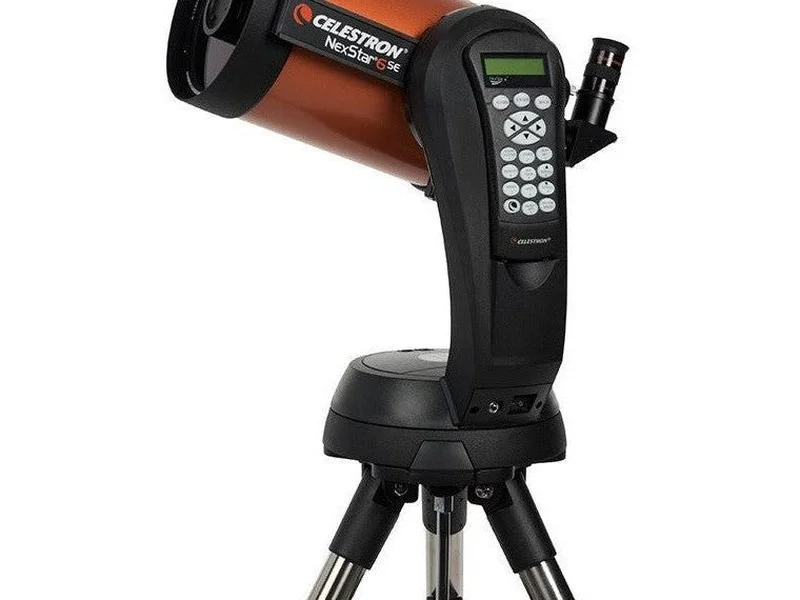
Single-arm alt-az fork (GoTo)
Object Database
40,000+ (stars, DSOs)
Alignment System
SkyAlign (2–3 bright stars)
Tracking
Motorised (sidereal)
Power Source
8× AA batteries or 12V DC
Celestron NexStar 6SE: What Is a Schmidt-Cassegrain?
The NexStar 6SE uses a folded optical path, a clever design that packs a 1500mm focal length into a 38cm tube:
Light path: Light enters through a corrector plate at the front, bounces off a primary mirror at the back, then reflects off a secondary mirror, and finally exits through a hole in the primary mirror to the focuser at the back. The result: high magnification in a compact package.
Compared to a Newtonian reflector of the same aperture, the SCT is much shorter and more portable. Compared to a refractor, it costs less and handles thermal expansion better. This is why SCTs dominate the computerised telescope market.
The Trade-off
The f/10 focal ratio (long focus) means:
- Excellent for planets and the Moon: high magnification resolves fine detail.
- Less ideal for wide-field: true field of view is narrow even with wide-angle eyepieces.
- Requires quality eyepieces: at f/10, cheaper eyepieces show optical flaws more obviously than on an f/4 scope.
The GoTo Experience
Alignment (SkyAlign)
Before you can use GoTo, the mount needs to know where it's pointing. You manually centre three bright objects (stars or planets) in the eyepiece. The hand controller records their positions, and the internal computer calculates the mount's orientation relative to the sky. This takes 5–10 minutes and is arguably the most critical step.
Finding Objects
Once aligned, you type an object designation (M31, NGC 2244, Sirius) into the hand controller, and the scope slews to it automatically. Most of the time, the object lands in the field of view. Sometimes, if alignment was sloppy or the object is near the horizon, it might be just outside. A quick hand nudge centres it.
Tracking
The motors continuously adjust the scope's position to compensate for Earth's rotation. At high magnification (150×+), this is a genuine convenience: you don't have to keep pushing the scope by hand.
Honest Assessment
The GoTo system works well when properly aligned. The alignment process is quick once you know it, but it requires clear skies and patience. If you rush it (picking faint stars, miscentring) tracking becomes unreliable. Most observers report that after a few sessions, alignment becomes second nature.
WiFi adapter note: Celestron sells a WiFi module (SkyPortal) that lets you control the scope from your phone. It's convenient for public viewing events or if you want to observe from inside a warm room, but it's an extra £189 at FLO and adds battery drain.
What Can You See with the NexStar 6SE?
The Moon
Superb. The f/10 focal ratio delivers high magnification naturally. Crater detail is exquisite. The Cassini division (a valley between two lunar mountain ranges) becomes obvious. Shadows near the terminator create stunning three-dimensional relief. You could spend hours on a clear lunar evening.
Jupiter
Belt structure is clear. The Great Red Spot is obvious (when it's on the visible hemisphere). Individual Galilean moons are sharp points of light. On excellent seeing nights, you might spot smaller features like festoons and white ovals. The NexStar's tracking keeps Jupiter centred without you pushing the scope.
Saturn
The Cassini division (gap in the rings) is easily visible. Cloud banding is obvious. The moons (Titan, Iapetus, Rhea) resolve individually. At f/10, Saturn views are genuinely impressive, though a 200mm Dob will still show marginally more detail due to the larger aperture.
Mars
On good opposition years (closest approach every 26 months), polar ice caps are visible. Dark surface markings emerge. Syrtis Major is unmistakable. On poor years, Mars is a rusty disc with hints of feature: the 150mm aperture does what it can, but Mars is a demanding target.
Deep-Sky Objects
M42 (Orion Nebula)
Good nebulosity. The Trapezium stars resolve. Darker dust lanes are obvious.
M13 (Hercules Cluster)
Partially resolved into stars. The centre is still dense, but the outer regions resolve nicely.
M51 (Whirlpool)
Visible as a spiral structure on dark nights. The bridge to NGC 5195 is detectable but subtle.
M31 (Andromeda)
Extended but constrained by the narrow field. The dust lane is subtle. Less impressive than through a 200P.
Planetary Nebulae
M57 (Ring) and M27 (Dumbbell) show clear structure. Smaller ones need averted vision.
Galaxies
M74 (Phantom Galaxy) is challenging. Brighter Virgo galaxies (M49, M60, M86) are easy finds but appear small.
The key: GoTo finds everything for you, which is convenient. But 150mm aperture is the limiting factor for faint objects. You'll see structure in bright DSOs, but faint galaxies will remain relatively dim.
NexStar 6SE vs Skyliner 200P: Which Should You Buy?
This is the most common comparison between computerised and manual scopes. Here's the reality:
200P advantages: 200mm aperture (vs 150mm) = more light-gathering, finer resolving power, easier to see faint objects. Manual mount is rock-solid (no vibration). No electronics to break. Costs around £340 (less than a third of the NexStar). Second-hand market is huge.
6SE advantages: GoTo automation finds objects reliably without hunting. Motorised tracking keeps objects centred at high magnification. Compact form factor and lower weight (easier to transport). Compact optical design (folded path) means shorter tube.
Who Should Buy Which?
Buy the 200P if: You prioritise aperture and optical performance. You're willing to spend 10 minutes manually finding objects. You observe mostly bright targets (Moon, planets, M42, M13). You plan to observe for 5+ years and want maximum resale value. You live in a light-polluted area and want raw light-gathering power.
Buy the 6SE if: You value convenience and automation. You want to spend more time observing and less time searching. You're interested in basic astrophotography (the f/10 ratio and stable tracking help). You have limited storage space. You want a "set it and forget it" experience at public viewing events.
Most serious amateur astronomers eventually recommend the 200P to beginners for purely visual observing. The aperture advantage is real and lasts a lifetime. The NexStar's convenience is genuine but comes at a cost: both in money and in the risk of technical failures.
What Buyers Say About the NexStar 6SE
On UK forums (Stargazers Lounge, ClearSkies), the NexStar 6SE has a mixed but generally positive reputation:
- Orange tube recognition: Celestron's iconic orange colour is immediately recognisable at dark sites. There's a huge global user base and active community support.
- GoTo reliability varies: When properly aligned, GoTo is reliable. Many users report going back and re-aligning during the session if tracking drifts. Some frustration with hand controller responsiveness and outdated UI design.
- Single-arm mount vibration: The most common complaint. At high magnification, the single-arm fork vibrates. It settles after 2–3 seconds, but it's an annoyance. Heavier mounts (8SE, larger models) are more stable.
- Battery consumption is real: 8× AA batteries deplete quickly, maybe 4–5 hours of continuous use. Most users recommend investing in a 12V external power supply (£40–60) immediately.
- Optical quality is solid: The SCT optics are good. No complaints about image quality; most criticism targets the mechanics and electronics.
Known Limitations
Single-Arm Fork Vibration
At magnifications above 150×, you'll notice vibration. A slight nudge to the tube or a gust of wind causes oscillation that takes 2–3 seconds to dampen. It's not a deal-breaker, but it's a compromise compared to a full-height Dobsonian base or a sturdy equatorial mount.
Battery Life is Mediocre
Eight AA batteries deplete within 4–5 hours of continuous use. Some observing sessions are shorter, but if you want to stay out all night, you'll need a 12V external power supply. Don't rely on batteries alone: budget for a PowerTank or similar (£50–80).
Narrow True Field of View
The f/10 focal ratio means your true field of view is narrow, even with a wide-angle eyepiece. This is excellent for planets but frustrating for sweeping through star clusters or nebulae. Wide-field observing is not this scope's strength.
Dew on the Corrector Plate
The front corrector plate is exposed to humid air. On UK nights (especially spring and autumn), dew condenses quickly. A dew shield (£20–40) or a 12V dew heater (£30–50) is practically essential. Without one, you'll be wiping the corrector plate regularly.
Thermal Equilibrium Takes Time
The 150mm corrector plate and primary mirror are thick. They take 20–30 minutes to reach thermal equilibrium with the surrounding air. On cold winter nights, this is less noticeable. On warm summer nights, rushing the scope to focus before thermal stabilisation results in soft focus and coma.
Hand Controller Interface Feels Dated
The keypad is basic and menu navigation is slow. There's no option to upgrade the hand controller; you're stuck with what ships. The WiFi SkyPortal app is better, but it's an additional expense.
Living With the NexStar 6SE
Alignment Ritual
The best observers develop a repeatable alignment routine: find Polaris or another circumpolar reference, centre three bright well-spaced stars, verify tracking by slewing to a fourth object, and only then start observing. It's a 10-minute investment that pays off in reliable GoTo accuracy all night.
Storage and Transport
At 14kg total, it's manageable. The fork arms fold inward for storage. Most observers keep it in a garage or storage box. Unlike a Dobsonian (which demands a large flat surface), the 6SE occupies less space: a corner cupboard or shelf is sufficient.
Build a Portable Power Kit
From day one, invest in:
- A 12V external power supply or PowerTank (£50–80)
- A dew shield (£20–30)
- A red LED headlamp (so you don't wreck night vision checking the hand controller)
- Spare eyepieces: a good 9mm planetary eyepiece (£80–120) and a 20mm wide-angle (£60–120)
Software Updates
Celestron occasionally releases hand controller firmware updates via USB. Check the Celestron website periodically, but don't obsess over it: the base firmware is mature and stable.
Essential Day-One Purchases
12V Power Supply (£50–80): Either a portable PowerTank lithium battery or a regulated 12V AC adapter. Eliminate battery anxiety immediately. This is non-negotiable.
Dew Shield (£20–40): A simple foam tube extension that reduces dew condensation on the corrector plate. UK humidity makes this essential in spring/autumn. Some observers DIY this with PVC pipe.
Better Star Diagonal (£30–60): The included basic star diagonal works, but upgrading to a 2" diagonal with higher-quality glass improves contrast and sharpness. Recommended but not mandatory day-one.
Red Headlamp (£10–20): Preserve your night vision. A basic red LED headlamp is cheaper than destroying an evening of dark-adapted vision.
Link to Equipment Guides for accessory recommendations.
Best Upgrades
Eyepieces
Celestron X-Cel LX 9mm: Excellent planetary eyepiece. Sharpens Jupiter and Saturn detail significantly. Wide eye relief. ~£80–100. View at FLO →
Explore Scientific 68° 20mm: Wide-angle deep-sky eyepiece. Makes the most of the f/10 system for nebulae and clusters. ~£100–150. View at FLO →
Filters and Adapters
Moon filter (ND13 or polarising): The full Moon is bright enough to hurt at high magnification. A neutral density filter tames glare. ~£15–25. View at FLO →
2" visual back: Celestron upgraded this on newer models, but if yours has a 1.25" back, a 2" adapter opens up premium wide-field eyepieces. ~£40–60.
Cooling and Thermal
Dew heater (12V, £30–50): More effective than a passive dew shield. Gently warms the corrector plate to prevent condensation without thermal shock. Popular option for UK observers. Browse at FLO →
WiFi SkyPortal (£189)
If you want smartphone control, this Bluetooth/WiFi module replaces the hand controller entirely. It's more responsive than the wired controller and allows observing from inside a warm room. Battery drain is higher, so you'll need robust 12V power.
Don't rush to upgrade. Use the bundled eyepieces and star diagonal for your first 10–20 observing sessions. You'll have a clearer sense of what your scope needs after that investment in time.
Upgrade Path
The NexStar 6SE sits at the entrance to the Celestron computerised ecosystem. Upgrade options:
- Stay and invest: Keep the 6SE and pour money into eyepieces, filters, and a better power system. This approach maximises optical performance within the 6SE's aperture limit.
- Sideways upgrade, 8SE: Same GoTo system, bigger aperture (203mm vs 150mm). More light, more resolving power, but more vibration in the single-arm mount. ~£1100. Read our full 8SE review →
- Vertical upgrade, replace the mount: Keep the 6SE OTA and sell it on the second-hand market. Invest in an equatorial GoTo mount (like a Celestron AVX) for more stable tracking and astrophotography capability. This is a serious step costing £1500+.
- Branch sideways, add a manual Dob: Many NexStar owners end up buying a 200P or 250P Dobsonian as a "second scope" for deep-sky observing. The GoTo for planets/Moon, the Dob for galaxies/nebulae. It's a compromise that works for some.
The hard truth: if pure visual performance is your goal, the NexStar 6SE is a compromise. It prioritises convenience over aperture. After a few years, some observers realise they'd prefer a larger manual scope or a computerised system on a more stable mount.
Celestron NexStar 6SE: Is It Worth It?
The Celestron NexStar 6SE is an excellent middle ground: it automates object finding, eliminates the frustration of the hunt, and delivers planetary views that are genuinely impressive. The f/10 focal ratio is optimised for the Moon and bright planets. Motorised tracking keeps objects centred without constant nudging. The 40,000-object database means you'll never run out of targets.
But at around £1,199, it's not a bargain: it's a convenience premium. You're paying roughly triple what a Sky-Watcher Skyliner 200P costs (around £340) for automation and a more portable package. The 200P will show you fainter galaxies, resolve more detail in star clusters, and prove more reliable over decades. The 6SE will find those objects faster and let you observe comfortably.
Buy the NexStar if you value convenience, prefer compact form factors, or want to explore astrophotography basics. Buy the 200P if you prioritise raw optical performance and plan to observe for years without worrying about electronics failing. Both are solid telescopes; the choice depends on what you value most: aperture or automation.
Affiliate disclosure: This guide is community-sourced research from UK astronomy forums (Stargazers Lounge, BBC Sky at Night forums, ClearSkies). I do not have personal hands-on experience with this scope. Specifications verified against official Celestron documentation and user reports. This page is not affiliated with Celestron or any retailer, though links may contain affiliate codes.
Back to Equipment Guides • Home