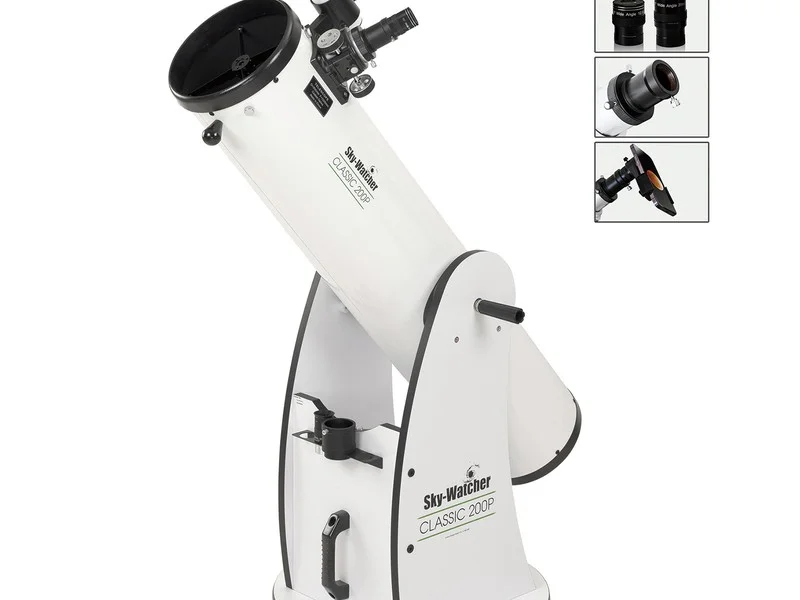
Mount Type
Full-size Dobsonian
Total Weight
~23kg (Tube 9kg, Base 14kg)
Included Eyepieces
10mm & 25mm (1.25")
Focuser
2" Crayford + 1.25" adapter
Skyliner 200P: Why 8 Inches Changes Everything
The jump from a 130mm or 150mm scope to 8 inches (200mm) is where amateur astronomy stops being a compromise and starts being genuinely rewarding. Here's why:
Light-gathering power: The 200P collects 2.4× more light than a 150mm scope, and 3.5× more than a 130mm. That's not a small upgrade. It's the difference between faint smudges and structured, detailed objects.
Resolving power: The Rayleigh criterion gives you 0.58 arcseconds at 8 inches (versus 0.77" at 150mm). This means you can split tighter binary stars, see finer detail on planetary surfaces, and resolve individual stars in globular clusters that appear as an unresolved blur through smaller apertures.
Practical limit: With decent eyepieces, you can push magnification to 300× (at 200mm, this is still well below the 2× per millimeter rule). At 150mm, 150× is often the practical ceiling. The extra magnification reveals detail you've never seen before.
Most observers who "outgrow" smaller telescopes land on the 200P for years. It's the Goldilocks aperture: large enough to satisfy, small enough to handle.
What Can You See with the Skyliner 200P?
The Moon
Incredible detail. Craters within craters. Rilles (narrow lunar valleys) become obvious. Crater chains. Shadow play near the terminator reveals topography that looks three-dimensional. You'll keep finding new details even in the same observation session.
Bright Planets
Jupiter: Multiple belt pairs, the Great Red Spot detail, individual cloud bands, Galilean moon transits. On excellent seeing nights, you might spot smaller features like festoons and white ovals.
Saturn: The Cassini division (the gap between the A and B rings) is easily visible. Cloud banding in the globe becomes obvious. The moons, Titan, Iapetus (with its extreme albedo variation), Rhea, resolve individually.
Mars: Polar ice caps. Dark surface markings (albedo features, not canals). Syrtis Major and Hellas Planitia are unmistakable on good opposition years.
Deep-Sky Objects
M42 (Orion Nebula)
Extensive nebulosity. The Trapezium stars resolve at lower magnification. Darker dust lanes emerge.
M13 (Hercules Cluster)
Resolves into individual stars across the central regions. Stars almost to the core.
M51 (Whirlpool)
Spiral arms become obvious on dark nights. The bridge to the companion galaxy NGC 5195 visible.
M31 (Andromeda)
Extends 2+ degrees across your field of view. The dust lane visible. Bright core obvious.
Planetary Nebulae
M57 (Ring Nebula), M27 (Dumbbell) show clear structure. Smaller ones require averted vision but are rewarding.
Virgo Galaxy Cluster
You can see 20+ galaxies in a single field. Many are mere smudges, but the variety is addictive.
The key: at 8 inches, many catalogue objects transition from "I'm not sure what I'm looking at" to "yes, I can definitely see that structure." That moment is why people observe.
What Buyers Say About the Skyliner 200P
On UK astronomy forums (Stargazers Lounge, ClearSkies, BBC Sky at Night forums), the 200P has a reputation that's earned through years of user reports:
- "Buy once, cry once": observers frequently report keeping a 200P as their goto scope for 10+ years, only upgrading to larger apertures or tracking mounts for specific projects (astrophotography, faint galaxy hunts).
- The second-hand market thrives. 200P scopes hold their value and have active demand. This longevity speaks to build quality and user satisfaction.
- Common recommendation for "first serious scope." Beginners asking "what telescope should I get?" are consistently steered toward the 200P if they've already owned a smaller scope and want to take the hobby seriously.
- No regrets. The phrase "I wish I'd bought this from the start" appears frequently when owners reflect on their progression. It's not a stepping stone. It's a foundation.
Known Limitations
Size and Weight
23kg total (9kg tube, 14kg base). It's not casually portable. You need car access. Storage space in a garage, shed, or loft is essential. Carrying it in two trips is the smart move; one trip is possible if you're strong and careful.
No Motorised Tracking
This is a manual alt-azimuth mount. Objects drift out of view at high magnification. You push the scope by hand to keep them centred. It's called "nudging" and it becomes second nature, but it's worth knowing upfront if you're imagining a hands-free observing session.
Collimation Required
Newtonian reflectors need occasional mirror alignment. Before each observing session (or every few sessions, depending on how much you move the scope), you may need to recollimate using a collimation cap. It's a 5-minute task once you've learned it, but it's mandatory maintenance.
Requires Flat Surfaces
The Dobsonian base needs a flat, stable surface. Rocky ground, sloped driveways, or heavily unlevel decking can be problematic. A concrete pad or flat patio is ideal.
Bundled Eyepieces Don't Maximize the 2" Focuser
The 200P ships with a 2" Crayford focuser, excellent for wide-field views and accommodating premium eyepieces. But the included 10mm and 25mm eyepieces are 1.25" format. To take real advantage of that 2" focuser, you'll want to invest in 2"-compatible eyepieces, which cost more upfront.
Living With the Skyliner 200P
Cooling Time
The 200mm mirror is thick. It takes 30–45 minutes to reach thermal equilibrium with the ambient air temperature. On a cold winter night, this is less critical (shorter cooling time, but you're willing to wait). On warm summer nights, the wait is frustrating but non-negotiable if you want sharp views.
Transport Tips
Two trips (tube separately from base) is safest. If you're carrying it as one unit to a dark site, cradle the tube across both your forearms and keep it horizontal. The base handles are sturdy and designed for this, but respect the weight.
Storage
A dedicated corner of a garage or shed is ideal. Standing it upright in a corner takes roughly the footprint of an office chair (maybe 1m² floor space). Some observers build a simple wooden cover (cardboard or plywood) to keep dust off the tube. If storing in a damp environment, ensure good ventilation to avoid fungus on the mirror.
Light-Polluted Garden vs. Dark Site
The 200P works in suburban light pollution (Bortle 6–7), but it truly shines under darker skies (Bortle 4–5 or better). If you're observing from a back garden, prioritize bright objects (planets, the Moon, M13, M42). For deep-sky hunting, a monthly trip to a dark-sky site is worth it. The difference is dramatic.
Best Upgrades
Eyepieces
BST StarGuider 8mm: High-quality planetary eyepiece. Sharpens Jupiter and Saturn views significantly. ~£120–150. View at FLO →
Explore Scientific 68° 20mm: Uses the 2" focuser, wide field of view, excellent for deep-sky sweeping. ~£180–220. View at FLO →
Accessories
Telrad finder: Replaces the 6×30 finder with a reflex sight overlay. Makes target acquisition faster and more intuitive (~£40–60). View at FLO →
Laser collimator: Makes mirror collimation a 30-second task instead of a 5-minute fiddling session (~£30–50).
Dew shield: Reduces dew accumulation on the primary mirror on humid nights. A DIY tube extension works, or buy a commercial foam shield (~£20–40). View at FLO →
Don't rush to "upgrade" your eyepieces out of the box. Spend 10–20 hours with the bundled glass first. You'll have a better sense of what your second eyepiece should prioritize.
Skyliner 200P vs Skyliner 250PX: Is It Worth Upgrading?
For many observers, the 200P is not a stepping stone. It's the destination. The next logical moves are:
- Staying put: Invest more in eyepieces and filters. A good wide-field 20mm and a planetary eyepiece kit (5mm, 8mm, 12mm) will keep you discovering new detail for years.
- Sideways upgrade: Add a GoTo tracking platform (like a Dob-Justinian or a simple equatorial platform). You keep the tube and base but gain automated tracking for long observing sessions or astrophotography.
- Vertical upgrade: Move to a Skyliner 250PX (10 inches) if aperture hunger sets in. Or explore a computerised Dobsonian like an XT10i (alt-azimuth GoTo) for hands-free tracking.
- Specialist direction: A 200P on a simple equatorial platform becomes a basic imaging rig for planetary and lunar photography. Many observers go this route rather than buying a new scope.
The reality is that 8 inches represents a maturity point in observing. Jumping to 12 or 14 inches brings diminishing returns for visual observation (more detail per photon, but from an already impressive foundation). Most serious amateur astronomers eventually own an 8-inch, whether it's a 200P or another brand.
Sky-Watcher Skyliner 200P: Is It Worth It?
The Sky-Watcher Skyliner 200P is the telescope most amateur astronomers wish they'd bought first. It sits at the intersection of affordability (around £340), genuine capability (8 inches is a serious aperture), and proven durability. You'll see planetary detail that changes how you observe Jupiter. You'll resolve globular clusters. You'll spot dozens of galaxies in a single sweep through Virgo. And you'll do all this with a scope that costs less than a decent camera.
It's heavy, requires a car to transport, and demands a bit of manual nudging to keep objects in view. But these are small inconveniences for the optical performance you're getting. This is the scope that separates casual stargazing from committed amateur astronomy. If you're ready for that leap, the 200P delivers.
Affiliate disclosure: This guide is community-sourced research from UK astronomy forums (Stargazers Lounge, BBC Sky at Night forums, ClearSkies). I do not have personal hands-on experience with this scope. Specifications verified against official Sky-Watcher documentation and user reports. This page is not affiliated with Sky-Watcher or any retailer, though links may contain affiliate codes.
Back to Equipment Guides • Home