RAF Lakenheath: The Night Britain's Air Defences Failed
Multiple US and RAF radar stations simultaneously tracked an unknown object over East Anglia. An RAF Venom night fighter was scrambled, locked its guns onto the target, then found the UFO sitting behind it. For ten minutes, the pilot tried everything to shake it. He couldn't. The case remains officially unidentified.
RAF Lakenheath & Bentwaters
(2130 to 0330 hrs)
RAF ATCC radar (Lakenheath)
night fighter
USAF Blue Book
The Lakenheath-Bentwaters incident is the most rigorously documented Cold War UFO case on record. Unlike most reports from the era, it involves multiple independent radar systems operating simultaneously, ground observers who corroborated the radar data, and a military jet intercept in which the pilot confirmed the target on his own aircraft radar before losing control of the encounter.
The case was analysed at length by radar physicist Dr Gordon Thayer for the USAF-commissioned Condon Report in 1969. His conclusion was unambiguous: "the probability that at least one genuine UFO was involved appears to be fairly high." He called it "the most puzzling and unusual case in the radar-visual files." It was later cited by the French government's COMETA report, a study by senior French defence officials released in 1999, as one of the most important UFO cases in history.
Seventy years later, nobody has offered a credible conventional explanation for what happened over Suffolk that night.
The Setting: Cold War East Anglia
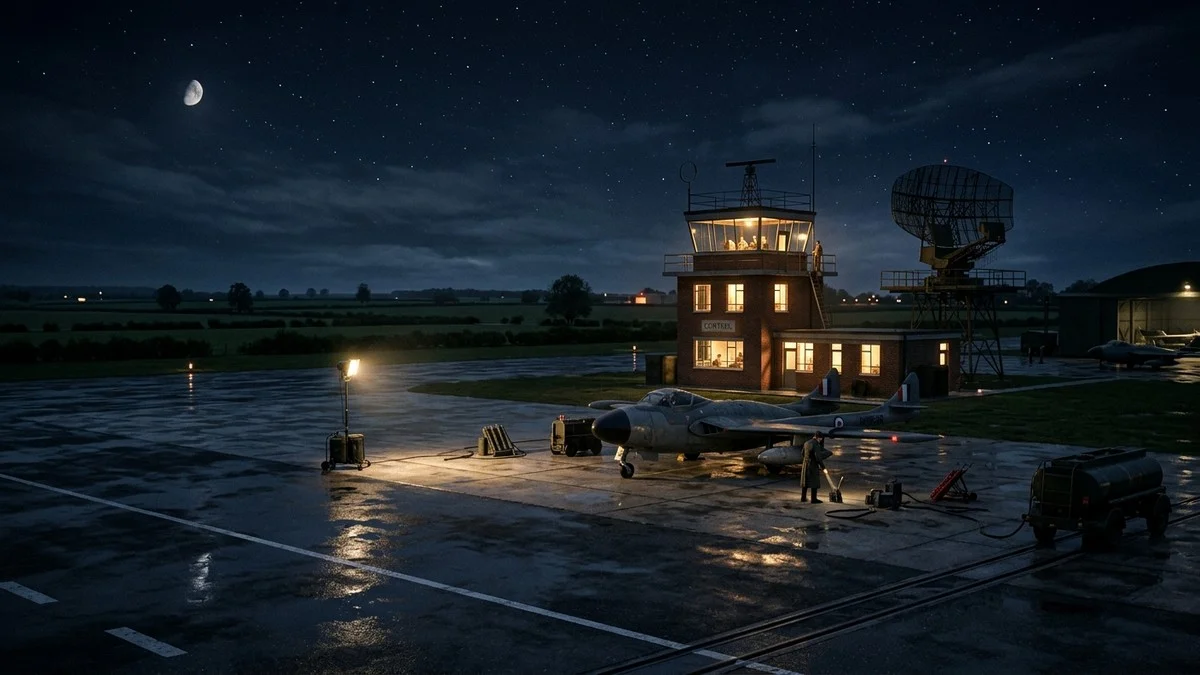
In August 1956, the Cold War was at its tensest. Soviet bombers were a genuine operational threat, and the eastern counties of England, flat, low-lying, closest to the continent, were among the most heavily defended airspace in Britain. RAF Bentwaters and RAF Lakenheath, both in Suffolk, were operated by the United States Air Force under NATO basing agreements. These were not sleepy provincial postings; they were front-line bases equipped with some of the most advanced radar technology available to Western forces.
RAF Bentwaters operated a Ground Controlled Approach (GCA) radar: a precision approach system primarily used for guiding aircraft through poor weather, but also capable of tracking airborne contacts. A few miles away, RAF Lakenheath had its own Air Traffic Control Centre (ATCC) with its own radar systems. The two facilities could compare notes, which is precisely what would prove crucial on the night of 13 August.
First Contact: Bentwaters Radar
At approximately 2130 hours on 13 August 1956, the GCA radar at Bentwaters detected an unusual return. The object appeared to be moving at an estimated 2,000–4,000 mph, far beyond any aircraft of the era. The radar operator tracked it crossing the scope in a near-straight line, then losing it at the edge of radar range.
What made the Bentwaters returns especially unusual was their character. Radar operators at the time were experienced at filtering out false returns: atmospheric inversions, flocks of birds, equipment noise. These returns did not behave like any of those. The object appeared solid and singular. Shortly after the first contact, the operators reported a second contact: a cluster of objects that merged into one large return, which then accelerated at an estimated 40–50 mph before disappearing.
The Bentwaters operators passed their reports to Lakenheath. Crucially, Lakenheath radar confirmed they were seeing something too.
"The fact that radar and ground visual observations were made on its rapid acceleration and abrupt stop certainly lend credence to the report."· RAF Lakenheath, Official Telex, 14 August 1956
A Six-Hour Encounter
What followed was not a brief, ambiguous blip. The Lakenheath radar tracked an unidentified object for the better part of six hours, from late evening through to the early hours of 14 August. The object's behaviour, as recorded in the official reports, was unlike anything the operators had encountered in their careers.
| Speed range | 0 to ~950 km/h (instantaneous, no acceleration phase) |
| Movement pattern | Straight-line segments of 13–30 km, with abrupt stops |
| Stop duration | 3 to 6 minutes stationary, then instant departure |
| Altitude | Varied: appeared on GCA and ATCC radar simultaneously |
| Visual confirmation | Yes: ground observers at Lakenheath confirmed radar tracks |
| Radar signature | Solid, distinct return, not atmospheric or equipment artefact |
The COMETA report, citing the official Blue Book investigation files, describes the object's movement precisely: it would change direction several times, "describing line segments ranging from 13 to 30 km, separated by abrupt stops for 3 to 6 minutes; the speed always went from a value of zero to a value of some 950 km/h without any transition." The phrase "without any transition" is key: no aircraft, then or now, can instantaneously accelerate from a dead stop to cruise speed with no observable acceleration phase.
The Intercept
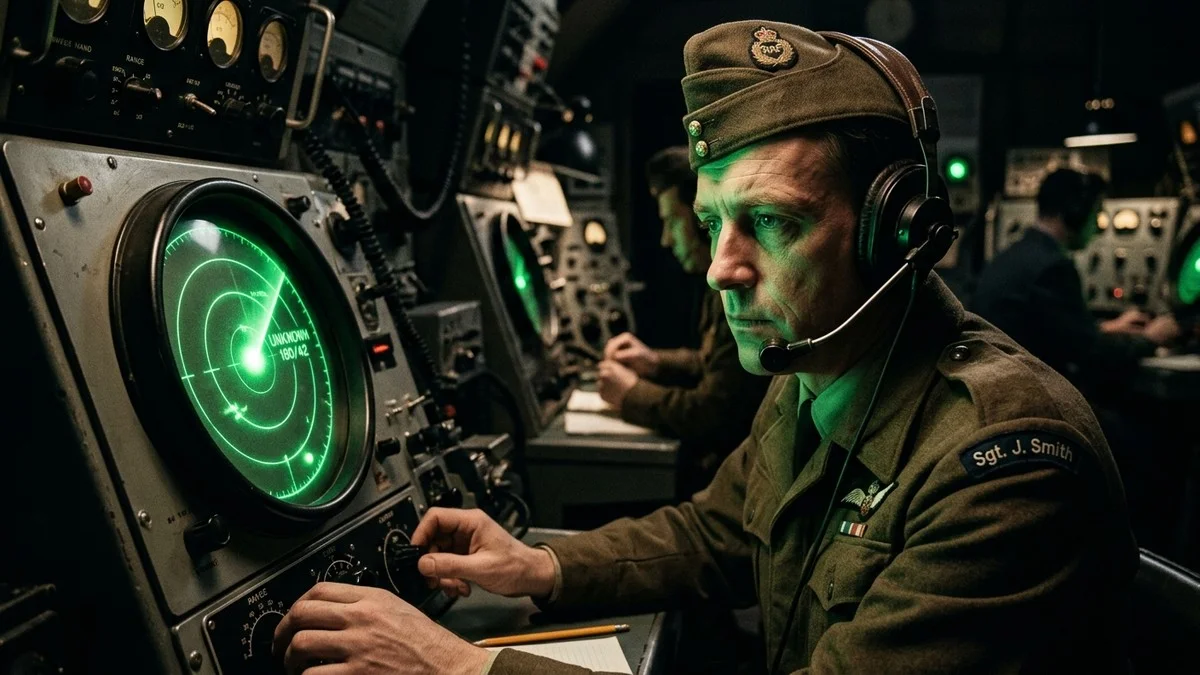
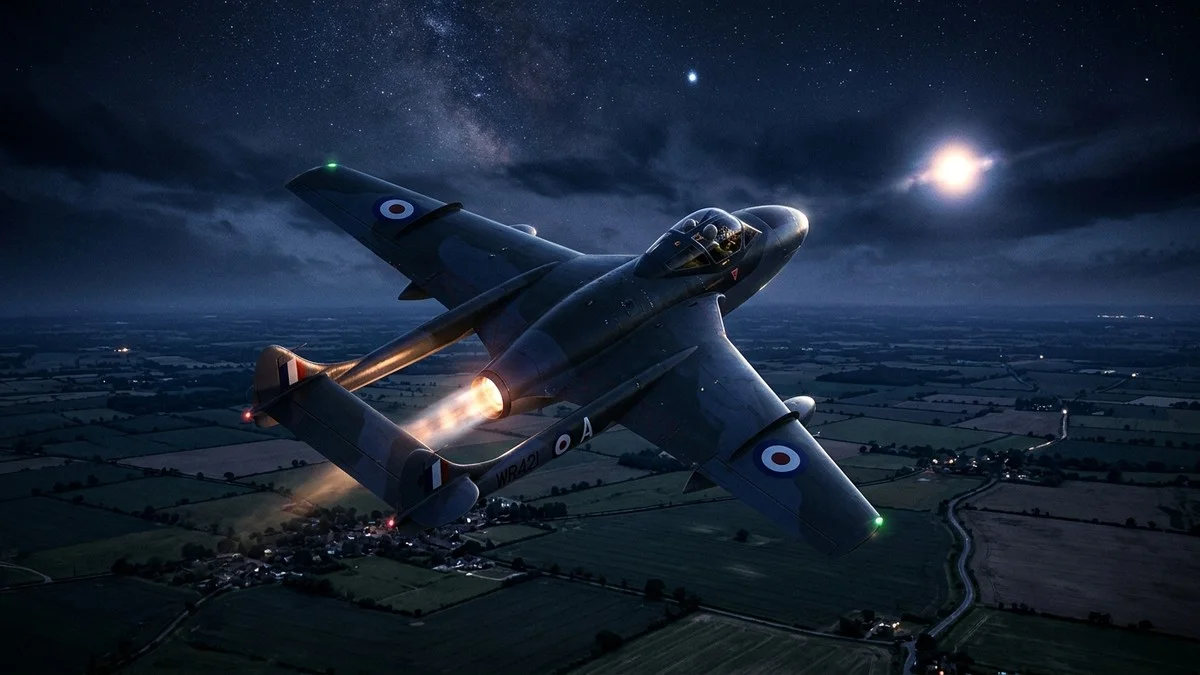
After 30 to 45 minutes of tracking the object on radar, the decision was made to scramble an RAF night fighter. A de Havilland Venom, a twin-boom jet armed with four 20mm cannon and equipped with an AI radar, was dispatched to investigate.
The Lakenheath ATCC guided the Venom toward the contact. The pilot acquired the target both visually and on his own aircraft radar. He reported locking his gunsight onto it: standard intercept procedure to confirm the contact. Then the situation changed entirely.
"The target made a swift circular movement and then fell in behind the Venom, following it at a constant distance. The pilot tried every manoeuvre for about 10 minutes: steep climbs, dives, sustained turns. He was unable to shake it."
· Summary of RAF Venom intercept, as recorded in USAF Blue Book and cited in the COMETA Report, 1999What the ground radar operators saw next was remarkable. The UFO executed a rapid movement and positioned itself behind the Venom. It then followed the jet at a constant distance, and maintained that position regardless of what the pilot did. The COMETA report summarises: "Watched by the radar technicians, the pilot tried every manoeuvre for about 10 minutes in order to move back behind the object (steep climbs, dives, sustained turns), but he didn't succeed: the UFO followed him at a constant distance according to the ground radar stations."
The Venom pilot, low on fuel, eventually had to break off and return to base. He asked the controllers to confirm whether the object was still following him. They said it was, for a short distance. Then the UFO came to a standstill, made several short movements, and departed northward at approximately 950 km/h. It left radar range at 0330 hours.
A second Venom was scrambled to replace the first, but it had to abort due to mechanical failure before establishing contact.
Key Witnesses: RAF and USAF Personnel
GCA Radar Operators
First to detect the anomalous returns. Tracked multiple contacts including a cluster that merged into a single large return. Experienced radar technicians who had eliminated equipment and atmospheric explanations before reporting upward.
ATCC Radar Operators
Independently confirmed contacts from a separate radar system. Tracked the object for approximately six hours. Guided the intercepting Venom to the target and observed the UFO manoeuvre behind the jet on their scopes.
Ground Visual Observers
Ground personnel at Lakenheath reported visual sightings consistent with the radar tracks: confirming the high speed and abrupt accelerations reported by the radar operators. Visual and radar evidence corroborated each other.
RAF Venom Pilot
Acquired the target both visually and on aircraft radar. Confirmed the lock-on before losing the target when the object manoeuvred behind him. Spent approximately ten minutes attempting to re-acquire and shake the object. Identity remains unknown in declassified records.
Lakenheath ATCC Controllers
Directed the intercept in real time. Observed the UFO's movement on radar throughout and communicated target position to the pilot. Their official telex, sent the same night, stated the radar and ground visual observations 'certainly lend credence to the report.'
What the Official Investigations Said
The Lakenheath-Bentwaters incident was reviewed by USAF Project Blue Book, the Air Force's official UFO investigation programme, which classified the case as "unidentified." That designation is significant: the overwhelming majority of Blue Book cases were explained away as weather phenomena, aircraft, stars, or misidentifications. "Unidentified" was a label Blue Book used sparingly and reluctantly.
The case received its most thorough technical analysis in 1969 as part of the Condon Report: officially the Scientific Study of Unidentified Flying Objects, commissioned by the US Air Force and conducted by the University of Colorado. Radar physicist Dr Gordon Thayer examined the Lakenheath data at length. His assessment is among the most careful and candid evaluations any UFO case has received from an official scientific inquiry:
"In conclusion, although conventional or natural explanations certainly cannot be ruled out, the probability that at least one genuine UFO was involved appears to be fairly high. Taking into consideration the high credibility of information and cohesiveness and continuity of account, combined with a high degree of 'strangeness', it is certainly one of the most disturbing UFO incidents known today."· Dr Gordon Thayer, Radar Physicist, Condon Report, 1969 (Case 2)
The French government's COMETA report, published in 1999 and written by a group of senior military officers, defence scientists, and intelligence officials, devoted significant space to Lakenheath as one of its "five major aeronautical cases in the world." The COMETA authors, who included a former head of French Space Studies and a former director of the French Institute of Higher Studies for National Defence, concluded that no conventional explanation had ever been offered, and that the case merited serious continued investigation.
Evidence Assessment
USAF GCA Radar
Bentwaters Radar TrackingMultiple distinct radar contacts confirmed by trained USAF operators. Object characteristics inconsistent with known aircraft, weather phenomena, or equipment anomalies.
RAF ATCC Radar
Independent CorroborationA completely separate radar system at Lakenheath tracked the same contacts simultaneously: ruling out single-system malfunction or operator error.
Ground Visual
Visual-Radar CorrelationGround observers at Lakenheath reported sightings consistent with the radar tracks, including the high speed and rapid accelerations.
Aircraft Radar
RAF Venom On-Board RadarThe intercepting pilot confirmed the target on his own aircraft AI radar: a third independent sensor system detecting the same contact.
Pilot Report
Intercept TestimonyAn experienced RAF night fighter pilot reported the UFO manoeuvring behind his aircraft and maintaining position through sustained evasive manoeuvres.
Official Telex
Contemporary DocumentationThe official Lakenheath telex sent the same night explicitly acknowledges radar and visual corroboration and states the observations 'lend credence to the report.'
Blue Book
USAF Classification: UnidentifiedProject Blue Book, which explained the vast majority of cases, left Lakenheath-Bentwaters classified as unidentified. No conventional explanation was ever officially offered.
Condon Report
Most Puzzling Radar-Visual CaseThe official US government scientific study called it 'the most puzzling and unusual case in the radar-visual files' and rated the probability of a genuine UFO 'fairly high.'
The Timeline
First Radar Contact: Bentwaters
GCA radar at RAF Bentwaters detects an anomalous return moving at an estimated 2,000–4,000 mph. The contact crosses the radar scope in near-straight line. Operators alert Lakenheath.
Cluster Contact
A cluster of objects appears on Bentwaters radar, merges into a single large return, and accelerates before disappearing. Lakenheath ATCC radar independently confirms contacts.
Extended Lakenheath Tracking Begins
Lakenheath ATCC radar begins sustained tracking of an unidentified object exhibiting stop-start movement: stationary for 3–6 minutes, then instantaneous acceleration to ~950 km/h.
Ground Visual Confirmed
Ground observers at Lakenheath visually confirm sightings consistent with radar tracks, including the abrupt accelerations and high speed.
RAF Venom Scrambled
After 30–45 minutes of sustained tracking, an RAF Venom night fighter is scrambled from a nearby base. Lakenheath ATCC guides it toward the contact.
Pilot Acquires Target
The Venom pilot acquires the object both visually and on aircraft AI radar. Reports locking his gunsight, then loses the target as the UFO manoeuvres rapidly.
UFO Positions Behind the Venom
Ground radar operators watch as the UFO moves to a position directly behind the Venom and follows it at a constant distance. The pilot is informed and attempts evasive manoeuvres.
Ten Minutes of Evasive Manoeuvres
The pilot executes steep climbs, dives and sustained turns for approximately ten minutes. The UFO follows throughout, maintaining constant separation on ground radar.
Venom Returns to Base
Low on fuel, the Venom pilot breaks off and returns to base. Ground radar confirms the UFO follows briefly, then halts. A second Venom is scrambled but has to abort with mechanical problems.
Object Departs
After several short movements, the UFO accelerates northward at approximately 950 km/h and disappears from all radar screens. The encounter ends after approximately six hours.
Why This Case Still Matters
The Lakenheath-Bentwaters incident predates the modern UFO conversation by decades. There was no internet, no viral video, no social media: just trained military personnel filing official reports through proper channels. The object they tracked was not a rumour or a blurry photograph. It was a solid radar return, simultaneously confirmed by multiple independent systems, that engaged and then outmanoeuvred an armed military interceptor sent specifically to identify it.
The performance characteristics (instantaneous zero-to-950 km/h acceleration, stationary hovering, and then the seemingly impossible reversal of roles where the pursuer becomes the pursued) were not explainable in 1956. They are not explainable now. No conventional aircraft propulsion system, then or today, can accelerate from stationary to high speed without any transition. No helicopter can match a jet's top speed. And no known aircraft, when being actively pursued by an armed military interceptor, can silently and instantaneously reposition itself on the pursuer's tail.
The Condon Report, for all its reputation for debunking, couldn't explain it. Blue Book couldn't explain it. The French government's senior defence scientists couldn't explain it. What Lakenheath 1956 offers is something rare in the UFO record: a case so technically rigorous, so multiply corroborated, and so extensively reviewed by credible institutions, that dismissing it requires dismissing the entire evidentiary framework of radar physics and military reporting.
"Taking into consideration the high credibility of information and cohesiveness and continuity of account, combined with a high degree of 'strangeness', it is certainly one of the most disturbing UFO incidents known today."
· Dr Gordon Thayer, Condon Report, 1969Sixty-eight years have passed. The files remain in the National Archives. The COMETA report remains publicly available. And the official status of the Lakenheath-Bentwaters incident remains exactly what it was when the Venom pilot landed and filed his report in the summer of 1956: unidentified.
There is one more detail worth sitting with: RAF Lakenheath was a US nuclear weapons base in 1956. That places this case within a pattern stretching from the green fireballs over Los Alamos to Rendlesham: explored in full in our UAP and nuclear weapons page.
See what the radar operators couldn't
Kit we've tested and reviewed in full
Bentwaters had radar; you've got binoculars, and on a clear East Anglian night, that's still the quickest way to tell an aircraft from something stranger.
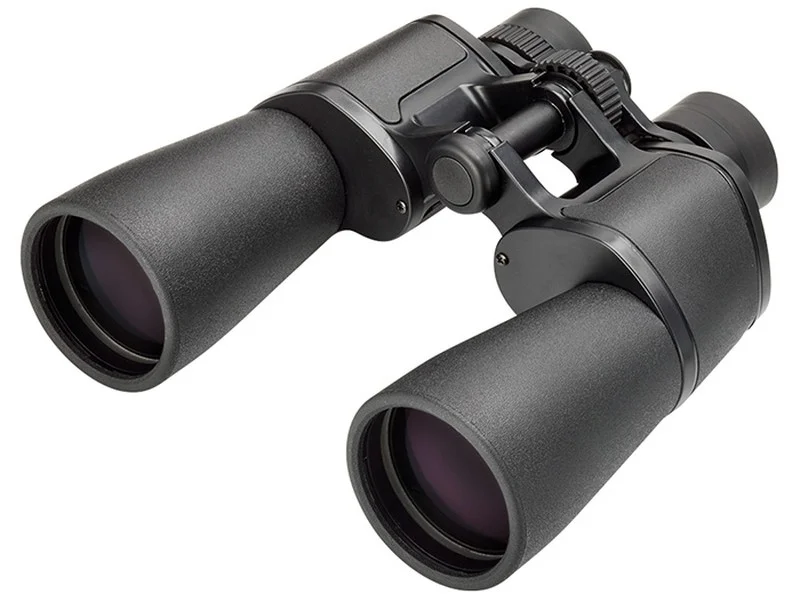
Bright, wide-field optics that make it easy to track anything moving fast or hovering unexpectedly.
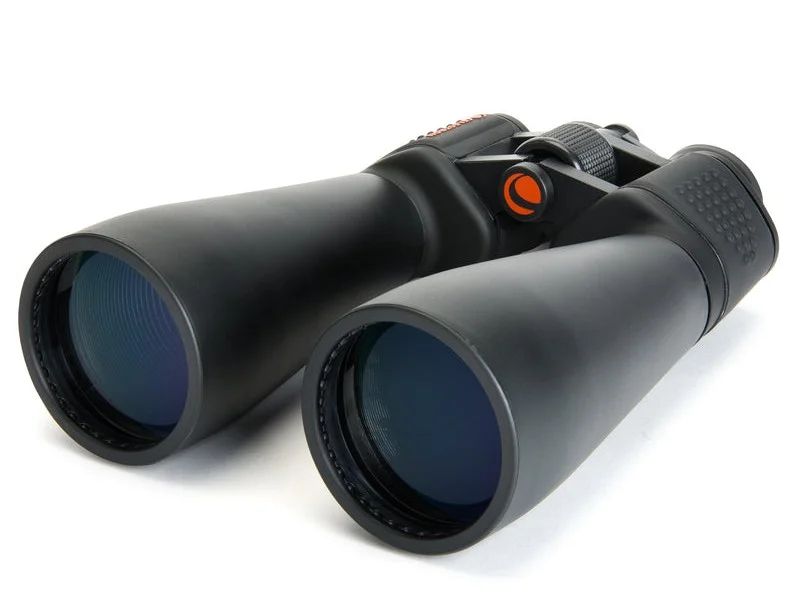
More light-gathering power for anything low on the horizon, well beyond what a Venom pilot could see with the naked eye.
Affiliate links: you pay the same price, we earn a small commission that helps keep WatchTheStars free.
Sources and Further Reading
Primary sources: USAF Project Blue Book files · National Archives (archives.gov); Official RAF Lakenheath telex, 14 August 1956.
Official investigations: Condon, E.U. (ed.), Scientific Study of Unidentified Flying Objects (University of Colorado / Bantam Books, 1969) · Case 2 analysis by Dr Gordon Thayer, pp. 248–264.
Government reports: COMETA, UFOs and Defence: What Should We Prepare For? (Association COMETA / VSD, 1999) · Chapter 2, Section 2.1.
Academic analysis: Thayer, G.D., "The Lakenheath England Radar/Visual UFO Case, August 13–14, 1956," Astronautics and Aeronautics, AIAA (1971).
PURSUE Release 01: The COMETA report text cited above was declassified and published as part of the US Department of War's PURSUE Release 01 on 8 May 2026, available at war.gov/UFO.
More UAP cases
- The Senator Russell Sighting4 OCTOBER 1955 · SOVIET TRANSCAUCASUS (PRESENT-DAY AZERBAIJAN) · FULL CIA FILE RELEASED 10 JULY 2026
- The RB-47 Encounter: 700 Miles, Three Sensors, No ExplanationMississippi → Texas → Oklahoma → Kansas · 17 July 1957 · ~0200–0340 CST
- The Newfoundland KC-97 Incident6 JULY 1955 · NEWFOUNDLAND, CANADA · FILE RELEASED 10 JULY 2026
- Apollo 17's Unknown CompanionTranslunar Coast · 9 December 1972 · Mission Elapsed Time 02:18:47
- The Green Fireball IncidentsDURATION: DEC 1948 – 1952 · LOCATION: LOS ALAMOS / SANDIA / KIRTLAND / WHITE SANDS · STATUS: UNEXPLAINED
- The 1976 Tehran UFO Incident: F-4 Jets, Weapons Failure and the Declassified DIA Report