The RB-47 Encounter: 700 Miles, Three Sensors, No Explanation
A USAF RB-47 strategic reconnaissance aircraft was shadowed by an unidentified object for over 700 miles across five states. The crew saw it. Their onboard ECM equipment detected its radar-like emissions. Ground radar tracked it alongside the aircraft. All three systems registered the same contact simultaneously, and on two occasions, it vanished from all three at exactly the same instant.
2,000+ miles total flight
55th Strategic Recon Wing
Ground radar (ADC)
Texas, Oklahoma, Kansas
USAF Blue Book & Condon
The RB-47 case is unique in the history of UFO research because it is the only case on record where an unidentified object was simultaneously detected by three completely independent sensor systems (visual observation, airborne electronic countermeasures equipment, and ground-based Air Defense Command radar) over an extended period of time and distance.
Most UFO reports rest on a single line of evidence: a witness saw something, or a radar blip appeared, or a photograph was taken. The RB-47 encounter has all three, working in concert, for the better part of two hours and across hundreds of miles of American airspace. When the object disappeared, it disappeared from all three systems at once. When it reappeared, all three picked it up again simultaneously.
The case was classified "unidentified" by USAF Project Blue Book. The Condon Report, the US government's official scientific review, could not explain it. The French COMETA report, prepared by senior military and intelligence officials in 1999, cited it as one of the most important UFO cases ever documented. Sixty-eight years later, no conventional explanation has been offered.
The Aircraft and Its Crew
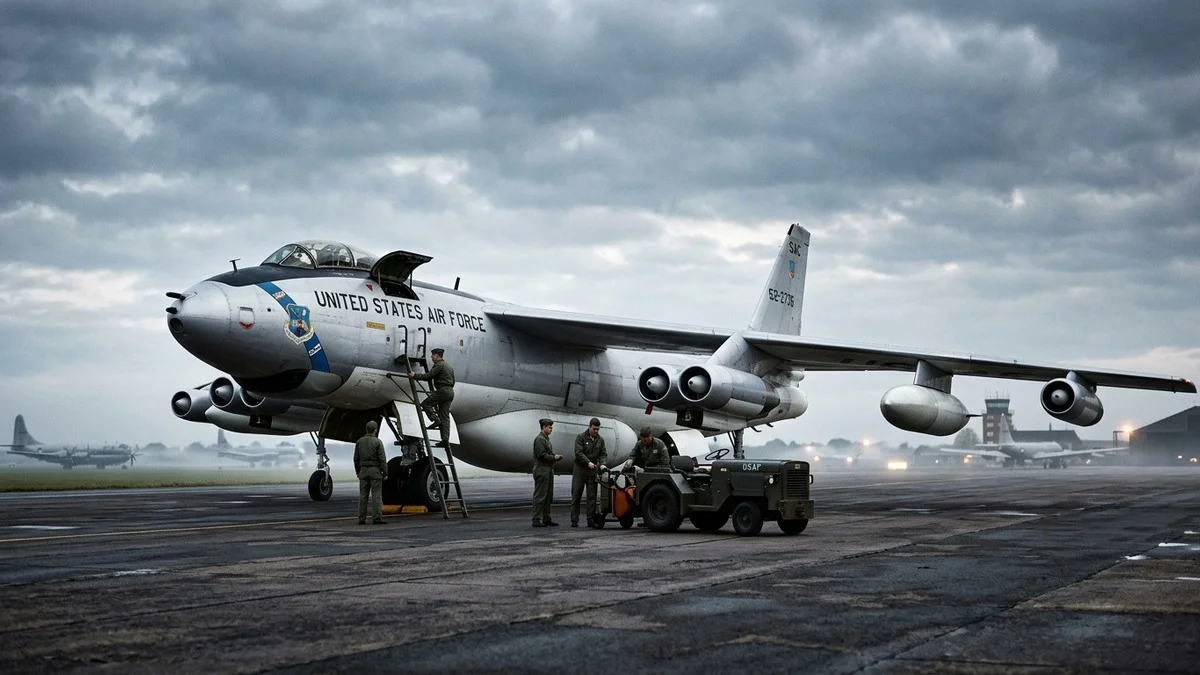
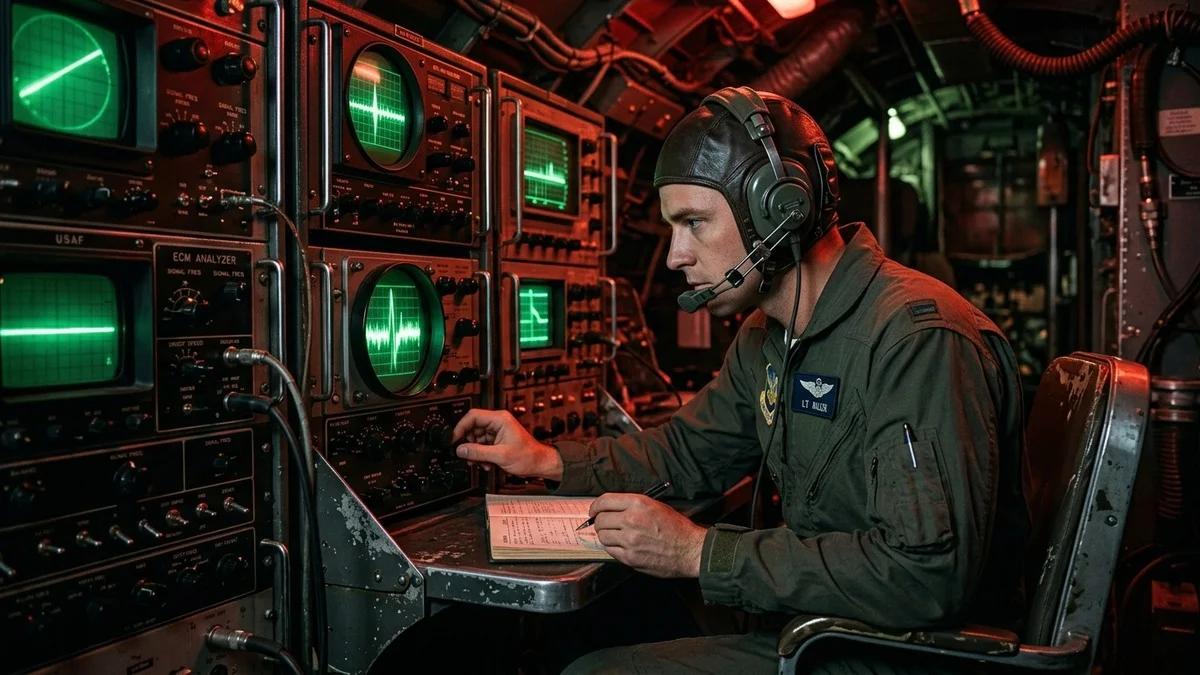
The Boeing RB-47H was among the most sophisticated intelligence-gathering platforms in the USAF inventory in 1957. Based on the B-47 Stratojet bomber airframe, the RB-47H had its bomb bays converted to carry three Electronic Warfare Officers, known as "Ravens", each equipped with highly classified ECM (Electronic Countermeasures) receivers capable of detecting, identifying and locating radar emissions across a wide frequency range. These were not passenger aircraft or transport planes. They were Cold War intelligence assets crewed by the most technically capable officers the Air Force could produce.
On the night of 17 July 1957, one such aircraft departed Forbes Air Force Base in Topeka, Kansas, on a training flight that would take it south across the Gulf Coast states before returning north. The crew of six were from the 55th Strategic Reconnaissance Wing, experienced airmen on a routine electronic intelligence training mission. Nobody expected what would happen over the next two hours.
The Three Sensor Systems
What makes the RB-47 case technically exceptional is the nature of its evidence. Before examining the timeline of events, it is worth understanding exactly what each of the three sensor systems detected, and why their simultaneous agreement is so significant.
| Visual (airborne) | Direct observation by trained aircrew. Bright blue-white light, estimated size of a house. Observed manoeuvring relative to the aircraft, disappearing and reappearing. |
| ECM (airborne) | Classified electronic receivers aboard the RB-47H detected pulsed microwave emissions at ~2,800 MHz, consistent with S-band radar, originating from the direction of the object. Azimuth tracked continuously. |
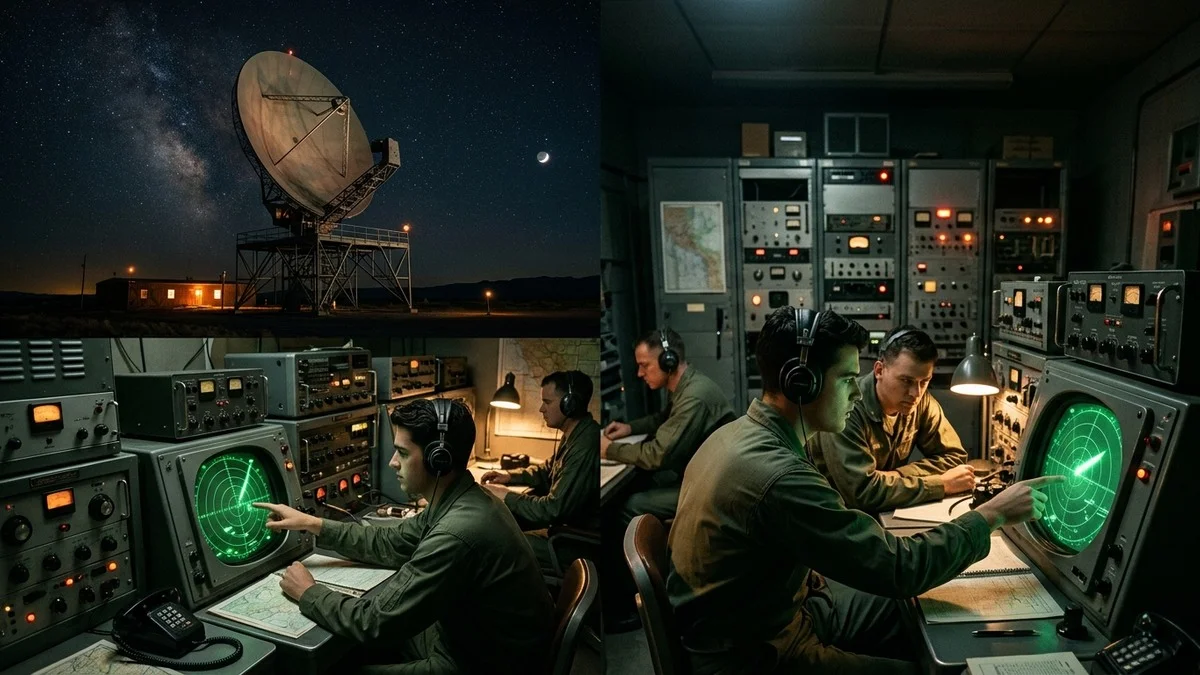
| Ground radar (ADC) | Air Defense Command radar at Duncanville, Texas, independently tracked a return alongside the RB-47 blip on its scope. Controllers confirmed the contact to the crew in real time. |
The ECM detection is especially significant. The aircraft's receivers were not designed to detect UFOs. They were designed to detect Soviet radar emissions. They picked up the object's signals because whatever the object was, it was emitting microwave energy in a frequency band normally associated with sophisticated radar systems. That emission was real, measurable and directional. It wasn't a visual illusion, an atmospheric phenomenon or a radar artefact. Something was transmitting, and it was transmitting from the same direction as the light the crew could see with their eyes.
The Encounter: A 700-Mile Shadow
The first contact came over the Mississippi coast in the early hours of 17 July. The aircraft was flying at approximately 34,500 feet, heading south toward the Gulf. ECM Officer Maj. Frank McClure, monitoring his equipment in the forward compartment, detected an unusual signal: pulsed emissions at around 2,800 MHz, coming from a bearing off the left side of the aircraft. The signal behaviour was unlike any ground radar station he knew of: it appeared to be moving.
As the RB-47 turned westward over Louisiana and into Texas, the signal remained. Then, as the aircraft crossed into the Dallas-Fort Worth area, the crew began to see something visually: a large, intensely bright blue-white light, estimated at "the size of a house" when viewed from the cockpit. Aircraft Commander Col. Lewis Chase and co-pilot Capt. James McCoid both confirmed the visual contact.
"The light was so bright, it seemed to illuminate the underside of our aircraft. It was not a star, not an aircraft light, not a flare. It was a large, intense, blue-white light that moved intelligently relative to our position."
· Col. Lewis Chase, Aircraft Commander, RB-47H, from James McDonald's 1971 investigationWhat happened next was the moment that separates the RB-47 case from most UFO reports. The crew contacted Air Defense Command ground control at Duncanville, Texas, and asked whether they had any traffic alongside them. The controller checked his scope and confirmed: yes, there was a return. It was tracking alongside the RB-47. At that moment, the crew had simultaneous confirmation from three completely independent sources (their own eyes, their own ECM equipment, and a ground radar station) that something was out there.
The Disappearances
Over the course of the encounter, the object disappeared and reappeared twice. These moments are critical to understanding why the case is so compelling.
On the first occasion, while over Texas, the bright light simply went out. Simultaneously, the ECM equipment registered the loss of the signal. And simultaneously, the ground radar controller at Duncanville reported that the second return had vanished from his scope. Three systems lost the contact at the same instant. A few minutes later, all three picked it up again, simultaneously, in a different position.
The second disappearance followed a similar pattern. As the RB-47 turned and the crew attempted to approach the object, the light extinguished, the ECM signal ceased, and ground radar lost the return, all at once. It was as if someone had switched something off.
"The most striking aspect of this case is the simultaneous disappearance from three independent sensor systems. A conventional aircraft, a meteor, an atmospheric phenomenon: none of these would disappear from ECM receivers and ground radar and visual observation at exactly the same instant. That simultaneity is extremely difficult to explain conventionally."· Dr Gordon Thayer, Radar Physicist, Condon Report Case 5 analysis, 1969
Key Witnesses: The RB-47 Crew
Col. Lewis Chase
Primary cockpit witness. Confirmed the large blue-white light visually. Contacted ADC ground control to verify the radar contact. His account was consistent across multiple investigators over the following decades.
Capt. James McCoid
Confirmed the visual sighting from the cockpit alongside Col. Chase. Corroborated the size, brightness and behaviour of the light.
Maj. Frank McClure
First crew member to detect the object, via ECM receivers. Tracked the pulsed microwave signal at ~2,800 MHz throughout the encounter. Observed the simultaneous disappearances from his equipment.
Capt. James Francke
Second ECM officer. Independently confirmed the signal detection and tracked the object's azimuth bearing from the aircraft.
2nd Lt. Walt Tuchscherer
Third ECM officer. Additional independent confirmation of the electronic emissions from the object.
ADC Ground Controller
Ground radar operator who confirmed a second return alongside the RB-47 on the ADC scope. Communicated with the crew in real time during the encounter, confirming the contact and reporting when it disappeared from radar.
Timeline
First ECM Contact: Mississippi Coast
Maj. McClure detects unusual pulsed microwave signal at ~2,800 MHz. The signal originates from a bearing off the aircraft's left side and appears to be moving. The RB-47 is heading south at 34,500 feet.
Visual Contact: Gulf Coast / Louisiana
Cockpit crew first observe a brilliant blue-white light at altitude. The light is described as large, 'the size of a house', and distinctly not an aircraft navigation light or star. It moves relative to the RB-47.
ADC Radar Confirmation: Dallas area
Col. Chase contacts Air Defense Command at Duncanville, Texas. The controller confirms a second radar return tracking alongside the RB-47 on the ADC scope. Triple confirmation: visual, ECM, ground radar all active simultaneously.
First Simultaneous Disappearance
The blue-white light extinguishes. At the identical moment, Maj. McClure's ECM signal vanishes and the ADC controller reports the second return has gone from his scope. All three systems lose contact simultaneously.
Simultaneous Reacquisition
All three sensors regain contact simultaneously (visual light reappears, ECM signal resumes, ground radar return returns) now in a new position ahead of and to the left of the RB-47.
Intercept Attempt
Col. Chase attempts to close on the object. As the RB-47 turns toward it, the light and ECM signal begin to fade. He breaks off the approach.
Second Simultaneous Disappearance
A second simultaneous loss of contact across all three systems. The object vanishes from visual observation, ECM receivers and ground radar at the same instant.
Final Contact: Oklahoma/Kansas Border
The object is briefly reacquired by ECM before disappearing for the final time as the RB-47 approaches the Kansas border. Total elapsed time of encounter: approximately 1 hour 30 minutes. Total distance shadowed: over 700 miles.
What the Official Investigations Found
USAF Project Blue Book classified the RB-47 case as "unidentified", one of only a small fraction of cases to receive that designation. The case was then examined in depth for the government-commissioned Condon Report in 1969, where radar physicist Dr Gordon Thayer produced a detailed technical analysis of the ECM data and the radar contacts. His conclusion was that the simultaneous multi-sensor detections could not be explained by any conventional hypothesis he could construct.
In 1971, atmospheric physicist Dr James McDonald, one of the most rigorous scientific investigators the UFO field has ever produced, published an extended analysis of the case in the journal Astronautics and Aeronautics. McDonald had personally interviewed the crew members and obtained access to original documents. His conclusion was unequivocal: the RB-47 case represented "the most puzzling and unusual case in the extensive files" and could not be explained by any natural or man-made phenomenon.
Philip Klass, the sceptical aviation journalist, attempted a conventional explanation in 1976, suggesting the ECM readings could have been misidentified ground radar stations. However, aerospace technology researcher Brad Sparks conducted an exhaustive investigation and published a detailed memorandum in 1997 comprehensively refuting Klass's analysis, demonstrating that the geography, timing and signal characteristics were inconsistent with any known ground radar facility along the flight path.
The French government's COMETA report (written by senior military officers, defence scientists and intelligence officials) cited the RB-47 case alongside Lakenheath 1956 and Tehran 1976 as one of the three most important military UAP encounters in history. The COMETA authors noted that three independent sensor systems "could hardly have such capabilities" if the object were a conventional aircraft or atmospheric phenomenon.
Evidence Assessment
Visual
Cockpit Visual ConfirmationTwo trained USAF officers, aircraft commander and co-pilot, confirmed a large blue-white light of unusual size and behaviour from the cockpit of the RB-47H.
ECM Signal
Pulsed Microwave Emissions DetectedThree independent Electronic Warfare Officers detected pulsed signals at ~2,800 MHz from the direction of the object. These signals behaved unlike any catalogued ground radar station.
Ground Radar
ADC Radar Track ConfirmedAir Defense Command radar at Duncanville, Texas independently tracked a return alongside the RB-47. The controller communicated this to the crew in real time.
Simultaneous Loss
Triple-Simultaneous DisappearancesOn two occasions, all three independent sensor systems lost contact at the exact same instant, and reacquired contact simultaneously. This cannot be explained by sensor malfunction.
Blue Book
USAF Classification: UnidentifiedProject Blue Book, which explained the vast majority of cases, classified the RB-47 encounter as officially unidentified.
Condon Report
Could Not Be ExplainedDr Gordon Thayer's technical analysis for the official US government scientific study concluded the simultaneous multi-sensor detection 'cannot be explained' by conventional means.
Klass Refuted
Sceptical Analysis Comprehensively RebuttedPhilip Klass's 1976 conventional explanation (misidentified ground radars) was systematically refuted by Brad Sparks in 1997 on geographic and technical grounds.
COMETA
Cited by French Government ReportSenior French military and intelligence officials named the RB-47 case as one of three most important military UAP encounters in history in the 1999 COMETA report.
Why This Case Is Different
The sceptic's standard toolkit for dismissing UFO reports does not work well against the RB-47 case. Misidentification? The object was tracked by ECM receivers that measure signal frequency and azimuth. They don't misidentify stars or aircraft lights. Mass hallucination? The ground radar controller was in a separate location and had no communication with the crew before confirming the contact. Equipment malfunction? Equipment malfunctions don't produce simultaneous failures across three independent systems in three different locations, each of which then simultaneously recovers.
The "simultaneous disappearances" are the hardest element to explain away. If the crew were misidentifying a star, the star would not disappear from the ADC radar scope at the same instant they lost visual contact. If the ECM readings were a misidentified ground radar, that radar wouldn't cease transmitting at the exact moment the light went out and the ADC return vanished. The simultaneity across three physically separate sensor systems demands a physical explanation, and none has been provided in sixty-eight years.
"In summary, I think it is fair to say that the RB-47 case must be regarded as one of the most significant unidentified aerial phenomena cases in the modern history of the subject. The multi-sensor nature of the evidence is unique."
· Dr James McDonald, Atmospheric Physicist, University of Arizona, Astronautics and Aeronautics, 1971Three sensor systems, and still a mystery: bring a fourth
Kit we've tested and reviewed in full
The RB-47's crew had electronic countermeasures, radar and their own eyes trained on the object. Binoculars are the simplest way to add real detail to a visual sighting of your own.
Bright and quick to aim: good enough to track a fast, unidentified light across a long stretch of sky.
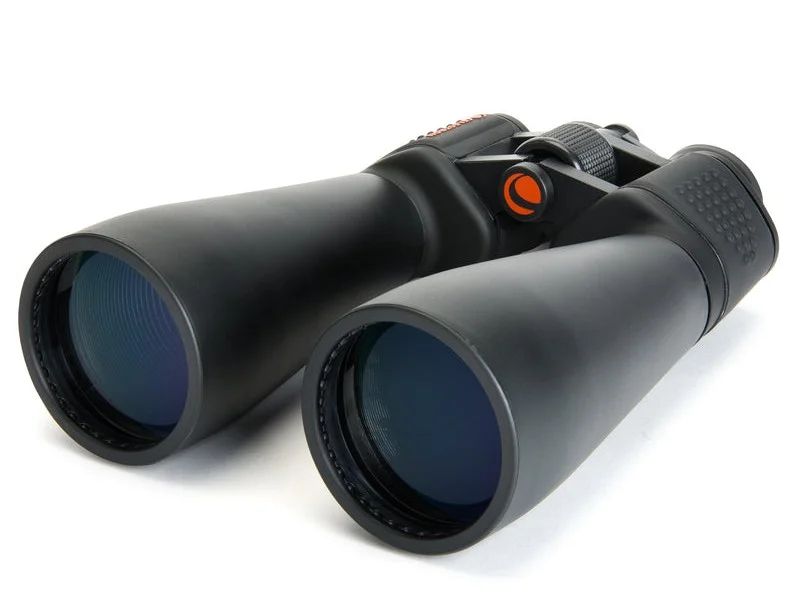
Extra aperture for a target holding station far off: closer to what three sensor systems were tracking that night.
Affiliate links: you pay the same price, we earn a small commission that helps keep WatchTheStars free.
Sources and Further Reading
Primary source: USAF Project Blue Book Case Files · RB-47 Encounter, 17 July 1957 · National Archives (archives.gov).
Official investigation: Condon, E.U. (ed.), Scientific Study of Unidentified Flying Objects (University of Colorado, 1969) · Case 5, analysis by Dr Gordon Thayer.
Academic analysis: McDonald, J.E., "Science in Default: 22 Years of Inadequate UFO Investigations," Astronautics and Aeronautics, AIAA (1971).
Sceptical rebuttal: Klass, P., UFOs Explained (Random House, 1976). Refuted in detail by: Sparks, B., "RB-47 UFO Encounter Memorandum" (1997).
Government report: COMETA, UFOs and Defence: What Should We Prepare For? (Association COMETA, 1999) · Section 2.2.
PURSUE Release 01: The COMETA report text was published as part of the US Department of War's PURSUE Release 01, 8 May 2026, available at war.gov/UFO.
More UAP cases
- RAF Lakenheath: The Night Britain's Air Defences FailedSuffolk, England · 13–14 August 1956 · 2130–0330 hrs
- Apollo 17's Unknown CompanionTranslunar Coast · 9 December 1972 · Mission Elapsed Time 02:18:47
- The Senator Russell Sighting4 OCTOBER 1955 · SOVIET TRANSCAUCASUS (PRESENT-DAY AZERBAIJAN) · FULL CIA FILE RELEASED 10 JULY 2026
- The 1976 Tehran UFO Incident: F-4 Jets, Weapons Failure and the Declassified DIA Report
- The Newfoundland KC-97 Incident6 JULY 1955 · NEWFOUNDLAND, CANADA · FILE RELEASED 10 JULY 2026
- The Chupa-Chupa AttacksSeptember–December 1977 · Colares, Vigia & the Pará coast · Status: Documented, Unexplained