Key takeaways
- NASA's Chandra X-ray Observatory has detected an X-ray signal from one of JWST's most baffling discoveries, the 'little red dots' scattered across the early universe, for the very first time.
- The best explanation is that these objects are 'black hole stars': vast clouds of hot gas, up to 500 light-years across, powered not by fusion but by a supermassive black hole devouring them from the inside.
- A separate JWST study found that an early-universe galaxy (GS-3073) contains chemical fingerprints that can only be explained by monster stars 1,000 to 10,000 times the mass of our Sun, stars so extreme they collapsed directly into black holes without exploding.
- Together, these discoveries may solve a decades-old cosmic mystery: how did supermassive black holes grow so enormous so quickly after the Big Bang?
Jump to section 6 sections
In the three years since the James Webb Space Telescope opened its eyes, astronomers have catalogued hundreds of mysterious objects scattered across the early universe. They're compact. They're intensely red. They're far too bright and far too numerous to fit into any existing model of how galaxies form. Nobody knows what they are. Astronomers call them "little red dots", and for a while, that was essentially the best anyone could do.
This week, that changed.
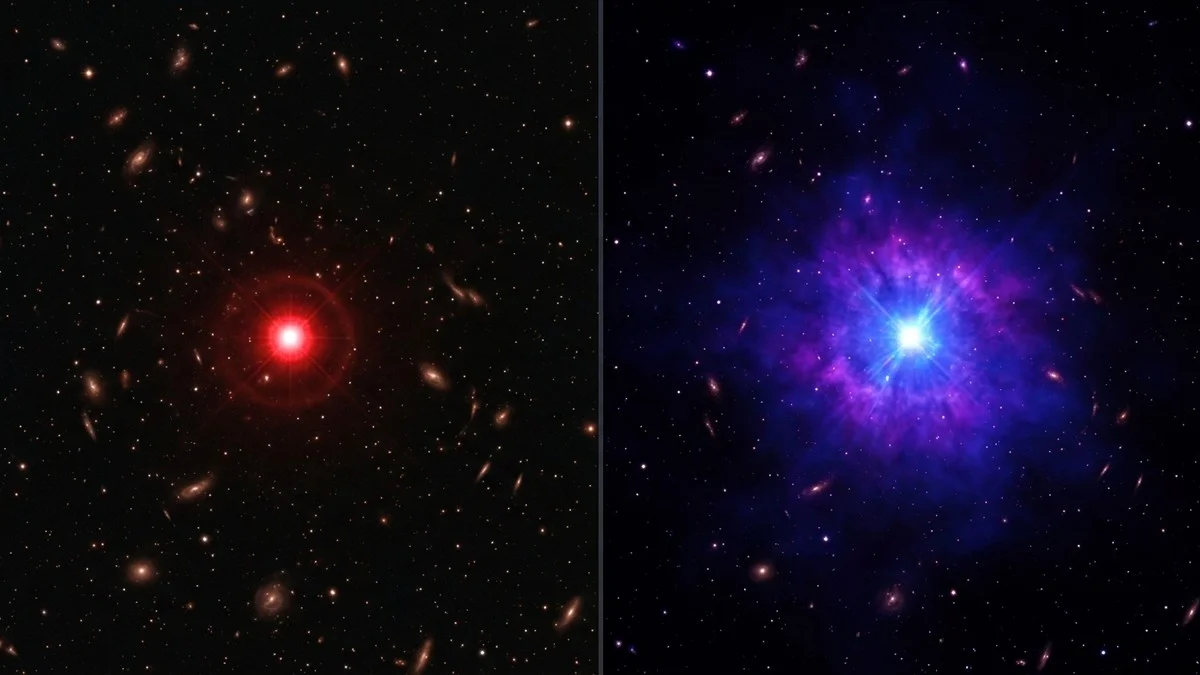
NASA's Chandra X-ray Observatory has detected an X-ray signal precisely coinciding with one of JWST's little red dots for the very first time. Prior to this, not a single one of these objects had ever been detected in X-rays. The new signal is extraordinary, and it points toward an explanation that, if confirmed, would be one of the strangest things in the observable universe: a black hole star.
What Are the Little Red Dots?
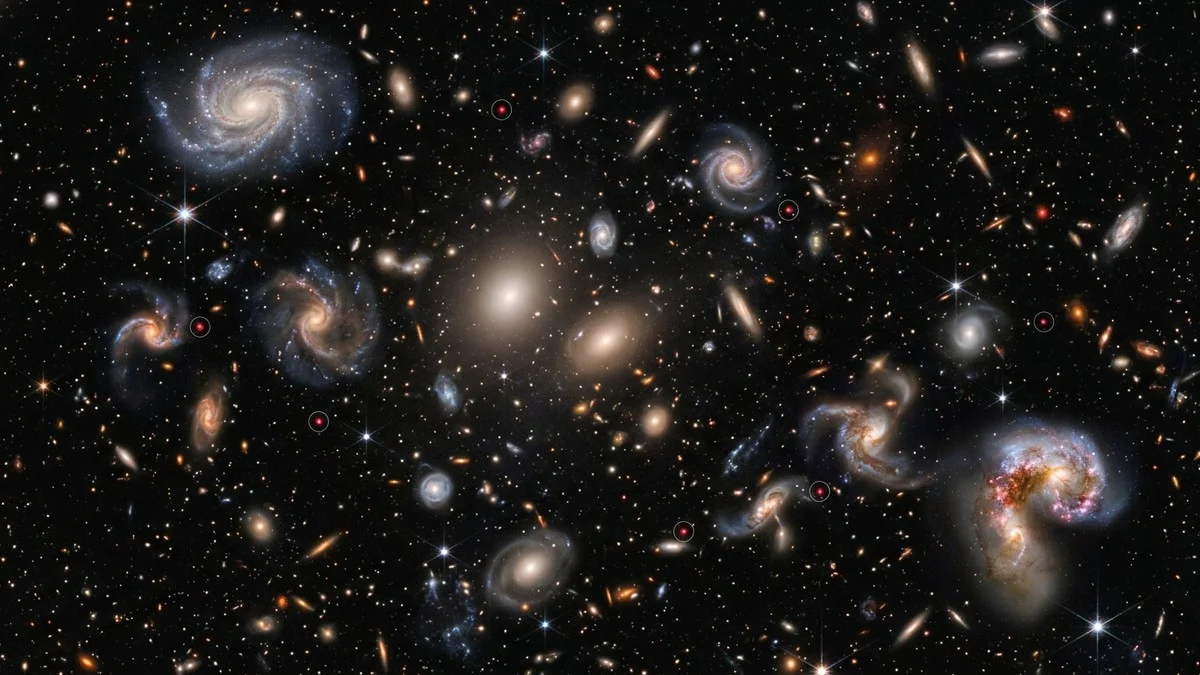
When JWST released its first deep field images in the summer of 2022, researchers expected surprises. The telescope is the most powerful infrared observatory ever built, capable of seeing galaxies that formed just a few hundred million years after the Big Bang. What they didn't expect was to find hundreds of tiny, ruby-red, star-like objects sprinkled throughout the earliest epochs of cosmic history, objects that appear in nearly every deep survey JWST has conducted since.
These "little red dots" (LRDs) are strange in almost every measurable way. They look point-like in some wavelengths, as if they might be individual stars, but their luminosity is far too high: they're pumping out as much energy as entire galaxies. They're found at redshifts of roughly 4 to 8, meaning we're seeing them as they existed between 600 million and 1.5 billion years after the Big Bang. And there are roughly 700 of them per square degree of sky, far more than theoretical models predicted for any kind of rare, extreme early-universe object.
Proposals to explain them have ranged from unusually dusty galaxies to some new category of active galactic nucleus. But none of the explanations quite fit. LRDs show strong hydrogen emission lines suggesting dense, fast-moving gas. They show a characteristic reddish colour that could indicate dust, extreme stellar populations, or something else entirely. And until this week, despite their enormous apparent luminosity, they had never been detected in X-rays, which is peculiar, because the most energetic objects in the early universe (quasars powered by actively feeding black holes) are nearly always bright X-ray emitters.
Chandra Finds the Smoking Gun
The breakthrough came from a team led by Russet Hviding at the Harvard-Smithsonian Center for Astrophysics, working with combined data from JWST and NASA's Chandra X-ray Observatory. After targeting a catalogued LRD with Chandra's extraordinarily sharp X-ray vision, they found exactly what three years of searching had failed to turn up: an X-ray signal, right on top of the red dot.
It wasn't just any signal. The X-ray luminosity is remarkable, far higher than would be expected from normal star formation activity, and at a level that indicates something compact and enormously energetic at the object's core. The team's conclusion, published in a study highlighted by NASA this week, is that this is the first little red dot confirmed to emit X-rays, and the X-ray source represents a growing supermassive black hole hidden inside the cloud.
Growing black holes are virtually always X-ray sources. As material spirals inward toward the event horizon, it forms an accretion disc that heats to tens of millions of degrees, radiating energy across the spectrum, including in hard X-rays that Chandra can detect. The fact that LRDs had never been seen in X-rays before was always one of the most puzzling aspects of their nature. If they contain active black holes, where were the X-rays? The answer, the new data suggests, may be that most LRDs are caught in a very brief phase when the surrounding gas is still thick enough to absorb the X-ray signal before it escapes, and this one has reached a stage where that gas is just thin enough to let the X-rays through.
"This is the first little red dot to be found to shine in X-rays," the team noted. If Hviding's team is correct, this X-ray dot represents a previously unknown transition phase in the formation of supermassive black holes, a brief window into something that existed in enormous numbers in the young universe, but that has never been directly confirmed until now.
No telescope will ever show you a black hole star, but here's what will still blow your mind
Kit we've tested and reviewed in full
These objects sit 13 billion light-years away, so nobody's backyard kit is getting anywhere near them. What you can do tonight is turn a decent set of binoculars or a small scope on the galaxies and clusters that are actually within reach.

A comfortable, budget-friendly pair for scanning star fields and getting your bearings before you chase anything fainter.

The bigger objective lenses pull in enough light to start hunting down brighter galaxies yourself, a small taste of the deep-sky hunting JWST does on a cosmic scale.
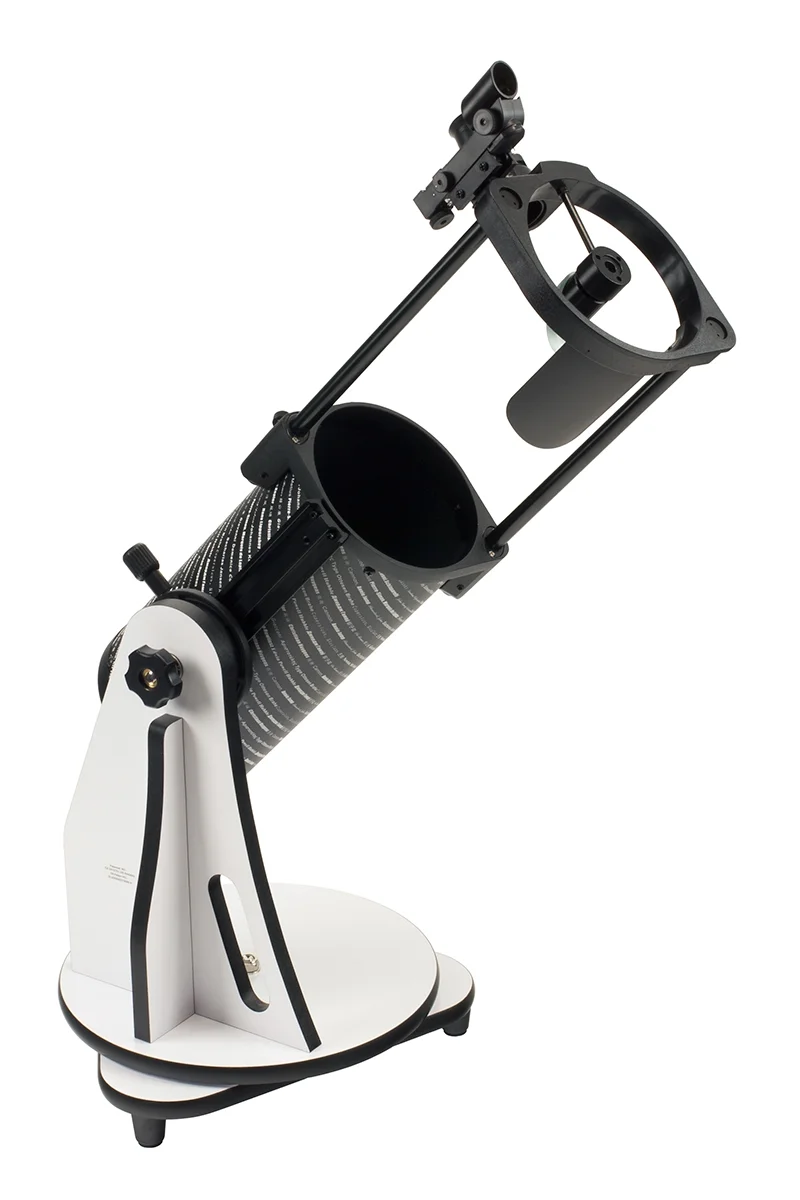
A small tabletop reflector that packs enough aperture to show galaxies and star clusters with genuine structure, no black hole stars, but plenty to keep you hooked.
Affiliate links: you pay the same price, we earn a small commission that helps keep WatchTheStars free.
What Is a Black Hole Star?
The term "black hole star" sounds like science fiction, and it sort of is. These objects don't exist anywhere in the modern universe. But in the extreme conditions of the early cosmos, theory has long predicted they could form.
The idea works like this. Imagine a cloud of gas, not the wispy clouds between stars, but an enormously dense, hot, compact cloud, collapsing under its own gravity. In the normal universe, that collapse either produces a star (if the cloud fragments into smaller pieces that ignite nuclear fusion) or, under the right conditions, a black hole. But in a black hole star, something different happens: the cloud is so extreme that a black hole forms at its centre before the gas has fully collapsed. The black hole then begins consuming the surrounding gas from the inside, radiating intense energy as it does. The gas cloud itself doesn't disappear: it glows. Heated from within by the black hole's accretion disc, it shines with an intensity that can rival an entire galaxy. From a distance, it looks like a single, compact, very red, very bright point.
In other words: a little red dot.
These objects would be enormous, up to 500 light-years across, which is the distance from our Sun to the nearest few hundred star systems. They wouldn't be permanent. Eventually the black hole would consume enough gas that the surrounding cloud thins out, the object stops glowing, and what remains is a naked supermassive black hole, perhaps the seed of a galaxy's central engine. The entire episode might last only a few million years, a cosmic eye-blink, which would explain why they're difficult to find in the present-day universe.
Monster Stars and the Nitrogen Clue
A separate but deeply connected piece of evidence comes from a different JWST study, one that looked not at the LRDs themselves but at the chemical fingerprints left behind in an early-universe galaxy called GS-3073.
GS-3073 sits at a redshift of 5.55, meaning we see it as it existed about one billion years after the Big Bang. A team led by Devesh Nandal, alongside Daniel Whalen, Muhammad Latif, and Alexander Heger, published a detailed analysis of GS-3073's chemical composition in The Astrophysical Journal Letters in late 2025. What they found was deeply unusual: a nitrogen-to-oxygen ratio of 0.46, a figure that is far beyond anything explained by normal stellar populations.
In a typical galaxy, the nitrogen-to-oxygen ratio reflects the mix of stars that have lived and died there over cosmic history. Supernovae and stellar winds enrich the surrounding gas with specific ratios of elements depending on the masses and types of stars involved. But 0.46 is not a ratio that any known category of star, supernova, or stellar explosion can produce. The only models that fit, the team found, are stars with masses between 1,000 and 10,000 times the mass of our Sun.
These hypothetical objects, "monster stars," or in the technical literature, very massive stars (VMS) at the extreme upper end, are thought to have existed only in the very early universe, when conditions were far more extreme than today. Without the heavy elements that modern stars contain, primordial gas clouds could collapse to form objects of staggering size that would be physically impossible in the present-day universe, where heavier elements help gas clouds fragment into smaller, more modest stars. At 10,000 solar masses, such a star would be about a hundred times the mass of the largest stars currently known to exist.
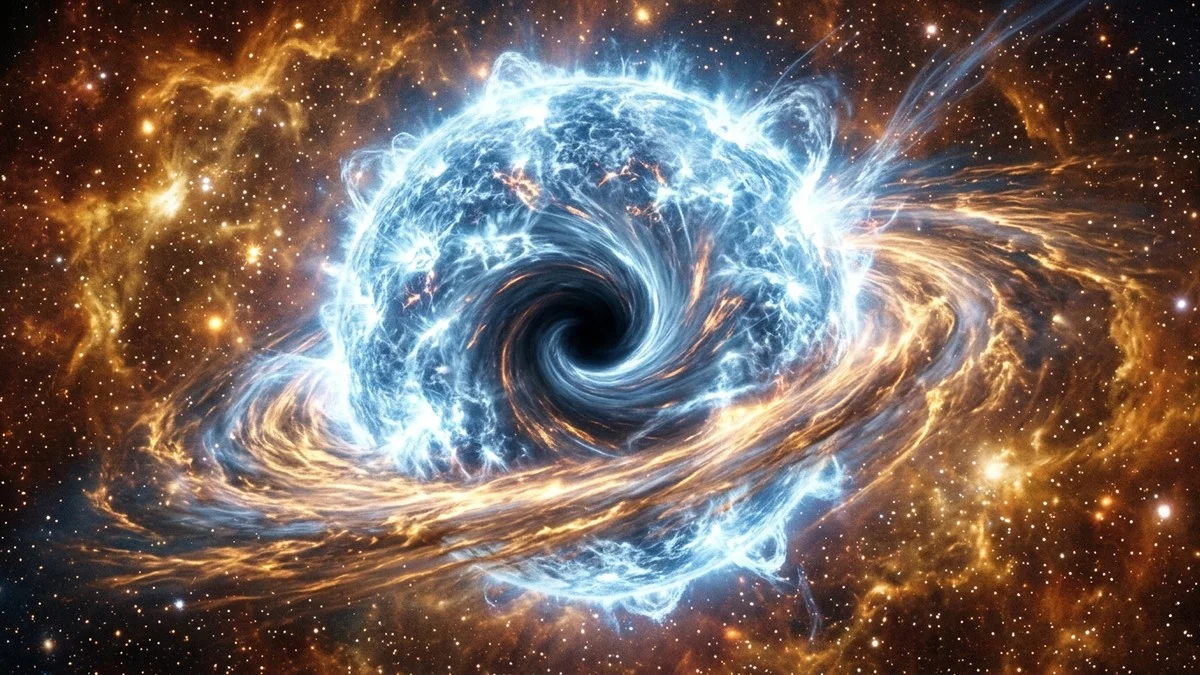
Crucially, such monster stars would not die in conventional supernova explosions. Models suggest that above a certain mass threshold, these stars simply collapse inward entirely, what astrophysicists call "direct collapse", forming a black hole in one step, without the violent explosion that disperses most of the star's mass back into space. A direct-collapse black hole could start with tens of thousands of solar masses already in place: not the stellar-mass seeds (a few tens of solar masses) that normal black holes start from, but a fully formed, large black hole that could then grow rapidly by consuming surrounding gas.
A direct-collapse black hole surrounded by a dense cloud of gas it is actively consuming.
Sounds familiar.
Solving the Supermassive Problem
The reason all of this matters so intensely to cosmologists comes down to a long-standing puzzle: how did the universe's supermassive black holes get so big, so fast?
The centres of most large galaxies, including our own Milky Way, contain a supermassive black hole. The Milky Way's, Sagittarius A*, weighs in at about four million solar masses. Other galaxies harbour black holes of billions of solar masses. That's extraordinary enough on its own. But JWST has made the puzzle considerably worse: it keeps finding galaxies in the very early universe, just a few hundred million years after the Big Bang, that already contain black holes of hundreds of millions, sometimes billions, of solar masses. There simply hasn't been enough time, by conventional models of black hole growth, for those black holes to have grown that large starting from stellar-mass seeds.
The problem is sometimes called the "too big, too soon" problem. And the two lines of evidence from this week's announcements (Chandra's X-ray dot, and Nandal's nitrogen excess in GS-3073) both point toward the same solution: the black holes didn't grow slowly from small beginnings. They started large, from direct-collapse events fuelled by monster stars, and grew rapidly by consuming the dense gas clouds surrounding them in the chaotic early universe. The little red dots may be the universe caught in the act of making its supermassive black holes.
If that's correct, these objects, numbering in the hundreds per JWST deep field, represent one of the most important and previously invisible chapters in cosmic history. The phase when supermassive black holes were born.
What Comes Next
One X-ray detection is compelling evidence, not definitive proof. The immediate priority is to find X-ray signals from more LRDs, a task that will require sustained Chandra observing campaigns, and potentially the future X-ray observatory Athena (currently in development by ESA, targeting a 2037 launch). More LRDs with X-ray counterparts would firmly establish that Chandra's detection isn't an anomaly but a window into a population.
The GS-3073 nitrogen excess result also awaits independent verification, and researchers want to identify more early-universe galaxies with similarly anomalous chemical ratios. If monster stars really did populate the young universe in significant numbers, their chemical fingerprints should be widespread, and JWST's NIRSpec spectrograph is precisely the instrument to find them.
There is also the question of what the LRDs eventually become. If the direct-collapse picture is correct, each one should evolve into a classical quasar, a naked, blazing supermassive black hole, once the surrounding gas is sufficiently consumed. JWST should, in principle, be able to catch objects in the transition between these phases, if researchers know what to look for. The Chandra X-ray detection may have given them exactly the right signpost.
The little red dots have been JWST's most persistent mystery for three years. This week, they finally started giving up their secrets, and the story they're telling is one of cosmic violence, impossibly massive stars, and the birth of the black holes that sit at the heart of almost every galaxy in the universe, including our own.
Frequently Asked Questions
Equipment guides
Related topics
Ian ClaytonAmateur astronomer and founder of WatchTheStars.co.uk, dedicated to helping others explore the wonders of our universe. Full profile →