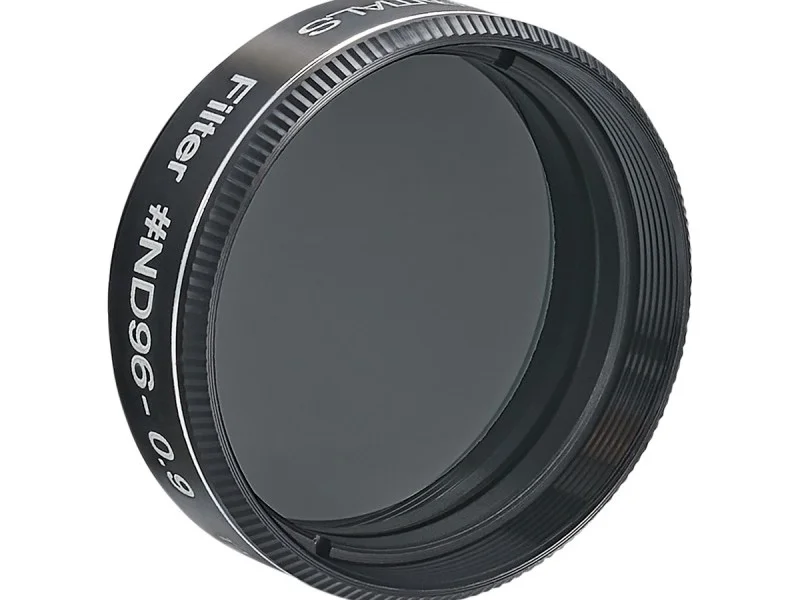
Astro Essentials Moon Filter 1.25" ND 0.9
| Key Specifications | |
|---|---|
| Size | 1.25" barrel |
| Filter Type | Neutral Density (ND 0.9) |
| Light Transmission | ~12.5% (87.5% reduction) |
| Colour Distortion | Minimal (neutral, not tinted) |
| Mount | Threaded to eyepiece barrel |
| Weight | ~30g |
| Compatibility | Any 1.25" eyepiece |
| Maintenance | None (optical surfaces protected) |
Who Is This For?
This filter is for literally every telescope owner. If you've observed the full Moon without a filter, you know the problem: the brightness is overwhelming, your eye aches after a few minutes, and you can't see detail because the glare dominates your vision.
- Complete beginners observing the Moon for the first time
- Anyone with a small scope where the Moon fills the field and the glare is intense
- Planetary observers who want comfort during long observations
- People testing whether they'll enjoy astronomy (the Moon is the best first target, and this makes it actually enjoyable)
If you own a telescope, you need this. It's not optional. It's foundational equipment.
What Does It Do?
The full Moon is one of the brightest objects in the night sky, roughly equivalent to staring at a floodlit building. When magnified through a telescope, that light hits your eye all at once, causing discomfort and temporary visual fatigue.
The ND 0.9 filter sits between your eye and the magnified image, reducing the light reaching your eye by 87.5%. This brings the Moon's brightness down to a comfortable level where you can spend hours exploring craters without squinting or eye strain.
The "neutral density" part matters: unlike some cheaper filters that cast green, amber, or blue tints, this filter reduces all colours equally. The Moon remains naturally grey-brown; only the brightness changes. You get accurate colours and true detail rendering.
How to Use It
Installation is trivial:
- Unscrew the top of your eyepiece (the part furthest from the scope)
- Thread the filter barrel onto the eyepiece barrel (clockwise, hand-tight only)
- Insert the eyepiece into the focuser as usual
- Observe. The Moon should now appear as a comfortable grey, with craters and detail clearly visible.
To remove: unscrew it counter-clockwise. Done.
Works with any eyepiece using a 1.25" barrel, which is almost everything. The filter has internal optical surfaces, so never touch the glass inside.
What the Community Says
Universally recommended. Stargazers Lounge threads on first telescopes always mention this in the first few posts. "Get a Moon filter" is the consensus answer to "what else do I need?"
Transforms the experience. Owners report that their first observation of the Moon without a filter is "too bright to enjoy," then switching it on makes them realise what they've been missing. Detail suddenly visible, comfort immediate.
Works brilliantly with small scopes. The smaller your telescope, the more intense the lunar glare becomes. On a 4-inch scope, a Moon filter is genuinely essential. On larger scopes (8"+), it's still necessary but slightly less critical.
Quality is reliable. The Astro Essentials brand has built a reputation on no-frills, honest optics at good prices. This filter has consistently positive reviews for optical quality and durability.
Cheap enough to buy spares. At £11, many observers keep one on their main eyepiece permanently and buy a second as backup. Some keep them on multiple eyepieces.
Known Limitations & Tradeoffs
- It's fixed, not variable. The ND 0.9 always reduces light by 87.5%. On a crescent Moon (which is much dimmer than full), this might be slightly too dark. On a full Moon, it's perfect. For maximum flexibility, consider the variable polarising filter (£24) instead, which lets you adjust darkness on the fly.
- Only works on 1.25" eyepieces. If you eventually buy 2" eyepieces (much larger and more expensive, mostly for deep-sky work), you'll need a separate 2" Moon filter. Most beginners use 1.25" for years before this becomes relevant.
- Doesn't help with atmospheric turbulence. A filter makes brightness comfortable but doesn't improve image sharpness or steadiness. On a night with bad "seeing" (atmospheric turbulence), the Moon will still look blurry. The filter just makes the blur less bright.
- Works only for the Moon and very bright planets. Jupiter and Saturn are too dim to need this filter. Use it only on the Moon and occasional observations of Venus at its brightest.
Alternatives & Upgrades
Astro Essentials Variable Polariser
Continuously adjustable filter, 1% to 40% transmission. More flexibility than fixed ND, works on any moon phase. Worth upgrading to once you're observing regularly.
~£24 View at FLO →Multiple Fixed ND Filters
Some observers buy ND 0.6, ND 0.9, and ND 1.2 to cover different moon phases. More options than one filter, but requires swapping.
~£11 each View at FLO →Colour Filters (GB, #21)
These are tinted (green or orange) and enhance contrast rather than just reducing brightness. Some observers prefer them, others find them gimmicky. Not neutral.
~£8–£12 View at FLO →Where It Sits on the Accessory Path
This is your first accessory. Before you buy anything else for your telescope, buy this. The Moon is the best first target: it's always there, bright, full of detail, and you can observe it from light-polluted areas. Without a filter, the experience is uncomfortable. With one, it's revelatory.
After this, consider: A collimation cap if you own a Newtonian reflector (£4), then a better finder like the Telrad (£43) when you're ready to hunt deep-sky objects.
Many observers never go further. A Moon filter can be your only accessory purchase and you'll still have thousands of hours of happy observing. It's not a stepping stone. It's a complete, permanent tool.