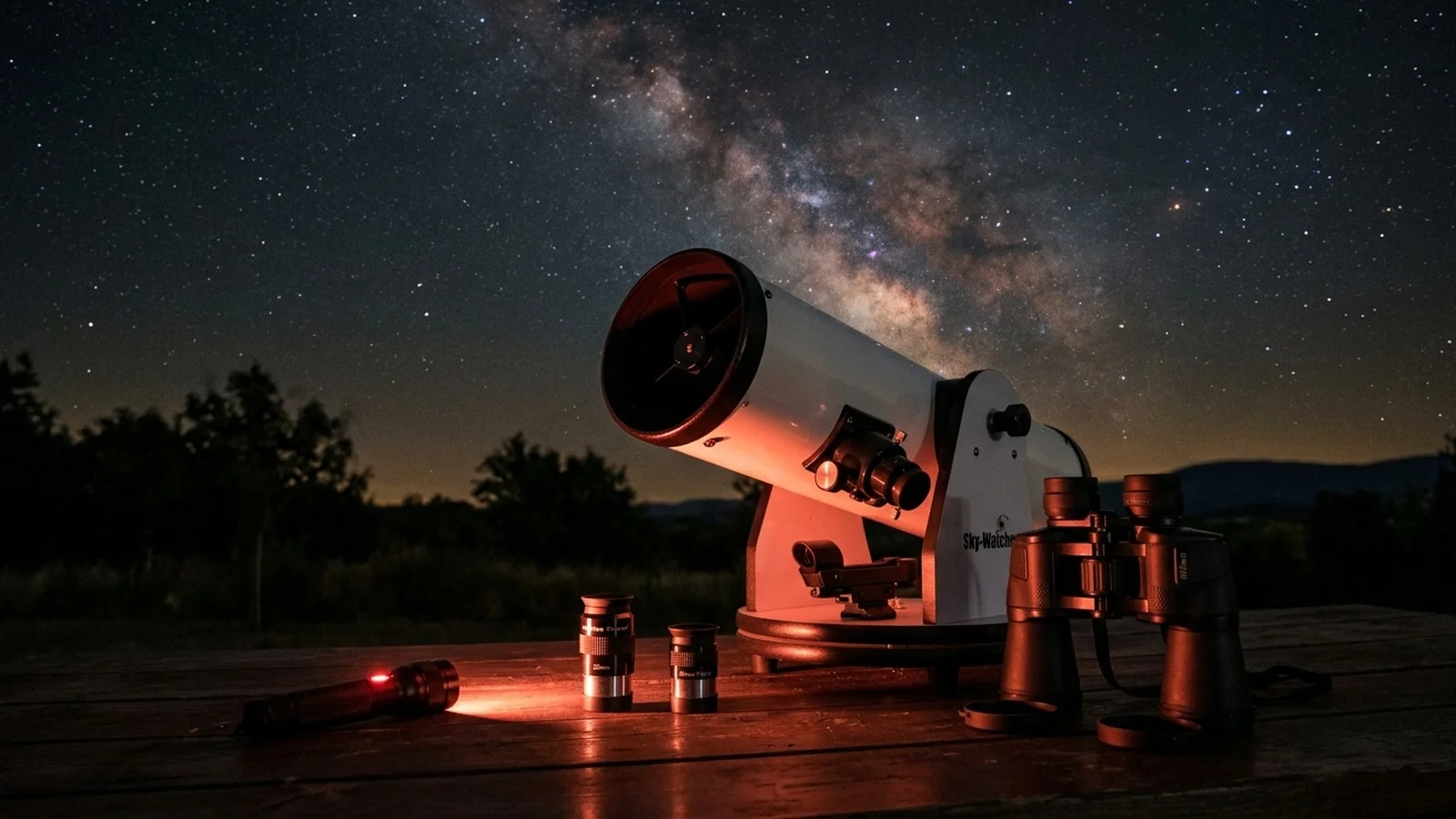
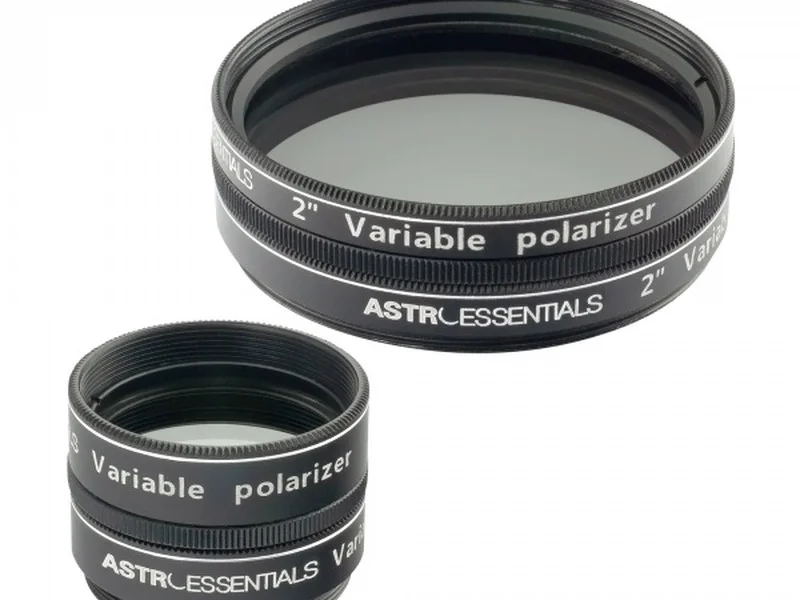
Astro Essentials Variable Polarising Filter 1.25"
| Key Specifications | |
|---|---|
| Size | 1.25" barrel |
| Filter Type | Variable Polarising (rotating) |
| Transmission Range | ~1% to ~40% |
| Adjustment Method | Rotating barrel (continuous) |
| Mount | Threaded to eyepiece barrel |
| Weight | ~55g |
| Best For | Moon (any phase), bright planets, flexible observing |
| Upgrade From | Fixed ND filter (ND 0.9) |
Who Is This For?
This is for observers who've already bought a fixed Moon filter and are observing regularly, at least a couple of nights per month. It's not a first accessory; it's an upgrade for people who've felt the limitation of a fixed filter and want more control.
- Regular lunar observers who notice that a single ND filter isn't quite right for every moon phase
- People observing at different locations where atmospheric conditions vary (damp garden vs. clear dark sky)
- Observers who use the same eyepiece for both planets and the Moon and need one filter that works for both
- Advanced amateurs who want maximum flexibility in their observing kit
Start with the fixed ND filter (£11). Upgrade to this once you've decided you're a serious observer who goes out regularly.
What Does It Do?
A fixed ND filter (like the ND 0.9) always reduces light by the same amount: 87.5% in that example. The problem: the Moon's brightness varies enormously depending on its phase. A full Moon is vastly brighter than a crescent. A fixed filter is a compromise: too dark for a crescent, not quite dark enough for full Moon.
The variable polarising filter solves this by using two rotating polariser sheets. As you rotate the barrel, the angle between them changes, and the light transmission changes continuously from ~1% (almost completely dark) to ~40% (barely filtered). You twist the barrel to dial in exactly the right brightness for any target, any phase, any night.
How it works: polarised light has a preferred axis. When two polarisers are aligned (0°), light passes through. When they're perpendicular (90°), no light passes. At intermediate angles, partial light passes. Rotate the barrel, change the angle, change the brightness: simple, elegant, infinitely adjustable.
How to Use It
Installation: Screw it onto your eyepiece barrel just like a fixed filter. That's it.
Usage:
- Point your scope at the Moon or planet
- Look through the eyepiece
- Grasp the rotating barrel and twist until the brightness feels right
- Tiny adjustments make small changes; bigger rotations make larger changes
- Optimal brightness is different for everyone: find what's comfortable for your eyes
Key technique: Unlike fixed filters, you can tweak the darkness during an observing session. Want to look at a crescent Moon? Set it to very low darkening. Switch to full Moon? Rotate to maximum. Switch to observing Jupiter? Find the comfortable middle ground. No swapping filters.
Sweet spot: Most observers find their "comfortable" position around the 50% rotation point, but this varies. Experiment on your first night.
What the Community Says
Appreciated by dedicated observers. People who observe the Moon regularly tend to love this filter. It solves a real problem: fixed filters are occasionally not quite right.
Noticeable upgrade in usability. Owners report that switching from a fixed to variable filter makes observing sessions more enjoyable because they spend less time adjusting filters and more time observing.
Works equally well on planets. Many observers keep this on their eyepiece permanently because it works for the Moon, Jupiter, Saturn, and Venus. A single solution to all bright-object observation.
Slightly more expensive, worth the cost. At £24 vs. £11 for the fixed ND, the variable filter costs roughly 2× as much. Most regular observers feel the difference in flexibility justifies that cost.
More durable than expected. The rotating mechanism is smooth and durable. Reports of long-term reliability are positive.
Known Limitations & Tradeoffs
- Not a replacement for the fixed filter. If you don't already have a Moon filter, buy the fixed ND first. The variable filter is an upgrade, not an entry point.
- Slightly heavier than fixed filters. The rotating mechanism adds mass. On a small scope where weight matters, this might be noticeable. On larger scopes, negligible.
- Requires learning the adjustment range. Unlike a fixed filter where you know exactly what you're getting, the variable filter requires you to learn your preferred setting. Takes one session to figure out.
- Only works on 1.25" eyepieces. A 2" version exists for larger eyepieces, but most beginners use 1.25" for years.
- Light transmission bottoms out around 1%. At minimum, it blocks 99% of light. On a very dim crescent Moon, this might be slightly too dark. Adjust to preference. The minimum isn't mandatory.
Alternatives & Related Tools
Fixed ND Filters (ND 0.6, 0.9, 1.2)
Buy three fixed filters covering different moon phases. More bulky than one variable, but very simple. Total cost ~£30 for all three.
~£11 each View at FLO →Astro Essentials Fixed ND 0.9
The original, still excellent. If you're on a tight budget or only observe occasionally, this is the best entry point.
~£11 View at FLO →Colour Filters (Tinted)
Tinted filters (green #21, orange #12) enhance contrast rather than just reducing brightness. Some observers prefer them for specific targets. Not neutral colour-wise.
~£8–£12 View at FLO →Where It Sits on the Accessory Path
This is an upgrade for established observers, not a first purchase. Buy the fixed ND filter first (£11). Use it for at least a month to establish observing habits. Once you're out several nights a month and you notice the limitations of a fixed filter, upgrade to this.
The decision to upgrade marks a transition: from "testing the hobby" to "this is my hobby." Once you've made that transition and invested in observing regularly, the variable filter becomes the more satisfying choice.
This becomes your Moon/planet filter for years. Once you have this, you likely won't need to buy another filter. It covers the entire range from crescent to full Moon and all bright planets in one tool.