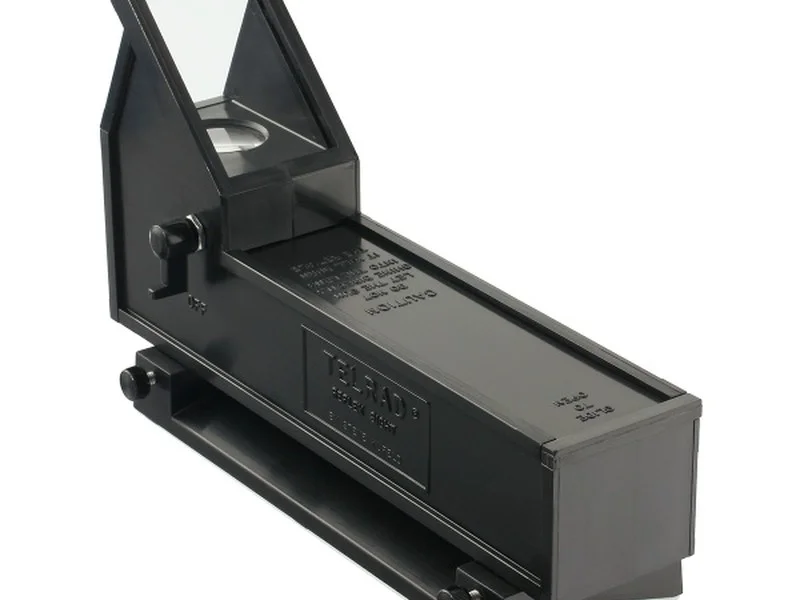
Telrad Red Dot Finder
| Key Specifications | |
|---|---|
| Type | Reflex sight finder (red dot) |
| Reticle Pattern | Three concentric red circles |
| Circle Sizes | 4°, 2°, 0.5° (field of view references) |
| Power Required | Two AA batteries (light use, ~6 months) |
| Mounting | Adhesive base (no drilling) |
| Weight | ~220g |
| Brightness Control | Yes (variable LED) |
| Learning Curve | Two to three nights to feel natural |
Telrad Finder Review: What Buyers Say
Anyone who plans to observe deep-sky objects regularly: galaxies, nebulae, star clusters. If you're only ever looking at the Moon and planets, your bundled red dot finder works fine. But once you start hunting faint objects, the Telrad becomes invaluable.
- Deep-sky observers who want to find dim galaxies and nebulae accurately
- People using star-hopping techniques (navigating from bright stars to faint targets)
- Beginners progressing beyond the Moon who are frustrated with tiny bundled finders
- Anyone observing from a reasonably dark site with binoculars or small telescopes
If you observe with a telescope pointed at dark sky for more than a couple of nights a month, this upgrade pays for itself in time saved and frustration avoided.
Telrad vs Red Dot Finder: Which Is Better?
The bundled finderscope is a tiny 1×24 sight: you look through a small barrel and see a reduced, inverted view of a small area of sky. Trying to find a faint galaxy in that miniature circle is like trying to navigate with a postage stamp.
The Telrad solves this by projecting three red concentric circles onto a glass plate that you look through with both eyes open. You see the circles overlaid on the real sky, so you're always aware of your surroundings and the scale of the object you're trying to find.
The three circles have specific meanings: the outermost (4°) shows the wide-field view, the middle (2°) shows a typical eyepiece field, and the innermost (0.5°) shows high-magnification detail. Once you learn to read the circles, they become a precise navigation tool, far more intuitive than a traditional finderscope.
Does the Telrad Fit My Telescope?
Installation: Clean the side of your telescope tube, peel off the adhesive backing, and stick the Telrad to the OTA (optical tube assembly). It sits perpendicular to the scope's axis. That's it: no drilling, no tools, no permanent modifications.
Basic technique:
- Locate a bright star near your target using the 4° circle
- Look at the sky through the 2° circle to see what's nearby
- Use the 0.5° circle for final centring once the target is in the main telescope
- Switch to your main eyepiece and observe
Star-hopping: The real power comes when you chain multiple stars together to reach faint targets. You move from bright star → dimmer star → target, using the Telrad to check your position at each step. This is how serious amateurs find 90% of deep-sky objects.
Battery: Insert two AAs, rotate the brightness dial to a comfortable level. On a typical observing schedule, batteries last 5–7 months.
What the Astronomy Community Says About the Telrad
The de facto standard. On Stargazers Lounge, when someone asks "what finder should I upgrade to?" the answer is almost always "Telrad." Not universal, but close.
Takes two to three nights to feel natural. Owners report a learning curve: the reflex sight feels strange at first. But by the third session, it clicks and becomes second nature. After that, you wonder how you ever used anything else.
Transforms observing success rate. Many observers report finding targets they'd given up on using the bundled finder. With the Telrad, the same targets become routine.
Works brilliantly in dark skies. The brighter your observing site, the dimmer the Telrad circles need to be. In truly dark sky sites, the circles can be set very low and remain visible. Light-polluted sites require higher brightness.
Some users miss the traditional finderscope. A few observers keep their original finderscope for verification (especially on faint targets), then use the Telrad for initial location. It's an "both" situation, not "either/or."
Known Limitations & Tradeoffs
- Learning curve is real. It takes a couple of nights to feel comfortable reading the circles. Beginners sometimes find it frustrating initially. Stick with it: the payoff is worth the brief confusion.
- Requires open eyes and natural darkness. Unlike a traditional finderscope, the Telrad relies on your night-adapted vision. In very light-polluted areas, the red circles may be harder to see against the bright background sky.
- Batteries are essential. Without power, there's no reticle. Keep spares nearby. AA batteries are cheap and universally available, but forgetting them will frustrate you.
- Adhesive base isn't permanent. On long flights or rough transport, the Telrad can come loose. Most observers keep it on permanently, but if you move the scope frequently, consider a mounting bracket alternative.
- Takes up mounting real estate. The Telrad attaches to the side of the tube. If you have other accessories in that area, spatial planning matters.
- Won't find targets brighter than naked-eye mag 6. Extremely faint (mag 10+) deep-sky objects sometimes need additional tools like a Telrad + traditional finderscope combo. For mag 6–9 targets, the Telrad excels.
Alternatives & Related Tools
Traditional Reflex Sight (Basic Red Dot)
Much cheaper finderscopes exist (some £10–£20), but they lack brightness, clarity, and the reference circles. Budget option if money is tight.
~£10–£20 View at FLO →RACI Finder (Premium)
A more expensive reflex finder with a different reticle pattern and brighter LED. Used by some advanced observers. Overkill for beginners but excellent if you want maximum brightness.
~£70–£100 View at FLO →Traditional Finderscope (Eyepiece-style)
A small telescope used as a finder (6×30, 8×50, etc.). Very precise but requires training to use. Less popular than Telrad for amateur observation.
~£30–£80 View at FLO →Where It Sits on the Accessory Path
This is your second major accessory, after the Moon filter. Once you've enjoyed the Moon and planets, the Telrad is what enables you to hunt deep-sky objects confidently. It's not essential (you can find everything with patience), but it's the upgrade that makes the hobby feel less frustrating and more rewarding.
Budget-conscious upgrading path: Moon filter (£11) → Collimation cap if Newtonian (£4) → Telrad (£43) → Better eyepiece (£45–£100) → Dew shield (£27).
This is where many observers stay. A good telescope, a Telrad finder, a Moon filter, and a decent eyepiece will support thousands of happy hours of observation. You don't need to go further, but if you do, you'll have the foundation to enjoy the advanced stuff.