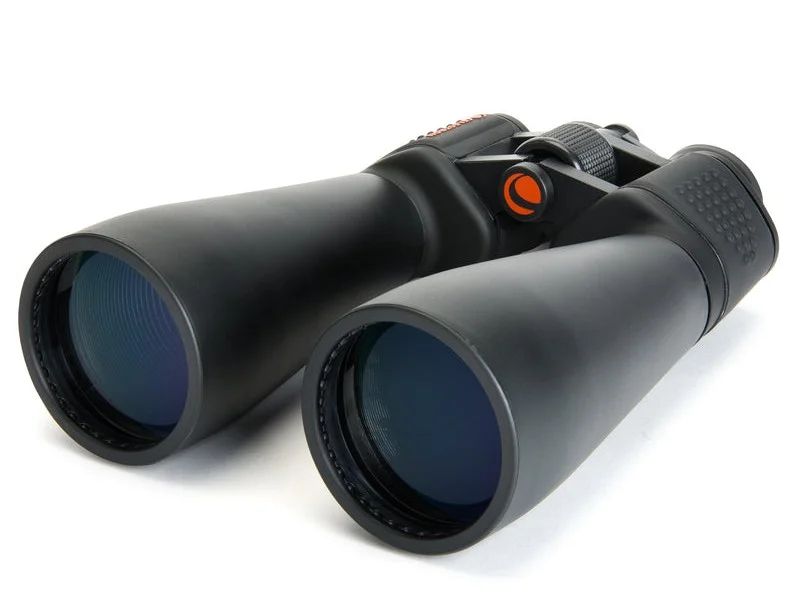
Celestron SkyMaster 15×70
| Celestron SkyMaster 15×70 Specifications | |
|---|---|
| Magnification | 15× |
| Objective Diameter | 70mm |
| Field of View | ~3.7° |
| Exit Pupil | 4.7mm |
| Weight | ~1.5kg (tripod-mounted) |
| Prism Type | BK-7 |
| Coatings | Multi-coated |
| Tripod Adapter | Yes (included) |
| Best For | Deep-sky observing, clusters, nebulae, galaxies |
Who Is the Celestron SkyMaster 15×70 For?
The SkyMaster 15×70 is for observers ready to commit to a tripod. These aren't for quick glances at the Pleiades: you set up, you sit down, you spend time on things. In return, you get views that rival a small telescope with the two-eyed advantage of binoculars.
- Deep-sky enthusiasts who want to see galaxies, nebulae, and cluster detail without buying a telescope
- People who have dark-sky sites: these binoculars reward excellent observing conditions with stunning views
- Amateur astronomers moving beyond hand-held observing: willing to set up a tripod for serious sessions
- Budget-conscious observers: these deliver telescope-class views for a fraction of the cost of an 80mm refractor
- Two-eyed advocates: who value the depth and contrast perception of binocular observing over single-eyepiece telescope views
If you prefer casual stargazing without setup complexity, stick with 10×50 hand-held binoculars. If you want deep-sky power, the 15×70 is the affordable entry point.
What Can You See with the Celestron SkyMaster 15×70?
The jump from 50mm to 70mm aperture is dramatic. You're collecting 96% more light, nearly double. At 15×, globular clusters resolve into individual stars. Faint galaxies go from smudges to 3D structures. Nebulae reveal internal detail that 50mm binoculars can only hint at.
Globular Clusters
M13 in Hercules fully resolved. Stars cascade across the field. M5, M22, M92 all show spectacular individual stars.
Galaxy Detail
M51 (Whirlpool) shows spiral arms clearly. M104 (Sombrero) shows the dust lane cutting across the disc. M31 fills the field as an extended oval.
Emission Nebulae
M42 (Orion Nebula) shows internal structure with distinct gas clouds. M27 (Dumbbell) is dumbbell-shaped. H-alpha nebulae become subtle but visible.
Planetary Nebulae
M57 (Ring Nebula) appears as a distinct ring. M97 (Owl Nebula) shows the owl-like structure. Subtle but real.
Open Clusters
M11 (Wild Duck) shows hundreds of stars. The Double Cluster in Perseus is spectacular. Pleiades fills the field with individual stars.
Jupiter & Saturn
Jupiter's belt structure is clear. Saturn's rings show Cassini Division hints. Moon craters are razor-sharp and detailed.
Note: Faint objects require truly dark skies (Bortle 4 or better). From light-polluted sites, the 15×70 is still excellent but understates its potential.
What Buyers Say About the Celestron SkyMaster 15×70
People consistently regret not buying these sooner. Stargazers Lounge threads report that the jump from 10×50 to 15×70 is larger than expected. The extra light and magnification transform faint objects from "barely visible" to "clearly visible and detailed."
The tripod requirement is actually liberating. Once mounted, you're done nudging. You can stare at a faint galaxy for 20 minutes, tracking nebula detail, without arm fatigue. This changes how you observe.
Optimal for target-specific observing. The narrow 3.7° field means you're spending time on individual objects rather than sweeping sky. This is intentional: the binoculars reward patience.
The included tripod adapter is adequate. It's a simple Vixen-standard bracket. Owners report reliability. If upgrading to a quality scope mount later, the bracket still works.
Atmospheric turbulence becomes visible. On nights with poor seeing, the 15× magnification amplifies atmospheric wobble. But on steady nights, the views are crystal-clear.
Known Limitations & Trade-offs
- Tripod is essential, not optional. At 1.5kg and 15× magnification, hand-holding is impractical. You need a sturdy tripod (£30–150 depending on quality). This is a real cost addition.
- Narrow field of view (3.7°) limits context. You're seeing a postage-stamp view of the sky. For Milky Way scanning, you'd prefer 7×50. For target-specific deep-sky, this is ideal.
- Setup and teardown takes time. Not grab-and-go equipment. You need 10 minutes to set up a tripod, mount, balance, and focus. This discourages casual observing.
- Multi-coated optics, not fully multi-coated. Some air-glass surfaces lack coatings. The practical effect: slightly dimmer and lower-contrast than premium binoculars. Still good, but noticeable vs. fully coated pairs.
- BK-7 prisms instead of BAK-4. Slightly lower optical performance than BAK-4. For astronomy, the difference is subtle. Brightness and contrast are adequate for the price.
- Light pollution impacts these more. The 70mm aperture and 15× magnification amplify light pollution. From suburban sites, you'll need to dark-adapt longer. From Bortle 4+ sites, they're spectacular.
Best Accessories for the Celestron SkyMaster 15×70
The tripod requirement means these binoculars benefit from quality support equipment:
Quality Tripod
The included bracket works, but a sturdy alt-azimuth mount ($£50–150) transforms these. Smooth tracking, solid stance, no jitter.
~£50–150 View on Amazon →Eyepiece Counterweight
Optional but useful: balances the binoculars on a scope mount for smoother up-down movement.
~£15–25 View on Amazon →Padded Case or Carrying Bag
At 1.5kg, protecting these during transport is sensible. A foam-padded case keeps them safe.
~£20–35 View on Amazon →Dark Sky Site + Sky Atlas
These binoculars deserve Bortle 3–4 skies. Invest in travel to a dark-sky site 1–2× per month. Bring Stellarium on a phone.
Fuel cost variesNote: The tripod cost isn't included in the stated £229 price. Budget an additional £40–100 for a decent alt-azimuth mount.
Celestron SkyMaster 15×70 vs SkyMaster Pro 20×80: Which Should You Buy?
The 15×70 is not a stepping stone to a telescope: it's a complete observing platform that many experienced amateurs never feel the need to go beyond.
If you want more light-gathering and magnification, the SkyMaster Pro 20×80 (~£305) steps up to 80mm objectives and 20×, a significant upgrade, but with a matching price and heavier tripod requirement.
If you're considering a telescope instead, they serve different purposes. A refractor gives you more magnification flexibility and better planetary detail. The 15×70 gives you better wide-field views and two-eyed contrast. Many observers own both.