Celestron SkyMaster Pro 20×80
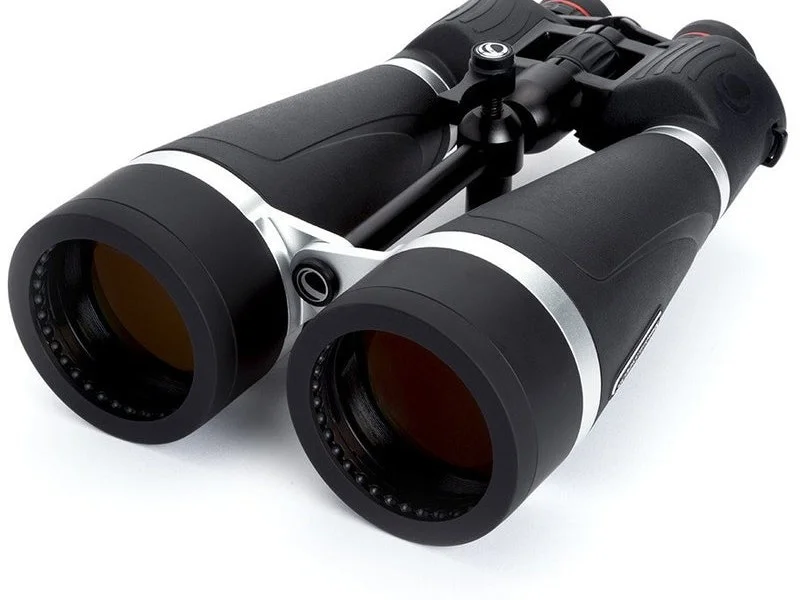
| Celestron SkyMaster Pro 20×80 Specifications | |
|---|---|
| Magnification | 20× (extreme) |
| Objective Diameter | 80mm (extreme light-gathering) |
| Field of View | ~2.5° |
| Exit Pupil | 4mm |
| Weight | ~2.3kg (tripod essential) |
| Prism Type | BK-7 |
| Coatings | Multi-coated |
| Tripod Adapter | Yes (included) |
| Best For | Extreme aperture deep-sky observing, globular clusters, faint galaxies |
Who Is the Celestron SkyMaster Pro 20×80 For?
The SkyMaster Pro 20×80 is specialist equipment, not an everyday pair. They're for observers who've already been through the 10×50 or 15×70 and want to step up. You need a quality tripod, access to dark skies, and the patience for a proper setup. What you get back is views that rival a 90mm refractor, with the binocular advantages of depth perception and higher contrast.
- Globular cluster enthusiasts who want to resolve clusters into individual stars
- Faint galaxy hunters who want to see distant galaxies with structure and extent
- Amateur astronomers with excellent dark-sky access: these thrive from Bortle 3 or better sites
- Observers choosing binoculars over a telescope for reasons of portability or aesthetic preference
- People with the space and patience for dedicated observing setups with tripods and mounts
If you want casual stargazing, these are overkill. If you're serious about deep-sky and you prefer the binocular observing style, they're transformative.
What Can You See with the Celestron SkyMaster Pro 20×80?
At 80mm aperture, you're approaching small-telescope light-gathering. The 20× magnification reveals detail that smaller binoculars can only hint at. Globular clusters resolve into cascades of individual stars. Distant galaxies show structure. Faint nebulae become visible from moderately dark skies.
Globular Clusters
M13, M5, M22, M92 all fully resolved into individual stars. The core and outer halo structure become visible.
Distant Galaxies
M104 (Sombrero) shows the dust lane structure clearly. M51 spiral arms are detailed. Faint galaxies in the Virgo Cluster become visible.
Nebulae
M42 shows exceptional structure. Emission nebulae reveal internal gas clouds and dark dust lanes. Planetary nebulae are bright and distinct.
Planetary Detail
Jupiter's subtle belts and zones are sharp. Saturn's rings show fine detail. The Moon is breathtaking: crater detail rivals a 90mm refractor.
Open Clusters
M11 (Wild Duck) shows hundreds of stars packed into the field. The Double Cluster is breathtaking. Star density is exceptional.
Faint Targets
Faint emission nebulae, dark nebulae, and distant galaxy clusters become visible that 50mm binoculars would miss entirely.
Note: These views require excellent dark skies (Bortle 3–4). From suburban Bortle 5–6 sites, the performance is still good but not maxed out.
What Buyers Say About the Celestron SkyMaster Pro 20×80
Owners consistently express amazement at the light-gathering. Stargazers Lounge threads report that the jump from 15×70 to 20×80 is substantial: objects that were barely visible become detailed and bright.
The 2.5° field is accepted as a feature, not a limitation. You're observing specific targets at high magnification, not sweeping wide sky. Observers report this changes their observing style productively: you spend more time on individual objects.
Atmospheric turbulence is amplified at 20×. On nights with poor seeing, the magnification reveals atmospheric wobble. But on steady nights, the views are crystal-clear and stable.
The tripod requirement is real but not prohibitive. Owners report that a quality alt-azimuth mount (£80–150) makes these comfortable and smooth to use. A cheap tripod is frustrating; a decent mount transforms the experience.
These are the "conversation piece" binoculars at star parties. When people look through 20×80 binoculars for the first time, their reaction is almost always astonishment. The combination of magnification and light-gathering is genuinely impressive.
Known Limitations & Trade-offs
- Tripod and quality mount are essential. At 2.3kg and 20× magnification, hand-holding is impossible. You need a sturdy alt-azimuth mount (not included), budget £80–150 for a decent one. Total setup cost is £280–350.
- Very narrow field (2.5°) limits context. You're seeing a postage-stamp view. For Milky Way observing, you'd want lower magnification or a 7×50. For target-specific deep-sky, this is ideal.
- Atmospheric turbulence becomes limiting. Poor seeing nights (turbulent atmosphere) amplify with 20× magnification. Observations on stable nights are exceptional; on turbulent nights, they're frustrating.
- Setup and transport are serious commitments. These require a permanent observing setup or transport in a car. Not grab-and-go equipment. Not suitable for apartment dwellers without outdoor access.
- Multi-coated, not fully multi-coated. Some air-glass surfaces lack coatings. The 80mm aperture compensates for brightness loss, but higher-end pairs are slightly more efficient.
- Light pollution impacts these significantly. The large aperture and high magnification amplify light pollution. From suburban sites, performance is acceptable but understated. From Bortle 3 sites, they're exceptional.
Best Accessories for the Celestron SkyMaster Pro 20×80
These binoculars are a serious observing system. Quality support equipment is essential:
Tripod & L-Bracket Adapter
Essential, not optional. These are too heavy and too high-powered to hand-hold steadily, so you need a solid photo tripod plus an L-bracket adapter to fasten them on. Cheap tripods wobble at 20× and ruin the view.
~£50–120 View at FLO →Counterweight / Balance Arm
Optional but useful. Balances the large front-heavy binoculars for smoother movement on a mount.
~£20–40 View on Amazon →Hard Carrying Case
At this price and size, protecting them during transport is sensible. Foam-lined hard cases (£50–80) are ideal.
~£50–80 View on Amazon →Dark-Sky Site Access
Bortle 3–4 skies are essential to justify the 80mm aperture. Invest in travel to dark-sky sites. These binoculars reward excellent observing conditions spectacularly.
Fuel cost variesNote: Total system cost is £385–555 when you include a quality mount. The binocular price is only part of the investment.
Is the Celestron SkyMaster Pro 20×80 Good for Astronomy?
The SkyMaster Pro 20×80 is the largest affordable binocular. Larger pairs (25×100, 30×130) exist but enter specialist territory: £500+ and heavy mounting infrastructure required.
At this size, the comparison to a telescope becomes real. A 90mm refractor (£300–500) offers similar light-gathering. The question is whether you prefer two-eyed binocular views or single-eyepiece magnification with more flexibility. Many experienced observers own both.
These aren't a stepping stone: they're a complete observing platform. If you want to go further, you're looking at premium binoculars (£500+) or a telescope upgrade. A lot of observers never feel the need to.