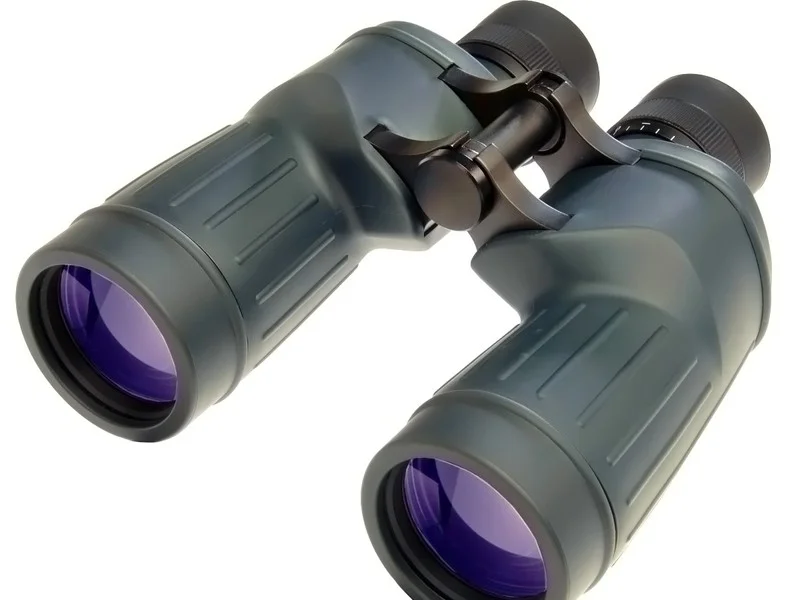
Helios Stellar II 10×50
| Helios Stellar II 10×50 Specifications | |
|---|---|
| Magnification | 10× |
| Objective Diameter | 50mm |
| Field of View | ~6.5° (wider than Opticron) |
| Exit Pupil | 5mm |
| Weight | ~875g |
| Prism Type | BAK-4 (premium) |
| Coatings | Fully multi-coated |
| Focus Type | Individual eyepiece (preferred for astronomy) |
| Best For | Extended observing sessions, premium hand-held astronomy |
Who Is the Helios Stellar II 10×50 For?
The Helios Stellar II is for observers who have decided binocular astronomy is their main thing and want the best 10×50 they can get. These aren't first binoculars. They're the pair you buy when you've already used a mid-range pair and know you want better.
- Experienced observers upgrading from the Opticron Adventurer: you've used mid-range binoculars and now want the best 10×50 available
- People spending 2–3 hour observing sessions regularly: the superior optics and individual eyepiece focus make long sessions comfortable
- Astronomers who value optical perfection: crisp, high-contrast views matter more to you than saving £65
- Those buying their "final" hand-held pair: expect to own these for 15+ years without wanting to upgrade
- Community astronomers who attend star parties and want to share views through premium optics
If you're still figuring out whether binocular astronomy appeals to you, the Opticron is smarter value. Our stargazing for beginners guide is a good place to start before spending £149. If you know it does and you want the best, these Stellar IIs are the answer.
What Can You See with the Helios Stellar II 10×50?
The Stellar II reveals the same targets as the Opticron Adventurer, but with noticeably crisper, higher-contrast views. Premium optics and BAK-4 prisms mean you're capturing and transmitting more light, and that light is being delivered to your eye more faithfully. The difference isn't huge, but it's real.
Jupiter's Detail
Belt structure is sharper. On steady nights, subtle features become visible that disappear in lower-quality optics.
Lunar Features
Craters and rilles are crisper. The sharpness across the whole field is impressive: star-testing these reveals excellent correction.
Globular Clusters
M13 shows more individual stars resolved than in mid-range binoculars. The contrast is higher.
Nebulae
M42 and M51 reveal subtle internal detail. The higher contrast makes faint nebulosity more visible.
Star Colour
Betelgeuse's reddish hue, Vega's blue-white colour: premium optics preserve stellar colours better than budget binoculars.
Milky Way
The wide 6.5° field reveals more context. Fine dust lanes and star density are exceptionally clear.
Note: The optical improvement over the Opticron is real but subtle. You notice it most during extended observing and on faint targets. They're also a great companion for the quieter stretches of a meteor shower, sweeping the sky for clusters and the Milky Way between meteors.
What Buyers Say About the Helios Stellar II 10×50
Extremely high owner satisfaction. BinocularSky reviews of the Stellar II rate it 4.8/5. Owners describe these as "the binoculars I'll never sell" and "worth every penny."
Individual eyepiece focus is genuinely better for astronomy. Once you set focus for each eye, you leave it alone. Temperature changes don't shift focus. Central focus wheels require constant adjustment: individual focus solves this.
The 6.5° field is wider than the Opticron's 6.3°. Small difference, but appreciated by Milky Way enthusiasts. You get slightly more context without sacrificing magnification.
Build quality is noticeably better. The barrels feel substantial, the focus mechanisms are smooth and precise, the prisms are glued with care. These feel like £160 binoculars.
The price premium is justified by premium glass and individual eyepiece focus. Owners report the optical improvement is noticeable for extended observing.
Known Limitations & Trade-offs
- 10× is still borderline for hand-holding. A tripod adapter (£20–30) remains beneficial for extended sessions. These are hand-holdable but not effortlessly so.
- Price premium is significant over the Opticron. If you're budget-constrained, the Opticron Adventurer is excellent value. The upgrade to the Stellar II is worthwhile only if optics are your priority.
- Individual eyepiece focus requires getting the adjustment right. You need to focus each eye separately. If you wear glasses asymmetrically (different prescriptions per eye), this is a feature. If your eyes are similar, it's a minor overhead.
- No central focus wheel means no "quick adjust" option. If you want to adjust both eyes at once (family member using your binoculars), you can't. This is rarely a practical issue for personal astronomy.
- Premium glass costs premium prices to replace. If you break the objective lens, repairs run £100+. This is true of all quality binoculars, but worth mentioning given the investment.
Best Accessories for the Helios Stellar II 10×50
These binoculars are complete instruments, but some accessories enhance long-term use:
Tripod Adapter Bracket
Optional but recommended. Vixen-standard mount, works with any camera tripod. Eliminates hand fatigue on 2–3 hour sessions.
~£20–30 View on Amazon →Premium Harness
Distributes weight evenly across shoulders. Makes extended hand-holding more comfortable (though tripod is still better).
~£18–25 View on Amazon →Lens Caps with Tether
Prevent losing the caps during dark observing. Quality caps (eg Opticron brand) are ~£10–12.
~£10–12 View on Amazon →Premium Carrying Case
At this price point, a protective foam case makes sense. Keeps them safe during travel to dark-sky sites.
~£35–50 View on Amazon →Helios Stellar II 10×50 vs Opticron Adventurer 10×50: Which Should You Buy?
The Stellar II is the premium endpoint for hand-held 10×50 binoculars. To get noticeably better optics you're either going tripod-mounted (15×70, 20×80) or into a telescope.
Many observers end up owning a Stellar II alongside a 15×70: the hand-held pair for casual scanning, the tripod pair for sitting down and staring at specific targets. They suit different moods.
These are buy-once binoculars. The build quality and premium glass age well. There's no optical reason to replace them in a decade.