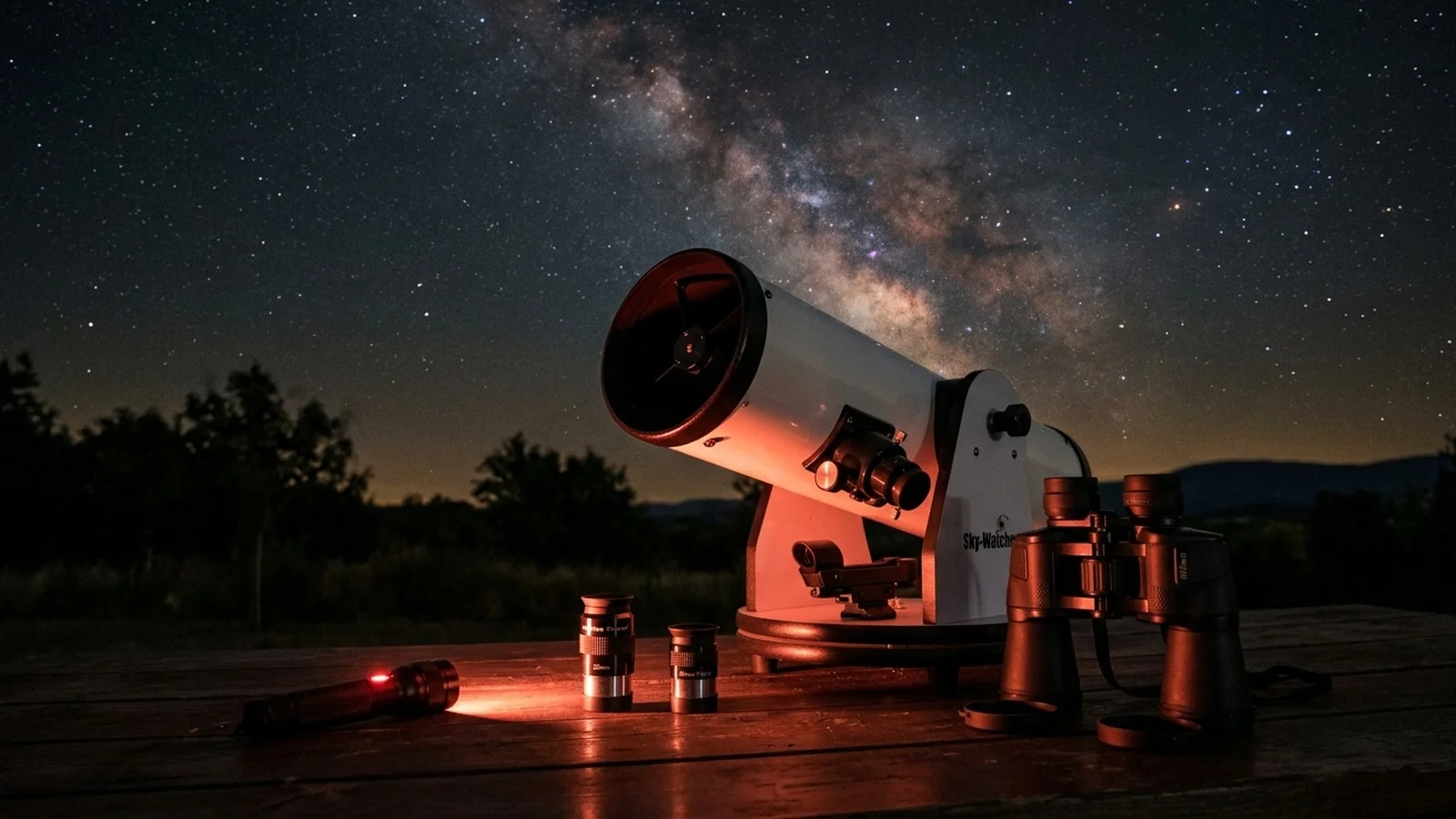
Opticron Adventurer T WP 8×42
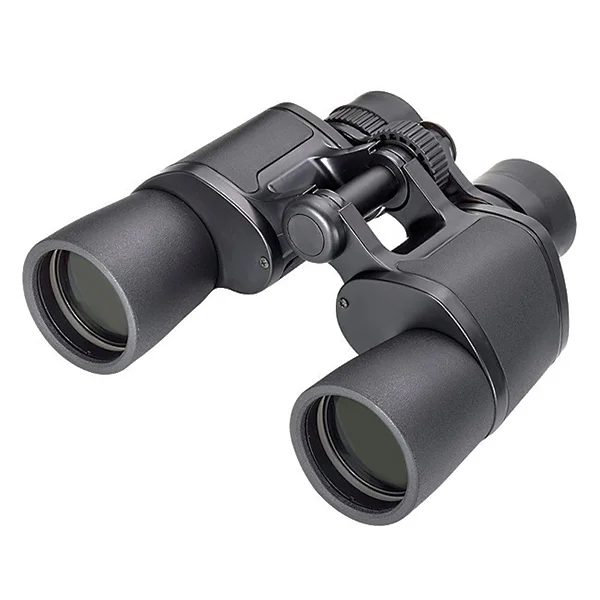
| Opticron Adventurer T WP 8×42 Specifications | |
|---|---|
| Magnification | 8× |
| Objective Diameter | 42mm |
| Field of View | ~5.7° |
| Exit Pupil | 5.25mm |
| Weight | ~650g (very portable) |
| Close Focus | ~2 metres |
| Prism Type | Roof prism |
| Coatings | Fully multi-coated |
| Waterproofing | Yes (nitrogen-filled) |
| Best For | Astronomy + daytime use, versatile all-rounder |
Who Is the Opticron Adventurer T WP 8×42 For?
The Opticron Adventurer T WP 8×42 is for people who want one pair of binoculars that does everything. It's comfortable to hand-hold, waterproof for UK weather, and at 650g light enough to carry anywhere. Around £79, you're getting fully multi-coated optics from a reputable British brand, not the corner-cut budget options at that price.
- Beginner astronomers who want waterproof binoculars that work in any UK conditions: no rain worries, no internal fogging
- Daylight naturalists and birdwatchers who also want to try stargazing: the 8×42 is ideal for both without compromise
- People who want a compact, pocketable pair: the roof prism design is slimmer than traditional Porro prism, and at 650g they're light enough to carry all day
- Outdoor enthusiasts who need durability in wet conditions: fully waterproof with fog-proof coating means they survive British weather without hesitation
- Learners who can't commit to a bigger pair yet: you get real optical quality at less risk than the ultra-budget models
If you want a single, versatile pair of binoculars that excel at both astronomy and daytime use, the Adventurer 8×42 is the sweet spot. It's from Opticron, a respected British optics brand based in Luton: you're not buying an unknown.
What Can You See with the Opticron Adventurer 8×42?
A 42mm objective gathers roughly 30× as much light as the dark-adapted human eye. The 8× magnification is moderate: lower than 10×, so hand-holding is easier and the field of view is wider than high-power models. This is the "Goldilocks" power for scanning the sky.
The Milky Way
Fantastic sweeping. The Milky Way is bright and wide in the 5.7° field, revealing dust lanes and star clouds. You can scan large regions of the Galactic spine without constantly adjusting.
Open Clusters
The Pleiades is beautiful: you see dozens of bright stars at once. The Double Cluster in Perseus, M11, the Hyades: all show excellent star density and resolve well at this power.
The Moon
At 8×, you see substantial crater detail with easy full-disc viewing. More magnification than the 7×, so craters are clearer; less than the 10×, so you get better context around each feature.
Brighter Nebulae
The Orion Nebula (M42) shows clearly as a nebulous cloud. The North America Nebula is visible under dark skies as a wispy extended region, subtle, but visible.
Galaxies (Bright)
M31 Andromeda is visible as a large oval with its dust lane visible in binoculars. The Whirlpool Galaxy (M51) appears as a smudge: you'd need higher magnification to see spiral structure.
Planets
Jupiter shows as a disc with hint of belts. Saturn's rings are visible but lack fine detail. For planetary observing, 10× or higher is better, but the Adventurer shows the planets clearly enough for casual observation.
Note: All views depend on light pollution and atmospheric conditions. These observations are realistic from a reasonably dark UK site.
What Buyers Say About the Opticron Adventurer 8×42
Great value for the price. Astronomy UK forums consistently rate the Adventurer 8×42 as one of the best £70–80 binoculars available. You're getting optics that punch above their cost.
Waterproofing is the real-world win. UK stargazers love that these are fully waterproof (nitrogen-filled). No anxiety about dew or sudden showers. You just observe. This peace of mind is underrated in British conditions.
The 8× magnification is comfortable for extended viewing. Unlike the 10× (which requires a tripod for long sessions), the 8× is genuinely hand-holdable for 30+ minutes without fatigue or noticeable tremor.
Excellent all-rounder for daytime use. Birdwatchers and hikers report these are first-rate for daytime wildlife spotting. The compact roof prism design means they're pocket-friendly compared to Porro prism alternatives.
Fully multi-coated optics are impressive for the price. The image is bright and sharp across the field. At this price point, many competitors only have multi-coated (partial coating), so the fact that all surfaces are coated is a genuine advantage.
Known Limitations & Trade-offs
- 42mm aperture is a compromise between 50mm and 32mm. Compared to a 50mm pair, you gather less light, noticeable on very faint deep-sky objects. Compared to a 32mm pair, you gather more, but it's not dramatic. The 42mm sits in the middle of the spectrum.
- 8× magnification won't show planetary detail. Jupiter's belts are visible but lack the fine structure you'd see at 10× or 15×. If planets are your primary interest, step up to a 10×50 or a telescope.
- Roof prism design (compact) vs Porro prism (bright). Roof prisms are more compact and modern, but Porro prisms (like the 7×50) can transmit slightly more light. For visual brightness, a 7×50 has a slight edge, though the 42mm's fully multi-coated optics partly offset this.
- Field of view is moderate. At 5.7°, it's narrower than the 7×50 (8.5°) but wider than the 10×50 (6.3°). You're neither maximising wide-field scanning nor detail: you're in the middle, which is fine but worth knowing.
- Twist-up eyecups are convenient but not perfect. They work for spectacle wearers, but some users report they can feel loose over time. Quality is solid, not premium.
Best Accessories for the Opticron Adventurer 8×42
The Adventurer 8×42 is a minimal-accessory device. You'll want:
Neck Harness
The bundled strap is adequate, but a padded harness distributes weight more comfortably during long observing sessions. Essential if you're out for more than 30 minutes.
~£12–18 View on Amazon →Protective Lens Caps
Keep dust off the objective lenses. The binoculars come with covers, but quality aftermarket caps are a worthwhile upgrade if you want extra durability.
~£4–6 View on Amazon →Neoprene Carrying Case
Protects them in transport and keeps dust off the optics. A soft case is adequate for a pair at this price point. Hard cases are overkill unless you're moving kit regularly.
~£8–15 View on Amazon →Tripod Adapter (Optional)
Not essential at 8×, but if you want to mount them on a tripod for long sessions (e.g. galaxy hunting), a bracket (~£15–25) gives you hands-free stability.
~£15–25 View on Amazon →Stellarium App
Binoculars show you what's there, but a star map tells you where to look. Stellarium (free) is essential. Pair it with a dark-sky site guide for maximum efficiency.
FreeOpticron Adventurer 8×42 vs Adventurer 10×50: Which Should You Buy?
The Adventurer 8×42 is the best all-rounder if you want one pair for both astronomy and daytime use. It's not the widest field or the most magnified: it's the sensible middle ground that works for everything without making you choose.
The obvious upgrade is the Opticron Adventurer T WP 10×50 (~£85): same brand, same waterproofing, more zoom and aperture. Many people end up owning both: the 8×42 for general use, the 10×50 for serious stargazing.
If you want telescope-level deep-sky views, the Celestron SkyMaster 15×70 (~£229) is the step up, but it needs a tripod.
A lot of beginners buy the Adventurer 8×42 first, discover they love binocular astronomy, and keep it even after they add a bigger pair. It earns its place as the grab-and-go option.