ZWO ASI294MC Pro
| Key Specifications | |
|---|---|
| Sensor Type | CMOS 4/3" 9.3MP (3096×2080) |
| Pixel Size | 4.63µm (good light-gathering) |
| Cooling | TEC to −40°C below ambient |
| Cooling Power | 12V DC (requires observatory PSU) |
| Connection | USB 3.0 |
| Barrel Mount | M48 thread (dedicated deep-sky mount) |
| Gain Control | High-gain mode for faint objects |
| Weight | ~450g (with heatsink & cooling block) |
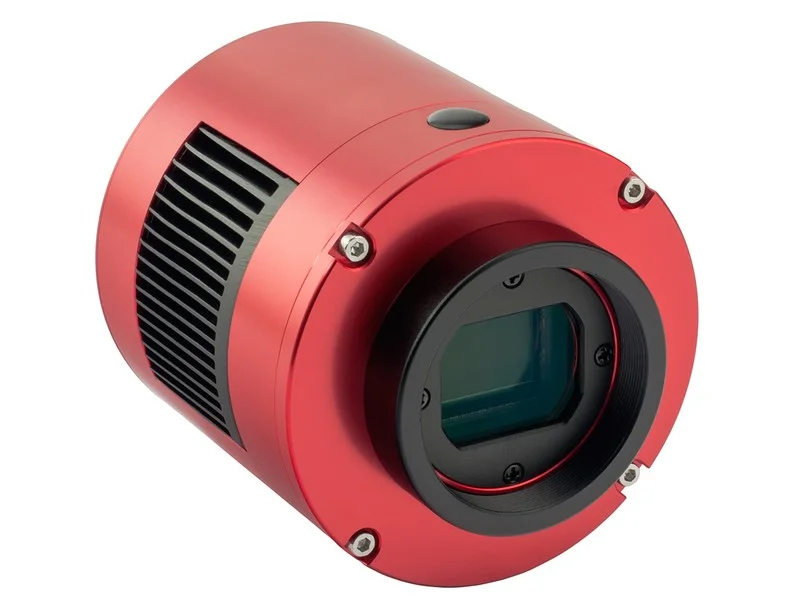
ZWO ASI294MC Pro Specifications: Sensor, Cooling, and Connections
The ZWO ASI294MC Pro is for amateur astronomers serious about deep-sky imaging: people who've done DSLR Milky Way work and want to photograph faint galaxies and nebulae with professional-grade results.
- Serious galaxy & nebula imagers. If you want to see spiral structure in M51 or resolve the dust lanes in NGC 2244, this camera is your target.
- People with dedicated observatories or mounts. This camera requires a solid equatorial mount (the Skyliner 200P or better) and careful focusing setup. It's not grab-and-go.
- Those committed to the hobby long-term. At around £1,030 it's a real investment. You're committing to 5+ years of regular observing.
- Anyone moving beyond DSLR astrophotography. If you've done stacking with the Canon EOS 2000D and want the next level, this is it.
Skip this if you're casual about astronomy or if your main interest is planetary imaging (use ASI120MC-S instead) or wide-field Milky Way (Canon EOS 2000D is better value).
What Can You Image with the ZWO ASI294MC Pro?
Spiral Galaxies
M51 Whirlpool, M101 Pinwheel, M74 Phantom. Thirty-minute exposures reveal spiral structure, dust lanes, and star-forming regions invisible to DSLRs.
Emission Nebulae
Orion Nebula (M42), Crab Nebula (M1), Lagoon Nebula (M8). The cooled sensor's sensitivity to faint light shows gas clouds and internal structure.
Faint Galaxies
M63 Sunflower, M66 & M95 Leo Triplet, NGC 2403. Objects requiring 30+ minute exposures to show detail: thermal noise from uncooled sensors ruins these shots.
Galaxy Clusters
Virgo Cluster (dozens of galaxies), Hercules Cluster (Abell 2151). Deep exposures reveal dwarf galaxies and faint members.
Results approach professional observatory images when stacking 10+ frames at 30-minute exposures. This is where amateur astrophotography becomes indistinguishable from published observations.
Is the ZWO ASI294MC Pro Worth It? The Cooling Argument
The problem: CMOS sensors generate thermal noise: random pixel fluctuations that look like grain in long exposures. At 30-second exposures from an uncooled DSLR, thermal noise is manageable. At 30-minute exposures, thermal noise drowns out faint objects.
The solution: The ASI294MC Pro has a thermoelectric (TEC) cooler: essentially a Peltier device that moves heat from the sensor to a heatsink. With the cooler running, the sensor temperature drops to −40°C (or colder) below ambient. At that temperature, thermal noise is reduced by a factor of 10–100 compared to uncooled sensors.
The practical result: A 30-minute exposure with this camera shows detail that a DSLR would need 5–10 hours of exposures (stacked) to match. That's the power of cooling.
ZWO ASI294MC Pro vs ASI294MC: What's the Difference?
Both cameras use the same Sony IMX294 4/3-inch sensor, 9.3MP, same USB 3.0 connection, same M48 thread. The only difference is the TEC cooler in the Pro. The cooler drops the sensor to −40°C below ambient, which dramatically reduces thermal noise in long exposures: the grainy mess that ruins faint galaxy shots.
For UK amateur astronomy at 1–2 minute exposures, the practical difference is small. At 30-minute single exposures, the Pro wins clearly. The question is whether you need those 30-minute exposures. Most UK imagers working with stacked short subs don't.
Deep-sky imaging workflow: Mount the camera in an M48 focuser (dedicated scope or Newtonian reflector prime focus). Connect USB 3.0 to your observatory computer. Connect 12V power to the cooler (from an observatory PSU, critical).
Cooling: Turn on the cooler 20–30 minutes before observing to let the sensor reach equilibrium temperature. Monitor on the computer: the cooler will maintain −40°C during the night.
Capture: Use SharpCap or N.I.N.A. to record 15–30 minute exposures. For faint galaxies, 20–30 minutes is typical. Record 5–10 frames for stacking.
Stacking: Use Siril or Astro Pixel Processor (paid, £60) to align and stack frames. The software automatically corrects for tiny misalignments caused by tracking errors.
Processing: PixInsight (£35) is the industry standard for advanced deep-sky processing: curves, deconvolution, colour balance. GIMP or Photoshop work for basic tweaks.
What the Community Says
Transformative upgrade from DSLR. Owners who've moved from Canon EOS 2000D to the ASI294MC Pro consistently report jaw-dropping improvements: faint galaxies now visible, nebula detail crisp and clean.
Cooling efficiency is excellent. The TEC cooler reaches −40°C below ambient on cold nights (UK winter). Noise reduction is dramatic and measurable in stacked results.
Needs a serious mount. This camera really shines on a proper equatorial mount (Skyliner 200P, Sirius EQ-G, or better). If your mount has tracking errors, they show up immediately in 30-minute exposures.
Learning curve is steep but rewarding. Processing cooled deep-sky images takes months to master. But once you nail the workflow, results rival professional papers and publications.
Reliability is outstanding. ZWO built this camera for observatories, not casual users. It's designed for nightly use and performs consistently.
Known Limitations & Tradeoffs
- Expensive upfront. At around £1,030 it's a serious investment. Add a quality equatorial mount (around £300–£1,000) and you're spending over £1,000.
- Requires infrastructure. This camera needs 12V power (from an observatory PSU, not a laptop), a dedicated mount, careful focusing (needs motorised focuser for best results), and processing software.
- Long exposures = tracking errors show up. A 30-minute exposure exposes every tracking error in your mount. You need excellent polar alignment and a well-maintained scope.
- Processing complexity. Cooled camera data requires PixInsight (£35) or equivalent for professional results. GIMP works for basics, but serious imagers use specialized software.
- Not portable. Unlike a DSLR in a backpack, this camera needs a permanent or semi-permanent observatory setup. Taking it on holiday isn't practical.
- UK summer is difficult. TEC cooling works best on cold nights. Summer temperatures (15°C+) mean the cooler can't reach −40°C below ambient, limiting your advantage.
Pairs Well With
Observatory-Grade 12V PSU
The cooler draws significant power. A cheap USB PSU won't cut it. Budget a proper 12V regulated power supply (20+ amps).
around £50–£100 View on Amazon →Equatorial Mount (Skyliner or better)
This camera deserves a serious mount. The Skyliner 200P (around £350) is the minimum; serious astrophotographers use Sirius mounts (around £600+).
around £350–£800 View at FLO →PixInsight Processing Software
The industry standard for professional deep-sky processing. Free alternatives exist, but PixInsight is the benchmark.
around £35 (one-time) View at FLO →Motorised Focuser
Critical for nightly focus shifts due to temperature changes. The ZWO EAF is the community standard: USB-C powered, 5kg load capacity, works with ASCOM, INDI, NINA, and ASIAIR. The EAF Pro (£249) adds built-in battery and WiFi.
around £159 View ZWO EAF at FLO →The Upgrade Path
Long-term deep-sky imager: This is the end of the consumer line. You're not upgrading from here: you're rotating equipment and adding support gear (better mounts, better software, filter wheels, spectrographs). The ASI294MC Pro keeps working for 10+ years.
Want planetary imaging too: Keep this for deep-sky and buy the ZWO ASI120MC-S (around £150) for planetary work. Two specialised cameras beat one compromise camera.
Need higher resolution: ZWO makes the ASI6200 (around £1,500+): larger sensor, higher resolution. But it's overkill for UK amateur astronomy and costs 2× as much.