ZWO ASI 294MC
| Key Specifications | |
|---|---|
| Sensor Type | CMOS 4/3" colour (Sony IMX294), 11.7 MP (4144×2822) |
| Pixel Size | 4.63µm (excellent light-gathering, ideal focal lengths) |
| Connection | USB 3.0 (fast data transfer) |
| Cooling | None: no active cooling, relies on ambient air |
| Barrel Mount | M42 thread (dedicated deep-sky camera mount) |
| Colour Filter | Bayer CMOS: captures colour in one exposure |
| Field of View | Wide fields suitable for nebulae, galaxies, large star clusters |
| Read Noise | Low: excellent for faint galaxies |
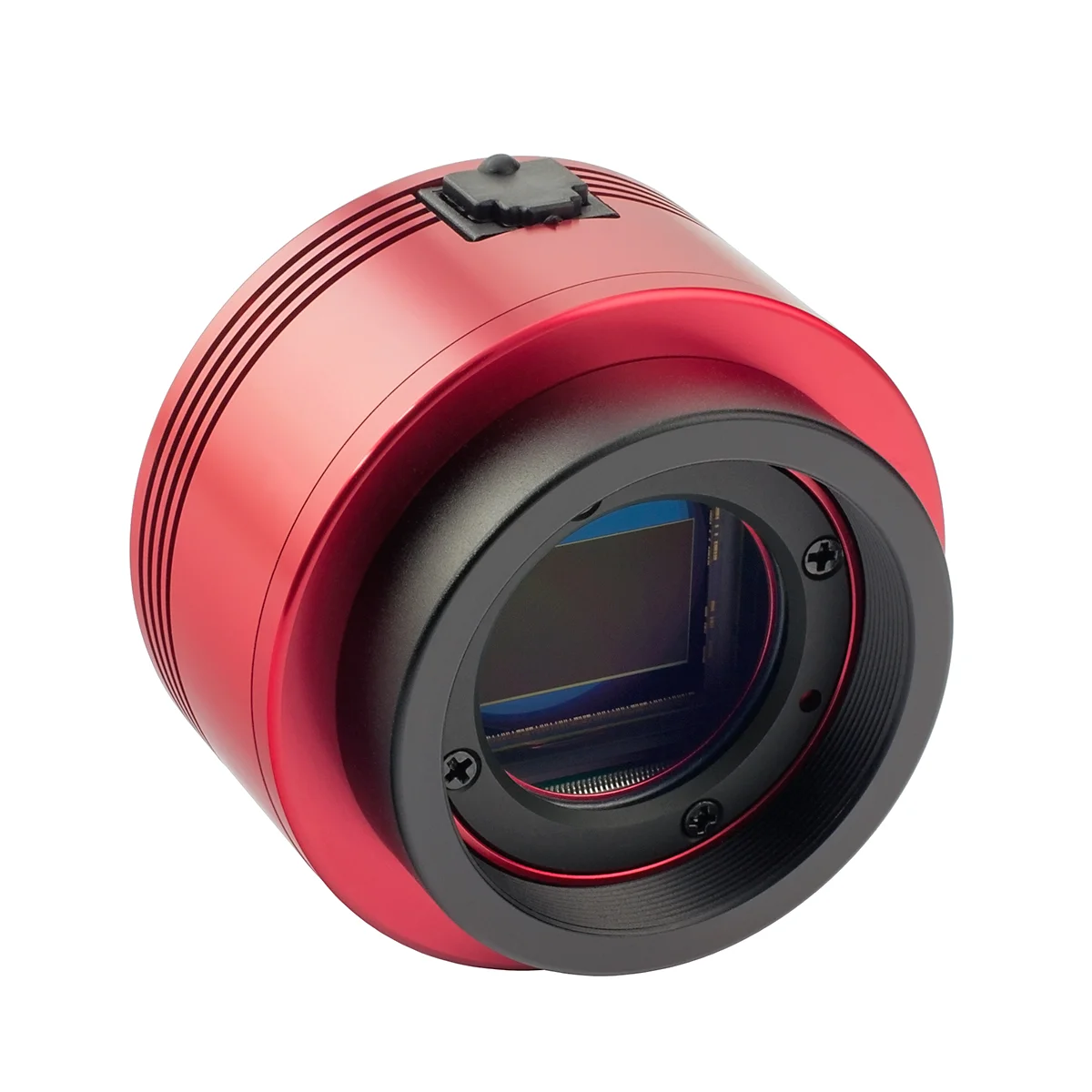
ZWO ASI 294MC Specifications: Sensor and Key Features
The ZWO ASI 294MC is for intermediate astrophotographers wanting serious deep-sky results without the cost and complexity of a cooled camera.
- Galaxy & nebula imagers on a budget. Same sensor as the £1,030 cooled ASI294MC Pro, but no cooling means £280 savings. For short exposures (sub-2 min) the difference is tiny.
- People moving from DSLR astrophotography. Standard DSLRs have IR-cut filters that block H-alpha nebula glow. This camera doesn't: you see nebulae other cameras miss.
- Those without observatory infrastructure. No need for 12V regulated PSUs, cooling loops, or permanent setups. Works off any telescope and USB power.
- Summer deep-sky observers. In UK winter this camera competes with cooled models for faint target detection. In summer, when cooling is less effective anyway, the price difference becomes irrelevant.
- Versatile imagers. This camera does planetary video stacking, wide-field Milky Way, deep-sky galaxies: everything except super-faint objects requiring 30-min+ exposures.
Skip this if you obsess over long exposures or if you need the ultimate sensitivity (use the cooled ASI294MC Pro instead).
What Can You Image with the ZWO ASI 294MC?
Spiral Galaxies
M51 Whirlpool, M101 Pinwheel, M74 Phantom. The 4/3" sensor frames large galaxies perfectly. Colour imaging reveals dust lanes and star-forming regions.
Emission Nebulae
Orion (M42), Rosette, North America, Lagoon. No IR-cut filter means H-alpha light (where most nebula glow lives) reaches the sensor. DSLRs are blind to this.
Open Star Clusters
Pleiades (M45), Beehive (M44), Double Cluster. Wide field of view captures entire clusters in exquisite detail.
Globular Clusters
M13 Hercules, M4, M15. The sensor's sensitivity reveals faint outer stars invisible to visual observation.
Typical deep-sky workflow: 10–15 exposures at 1–2 minutes each, stacked in Siril or Astro Pixel Processor. Total integration time 15–30 minutes. Results rival DSLRs that needed 5+ hours of exposures.
ZWO ASI 294MC vs 294MC Pro: Is the Cooled Version Worth the Extra £280?
The cooling question: Thermal noise (random pixel fluctuations) grows exponentially with exposure time and temperature. At 1-minute exposures on a 10°C night, thermal noise is negligible. At 30-minute exposures, thermal noise becomes a problem, which is why the cooled ASI294MC Pro costs £1,030.
The uncooled advantage: Sub-2-minute exposures are the sweet spot for UK amateur astronomy. Longer than that and atmospheric turbulence ruins sharpness anyway. At 1–2 minutes, this uncooled camera is indistinguishable from the cooled version.
Practical result: 10 exposures at 2 minutes each = 20 minutes total integration. Stacking 10 frames averages out thermal noise. Cooled cameras can take 1 image at 30 minutes and get similar results, but on UK weather, that 1 image often gets ruined by clouds before the exposure finishes.
Summer penalty: On warm nights (15°C+), thermal noise increases. Summer observing favours galaxies over nebulae (high altitude, cooler air in early morning). Plan observations for pre-dawn hours when air is coldest.
No IR-Cut Filter = No Blind Spot
DSLR problem: Most unmodified DSLRs have an IR-cut filter to block infrared light from reaching the sensor. This makes daytime photos cleaner, but it also blocks the H-alpha emission line (656 nm): the primary glow from ionised hydrogen nebulae.
This camera: No IR-cut filter. H-alpha light reaches the sensor unimpeded. Emission nebulae (Orion, Rosette, North America, etc.) glow bright red without filters or special processing.
The consequence: A DSLR needs 5+ hours of stacked exposures to match this camera's 30-minute nebula result. That's a game-changer for UK amateur astronomy, where 5-hour nights are rare.
Downside: Solar and daytime photos show infrared haze. Solution: if you ever do daytime Solar work, it's a limitation. For night-sky work, zero disadvantage.
What the Community Says
Exceptional value compared to cooled pro model. The ASI294MC Pro (£1,030 with cooling) uses the same sensor. For 1–2 minute exposures, this uncooled version is effectively identical. That £280 savings is real.
H-alpha sensitivity is transformative. Owners consistently report nebula images that rival much more expensive cooled systems. The no-IR-filter design is underrated.
Versatility is outstanding. This camera does planetary video, Milky Way wide-field, deep-sky galaxies: all with one sensor. Jack-of-all-trades, master of several.
USB 3.0 convenience is excellent. Fast data transfer means short download times and quick feedback on exposure settings.
Reliability and firmware support are world-class. ZWO's driver ecosystem is mature. Works with every major astrophotography software stack.
Known Limitations & Tradeoffs
- No cooling limits long exposures. Beyond 2–3 minutes on warm nights, thermal noise becomes visible. For sub-2-min stacking workflows this is fine; for single 30-min exposures, use the cooled Pro version.
- Summer temperatures reduce sensitivity advantage. A 15°C+ night significantly increases thermal noise. Plan observing for winter or pre-dawn hours when air is coolest.
- Requires good tracking mount. This camera's resolution (4144×2822 pixels) magnifies tracking errors. You need an equatorial mount with accurate polar alignment.
- Thermal noise visible in processing. Unlike cooled cameras where thermal noise is nearly invisible, this camera shows grain in shadows of stacked images. GIMP's despeckle filter helps.
- No cooling block = no 12V infrastructure needed (advantage), but also less rugged (disadvantage). Cooling block adds durability; without it, handle carefully in the field.
- Bayer filter reduces effective resolution slightly. Colour interpolation costs ~10–15% sharpness vs a monochrome sensor. Fine for galaxies; noticeable on tiny planetary detail.
Pairs Well With
Equatorial Mount (Skyliner 200P or Better)
This camera's resolution demands accurate tracking. A quality equatorial mount (HEQ5 Pro or similar) is essential, not optional.
around £350–£1,000 View mounts at FLO →Siril or Astro Pixel Processor
Siril is free and excellent; Astro Pixel Processor (paid, ~£60) is more automated. Both align and stack your images seamlessly.
Free to ~£60 View at FLO →PixInsight Processing Software
Industry standard for professional deep-sky processing. Advanced curves, deconvolution, colour balance: essential for publication-quality results.
around £35 (one-time)Filter Wheel (Optional)
Add a motorised filter wheel for Narrowband imaging (H-alpha, OIII, SII). Requires external power but dramatically improves nebula contrast. Advanced upgrade.
around £200–£400 View at FLO →The Upgrade Path
Intermediate deep-sky imager: This is a genuinely capable long-term camera. You're not outgrowing it. You're mastering stacking and processing.
Want better deep-sky (especially summer): Upgrade to the ZWO ASI294MC Pro (around £1,030): same sensor with TEC cooling to −40°C. You gain the ability to take 20–30 minute exposures without thermal noise dominating.
Want maximum sensitivity: ZWO makes the ASI6200 (around £1,500+) with larger sensor, higher resolution. It's overkill for UK amateur astronomy but excels for faint dwarf galaxies and extreme deep-sky.
Want planetary AND deep-sky: Keep this for deep-sky and add the ZWO ASI 662MC (around £199) for planetary work. Two specialised cameras beat one compromise camera.