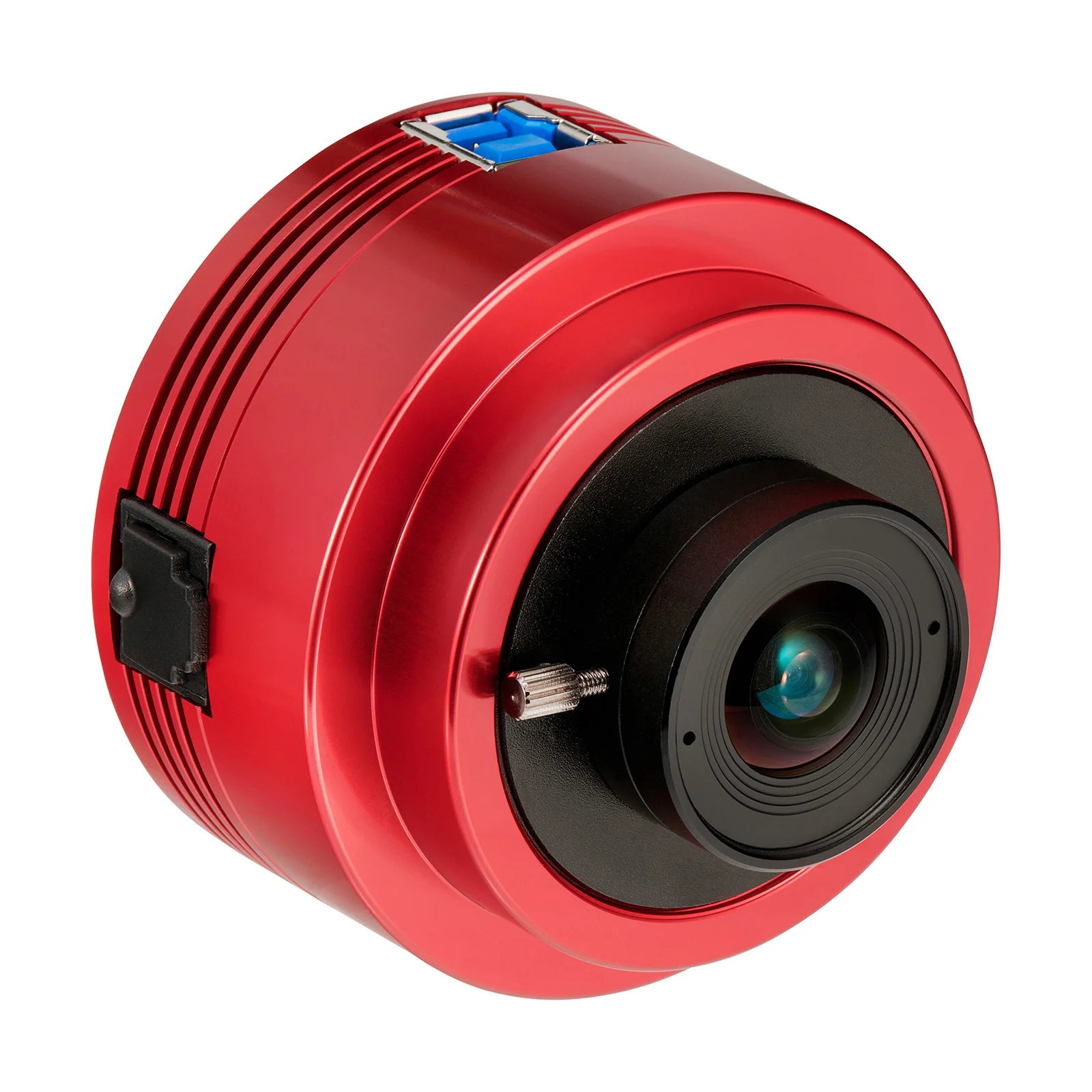
ZWO ASI 662MC
| Key Specifications | |
|---|---|
| Sensor Type | CMOS 1/2.8" colour (Sony IMX662), 1920×1080 |
| Pixel Size | 2.9µm (higher resolution than older models) |
| Read Noise | Ultra-low 0.5e at highest gain |
| Connection | USB 3.0 (fast data transfer, high frame rates) |
| Frame Rate | Up to 130 fps at reduced resolution (640×480) |
| Sensor Tech | Backside-illuminated (BSI): significantly more sensitive than front-illuminated designs |
| Barrel Mount | 1.25" nosepiece (standard focuser fit) |
| Guide Port | ST4 autoguider connector |
ZWO ASI 662MC Specifications: IMX662 Sensor and Frame Rates
The ZWO ASI 662MC is for intermediate planetary imagers who want colour planetary images without the fuss of a mono camera + filter wheel setup.
- Colour enthusiasts. If you want instant colour Jupiter and Saturn images, this camera delivers. No filter wheels, no three-exposure sequences: just shoot and see colour immediately.
- Lucky imaging practitioners. The ultra-low read noise and high frame rates (130 fps at reduced resolution) make this camera exceptional for lucky imaging workflows. You can record thousands of frames in seconds.
- People upgrading from the ASI 120MM Mini. Higher resolution, USB 3.0 bandwidth, and colour all in one. The step up is genuine.
- Mars & Mercury specialists. These planets benefit from colour and detailed observation. The IMX662 sensor is sensitive enough to pull detail from faint Mars.
- Those who value convenience over perfection. You sacrifice some sharpness compared to a mono camera, but gain speed and simplicity. Fair tradeoff.
Skip this if sharpness is paramount (use the mono ASI 120MM Mini instead) or if you're only capturing the Moon in black & white.
What Can You Capture?
Colour Jupiter
Cloud belts in red, blue, and brown. The Great Red Spot shows distinct colour. Video stacking produces images good enough for publication-quality astronomy magazines.
Colour Saturn
Ring colour bands and shadow gradients. The globe shows subtle colour zones. Ring plane changes reveal new detail every year.
Mars Features
Hellas Planitia, Syrtis Major, polar caps, all in colour. Mars is small and faint; the IMX662's sensitivity helps pull detail from poor seeing.
Mercury & Venus
Challenging targets, but the camera's sensitivity helps. Mercury shows phase changes; Venus shows crescent geometry and cloud dynamics.
Lucky imaging with high frame rates is the key to this camera's potential. Record 60 seconds of video at 100+ fps, that's 6,000 frames. Select the sharpest 1% (60 frames) and stack them. The result is stunning.
Backside-Illuminated (BSI) Advantage
What is BSI? Traditional CMOS sensors have their circuitry on the same side as the light-sensitive layer: light has to pass through all that wiring to reach the sensor, losing sensitivity. BSI flips the design: light hits the sensor first, then passes to the circuitry underneath. Result: 40–50% more sensitivity with the same pixel count.
Why it matters: Mercury and Mars are genuinely faint. A non-BSI camera would show a dim disc. The IMX662's BSI sensor reveals surface detail that would be lost otherwise.
USB 3.0 bonus: The ASI 662MC's USB 3.0 connection allows 130 fps at lower resolution: enough frames to do serious lucky imaging. Older USB 2.0 cameras can't match this frame rate.
Lucky Imaging Explained
The atmospheric turbulence problem: Earth's atmosphere is never perfectly steady. Wind layers at different altitudes create convection cells that distort starlight. Telescopes magnify this distortion: a 10" scope at 200× shows the atmosphere's turbulence as dramatic image waviness.
The solution: Record video at high frame rate. At any given moment, one or two frames will be captured during a brief atmospheric "steady" window. That frame will be crisp. Software scans all frames, identifies the sharpest ones, and stacks them.
Practical workflow: Record 30–60 seconds of video at 100+ fps. That's 3,000–6,000 frames. Use Autostakkert! to automatically identify and stack the best 50–100 frames. The result is a single sharp image that no single frame could produce.
The ASI 662MC advantage: USB 3.0 bandwidth and 130 fps frame rate mean you can record huge video files without dropping frames. More frames = more chance to capture perfect atmospheric windows.
Colour vs Mono: The Tradeoff
Colour advantage (ASI 662MC): Instant colour, no filter wheels, simple workflow, intuitive results.
Colour disadvantage: Bayer filter interpolation reduces sharpness by ~20–30% compared to mono. For pixel-peeping detail, mono wins.
Mono advantage (ASI 120MM Mini): Maximum sharpness, superior detail resolution, excellent for Moon and Jupiter.
Mono disadvantage: Black & white images (unless you add a filter wheel), more complex workflow, longer processing time.
Which is better? Depends on your priorities. If colour matters and you don't obsess over sharpness, the ASI 662MC is more fun. If every pixel of detail is important, go mono.
What the Community Says
IMX662 sensor is a real upgrade. Owners consistently report better detail visibility compared to older ASI models. The combination of BSI technology and low read noise is excellent.
USB 3.0 is a game-changer. Frame rates of 100+ fps without dropping data make lucky imaging workflows fast and productive. Video files load instantly; no waiting for transfers.
Colour is more forgiving than expected. Even with Bayer filter interpolation, results rival mono cameras for most planetary targets. The sharpness difference is smaller than specifications suggest.
Fast, responsive, reliable. ZWO's firmware and driver support is excellent. The camera works out-of-the-box with SharpCap and other software.
Price-to-performance ratio is outstanding. At around £199, this camera competes with much more expensive systems. It's a real bargain in the planetary camera space.
Known Limitations & Tradeoffs
- Bayer filter reduces sharpness. Colour comes at a cost: roughly 20–30% less detail resolution than an equivalent mono camera. For Moon imaging this is noticeable; for Jupiter and Saturn it's minimal.
- Requires USB 3.0 host. Older laptops with USB 2.0 only won't get the full frame rate benefit. Budget for a USB 3.0 expansion card if needed (~£20).
- Video file sizes are large. 60 seconds of 100+ fps video is 2–3 GB. You'll need fast storage and adequate disk space.
- Colour casts with poor filters. If your telescope has optics issues (chromatic aberration), colour images will show colour fringing. Mono is more forgiving.
- Requires atmospheric stability. Lucky imaging works only on nights with decent seeing. Poor atmospheric turbulence means no amount of technology helps.
- Software learning curve. Autostakkert! and SharpCap Pro have learning curves. Budget time to master the workflow.
Pairs Well With
SharpCap Pro
The Pro version adds live stacking, planetary autofocus, and analytical features. Free SharpCap is good; Pro is professional-grade.
around £30 (one-time)Autostakkert!
The essential lucky imaging software. Automatically detects the sharpest frames and stacks them. Free, but donations appreciated.
Free (donation-based)USB 3.0 Hub
If your laptop has limited USB 3.0 ports, a powered hub ensures stable power and data transfer. Critical for recording long video sessions.
around £17 View Sabrent 4-Port Hub on Amazon →Motorised Focuser
Temperature causes focus drift. A motorised focuser maintains focus automatically throughout the night. The ZWO EAF is the community standard: USB-C powered, works with ASCOM, NINA, and SharpCap.
around £159 View ZWO EAF at FLO →The Upgrade Path
Intermediate planetary imager: This is a solid long-term camera. You won't outgrow it. You'll master it.
Want maximum sharpness: The mono ASI 120MM Mini (around £153) is sharper for planetary detail. Both excel; choose based on colour vs sharpness priority.
Want deep-sky AND planetary: Keep this for planetary colour work and add the ZWO ASI294MC (around £745) for cooled deep-sky imaging. Two specialised cameras beat one compromise camera.
Want higher resolution: ZWO makes the ASI 178MC: higher resolution, even faster frame rates. But it's a lateral move, not an obvious upgrade.