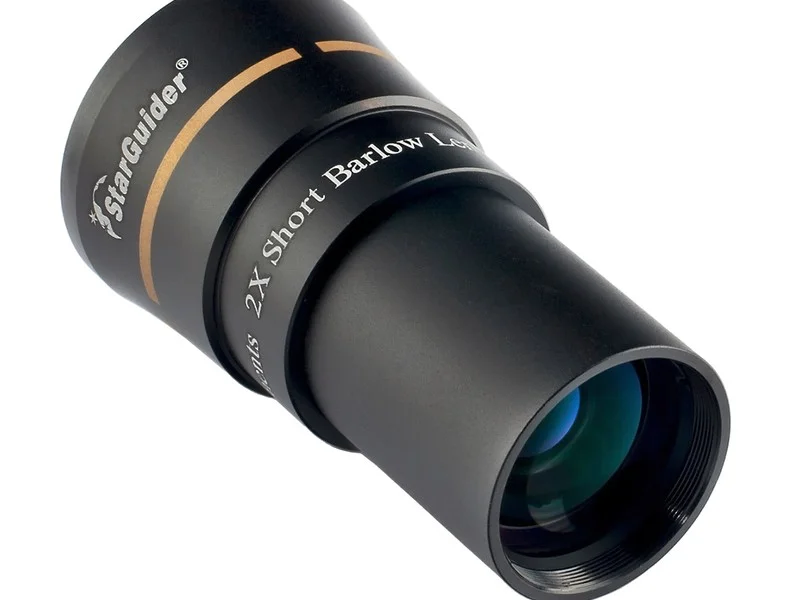
Astro Essentials 2× Barlow Lens
| Key Specifications | |
|---|---|
| Magnification Multiplier | 2× (doubles focal length reduction) |
| Optical Type | Multi-coated doublet |
| Barrel Size | 1.25" |
| T-Thread Mount | Yes (for planetary cameras) |
| Weight | ~120g |
| Eye Relief Multiplier | Halved (20mm eye relief becomes 10mm) |
| Optical Loss | ~10–15% light loss (acceptable) |
| Use Case | Planetary observing, high-power work |
| Available From | First Light Optics, Amazon UK, eBay |
How a Barlow Works
A Barlow lens is a diverging lens that sits in your focuser. You insert an eyepiece into the Barlow, and the Barlow multiplies the magnification. Mathematically: a 2× Barlow doubles the effective focal length reduction, which doubles magnification.
Example: Your Heritage 150P has a 750mm focal length. Your 25mm bundled eyepiece gives 750÷25 = 30×. Pop that 25mm into the 2× Barlow and it becomes a 12.5mm equivalent: 750÷12.5 = 60×. Instant magnification doubling.
The cost is simple: add a glass element (Barlow) to the optical chain, you lose ~10–15% light. It's small and acceptable for planetary work. The tradeoff is worth it on a budget.
Who Is This For?
The Barlow is for anyone who owns two eyepieces and wishes they had four. It's force-multiplier thinking: instead of buying a third and fourth eyepiece, buy a Barlow and it turns your collection into double the range.
- Planetary observers on a budget who want high-power options without the £80 per eyepiece cost
- People who own the BST 8mm and 18mm pair and want medium-power options (turn the 18mm into a 9mm equivalent)
- Beginner to intermediate observers who haven't decided if they're serious enough to invest in a premium eyepiece collection
Practical Examples: What a 2× Barlow Does
BST 18mm becomes 9mm
Heritage 150P: 83× → 166×
High-power planetaryGood for detailed planetary work on steady nights. High power reveals more, but amplifies atmospheric turbulence.
25mm bundled becomes 12.5mm
Heritage 150P: 30× → 60×
Medium powerA respectable middle ground between low-power sweeping and high-power planetary detail.
BST 8mm becomes 4mm
Heritage 150P: 94× → 188×
Extreme powerOnly usable on perfect seeing nights with large scopes. Eye relief drops to 10mm (uncomfortable). Atmospheric turbulence is visible.
The Trade
Cost: around £55
Doubles optionsAdds three new magnification points (from two eyepieces) for around £55. Expensive eyepieces cost £80 each; this is a bargain.
What the Community Says
Planetary observers swear by them. Dedicated lunar and planetary observers often own multiple Barlows (1.5×, 2×, 3×) to cover different magnification ranges without buying individual eyepieces.
"Good enough for the price." The Astro Essentials 2× isn't premium optics, but it's not rubbish either. The multi-coated doublet is reliable and the light loss is acceptable.
T-thread is useful. The attachment point for planetary cameras makes it double as an adapter for astrophotography. Useful if you ever get curious about planetary imaging.
First Barlow is essential; higher multiples are niche. A 2× Barlow is worth having. A 3× Barlow is a specialist tool for extreme planetary detail on steady nights. A 1.5× (if you ever see one) is for smooth magnification scaling.
Known Limitations & Critical Tradeoffs
- Not a replacement for good eyepieces. It's an addition. A Barlow through a bad eyepiece makes a bad eyepiece into a bad eyepiece at higher power. If the bundled 25mm is poor, doubling it doesn't help. This is why it pairs best with the BST 8mm and 18mm (which are good).
- Eye relief is halved. Your 20mm eye relief becomes 10mm. For glasses-wearers or observers sensitive to eye position, this gets uncomfortable. You're essentially glued to the Barlow.
- 10–15% light loss. Not catastrophic, but noticeable on faint objects. This is why Barlows are planetary tools, not deep-sky tools. You don't have enough light to waste.
- Magnification has limits. Your scope has a maximum usable magnification (roughly 2× the aperture in millimetres). A Heritage 150P maxes out around 300×. A 2× Barlow helps, but don't expect magic.
- Add-on complexity. You're adding another optical element that can get dust on it, needs cleaning, and takes up focuser space. It's one more thing to maintain.
- Works with 1.25" eyepieces only. If you ever upgrade to 2" eyepieces (Skyliner 200P does this), the 1.25" Barlow won't fit. You'd need a 2" Barlow (costs ~£40).
When to Buy: A Decision Tree
- Buy a Barlow if: You own two eyepieces (e.g., BST 8mm + 18mm) and want high-power options without spending £80 on a third eyepiece. You observe planets regularly and want magnification range.
- Skip the Barlow if: You're purely a deep-sky observer (Barlows lose light, bad for faint objects). You own only one eyepiece (Barlows work best with at least two good eyepieces to multiply). You prefer simplicity and are okay with fewer magnification options.
- Consider a Barlow as your third purchase (after 8mm and 18mm eyepieces): This is the efficient path. Three physical pieces (8mm, 18mm, Barlow) give you four magnification points: 8mm, 18mm, 4mm (8mm + Barlow), and 9mm (18mm + Barlow).
Best Eyepieces to Use with a Barlow
BST StarGuider 8mm
Creates a 4mm equivalent (188× in Heritage 150P). Excellent planetary workhorse pairing.
£55 (total: £72 for two high-powers) View at FLO →BST StarGuider 18mm
Creates a 9mm equivalent (83× in Heritage 150P). Medium power for lunar detail and general observing.
£55 (creates another option from existing eyepiece) View at FLO →Celestron X-Cel LX 9mm
Creates a 4.5mm equivalent (166× in Heritage 150P). Premium high power. Overkill with a Barlow, but it works.
£115 View at FLO →Bundled 25mm
Creates a 12.5mm equivalent (60× in Heritage 150P). Respectable medium power from stock eyepiece.
Already ownedCommon Misconceptions About Barlows
- "A Barlow is a cheap replacement for a real eyepiece." Wrong. A Barlow is a multiplier that works best with good eyepieces. It's an addition to a kit, not a substitute.
- "I can buy the bundled eyepieces and just use a Barlow." Possible, but inefficient. The bundled eyepieces are basic. Use a Barlow with the BST 8mm and 18mm instead.
- "A 3× Barlow is better than a 2× Barlow." Different, not better. A 3× multiplies magnification more (useful for extreme planetary detail), but loses more light and has even shorter eye relief. Specialist tool, not beginner-friendly.
- "I can use a Barlow for deep-sky observing." Technically yes, but it loses light and darkens faint objects. Barlows are planetary tools. Use them for the Moon and planets, not galaxies.