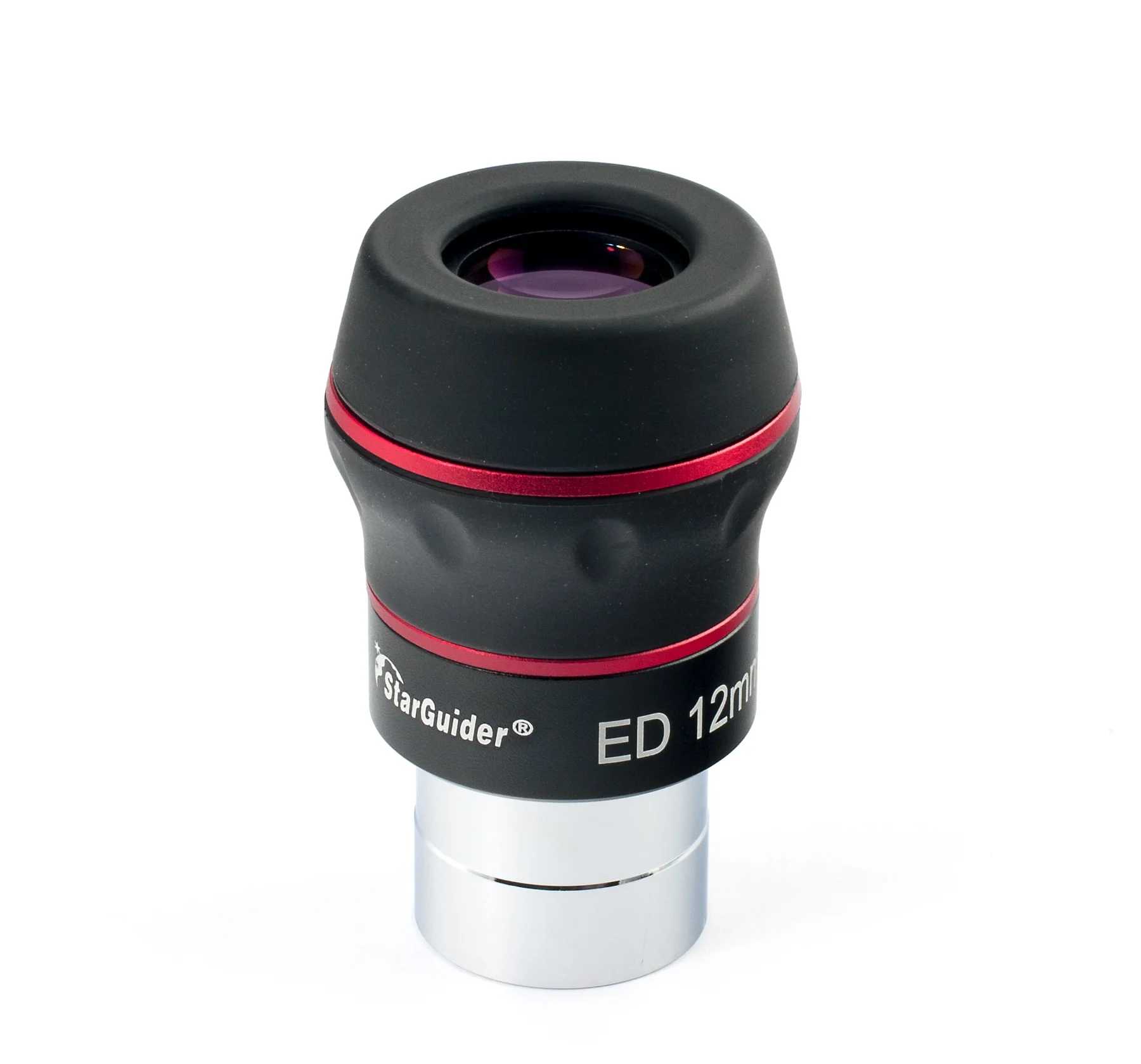
BST StarGuider 60° 12mm ED
| Key Specifications | |
|---|---|
| Focal Length | 12mm |
| Apparent Field of View | 60° |
| Eye Relief | 20mm |
| Lens Elements | 5 (ED glass, fully multi-coated) |
| Barrel Size | 1.25" |
| Weight | ~165g |
| Features | Threaded for 1.25" filters, rubber grip |
| Waterproof | No |
| Available From | First Light Optics, Amazon UK |
BST StarGuider 12mm: Who Is This For?
The BST StarGuider 12mm is the eyepiece that fills the gap between low-power exploration and high-power planetary work. It's perfect if you own the 8mm and 18mm but find yourself wishing for something in the middle: a true all-rounder that shows Moon craters with clarity, planetary cloud belts with definition, and open clusters without too much magnification.
- Observers with the 8mm and 18mm who want a complete 3-eyepiece core set
- Moon enthusiasts who want magnification that reveals crater detail without washing out in light pollution
- Planetary watchers who appreciate a sweet-spot power between the 8mm's extremes and the 18mm's wide views
- Anyone learning how magnification impacts what they see: the 12mm teaches the mid-range beautifully
What Can You See with the BST StarGuider 12mm?
Heritage 130P
f/5, 650mm focal length
54×Perfect mid-power. Jupiter's Great Red Spot is visible. Saturn's Cassini division shows clearly. Moon craters at this power are genuinely spectacular: the terminator looks like a mountain range.
Heritage 150P
f/5, 750mm focal length
62×The ideal "general observing" power for a 150mm. More detail than the 18mm, less fatigue than the 8mm. The sweet spot for a 5-inch scope.
NexStar 6SE
f/10, 1500mm focal length
125×Excellent planetary power on a 6-inch SCT. Jupiter's clouds are crisp. Saturn's rings show fine division. Moon terminator reveals deep rilles and tiny craters.
Open Clusters
Any scope
ExcellentThe 12mm is brilliant for clusters like M35, M37, and the Pleiades. Wide enough to show structure, high enough magnification that stars don't blend.
The 12mm pairs brilliantly with the 8mm and 18mm. Together they form the core three-eyepiece set that handles virtually all observing scenarios: from finding objects to seeing deep planetary detail.
BST StarGuider 12mm: What Buyers Say
The BST StarGuider range is legendary for value. The 8mm and 18mm are forum staples, and observers consistently report the 12mm fills a genuine gap between them. It's the natural third eyepiece once you own the pair.
"Perfect mid-power for the Moon." Many observers describe the 12mm as the go-to eyepiece for lunar work. At 54–125× depending on scope, it's magnified enough to reveal tiny craters without overwhelming atmospheric turbulence.
ED glass makes the difference. The extra-low dispersion element minimises chromatic aberration: Jupiter's edges look clean, not purple-fringed. That's noticeable compared to cheaper eyepieces at this magnification.
Exceptional value outperforming twice the price. For £55, this eyepiece competes with designs costing £120+. The ED glass and 60° field are usually found in premium eyepieces.
Known Limitations & Tradeoffs
- Sits between two strong performers. If you only budget for two eyepieces, the 8mm and 18mm are a better investment. The 12mm is the third piece that completes the set.
- Still 60° field, not wider. It's not a wide-field eyepiece in the modern sense. For true immersive views, you'd want a 68° or wider design, at higher cost.
- Not a high-power specialist. If extreme planetary magnification (150×+) is your goal, the 8mm is better. The 12mm trades maximum power for versatility.
- Not waterproof. Standard care required: store indoors after damp sessions.
Pairs Well With
BST StarGuider 8mm
The high-power planetary companion. The 8mm and 12mm together cover planetary work and Moon detail perfectly.
~£55 View at FLO →BST StarGuider 18mm
The low-power wide-field partner. These three eyepieces (8mm/12mm/18mm) form the complete core set for any observing scenario.
~£55 View at FLO →Moon Filter (1.25")
Thread this directly onto the 12mm for observation of a brilliant Full Moon. Reduces glare and lets you see faint craters near the terminator.
~£11 View at FLO →Astro Essentials 2× Barlow
Double the 12mm to get a 6mm (245× in an SCT, 108× in a Heritage 150P). Great for extreme planetary nights, though eye relief gets tighter.
~£55 View at FLO →BST StarGuider 8mm vs 12mm: Which Focal Length Should You Choose?
Buy the 8mm if you're starting out: it covers planetary work (94× on a Heritage 150P) and is the more versatile first purchase. Buy the 18mm as the second eyepiece for wide-field and finding objects. The 12mm then completes the trio.
If you can only afford one and already own the 18mm, buy the 8mm. If you own the 8mm and 18mm and want to fill the middle ground, the 12mm (62× on a Heritage 150P) is the obvious next step. Three eyepieces under £170 total covers almost every observing scenario for at least a year.