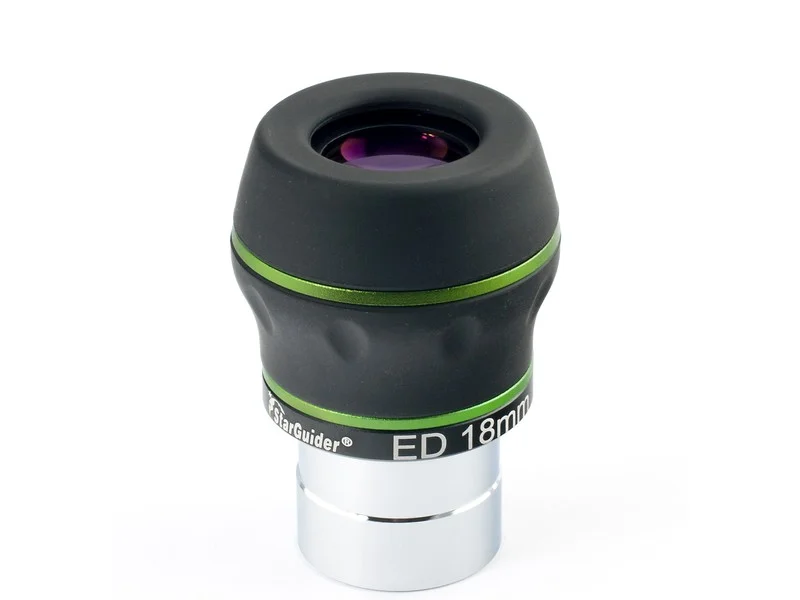
BST StarGuider 18mm 60° ED
| Key Specifications | |
|---|---|
| Focal Length | 18mm |
| Apparent Field of View | 60° |
| True Field of View | Varies by scope (7.5° in f/5 scope) |
| Eye Relief | 25mm |
| Lens Elements | 4 (multi-element ED design) |
| Barrel Size | 1.25" |
| Weight | ~160g |
| Coatings | Fully multi-coated (ED glass) |
| Waterproof | No |
| Available From | First Light Optics, Amazon UK |
BST StarGuider 18mm: Who Is This For?
The BST StarGuider 18mm is the eyepiece for observers who want to see the full context of what they're looking at. Where the 8mm burrows deep into planets and lunar craters, the 18mm pulls back and shows you entire nebulae, open clusters spanning multiple eyepiece widths, and the Milky Way in all its sprawling glory.
- Deep-sky observers who hunt Messier objects and galaxies
- People who love open clusters like the Pleiades, Double Cluster, and the Beehive (M44)
- Sweepers who just want to pan across the Milky Way and find beautiful things
- Anyone buying their second eyepiece: pair it with the 8mm and you've got a complete observing kit for £110
What Can You See with the BST StarGuider 18mm?
The 18mm is lower power than the 8mm, designed for finding objects and seeing their full extent:
Heritage 130P
f/5, 650mm focal length
36×Perfect for finding faint objects. The Pleiades fit in the field with room to spare. Large nebulae show their full structure.
Heritage 150P
f/5, 750mm focal length
42×Wider view with more aperture. The Orion Nebula shows extended structure. Galaxies look less like tiny dots.
Skyliner 200P
f/6, 1200mm focal length
67×A larger scope at medium power. Open clusters show dozens of stars. The Andromeda galaxy sprawls across the view.
Evostar 90
f/10, 900mm focal length
50×A refractor at lower power means beautiful contrast and crisp stars. Perfect for star clusters and large nebulae.
The 18mm is the "I just want to see pretty things" eyepiece. You'll spend most of your observing time here, especially on first nights with a new scope.
BST StarGuider 18mm: What Buyers Say
The 8mm and 18mm pair is legendary. On Stargazers Lounge and Reddit's r/astronomy, when someone asks "what two eyepieces should I buy?", the answer is always "the BST 8mm and 18mm". Observers own these for years.
"The workhorse eyepiece." Forum regulars describe the 18mm as the eyepiece you use 70% of the time. Low power, wide field, comfortable eye relief. It's the one that gets grabbed on every clear night.
Excellent for discovering your observing style. The 18mm at low power is forgiving. You can scan the sky, locate objects without star-hopping effort, and find the targets you actually enjoy observing. Once you know what interests you, the 8mm lets you push magnification on those specific targets.
Same quality as the 8mm. The ED glass and multi-element design deliver sharpness that rivals eyepieces costing 2–3 times as much. At around £55, it's objectively one of the best eyepiece bargains on the UK market.
Known Limitations & Tradeoffs
- At low power, atmospheric turbulence is more visible. The large exit pupil (diameter of light emerging from the back of the eyepiece) means you see more of the atmosphere's movement. On a turbulent night this can be annoying. On a calm night it's beautiful. This isn't a flaw of the eyepiece: it's how low-power observing works.
- Not waterproof. Store it indoors after damp observing sessions. Moisture can degrade the optics over time.
- Still 60°, not 68° or wider. If you love immersive wide-field views, the Explore Scientific 68° eyepieces (costs £145+) offer a notably wider view. The 18mm is respectable; it's not the ultimate wide field.
- Lower magnification has limits. At 36× in a Heritage 130P, planetary detail is minimal. You need the 8mm for that. The 18mm is deep-sky only.
Pairs Well With
BST StarGuider 8mm
The essential pairing. Low and high power from one matched pair. Most observers own no other eyepieces for months.
~around £55 View at FLO →Explore Scientific 68° 20mm
Eventually, you'll want a wider-field alternative to the 18mm. The 68° field is immersive for deep-sky objects. Requires a 2" focuser (Skyliner 200P+).
~£145 View at FLO →Astro Essentials 2× Barlow
Use it with the 18mm to get a medium-power eyepiece (9mm equivalent). Adds versatility without buying a third eyepiece.
~£55 View at FLO →Celestron X-Cel LX 9mm
A premium alternative to the 8mm, if you decide you want better planetary performance. Or keep the 8mm and step up only after confirming you love the hobby.
~£115 View at FLO →Is the BST StarGuider 18mm Worth It?
The 8mm and 18mm together are the foundation. Many observers stay with this pair for their entire first year. It's not a stepping stone: it's a complete observing system.
The next step is specialisation. After a year observing, you'll know whether you love planets (in which case upgrade to a Celestron X-Cel LX or premium eyepiece for the 8mm range) or deep-sky objects (in which case explore wider-field options like the Explore Scientific 68°). The 18mm is happy either way.
Buy the 18mm. Use it for a year. Let it tell you what you love observing. Then upgrade appropriately.