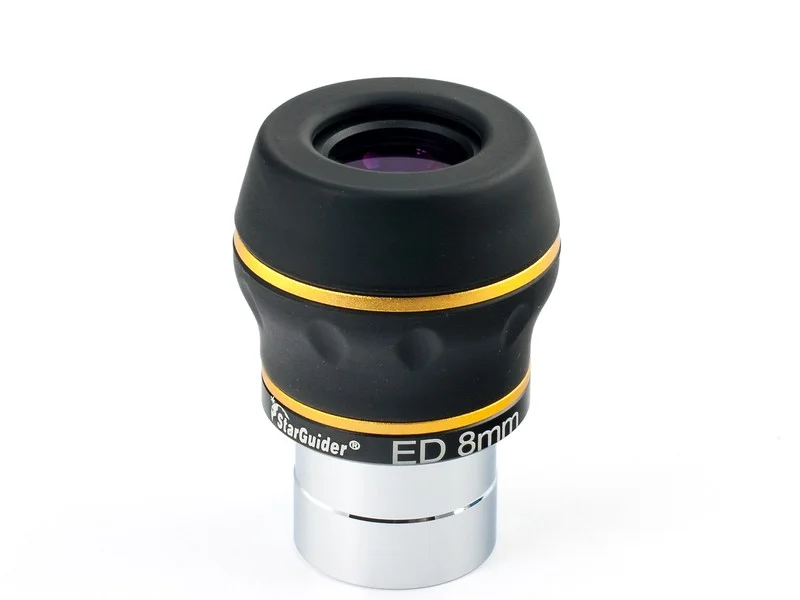
BST StarGuider 8mm 60° ED
| Key Specifications | |
|---|---|
| Focal Length | 8mm |
| Apparent Field of View | 60° |
| True Field of View | Varies by scope (7.5° in f/5 scope) |
| Eye Relief | 20mm |
| Lens Elements | 4 (multi-element ED design) |
| Barrel Size | 1.25" |
| Weight | ~170g |
| Coatings | Fully multi-coated (ED glass) |
| Waterproof | No |
| Available From | First Light Optics, Amazon UK |
BST StarGuider 8mm: Who Is This For?
The BST StarGuider 8mm is the eyepiece for anyone who's just bought their first scope and realised the bundled 25mm and 10mm aren't quite cutting it. It's the single most recommended first upgrade on UK astronomy forums for one simple reason: it works. Brilliantly. At the price. If you're still finding your way around the scope itself, our how to use a telescope guide covers the basics before you start swapping eyepieces.
- First-time eyepiece buyers who want a meaningful upgrade without spending £80+
- Planetary observers who want to push magnification and see Jupiter's storm systems in detail
- Moon lovers who want to resolve craters and mountains at high power
- People testing whether they'll stay in the hobby: this is cheap enough to not regret, good enough to convince you to keep observing
If you own a Heritage 130P, 150P, Evostar 90, or any comparable f/5–f/10 scope with a 1.25" focuser, this eyepiece belongs in your kit. Not sure which scope to start with? Browse our full round-up of telescopes first.
What Can You See with the BST StarGuider 8mm?
The magnification depends on your telescope's focal length. Here's what 8mm delivers in four common UK beginner scopes:
Heritage 130P
f/5, 650mm focal length
94×Jupiter shows belt detail and the Great Red Spot on calm nights. Saturn's rings resolve the Cassini Division. Moon craters leap out in three dimensions.
Heritage 150P
f/5, 750mm focal length
94×Same magnification, more light. Jupiter's storms jump out. Planets look crisp and detailed. This is where the 8mm shines.
Skyliner 200P
f/6, 1200mm focal length
150×High power, but not so high you're fighting atmospheric turbulence. Perfect for planetary observing on a steady night.
Evostar 90
f/10, 900mm focal length
112×A refractor at high power is pure luxury. Moon and planets look like oil paintings. Pin-sharp contrast.
Note: All magnifications assume good atmospheric seeing. On a turbulent night, you'll get better views at slightly lower power (25mm eyepiece instead). On a perfectly calm night at a dark-sky site, push higher.
BST StarGuider 8mm: What Buyers Say
The reviews are unanimously positive. Stargazers Lounge, CloudyNights, and UK astronomy Facebook groups consistently recommend this eyepiece as the essential first upgrade. Owner feedback is almost always "I wish I'd bought this earlier."
"It transforms what you see." The jump from the bundled 10mm (basic Plössl) to the 8mm BST is striking. Planetary detail suddenly appears. Contrast improves. The view sharpens. For around £55 it's absurdly good value.
Paired with the 18mm, it's a complete system. Many observers own nothing but the 8mm and 18mm for their entire first year. Together at £110, they cover low-power wide-field work and high-power planetary observing. That's enough.
Build quality punches above the price. The eyepiece feels solid. The focus grip is smooth. The ED glass delivers clean views. This is the gateway drug to better optics.
One caveat: very short focusers. A handful of users with extremely short focusers (some compact refractors) report that the 8mm's length prevents full focus travel. 99% of scopes are fine; just check your spec if you own something unusual.
Known Limitations & Tradeoffs
- Not a wide-field eyepiece. At 60° apparent field it's respectable, but not immersive like an 82° premium eyepiece. That said, 60° is the sweet spot for most observers. Go wider and you start losing edge sharpness or paying premium prices.
- High magnification magnifies vibration. At 94× or 150× in the scopes above, any scope wobble or atmospheric turbulence becomes visible. You need a steady mount and patience for the air to settle. This is telescope physics, not an eyepiece fault.
- Eye relief is 20mm, not longer. For glasses-wearers, 20mm is comfortable but not luxurious. You're glued fairly close to the lens. If you absolutely need 25mm+ eye relief, step up to a premium eyepiece (costs £100+).
- 1.25" focuser limits. The 8mm is designed for 1.25" focusers, which is all you get on tabletop scopes and smaller refractors. That's fine for most people; just know the ceiling.
- Not waterproof. Unlike premium eyepieces, the BST isn't sealed against moisture. Use it in damp conditions if you're confident, but don't leave it outside in the rain. Store it indoors after observing sessions.
Pairs Well With
The 8mm is most powerful when paired with complementary eyepieces. Here's what works alongside it:
BST StarGuider 18mm
The perfect companion. Low-power wide-field work with the same optical quality. Together they cost £110 and handle 95% of observing scenarios.
~around £55 View at FLO →Astro Essentials 2× Barlow
Turns your 8mm into a 4mm (188× in a Heritage 150P). High-power planetary work without buying a separate eyepiece. Halves eye relief but unlocks new magnifications.
~£55 View at FLO →Explore Scientific 68° 20mm
If you upgrade from the 18mm, the 68° wide field is immersive. More expensive, but the view difference is real on a 200P or larger.
~£145 View at FLO →Celestron X-Cel LX 9mm
A step up in build quality and planetary sharpness. If the BST 8mm works for you and you want premium optics at high power, this is the next rung.
~£115 View at FLO →Is the BST StarGuider 8mm Worth It?
The BST 8mm is the foundation. It's entry-level in price (around £55) but not in quality. Many experienced observers own nothing fancier. They stick with the 8mm and 18mm pair for years.
The next step is better build quality. The Celestron X-Cel LX 9mm (£115) or Explore Scientific 68° eyepieces (£145+) are the natural upgrades. They offer sharper optics, better edge correction, and more durable construction. But they're not necessary. The BST does the job.
The step after that is specialisation. A dedicated 4mm for extreme planetary power. A 32mm wide-field for open clusters. A 2" eyepiece for immersive views. You only buy these after confirming which targets you actually observe.
Start with the 8mm. If you love planetary work, upgrade to a Celestron or Explore Scientific. If you love deep-sky objects, upgrade to a wider-field eyepiece. The 8mm gets you to the crossroads; your observing habits tell you which fork to take.