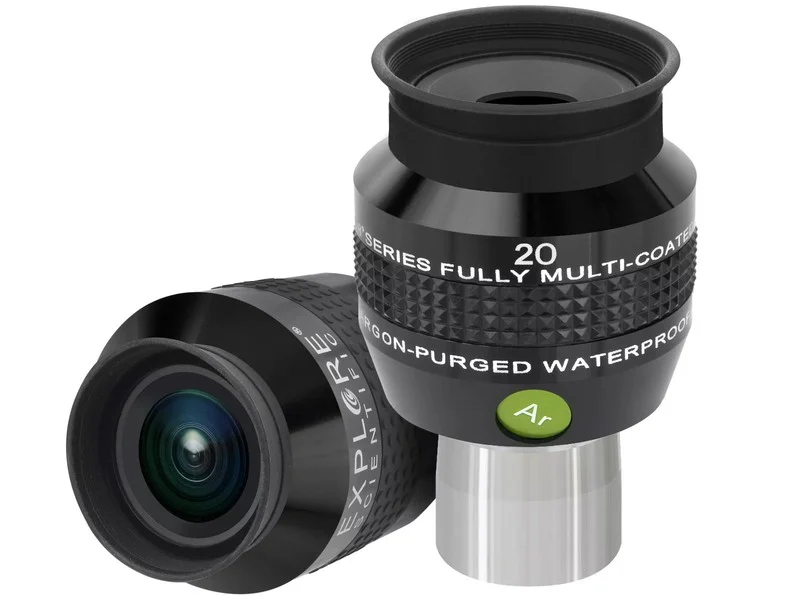
Explore Scientific 68° 20mm
| Key Specifications | |
|---|---|
| Focal Length | 20mm |
| Apparent Field of View | 68° |
| Eye Relief | 23mm |
| Lens Elements | 8 (fully multi-coated) |
| Barrel Size | 2.0" (requires 2" focuser) |
| Weight | ~450g |
| Features | Waterproof, multi-coated glass |
| Waterproof | Yes |
| Compatible With | Skyliner 200P, Evostar 125 EQ, 8" and larger scopes |
| Available From | First Light Optics, Amazon UK |
Explore Scientific 68° 20mm: Who Is This For?
The Explore Scientific 68° 20mm is for observers who own a 2" focuser (which means a Skyliner 200P or larger scope) and want to experience what "immersive wide-field" actually feels like. It's the eyepiece that makes you understand why aperture matters: a wider field with more light creates a view that feels boundless.
- Deep-sky observers with 200mm+ scopes who've mastered the 60° eyepieces and want the next step
- Cluster and nebula enthusiasts who want to see entire structures in a single eyepiece field
- People willing to invest in the experience: around £145 is serious money, but the memory of the first night through this eyepiece lasts for years
Critical note: This eyepiece only works in 2" focusers. If you own a Heritage 130P or 150P (both 1.25"), you cannot use this eyepiece. Full stop. It's a physical constraint, not a downside: it just means you need the right telescope.
What Can You See with the Explore Scientific 68° 20mm?
Skyliner 200P
f/6, 1200mm focal length
60×Perfect low-power wide-field. The Andromeda Galaxy sprawls across the view. You're surrounded by stars instead of looking at them.
Evostar 125 EQ
f/10, 1250mm focal length
62×A large refractor with the ES 68° is pure luxury. The Pleiades fill the field. The Moon's terminator is sweeping and dramatic.
The Wow Factor
Any 200mm+ scope
UnforgettableThe jump from 60° to 68° might seem small, but the psychological difference is enormous. The universe feels bigger.
Why 68° Matters
vs 60° Plösls
33% widerYou see 33% more sky. Objects that felt cramped in a 60° eyepiece suddenly breathe and expand in the 68°.
The apparent field difference (68° vs 60°) translates to a noticeable difference in presence and immersion. Once you've looked through a 68° eyepiece, going back to 60° feels narrow.
Explore Scientific 68° 20mm: What Buyers Say
"The eyepiece that changes everything." Multiple forum posts describe the first night through a 68° eyepiece as life-changing. Observers talk about feeling like they're floating in space rather than looking through a tube.
Waterproof matters. Unlike budget eyepieces, the ES 68° is sealed against moisture. If you observe in damp UK conditions (which you will), this feature adds confidence and longevity.
Not just for clusters: galaxies transform too. The Andromeda galaxy looks less like a smudge and more like a landscape when you see its full extent in a 68° field. Same with the Triangulum Galaxy and large nebulae.
Only for larger scopes. The 200mm minimum isn't arbitrary: smaller scopes don't gather enough light to justify the lower magnification. In a 150mm scope a 60° eyepiece is brighter and more useful.
Expensive but keeps its value. Used ES 68° eyepieces hold their value on astrophotography forums. People buy these and keep them for decades.
Known Limitations & Tradeoffs
- 2" focuser only. This is the biggest barrier. If your scope has a 1.25" focuser, you cannot use this eyepiece. Not recommended, not possible. Done. You need a Skyliner 200P or equivalent.
- around £145 is expensive. That's more than a BST eyepiece pair. Make sure you actually want immersive wide-field views before committing. Test with the 18mm first.
- Heavy. At 450g it's noticeably heavier than smaller eyepieces. Some vintage focusers struggle to support it. Modern 2" focusers handle it fine, but check your mount's specs.
- Lower magnification than 8mm options. If you want to push power on planets, you'll pair this with a higher-power eyepiece (8mm, 9mm). The ES 68° is deep-sky specialised.
Pairs Well With
BST StarGuider 8mm (1.25" adapter)
If you want planetary power alongside wide-field work, use a 2→1.25" adapter to use your 8mm in the 2" focuser. Not elegant, but it works.
~£55 (+ £5 adapter) View at FLO →Celestron X-Cel LX 9mm (2" tube available)
Celestron makes X-Cel LX eyepieces in 2" barrels. Pair the 20mm ES with a 2" X-Cel LX 9mm for the full deep-sky-and-planetary kit.
~£90 View at FLO →Astro Essentials Barlow (2" version)
Double the 20mm to 10mm equivalent for medium-power work. The 2" Barlow version pairs seamlessly with this eyepiece.
~£40 View at FLO →Is the Explore Scientific 68° 20mm Worth £145?
This is the premium end of mid-range eyepieces. Below it: the 60° eyepieces (BST, X-Cel LX, ES 52°). Above it: ultra-premium 82° eyepieces and specialty designs (costs £150–£300+).
Most observers who buy this never need anything wider. The 68° field is genuinely immersive. The gap between 68° and 82° is smaller than the gap between 60° and 68°. Many astronomers stay with the ES 68° for life.
Buy this eyepiece only if you own a Skyliner 200P or larger scope AND you've confirmed you love deep-sky observing. It's the reward for staying in the hobby past the first year.