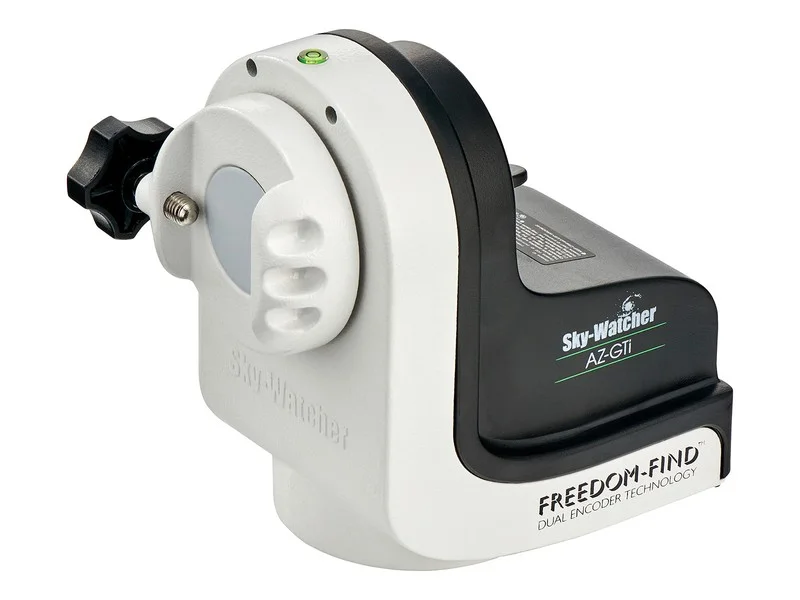
Sky-Watcher AZ-GTi
| Key Specifications | |
|---|---|
| Mount Type | Computerised Alt-Az (GoTo) |
| Payload | 5kg maximum |
| Object Database | 40,000+ stars, planets, nebulae, galaxies |
| Slew Speed | Variable, 1–4°/sec |
| Tracking Accuracy | ~1 arcminute RMS after alignment |
| Power | Two AA batteries (optional external 12V) |
| Hand Controller | SkyView-GoTo with iPhone/Android app |
| Weight (head only) | ~3.5kg |
| Tripod | Standard camera tripod (not included) |
| Best For | Refractors, compact scopes, grab-and-go observing |
Who Is This For?
The AZ-GTi is for observers who've outgrown manual star-hopping but don't want to carry a 20kg mount. It's the portable GoTo mount: you hand-carry it to a dark site in one trip, set it on any camera tripod, and five minutes later you're looking at Jupiter.
- Observers with lightweight refractors: 80mm, 90mm, 100mm scopes that weigh 3–4kg
- People tired of star-hopping but not ready for serious equipment
- Grab-and-go stargazers who want computerised finding without the setup complexity
- Binocular mount users wanting something portable with tracking
- Astrophotographers working with small telephoto lenses or small telescopes
If you own a 200mm Dobsonian or a 150mm SCT, the AZ-GTi will strain under the weight and track poorly. If you only use eyepieces under 1,200×, you might find manual tracking is fine. But for refractors and compact scopes in the 3–5kg range, the AZ-GTi removes the tedium of object-hunting.
Sky-Watcher AZ-GTi: What Scopes Work Well?
The AZ-GTi's 5kg payload sounds light, but it's perfect for several common scopes:
Refractors 80–100mm
An 80mm refractor weighs ~3kg, well within payload. The AZ-GTi tracks them effortlessly and the GoTo is brilliant for planetary work.
Compact Newtonians
A 130mm tabletop Dobsonian converted to alt-az GoTo tracking. Provides aperture with portability.
Spotting Scopes & Binoculars
A lightweight spotting scope (1–2kg) paired with the AZ-GTi becomes a superb geological survey instrument. Binoculars gain smooth tracking for extended viewing.
Small Camera Setups
A 135mm telephoto lens or small refractor with a DSLR becomes a tracked astrophotography platform. Holds 15–20 minute exposures without trailing.
Do not exceed the 5kg limit. A 150mm f/8 SCT (5.5kg) will cause tracking drift and vibration.
Sky-Watcher AZ-GTi Review: What Buyers Say
Excellent for what it's designed for. Stargazers Lounge and Reddit's r/astronomy threads praise the AZ-GTi for portability and accuracy with lightweight scopes. Users consistently report happy experience on refractors.
Battery life is sufficient. Two AA batteries last 8–12 hours of continuous observing and slewing. Many users carry a spare pair for night sessions or upgrade to external 12V power.
Smartphone app is intuitive. The SkyView-GoTo app works smoothly on iPhone and Android. Alignment takes 5 minutes, slewing is smooth, and object finding works as advertised.
Tracking is accurate for visual observing. After proper alignment, tracking keeps objects centred through a wide-angle eyepiece for hours. High-magnification work requires occasional small nudges, but nothing intrusive.
Vibration can be an issue with fast-moving slews. Some users report the head shakes slightly during fast slews on lightweight tripods. Upgrading to a sturdy professional tripod eliminates this.
Known Limitations & Tradeoffs
- 5kg payload is a hard ceiling. Load more than 5kg and the mount will vibrate, track poorly, and potentially become unstable. A 150mm f/8 SCT at 5.5kg will cause problems.
- Alt-Az means field rotation. Unlike equatorial mounts, the AZ-GTi rotates the field as it tracks. This is fine for visual observing and short exposures, but ruins long astrophotography. Not ideal for imaging beyond 10 minutes.
- Requires a sturdy tripod. The mount comes alone; you need a camera tripod rated for at least 10kg total weight (mount + scope). Flimsy tripods will cause excessive vibration.
- Slew speeds can cause vibration. Fast slews (4°/sec) on lightweight tripods can make the head shake. Slower slews (1–2°/sec) eliminate this, but object-hunting takes longer.
- Alignment required every session. Unlike permanent equatorial setups, you'll do a two-star alignment each time. Takes 5 minutes and becomes routine, but it's a step manual mounts skip.
- Battery dependency. You must carry batteries or an external power supply. Forgetting batteries at home ends the observing session. AA batteries can die unexpectedly in cold weather.
Pairs Well With
The AZ-GTi works best with these specific scopes and setups:
- Explore Scientific 68° 20mm eyepiece (£120): A wide-field eyepiece transforms the AZ-GTi into an immersive observing platform. The GoTo puts galaxies in the middle of the field, and the wide eyepiece shows context.
- BST StarGuider eyepieces: Lightweight, sharp, and ideal for planetary work with refractors.
- Celestron or Sky-Watcher 80mm refractors: At £150–£250, these paired with the AZ-GTi create a complete grab-and-go planetary observation system.
- Manfrotto or Really Right Stuff tripod: A professional-grade camera tripod eliminates vibration issues and makes the whole experience smooth.
Is the Sky-Watcher AZ-GTi Worth It?
The AZ-GTi is the entry point to computerised observing for people who've outgrown manual astronomy but aren't ready for a 20kg equatorial mount. It's lightweight, portable, and accurate enough for comfortable visual observing with refractors and compact scopes.
If your scope weighs under 5kg and you hate star-hopping, the AZ-GTi removes the tedium without adding complexity. If you own heavier equipment, look at the EQ5 Pro or HEQ5 Pro instead. If you're happy with manual tracking, there's no shame in skipping computerised equipment. A manual mount is simpler and lighter.