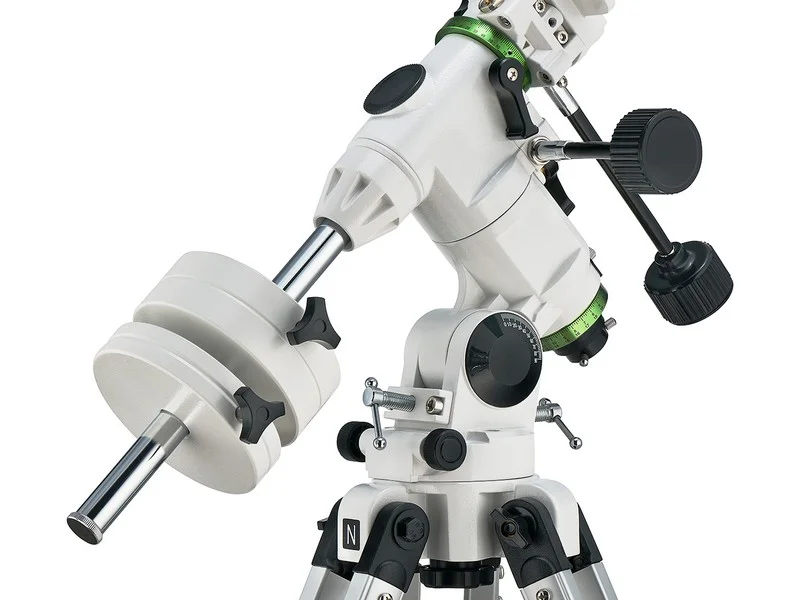
Sky-Watcher EQ3-2
| Key Specifications | |
|---|---|
| Mount Type | Manual Equatorial |
| Payload | 6kg maximum |
| RA Tracking | Manual slow-motion control |
| Dec Movement | Manual slow-motion control |
| Polar Alignment | Manual via Polaris or south pole |
| Worm Drives | Single-ratio worms (no motor sockets) |
| Weight (head only) | ~2.8kg |
| Tripod | Included (lightweight) |
| Dovetail | Standard Vixen-compatible |
| Best For | Learning polar alignment, visual observing, refractors |
Who Is This For?
The EQ3-2 is for observers who want to learn how equatorial mounts work without spending serious money. It's the bundled mount on the Evostar 90 EQ2, but you can buy it standalone to upgrade from a Dobsonian or to experiment with manual equatorial tracking.
- Complete beginners to equatorial mounts: Want to understand polar alignment and RA tracking before committing to motorised systems
- Refractor owners: The EQ3-2 is perfectly matched to 80mm and 90mm refractors
- People learning astrophotography: Short-exposure photography works fine; teaches the fundamentals
- Observers who value simplicity: No electronics, no batteries, no alignment routines. Just point and observe.
If you need long astrophotography exposures, the EQ3-2 won't do it. You need a motorised mount. If you already understand equatorial mounts and want serious equipment, the EQ5 Pro is the next step up.
Understanding Equatorial Tracking
The key difference between an equatorial mount and a Dobsonian: an equatorial mount's RA (right ascension) axis aligns with Earth's spin axis. Once polar-aligned to Polaris, rotating the RA axis one full turn per sidereal day tracks the entire sky automatically, you just need one knob.
This is why equatorial mounts are ideal for long observing sessions and photography. On a Dobsonian, you constantly nudge up/down and left/right. On the EQ3-2, one knob handles the 15°-per-hour drift west.
The learning curve is understanding polar alignment. YouTube has excellent guides, and once you've done it three times, it becomes routine.
What Scopes Work Well?
80–100mm Refractors
The sweet spot. An 80mm refractor at 3kg is a perfect match. Polar alignment becomes second nature on these.
Evostar 90 EQ2
This is what the EQ3-2 was designed for. If you own an Evostar 90, you already have this mount.
Compact Newtonians
A 130mm tabletop Dobsonian tube (optical tube only, ~3kg) mounted on the EQ3-2 provides aperture with equatorial convenience.
Binoculars
A binocular mount adaptor lets you use the EQ3-2 with 10×50 or 15×70 binoculars. Tracking is smooth and comfortable.
Do not exceed 6kg. Heavier scopes will vibrate and be hard to move smoothly.
What the Community Says
Excellent learning mount. Stargazers Lounge recommends the EQ3-2 as the "best way to understand equatorial mounts" for the price. Users consistently report it's worth buying even if you upgrade later, just for the education.
Polar alignment is easier than you think. The procedure sounds complex, but real users report it takes 5–10 minutes after the first try, and 2–3 minutes by night five. YouTube guides are clear and helpful.
Tracking is smooth and accurate. Once aligned, the RA knob tracks smoothly and accurately enough for extended observing sessions. One user reported successful 5-minute exposures with a camera.
Build quality is basic but functional. The worm drives are single-ratio (no motor sockets), the tripod is lightweight but sturdy enough. It's not robust enough for heavier scopes, but it knows its place.
Manual operation is not a limitation. Several community members own motorised mounts but use the EQ3-2 because the pure simplicity is refreshing. No batteries, no electronics, no learning a new controller.
Known Limitations & Tradeoffs
- No motors, ever. The EQ3-2 has no motor sockets. You cannot add motors. If you later want automated tracking, you must buy a new mount (EQ5 Pro, HEQ5 Pro).
- Polar alignment is required every session. You must align to Polaris (or the south celestial pole) before observing. Takes 5 minutes but it's non-negotiable.
- Manual tracking means your focus drifts. Unlike motorised mounts, as you track objects across the sky, your focus point shifts slightly. Not a problem for visual observing, a nuisance for long exposures.
- Single-ratio worm drives. The RA drive has one speed. You can't shift between fine tracking and fast slewing. You nudge slowly or not at all.
- Payload is strict at 6kg. Anything over 6kg and vibration becomes noticeable. A 150mm refractor at 7kg will be frustrating.
- Dec slow-motion is not intuitive. Dec (north-south) movement requires two separate slow-motion knobs. Takes practice. One user reported weeks before feeling comfortable.
- Tripod is lightweight. The included tripod works but feels cheap. A sturdy photography tripod (£100–£200) eliminates any vibration concern.
Is the EQ3-2 Worth It? The Bottom Line
The EQ3-2 is not the "best" mount, but it's the best teaching mount for the price. If you think equatorial tracking is something you want to master, buy this. Use it for a season. Learn polar alignment, learn RA slow-motion, experience the difference between alt-az and equatorial tracking.
If you love it, upgrade to the EQ5 Pro with motors. If you decide manual mounts suit you fine, the EQ3-2 will serve you perfectly for years. Either way, you'll understand equatorial astronomy at a deep level, and that knowledge will make you a better observer.