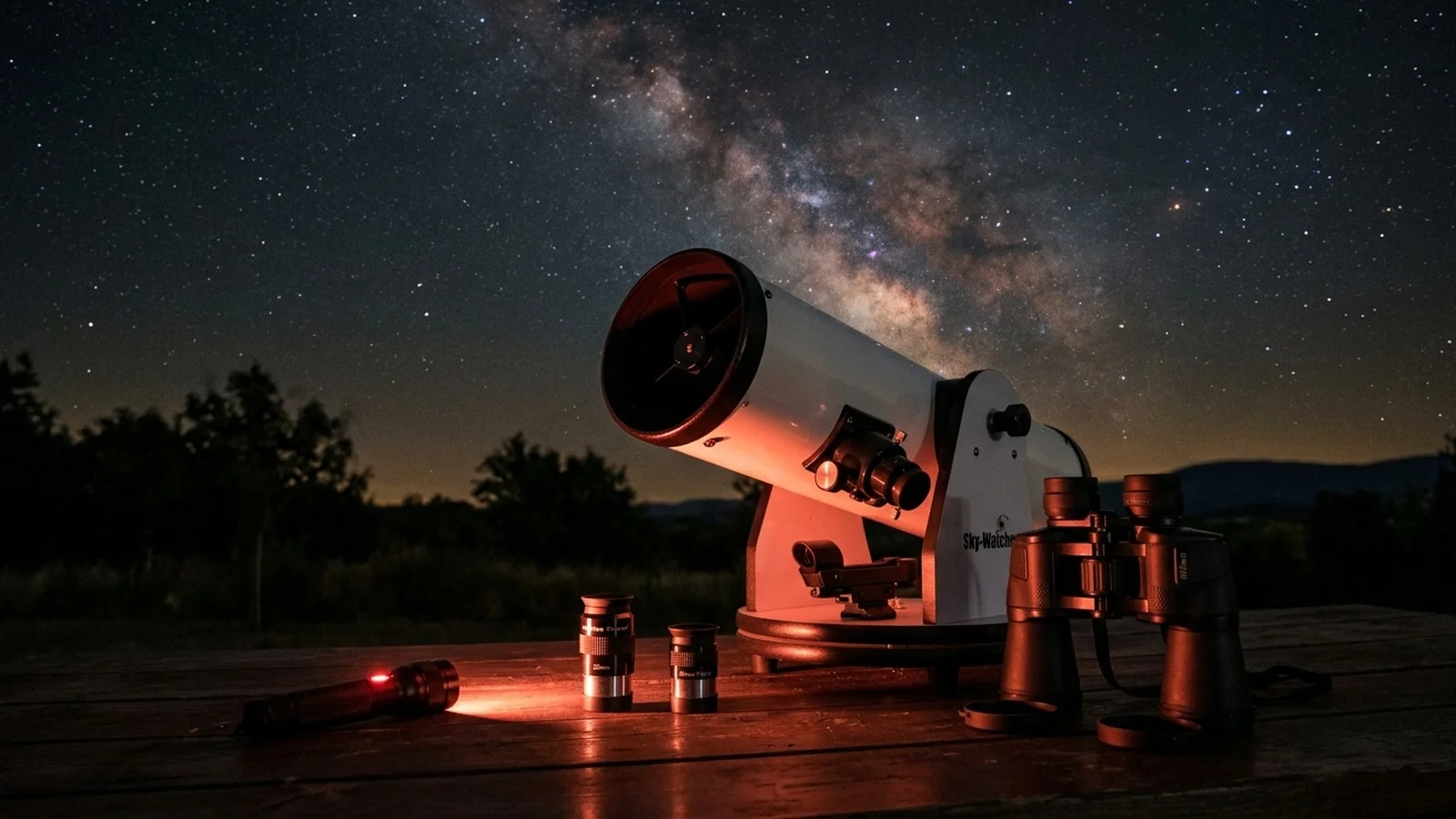
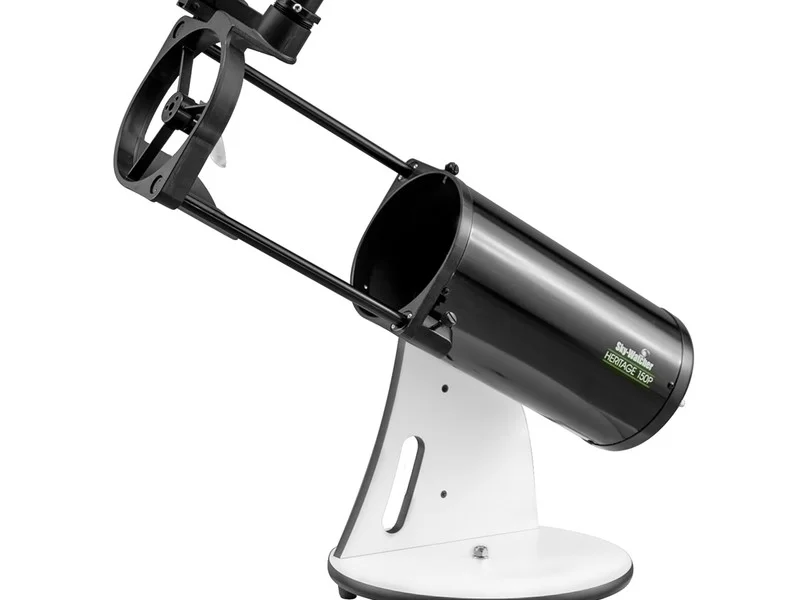
Sky-Watcher Heritage 150P FlexTube
The BBC Sky at Night Magazine Editor's Choice. A 150mm tabletop reflector with a parabolic primary mirror, delivering noticeably better image quality than the 130P, and worth every extra pound for beginner deep-sky observers.
| Specification | Value |
|---|---|
| Aperture | 150mm (6 inches) |
| Focal Length | 750mm |
| Focal Ratio | f/5 |
| Optical Type | Newtonian Reflector |
| Primary Mirror | Parabolic |
| Mount | Tabletop Dobsonian |
| Optical Tube Weight | ~5.5 kg |
| Mount Weight | ~2 kg |
| Total Weight | ~7.5 kg |
| Focuser | 1.25" helical |
| Included Eyepieces | 10mm (75×), 25mm (30×) |
| Finder | Red dot |
| Collimation | Three-screw primary (user-adjustable) |
Heritage 130P vs Heritage 150P: Which Should You Buy?
The Heritage 150P costs a bit more than the 130P. The question every beginner asks is: does it matter? The answer is yes, noticeably so, and here's why:
Heritage 130P
Heritage 150P
The key differences:
33% more light gathering area. The 150mm aperture collects about one-third more light than the 130mm. This means fainter objects become visible: dwarf galaxies you couldn't see in the 130P suddenly appear. Deep-sky objects show more detail and surface brightness.
Parabolic vs spherical mirror. The 130P uses a spherical primary mirror (faster and cheaper to manufacture), which causes slight coma: stars at the edges of the field look slightly stretched. The 150P has a parabolic primary, which eliminates this aberration entirely. At low power you won't notice, but as you use wider-angle eyepieces the difference becomes obvious.
Community consensus is clear. On Stargazers Lounge and astronomy forums, the refrain is nearly universal: "I wish I'd gone for the 150P instead of the 130P." People don't regret buying the 150P; they regret not having bought it instead. That's telling.
Who Is the Heritage 150P For?
Beginners who want to see things properly. If you're completely new to astronomy, the Heritage 150P is the sweet spot between affordability and image quality. You won't regret the choice.
Anyone chasing deep-sky objects. Galaxies, nebulae, and faint clusters are what the 150P excels at. The extra aperture and parabolic mirror make a real difference on these targets.
People who have space for a tabletop scope. You'll need a sturdy surface at roughly waist height: a garden table, a wall-mounted shelf, or a cheap plant stand (£15–£30). If you don't have access to a suitable surface, the Skyliner 200P or a different scope type might be better.
Anyone wanting the best value tabletop Dobsonian. If you compare aperture-per-pound spent, the 150P offers one of the best returns in amateur astronomy. It's not the absolute cheapest, but it's the best you can get for the money.
Skip this if: You primarily want high-magnification planetary observation (Moon, Jupiter, Saturn detail). For that, consider the Evostar 90 refractor instead: the f/10 focal ratio is better suited. Or if you have no place to put a table, the Skyliner 200P ground-standing design works better.
What Can You See with the Heritage 150P?
The same targets as the 130P, but with more detail and consistency:
The Moon. Sharp, high-contrast craters, mountain ranges, rilles, and valleys. You can spend entire nights exploring the terminator (the line between day and night) as new features emerge. The 10mm eyepiece gives 75× magnification: enough to see remarkable detail.
Jupiter. Cloud belts in the north and south equatorial zones, the Great Red Spot (when it's visible), the festoon detail. You'll see the Galilean moons as distinct points of light, and their shadows crossing the disc on good nights. Io's volcanic activity has even been detected through modest scopes like this.
Saturn. The rings are unmistakable, and on nights with steady atmosphere (good seeing) you'll see the Cassini Division: the gap between the A and B rings. The cloud bands on the planet itself become visible. The cloud detail is subtle, but it's there.
Deep-sky objects:
- M42 (Orion Nebula): Shows the Trapezium, the four bright stars at the nebula's heart, and sweeping gas clouds around them. In the 130P it's a bright smudge; in the 150P you see structure.
- M13 (Hercules Globular): Individual stars resolve at the cluster's edges. The core remains unresolved but appears as a glow against the stellar halo.
- M31 (Andromeda Galaxy): Appears larger and brighter than in the 130P. The dark dust lane near the core becomes visible.
- M51 (Whirlpool Galaxy): Visible as a fuzzy double object: the main galaxy and its companion. On a truly good night with a dark sky, you might glimpse the spiral structure.
- Hundreds of open clusters, faint galaxies, and nebulae. The 150P opens up to you all the targets in Messier's catalogue and beyond.
What Buyers Say About the Heritage 150P
Stargazers Lounge: The most common thread is "I bought the 130P and now I wish I'd invested in the 150P instead." The parabolic mirror quality at this price point is consistently praised. "For the money, Sky-Watcher's optics are outstanding."
BBC Sky at Night Magazine: Editor's Choice award. That speaks for itself.
Reddit (r/astronomy, r/telescopes): Regular recommendations for beginners. The main caveat is the tabletop requirement: you need a suitable surface.
Astronomy UK clubs: A staple at star parties. Many club members use these scopes as grab-and-go alternatives to their larger equipment. The optical quality is reliable.
Heritage 150P: Known Limitations
Tabletop design requires a surface. You need a sturdy table, shelf, or stand at waist height. It's not the most elegant solution, and you can't use it in the middle of a field without carrying additional equipment.
Heavier than the 130P. At 7.5 kg total (optical tube + mount), it's significantly heavier than the 130P's 5.2 kg. Still light enough for one trip to the garden, but you'll notice the extra weight if you're moving it frequently.
1.25" focuser. The eyepieces are 1.25" (not the larger 2" standard). This limits your choice of wide-angle eyepieces down the line, though there are plenty of good 1.25" options available.
Bundled eyepieces are still basic. The 10mm and 25mm that come with the scope are functional but not particularly good. Budget an extra £45–£50 for a BST StarGuider 8mm or similar upgrade, it will transform what you see.
Needs occasional collimation. The primary mirror can drift slightly out of alignment. Every few months (or after moving the scope), you may need to tweak the three adjustment screws at the back of the primary. It's not difficult, our how to use a telescope guide walks through it, but it's not something the completely non-technical should ignore.
Red dot finder accuracy. The supplied red dot finder can be finicky to align and sometimes drifts. Many owners replace it with a Telrad finder (£43) early on, it's a worthwhile upgrade for faster object location.
Heritage 150P: Best First Upgrades
You don't need to buy anything else the day you get the scope. But these upgrades are cheap and make a real difference:
- BST StarGuider 8mm eyepiece: gives 94× magnification, dramatically sharper planetary detail ~£45 View at FLO →
- BST StarGuider 18mm eyepiece: fills the gap between the bundled 25mm and 10mm ~£45 View at FLO →
- Telrad finder: replaces the red dot finder, more reliable object location ~£43 View at FLO →
- Rigel QuickStep collimation cap: makes collimation simpler and more accurate ~£6 View at FLO →
- Collimation laser (optional): faster collimation on nights when the mirror has drifted ~£25 View at FLO →
See our eyepiece guide for detailed recommendations on different magnifications. See our accessories guide for finder, collimation, and support options.
Heritage 150P vs Skyliner 200P: Is It Worth Upgrading?
The Heritage 150P is currently a sweet spot. You're not buying a stepping stone: this is a scope you can use for years. It won't become obsolete or "too basic" for you.
That said, when and if you want more light-gathering power, the next step up is clear: the Sky-Watcher Skyliner 200P (around £340). An 8-inch aperture on a full-size Dobsonian base. It gathers 1.8 times more light than the 150P. At that point you move from a scope that fits in a cupboard to one that needs dedicated storage space. But deep-sky observing becomes a completely different experience.
Between the 150P and 200P there's a significant jump in size and cost. Many people stay with the 150P for years before making that leap. That's fine: it's a lifetime scope.
The Heritage 150P is the best value beginner's deep-sky telescope you can buy. The parabolic mirror and extra 20mm of aperture deliver noticeable improvements over the 130P, and the BBC Sky at Night Editor's Choice award reflects genuine optics quality. If your budget stretches to £220 and you have a suitable table, buy this. You won't regret it, and you certainly won't outgrow it.