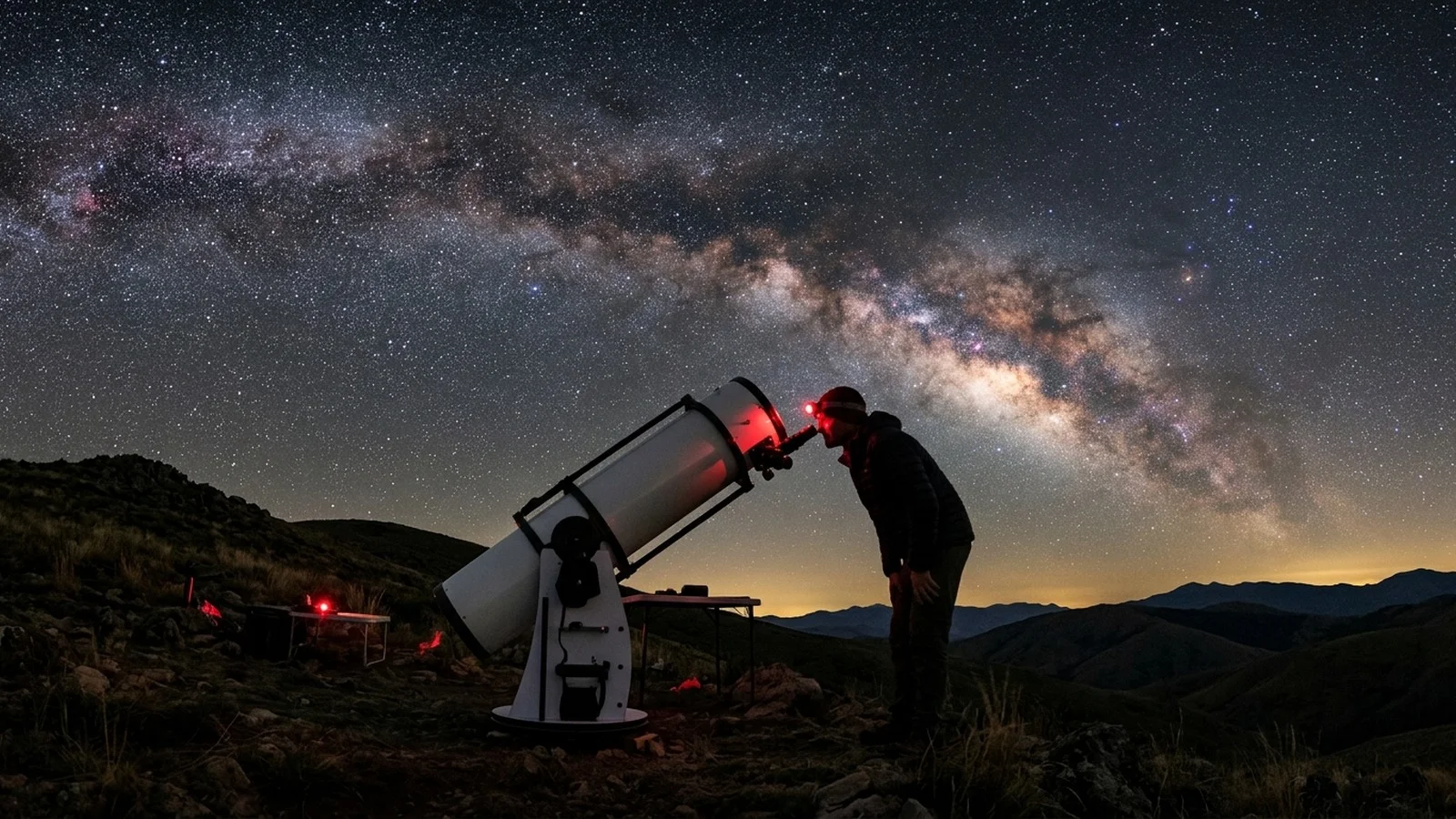
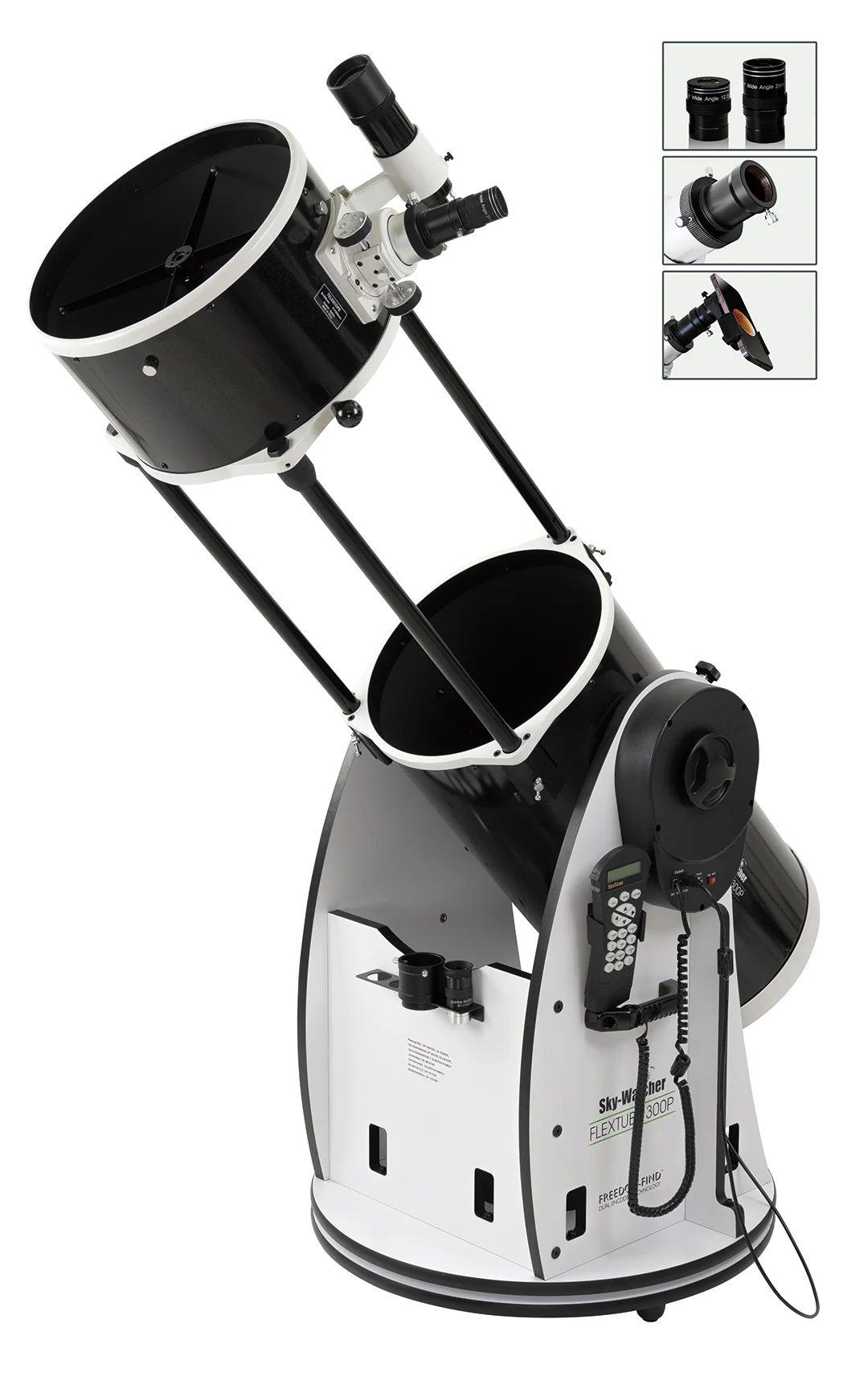
Sky-Watcher Skyliner 300P GOTO: Complete Premium Visual Kit
A 12-inch GOTO Dobsonian with Tele Vue Nagler eyepieces. This is the setup serious visual observers work towards: a telescope that resolves globular clusters to the core, shows genuine structure in galaxies, and paired with the finest wide-field eyepieces ever made. All linked, all ready to order.
Why the Sky-Watcher Skyliner 300P FlexTube GOTO?
Three hundred millimetres of aperture is where visual astronomy reaches a level most observers don't know is possible. M13 resolves to individual stars right to the core. M51's spiral arms show genuine structure. The Virgo Cluster becomes a field full of ghost galaxies. Saturn's Encke Division, the thin gap inside the A ring, becomes visible under good seeing. The FlexTube GOTO version adds computerised pointing that finds any of 42,000 objects automatically, removing the star-hopping challenge that would otherwise require years of experience at this aperture level.
What's Included in This Skyliner 300P Kit?
At this aperture level, the accessories matter as much as the telescope. The eyepieces especially: a £200 Nagler shows more than a £50 alternative on a scope this powerful.
Tele Vue Nagler Type 7: 19mm (82° field)
The Nagler 19mm is the wide-field workhorse for a 12-inch Dob: 79× magnification with an 82° apparent field that fills your entire vision. Objects appear to float in space rather than sit inside a tube. Globular clusters, emission nebulae, open clusters: this is the eyepiece you'll reach for most often. Tele Vue Naglers have been the benchmark for wide-field eyepieces for four decades. Once you've seen the Orion Nebula through one, there is no going back.
Tele Vue Nagler Type 7: 9mm (82° field)
The Nagler 9mm gives you 167× on the 300P: the medium-to-high power eyepiece for planetary detail, tight double star splits, and resolving the cores of the densest globular clusters. The same 82° field and the same immersive view as the 19mm, at higher power. Together the 9mm and 19mm form a two-eyepiece system that covers essentially all of what a 12-inch Dobsonian is used for.
Tele Vue 3–6mm Nagler Zoom: Planetary
For serious planetary work on Saturn, Jupiter, and Mars, you want magnifications between 250× and 500×: the range where disc detail becomes fine and seeing-limited. The Tele Vue Nagler Zoom covers 3mm to 6mm (500× to 250× on the 300P) in a continuous twist, letting you dial precisely to the best magnification the atmosphere will support on any given night. The optical quality is exceptional: not a compromise zoom but a proper planetary eyepiece with a range.
Laser Collimator
At 12 inches of aperture and high magnifications, even slightly off collimation will noticeably degrade the image, particularly for planetary detail and tight double stars. A laser collimator makes the check and correction a two-minute procedure before every session. At this investment level a good collimator is non-negotiable. FLO stocks several reliable models.
Telrad Finder
Even with GOTO, the Telrad is valuable: for initial star alignment, for quickly centring a known bright object, and for those moments when you simply want to point manually rather than wait for a slew. Every Dobsonian owner ends up with a Telrad. The 300P GOTO base accepts a standard Telrad base mounting without modification.
Astronomy Observing Chair
The eyepiece of a 12-inch Dobsonian ranges from just above ground level (when pointing near the zenith) to over 1.8 metres high (at the horizon). A height-adjustable astronomy observing chair is not a luxury at this aperture level: it's the only way to use the telescope comfortably across the sky. Invest in a proper adjustable stool; it will outlast multiple telescopes.
Red Torch
Dark adaptation is everything at this aperture level: a fully dark-adapted eye sees galaxies that a partially adapted eye misses entirely. A quality red torch with variable brightness lets you read charts, adjust the GOTO handset, and navigate the observing site without destroying the night vision you've spent 30 minutes building. Every minute you stay fully dark-adapted at the eyepiece of a 12-inch Dob is repaid in fainter objects seen.
Total Cost: £3,770 to £3,800
Skyliner 300P GOTO + 7 accessories
Optional extras & upgrades
The manual Skyliner 300P FlexTube (non-GOTO) is available at around £800 less, but at 12 inches, learning to star-hop to faint targets without computerised pointing requires considerable experience. The GOTO version earns its premium quickly. Tele Vue Ethos eyepieces (100°–110° field) are the upgrade above Naglers at ~£400+ each, extraordinary but optional. A Moon filter and variable polarising filter (~£35 combined, FLO) are worth adding for lunar evenings. UHC and O-III nebula filters dramatically improve deep-sky views from suburban sites, each around £50–100 from FLO.